1. Introduction and History
The 10C2 is a compact, low-power vacuum tube that emerged during the mid-20th century as part of the miniaturized tube development era. Designed primarily for portable and compact electronic equipment, the 10C2 represents an important category of small-signal tubes that bridged the gap between early large format tubes and the eventual transition to solid-state electronics.
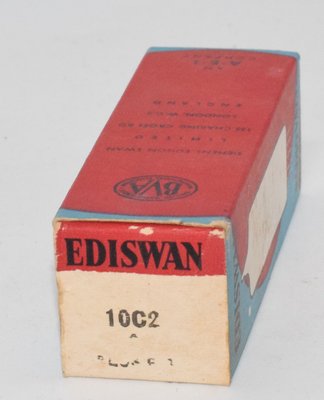
Manufactured by various companies including Ediswan, Mullard, and other European tube makers, the 10C2 gained particular popularity in European radio and audio equipment during the 1950s and 1960s. The tube's compact size and moderate power requirements made it ideal for battery-powered portable radios and compact amplification circuits. While production has long ceased, NOS (New Old Stock) examples remain sought after by vintage audio enthusiasts and restoration specialists.
2. Technical Specifications and Design
Basic Parameters
- Tube Type: Diode (dual diode configuration)
- Filament Voltage: 10V AC/DC
- Filament Current: Approximately 0.2A
- Maximum Plate Voltage: 330V
- Maximum Plate Dissipation: 2.5W per diode
- Heater Type: Directly heated cathode
- Base Type: Noval (9-pin) or equivalent miniature base
- Overall Dimensions: Approximately 2.5 inches (63mm) in height, 0.75 inches (19mm) in diameter
Electrical Characteristics
The 10C2 functions as a dual diode, with two independent diode elements housed within a single glass envelope. Each diode section can handle moderate current levels, making it suitable for rectification, detection, and mixing applications. The tube exhibits typical diode characteristics with forward voltage drop of approximately 15-20V when conducting at rated current.
The directly heated filament design ensures rapid warm-up, a critical feature for portable equipment. The tube's internal construction features robust molybdenum anodes and carefully designed cathode geometry to minimize noise and microphonics—important considerations for audio applications.
Physical Construction
The 10C2 employs a compact glass bulb with internal electrode geometry optimized for the miniature form factor. The tube features a nickel-plated steel base with pin configuration that ensures proper biasing and signal routing. The internal structure includes mica spacers to maintain precise electrode spacing and prevent arcing, particularly important given the tube's compact dimensions.
3. Applications and Usage
Historical Applications
The 10C2 found widespread use in:
- Portable Radio Receivers: Primary application in battery-powered AM/FM receivers throughout Europe
- Rectification Circuits: Low-voltage power supply rectification in compact equipment
- Detection and Demodulation: Audio signal detection in radio frequency circuits
- Mixing Circuits: Frequency mixing in superheterodyne receiver designs
- Audio Mixing: Low-level audio signal combining in compact mixing consoles
Contemporary Usage in Audio Restoration
Today, the 10C2 is primarily encountered in restoration and preservation projects for vintage European audio equipment. Restorers value NOS examples for their ability to restore equipment to original specifications without modification. The tube's availability in the used market, while limited, remains adequate for most restoration needs.
Audio enthusiasts pursuing authentic vintage sound reproduction seek out original 10C2 tubes to maintain the sonic character of period equipment. The tube's contribution to the overall sonic signature of vintage equipment, though subtle, is considered important by purists.
4. Sound Characteristics
Audio Performance Profile
The 10C2, when used in audio applications, contributes distinctive sonic characteristics that reflect its design philosophy and historical context:
Tonal Qualities
- Midrange Presence: The 10C2 exhibits a naturally emphasized midrange, particularly in the 500Hz-3kHz region, characteristic of tubes designed for voice clarity in portable radios
- Warmth and Compression: Like most directly-heated cathode tubes, the 10C2 imparts a subtle compression and warmth to audio signals, with gentle harmonic coloration
- High-Frequency Character: Extended but not aggressive treble response, with a natural rolloff above 8kHz that prevents harshness
- Bass Response: Moderate bass extension with a slight emphasis in the 100-200Hz region, contributing to perceived fullness
Noise and Distortion Characteristics
The 10C2 demonstrates relatively low noise floor for its era, though not approaching modern solid-state standards. Harmonic distortion is primarily second and third order, producing musically pleasant coloration. The tube exhibits minimal microphonics when properly shock-mounted, though mechanical coupling can be audible in sensitive applications.
Dynamic Response
Audio passing through 10C2 circuits exhibits subtle dynamic compression, with gentle knee characteristics that many describe as "musical." Transient response is smooth rather than articulate, contributing to the warm, forgiving character associated with vintage tube equipment.
5. Equivalent or Substitute Types
Direct Equivalents
- 10C2 (all manufacturers): Mullard, Ediswan, Telefunken, and other makers produced identical specifications
- Regional Equivalents: EZ80 in some applications (though different pinout and heater voltage)
Functional Substitutes
Finding true substitutes for the 10C2 presents challenges due to its specific heater voltage and compact form factor:
- 12AX7/ECC83: Can substitute in some audio applications with circuit modification, though different characteristics
- 6AL5: Alternative dual diode with different heater voltage (6.3V vs 10V)
- EZ81: Modern equivalent diode with different specifications
Substitution Considerations
Direct substitution without circuit modification is rarely possible. Any replacement requires careful verification of heater voltage, pin configuration, and electrical specifications. For restoration work, sourcing original 10C2 tubes is strongly recommended to preserve equipment authenticity and performance characteristics.
6. Notable Characteristics
Advantages
- Compact, space-efficient design suitable for portable equipment
- Low filament power consumption (essential for battery operation)
- Dual diode configuration in single envelope reduces component count
- Robust construction capable of handling vibration and mechanical stress
- Reliable performance with extended service life when properly operated
- Distinctive sonic character valued by vintage audio enthusiasts
Limitations and Considerations
- Obsolete design with limited current production
- NOS availability declining, with prices increasing for quality examples
- Heater voltage specificity limits substitution options
- Compact design can increase internal heat density
- Requires proper circuit design to avoid thermal stress
- Microphonic characteristics require careful mechanical isolation in audio applications
Reliability and Longevity
The 10C2 demonstrates excellent reliability when operated within specifications. Many examples have provided decades of service, with failures typically resulting from thermal stress or electrical overstress rather than design deficiency. NOS tubes, when properly stored, maintain specifications indefinitely, though periodic operation helps prevent cathode poisoning.
Identification and Verification
Authentic 10C2 tubes feature clear markings identifying manufacturer and production date codes. Ediswan examples typically display the company logo and date codes in the glass or on the base. Verification of specifications requires testing with appropriate tube testing equipment, particularly important given the market presence of relabeled or misidentified tubes.
Conclusion
The 10C2 represents an important chapter in vacuum tube history, embodying the miniaturization trends that characterized mid-20th century electronics. While no longer manufactured, the tube maintains relevance in restoration and preservation of vintage audio equipment. Its compact form factor, low power consumption, and distinctive sonic characteristics continue to attract interest from audio enthusiasts and professional restorers. For those working with period equipment, sourcing quality NOS 10C2 tubes remains worthwhile, ensuring authentic restoration and preservation of vintage audio's sonic heritage.