1. Introduction and History
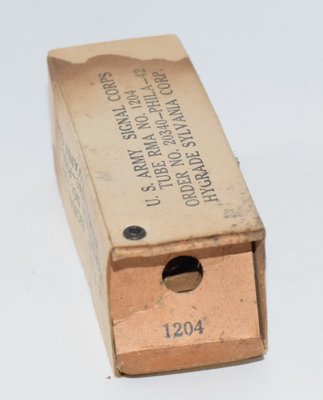
The 1204, more commonly known by its RETMA (Radio Electronics Television Manufacturers Association) designation 7AB7, is a single-ended RF pentode vacuum tube that emerged during the World War II era. Manufactured by Sylvania and other American tube manufacturers, the 7AB7 was introduced around 1942 as part of the miniature 7-pin tube family that gradually replaced the older octal-based tubes.
This tube was developed during a period of significant innovation in vacuum tube technology, when manufacturers were striving to create smaller, more efficient tubes for military and civilian radio equipment. The 1204/7AB7 represents the transition toward miniaturization in vacuum tube design, offering improved performance in a more compact package than its predecessors.
Sylvania, as one of the major tube manufacturers of the era, produced high-quality examples of the 1204/7AB7, with NOS (New Old Stock) units from 1942 being particularly sought after by collectors and vintage equipment restorers today.
2. Technical Specifications and Design
Physical Characteristics:
- Base type: 7-pin miniature (B7G)
- Envelope: Glass, typically clear or with getter flash at top
- Construction: Single-ended RF pentode
- Height: Approximately 1.75 inches (44.5mm)
- Diameter: Approximately 0.75 inches (19mm)
Electrical Parameters:
- Heater voltage: 6.3V
- Heater current: 0.3A
- Maximum plate voltage: 300V
- Maximum screen voltage: 150V
- Typical plate resistance: 0.7 megohms
- Transconductance: Approximately 4,000 micromhos
- Plate current at typical operating conditions: 10mA
- Screen current at typical operating conditions: 2.5mA
Pin Configuration:
- Plate
- Screen Grid (G2)
- Cathode and Suppressor Grid (G3)
- Heater
- Heater
- Control Grid (G1)
- Internal Shield and Suppressor Grid
The 7AB7 features a high-transconductance design optimized for RF amplification, with internal shielding to reduce grid-to-plate capacitance for better high-frequency performance.
3. Applications and Usage
The 1204/7AB7 was primarily designed for and used in the following applications:
Primary Applications:
- RF Amplifier: Commonly used in the RF stages of AM/FM receivers and television sets
- IF Amplifier: Excellent performance in intermediate frequency amplification stages
- Video Amplifier: Used in early television receivers for video signal amplification
- Military Communications Equipment: Found in various WWII-era military radio receivers and transmitters
Common Circuits:
In typical RF amplifier applications, the 7AB7 would be operated with a plate voltage of 250V, screen voltage of 100-150V, and a negative grid bias of approximately -1 to -3V. The high transconductance of the tube made it particularly effective in providing significant gain at radio frequencies with relatively low noise.
In IF amplifier stages, the tube was often used in transformative coupled circuits operating at frequencies between 455kHz (for AM receivers) and 10.7MHz (for FM receivers).
4. Equivalent or Substitute Types
The 1204/7AB7 can be substituted with several other tubes depending on the application requirements:
Direct Equivalents:
- 7AB7: The more common RETMA designation for the 1204
Potential Substitutes (may require circuit adjustments):
- 6SG7: An octal-based RF pentode with similar characteristics, though requiring a different socket
- 6SK7: Another octal RF pentode, but with somewhat lower transconductance
- 6BD6: A 7-pin miniature RF pentode with similar characteristics
- 6BA6: A popular miniature RF pentode, though with lower transconductance than the 7AB7
- 6AU6: A sharp-cutoff pentode that can substitute in some applications, but with different characteristics
When considering substitutions, it's important to note that while electrical parameters may be similar, differences in inter-electrode capacitances can affect circuit stability and may require neutralization adjustments, particularly in RF applications.
5. Notable Characteristics
The 1204/7AB7 tube has several distinctive characteristics that made it popular in its time:
Performance Advantages:
- High Transconductance: The approximately 4,000 micromhos transconductance provided excellent gain, particularly valuable in RF and IF amplification stages
- Good High-Frequency Performance: Internal shielding and low inter-electrode capacitances made it suitable for higher frequency applications compared to many contemporaries
- Miniature Footprint: The 7-pin miniature format allowed for more compact equipment design compared to octal-based predecessors
- Reliability: Particularly the Sylvania-manufactured units were known for their consistent performance and longevity
Collectibility:
NOS (New Old Stock) examples from 1942, especially those manufactured by Sylvania as mentioned in the product information, are particularly valued by collectors and restorers of vintage radio equipment. These early production tubes often feature distinctive construction details that differentiate them from later production runs.
Modern Relevance:
While no longer in production, the 1204/7AB7 remains relevant for:
- Restoration of vintage radio and television equipment from the 1940s and 1950s
- Audiophile applications where vintage tube equipment is prized for its sonic characteristics
- Educational purposes in understanding vacuum tube technology development
The 1204/7AB7 represents an important transitional design in vacuum tube development, bridging the gap between the larger octal-based tubes of the pre-war era and the increasingly miniaturized tubes that would follow in the post-war consumer electronics boom.