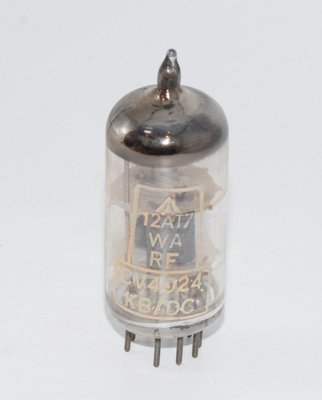
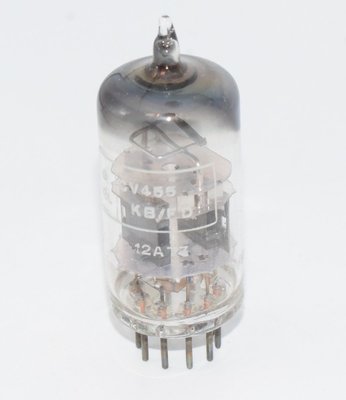
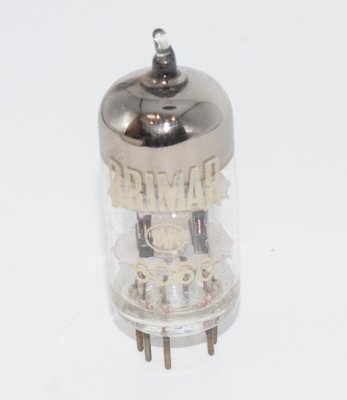
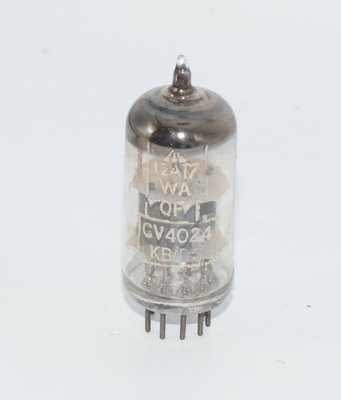
1. Introduction and History
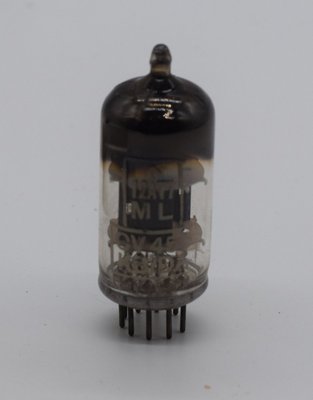
The 12AT7, also known by its European designation ECC81, is a medium-mu dual triode vacuum tube that has been a cornerstone of electronic design since its introduction in the late 1940s. Developed as part of the 12A_7 family of miniature 9-pin (noval) dual triodes — alongside the 12AX7 (ECC83) and 12AU7 (ECC82) — the 12AT7 occupies a distinctive middle ground in the family, offering a unique combination of moderate gain and relatively high transconductance that made it exceptionally versatile.
While the 12AX7 (μ=100) was designed as the high-mu voltage amplifier of the family and the 12AU7 (μ=17) served as the low-mu power/driver type, the 12AT7 with its amplification factor of approximately 60 was primarily engineered for RF oscillator, mixer, and high-frequency amplifier applications. Its ability to handle higher plate currents than the 12AX7 while maintaining respectable gain made it the preferred choice for VHF/UHF circuits, FM tuners, and phase-splitter stages.
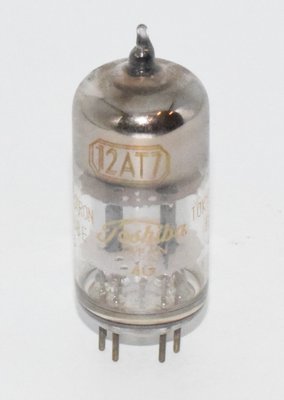
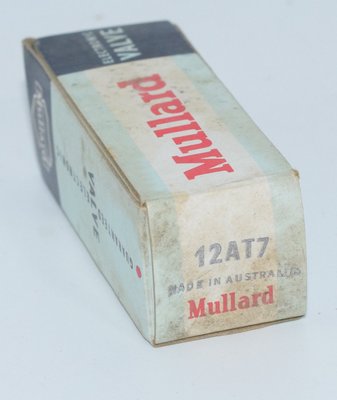
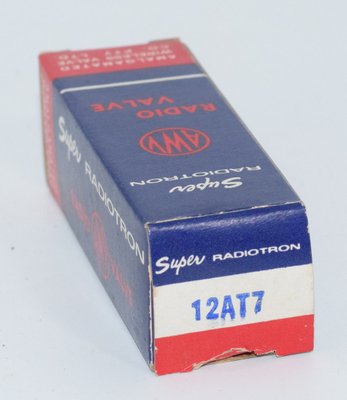
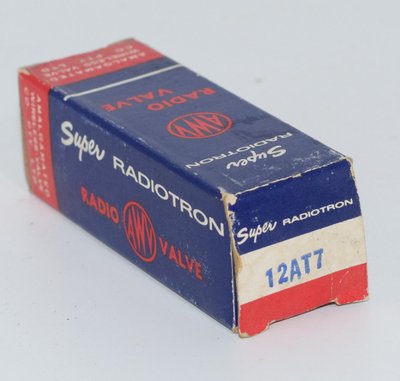
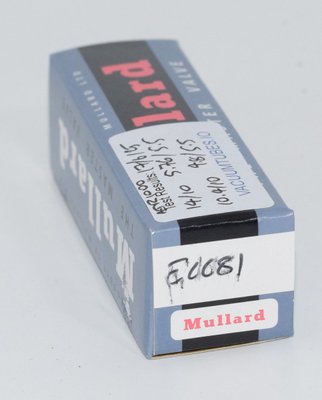
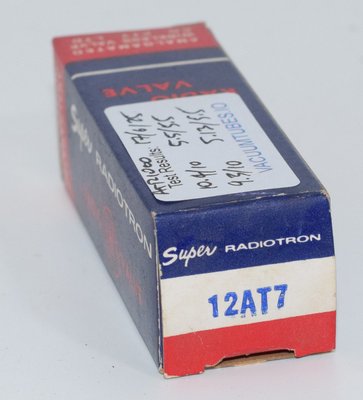
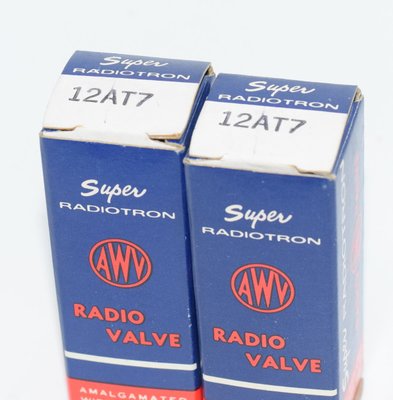
The tube was manufactured by virtually every major tube producer worldwide, including RCA, GE, Sylvania, Mullard, Philips, Telefunken, Siemens, Amperex, Toshiba, and AWV (Super Radiotron) in Australia. Its widespread production across multiple continents ensured abundant supply and led to numerous variants optimized for specific applications, from ruggedized military versions to premium low-noise industrial types.
The 12AT7 remains in active production today by manufacturers such as JJ Electronic, Electro-Harmonix (New Sensor), Shuguang, and Psvane, testament to its enduring relevance in guitar amplifiers, high-fidelity audio equipment, and microphone preamplifiers.
2. Technical Specifications and Design
Heater Ratings
| Parameter | Value |
|---|---|
| Heater Voltage (Vh) | 6.3 V (or 12.6 V with heaters in series) |
| Heater Current (Ih) | 0.3 A (at 6.3 V) |
Like all members of the 12A_7 family, the 12AT7 features a center-tapped heater, allowing operation at either 6.3 V (parallel, 0.3 A) or 12.6 V (series, 0.15 A). This dual-voltage heater capability was a key design feature enabling use in both AC-powered equipment and 12-volt automotive/mobile applications.
Maximum Ratings (Per Section)
| Parameter | Value |
|---|---|
| Maximum Plate Voltage (Va max) | 300 V |
| Maximum Plate Dissipation (Pa max) | 2.5 W |
| Maximum Cathode Current (Ik max) | 15 mA |
| Maximum Cathode-to-Heater Voltage (Vhk max) | 90 V |
The 2.5 W plate dissipation rating per section is notably higher than the 12AX7's 1.0–1.2 W, giving the 12AT7 significantly greater current-handling capability. The 90 V maximum cathode-to-heater voltage rating is important in circuits where the cathode operates at elevated DC potentials, such as cascode configurations or series-connected stages. Designers must ensure this limit is respected to prevent heater-cathode breakdown.
Typical Operating Points and Characteristics
The 12AT7's electrical characteristics vary significantly with operating conditions. The following table presents verified data from manufacturer datasheets at four standard operating points:
| Plate Voltage (Va) | Grid Voltage (Vg1) | Plate Current (Ia) | Plate Resistance (ra) | Transconductance (gm / S) | Amplification Factor (μ)* |
|---|---|---|---|---|---|
| 100 V | -1 V | 3 mA | 16,500 Ω | 3.75 mA/V | ~62 |
| 170 V | -1 V | 8.5 mA | 11,000 Ω | 5.9 mA/V | ~65 |
| 200 V | -1 V | 11.5 mA | 10,500 Ω | 6.7 mA/V | ~70 |
| 250 V | -2 V | 10 mA | 11,000 Ω | 5.5 mA/V | ~60.5 |
*Note: The amplification factor (μ) is calculated from the relationship μ = gm × ra. The commonly cited nominal value of μ ≈ 60 for the 12AT7 corresponds to the 250 V operating point. As the table demonstrates, μ varies somewhat with operating conditions, ranging from approximately 60 to 70 across these standard points.
It is essential for designers to note the significant variation in transconductance across operating points — from 3.75 mA/V at 100 V plate voltage to 6.7 mA/V at 200 V. Quoting a single "typical" transconductance value without specifying operating conditions can be misleading. The plate resistance similarly varies from 16,500 Ω at low plate voltages down to 10,500 Ω at higher voltages. These variations must be accounted for in circuit design.
Physical Construction
| Parameter | Detail |
|---|---|
| Base Type | Noval (B9A) — 9-pin miniature |
| Envelope | T-6½ miniature glass (approximately 20mm diameter) |
| Mounting Position | Any (unless otherwise specified by manufacturer) |
| Overall Length | Approximately 55–58 mm (varies by manufacturer) |
Pin Configuration (Bottom View)
| Pin | Function |
|---|---|
| Pin 1 | Plate (Anode) — Triode 1 |
| Pin 2 | Grid — Triode 1 |
| Pin 3 | Cathode — Triode 1 |
| Pin 4 | Heater (one end) |
| Pin 5 | Heater (center tap / other end) |
| Pin 6 | Plate (Anode) — Triode 2 |
| Pin 7 | Grid — Triode 2 |
| Pin 8 | Cathode — Triode 2 |
| Pin 9 | Heater (other end / center tap) |
The pin configuration is identical to the 12AX7 and 12AU7, which is one reason these three tube types are sometimes (though not always correctly) interchanged in audio circuits. For 6.3 V heater operation, pins 4 and 5 are connected together and the heater supply is applied between pins 4/5 and pin 9. For 12.6 V operation, the heater supply is connected between pins 4 and 5, with pin 9 left unconnected or used as the center tap for hum reduction.
Internal Construction
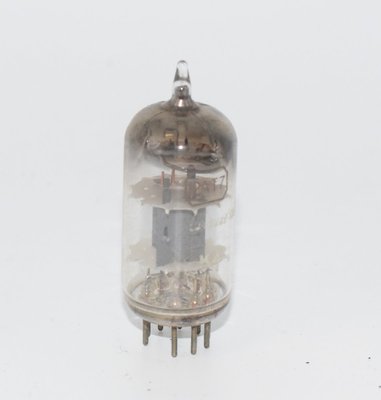
The 12AT7 contains two independent triode sections within a single glass envelope, sharing only the heater supply. Each triode features a cathode, control grid, and plate. The internal construction typically employs a frame grid or wound grid design depending on the manufacturer and era. The relatively close grid-to-cathode spacing contributes to the tube's good high-frequency performance and higher transconductance compared to the 12AX7.
3. Applications and Usage
Original Design Applications
The 12AT7 was primarily designed for high-frequency and RF applications, distinguishing it from the 12AX7 which was optimized for audio voltage amplification:
- VHF/UHF oscillators and mixers — The tube's combination of moderate gain and high transconductance made it ideal for local oscillator and frequency converter circuits in FM and television receivers.
- Cascode RF amplifiers — Two triode sections could be connected in a cascode configuration for excellent high-frequency gain with low noise.
- FM detector circuits — Used in ratio detector and Foster-Seeley discriminator stages.
- Phase splitter/inverter circuits — The moderate gain and good linearity made it well-suited for cathodyne and long-tailed pair phase splitters driving push-pull output stages.
Audio Applications
- Phase inverter/driver stages — Perhaps its most common audio application, particularly in guitar amplifiers (e.g., Fender, Marshall, Vox designs) where it drives push-pull output stages.
- Reverb driver circuits — The higher current capability makes it effective for driving spring reverb tanks.
- Line-level preamplification — Used where moderate gain with higher current drive is needed.
- Microphone preamplifiers — Some designs exploit the 12AT7's lower noise at higher operating currents.
- Headphone amplifiers — The higher current capability compared to the 12AX7 allows direct headphone driving in some designs.
Industrial and Military Applications
- Radar and communications equipment — Ruggedized versions (12AT7WA, 12AT7WC) were developed for military use.
- Test and measurement equipment — Used in oscilloscopes, signal generators, and frequency counters.
- Computer circuits — Early digital computers employed 12AT7s in various logic and switching circuits.
4. Sound Characteristics
The 12AT7 has a distinctive sonic signature that sets it apart from its 12A_7 family siblings. Audiophiles, recording engineers, and guitar players describe its tonal qualities in the following terms:
General Tonal Character
The 12AT7 is widely regarded as having a clean, articulate, and slightly lean sound compared to the warmer, more harmonically rich 12AX7. Its lower gain means less inherent harmonic distortion at equivalent signal levels, resulting in a more transparent and detailed presentation. The higher transconductance contributes to a sense of speed and transient accuracy that many listeners find appealing.
Frequency Response Characteristics
- Bass: Tight, controlled, and well-defined. The 12AT7 does not produce the same degree of low-frequency bloom or warmth as the 12AX7. Bass notes are articulate with good pitch definition, though some listeners find the low end slightly less full-bodied.
- Midrange: Clear and present without excessive coloration. The midrange is often described as honest and uncolored, making the 12AT7 a good choice where transparency is valued over euphonic warmth.
- Treble: Extended and detailed, reflecting the tube's RF heritage. High-frequency performance is excellent, with good air and sparkle. Some listeners note a slight brightness compared to the 12AX7, which can be either a benefit or a drawback depending on the associated equipment and personal preference.
Dynamic Behavior
The 12AT7's higher current capability gives it excellent dynamic headroom and a sense of effortless transient response. When driven into clipping (as in guitar amplifier applications), it produces a tighter, more controlled overdrive with less compression than the 12AX7. The breakup character is often described as crisper and more defined, with less sustain but greater note separation.
Harmonic Distortion Profile
When operated within its linear range, the 12AT7 produces relatively low levels of harmonic distortion. When pushed, it tends to generate a balanced mix of even and odd harmonics, though the overall distortion level is lower than a 12AX7 at equivalent drive levels due to the lower gain. This makes it sound cleaner at comparable signal levels.
Manufacturer Variations
Vintage 12AT7s from different manufacturers exhibit notable sonic differences:
- Mullard (UK/Australia): Warm, smooth, with a slightly rich midrange — often considered the most musical-sounding.
- Telefunken (Germany): Exceptionally detailed and transparent, with extended highs and tight bass. Highly prized and commanding premium prices.
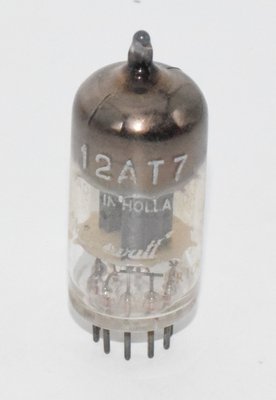
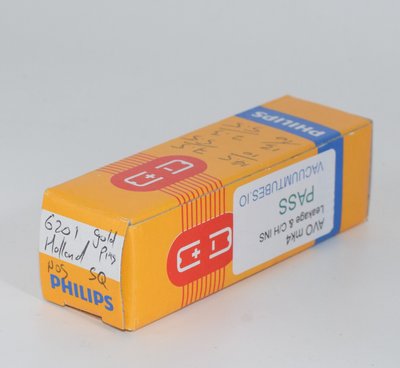
- Philips/Amperex (Holland): Balanced and refined, with excellent clarity and a slightly sweet top end. The Philips Miniwatt Holland variants are particularly sought after.
- RCA/GE/Sylvania (USA): Generally clean and reliable, with a straightforward, uncolored sound. GE types are known for good reliability and consistent performance.
- Toshiba (Japan): Clean and precise, with good detail retrieval and neutral tonal balance.
- AWV Super Radiotron (Australia): Well-regarded for their robust construction and warm, musical character, these Australian-made tubes have developed a following among collectors.
5. Equivalent and Substitute Types
Close/Identical Substitutes (Direct Drop-In Replacements)
The following types are electrically identical or very closely matched to the 12AT7 and can be used as direct replacements without circuit modification:
| Type | Notes |
|---|---|
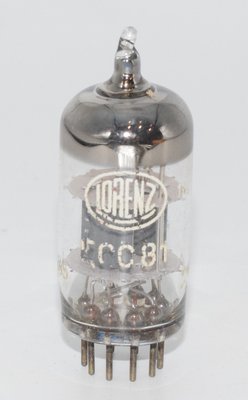
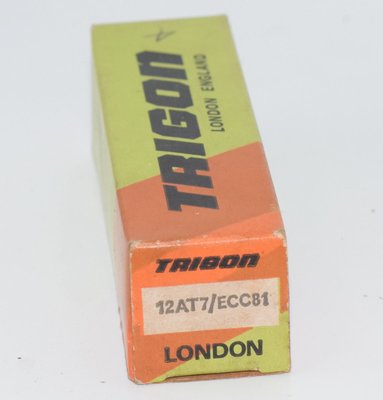
| ECC81 | European (Mullard/Philips) designation for the same tube. Identical in all respects. |
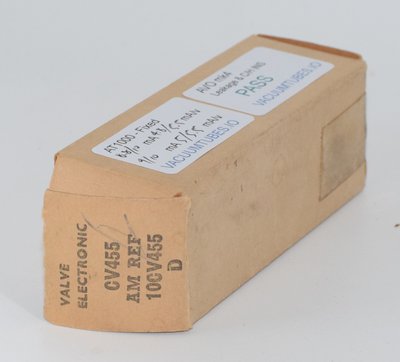
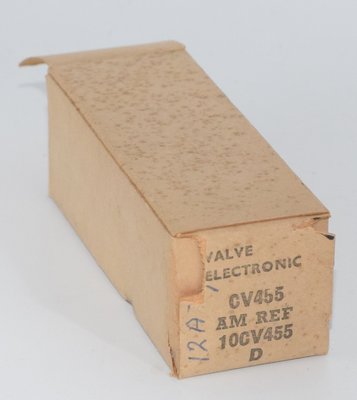
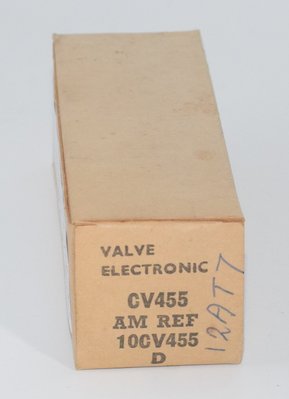
| CV455 | UK military (Common Valve) designation. Identical electrically; may have enhanced quality control and ruggedization. |
| CV10662 | UK military designation. Direct equivalent to 12AT7. |
| CV8154 | UK military designation. Direct equivalent to 12AT7. |
| CV9859 | UK military designation. Direct equivalent to 12AT7. |
These types share the same pinout, heater ratings, and electrical characteristics as the standard 12AT7 and can be substituted freely.
Different Rating Substitutes (NOT Direct Drop-In)
The following types are related to the 12AT7 but have different ratings, tighter specifications, or modified characteristics. While they may physically fit the same socket, they should not be treated as identical drop-in replacements without verifying compatibility with the specific circuit:
| Type | Notes |
|---|---|
| 6201 / CK6201 | Premium military/industrial version with tighter specifications and enhanced reliability. Different ratings from standard 12AT7 — verify circuit compatibility. |
| E81CC / ECC801 / ECC801S | European premium/special-quality versions with enhanced specifications. Not identical ratings to standard ECC81/12AT7. |
| M8162 | British military premium version (CV/STC designation). Different ratings from standard 12AT7. |
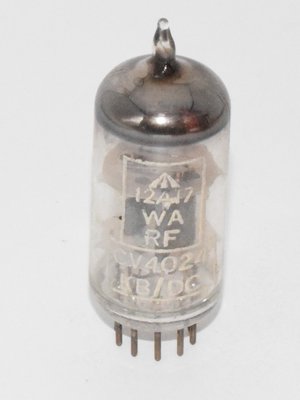
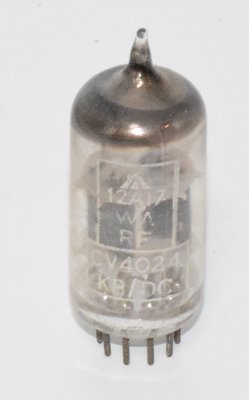
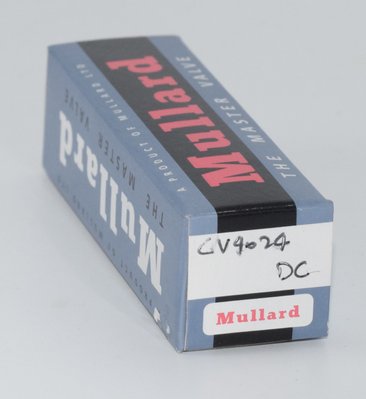
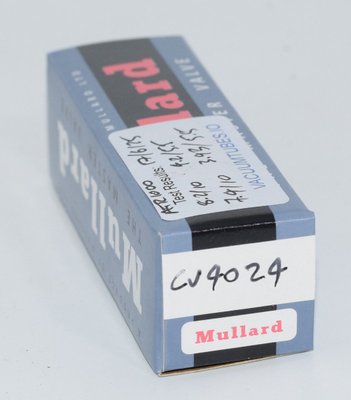
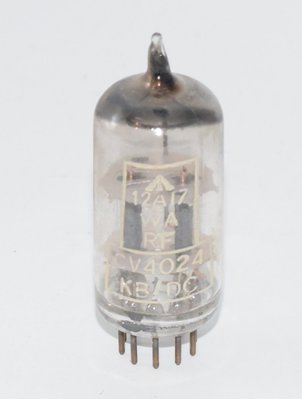
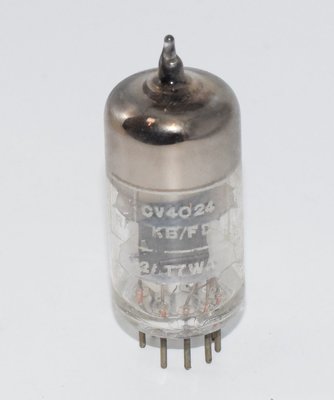
| CV4024 | UK military premium designation with tighter tolerances and different ratings. |
| 12AT7WA / 12AT7WC | Ruggedized military versions with enhanced vibration resistance and potentially different maximum ratings. |
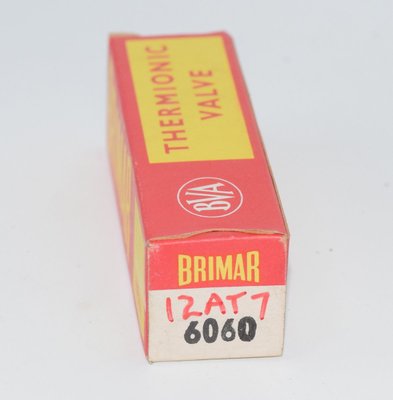
| 6060 | Related type with different specifications. |
| 6679 | Low-noise selected version with different ratings. |
| 7492 / 7728 | Special-purpose variants with modified characteristics. |
| A2900 / E2157 | European special-purpose designations with different ratings. |
| B152 / B309 / B739 | Alternative designations with different specifications. |
| CC81E | Variant designation with potentially different ratings. |
| QA2406 / QS2406 | Special-purpose designations with different specifications. |
Important Note: Many of these "different rating" types will work in most 12AT7 circuits without problems, and some (like the 6201 and E81CC) are often considered upgrades. However, their specifications differ from the standard 12AT7, and designers should verify that the specific differences are acceptable for their application. In critical circuits, the different maximum ratings or operating characteristics could matter.
12A_7 Family Interchangeability
The 12AT7, 12AX7, and 12AU7 share the same pinout and heater configuration, leading to frequent questions about interchangeability. While they will physically fit the same socket, they have very different electrical characteristics and are generally not interchangeable without circuit redesign:
| Type | μ (Amplification Factor) | gm (Transconductance) | ra (Plate Resistance) | Pa max |
|---|---|---|---|---|
| 12AX7 (ECC83) | 100 | 1.6 mA/V | 62,500 Ω | 1.0–1.2 W |
| 12AT7 (ECC81) | ~60 | 3.75–6.7 mA/V | 10,500–16,500 Ω | 2.5 W |
| 12AU7 (ECC82) | 17 | 2.2 mA/V | 7,700 Ω | 2.75 W |
Substituting a 12AT7 for a 12AX7 will result in lower gain but higher current draw, which may exceed the current capability of the power supply or bias network. Substituting for a 12AU7 will increase gain but the much higher plate resistance may cause issues in circuits designed to drive low-impedance loads. Such substitutions should only be made with full understanding of the circuit implications.
6. Notable Characteristics
High Transconductance for a Medium-Mu Triode
The 12AT7's most distinctive electrical characteristic is its high transconductance relative to its amplification factor. At the 200 V operating point, the transconductance reaches 6.7 mA/V — more than four times that of the 12AX7 and roughly three times that of the 12AU7. This high transconductance, combined with moderate gain, gives the 12AT7 excellent high-frequency performance and was the primary reason for its widespread use in VHF/UHF circuits.
Excellent High-Frequency Performance
The 12AT7's RF heritage means it has inherently good high-frequency characteristics, including low interelectrode capacitances and good gain-bandwidth product. This makes it perform well in audio circuits where extended high-frequency response and fast transient behavior are desired.
Robust Current Handling
With a maximum plate dissipation of 2.5 W per section and maximum cathode current of 15 mA, the 12AT7 can handle significantly more current than the 12AX7. This makes it suitable for driving loads that require more current, such as long cable runs, reverb tanks, or headphones.
Operating Point Sensitivity
As demonstrated by the verified operating point data, the 12AT7's characteristics vary considerably with operating conditions. The transconductance nearly doubles from 3.75 mA/V at Va=100V to 6.7 mA/V at Va=200V, and the plate resistance drops from 16,500 Ω to 10,500 Ω over the same range. Circuit designers must carefully consider the intended operating point when designing with this tube, as performance predictions based on a single set of "typical" values may be significantly inaccurate.
Low Grid Bias Requirements
The 12AT7 operates with very small grid bias voltages — typically -1 V to -2 V at standard operating points. This means the tube is sensitive to grid voltage changes and can be easily overdriven by relatively small input signals, a characteristic that is exploited in guitar amplifier phase inverter stages where controlled clipping is desired.
Microphony Considerations
Standard 12AT7s can exhibit microphonic behavior (converting mechanical vibrations into electrical signals), though generally less so than the 12AX7 due to the lower gain. Premium versions such as the 6201, E81CC, and military types were specifically designed with enhanced mechanical damping to reduce microphony for critical applications.
7. Usage in the Audio Community
Guitar Amplifiers
The 12AT7 is ubiquitous in guitar amplifier design, though its role differs from the 12AX7:
- Phase Inverter/Splitter: This is the 12AT7's signature role in guitar amplifiers. Classic Fender designs (Twin Reverb, Deluxe Reverb, Super Reverb) and many Marshall amplifiers use a 12AT7 in the long-tailed pair phase inverter position. The moderate gain and higher current capability provide excellent drive for push-pull output stages while maintaining good balance and headroom.
- Reverb Driver: The 12AT7's current-handling ability makes it ideal for driving spring reverb tanks, which present a relatively low-impedance load. Fender amplifiers commonly use one triode section for this purpose.
- Gain Reduction Modification: Guitar players sometimes substitute a 12AT7 for a 12AX7 in preamp gain stages to reduce overdrive and achieve a cleaner tone. While this is a common modification, it should be done with awareness that the different operating characteristics may shift the bias point and affect the circuit's behavior in ways beyond simply reducing gain.
- Effects Loop Stages: Some amplifiers use 12AT7s in effects loop send/return stages where the higher current capability helps drive cables and effects pedals.
High-Fidelity Audio
- Preamplifier Stages: Some hi-fi preamplifier designs use the 12AT7 where its combination of moderate gain and high transconductance provides excellent detail and transient response. Its lower gain compared to the 12AX7 can be advantageous in high-output source applications where excessive gain would require more negative feedback.
- Phono Stages: While less common than the 12AX7 in RIAA phono stages (due to lower gain), some designs use the 12AT7 in later phono stage positions or in MC cartridge head amplifiers where its lower noise at higher operating currents is beneficial.
- Driver Stages: The 12AT7 excels as a driver for power tubes, particularly in circuits where the phase inverter must deliver significant voltage swing with good linearity.
- DAC Output Stages: Modern tube DACs sometimes employ 12AT7s in their analog output stages, taking advantage of the tube's transparency and detail retrieval.
Professional Audio and Recording
- Microphone Preamplifiers: Several classic and modern microphone preamp designs incorporate 12AT7s, valued for their clean gain and good noise performance at appropriate operating points.
- Studio Compressors and Limiters: Some vintage studio equipment uses 12AT7s in sidechain and control circuits.
- DI Boxes: Tube direct injection boxes for bass and acoustic instruments sometimes use 12AT7s for their ability to handle higher signal levels without excessive distortion.
Tube Rolling and Collecting
The 12AT7 has a dedicated following among tube rollers and collectors, though the market is generally less frenzied than for the 12AX7:
- Most Sought-After Vintage Types: Telefunken ECC81 (smooth plates and ribbed plates), Mullard CV4024, Amperex Bugle Boy ECC81, Philips Miniwatt Holland, and Siemens E81CC are among the most prized by collectors.
- Best Value Vintage Types: GE, RCA, and Sylvania 12AT7s from the USA, along with AWV Super Radiotron types from Australia, offer excellent performance at more accessible prices than European premium brands.
- Current Production: JJ ECC81, Electro-Harmonix 12AT7, Mullard 12AT7 reissue (New Sensor), and Psvane 12AT7 are among the most popular currently manufactured options.
- NOS (New Old Stock): Unused vintage 12AT7s remain available from specialist dealers, with prices varying dramatically based on manufacturer, era, and condition. Military-spec types (CV455, CV4024) are particularly valued for their consistent quality and long service life.
Practical Advice for Audio Users
When selecting 12AT7s for audio use, consider the following:
- For phase inverter duty: Matched sections (balanced triodes) are important for maintaining symmetry in push-pull drive. Many tube dealers offer section-matched 12AT7s for this purpose.
- For low-noise applications: Premium types like the 6201 or E81CC were specifically selected for low noise, though their different ratings should be verified against circuit requirements.
- For reverb driver duty: Reliability and current handling are paramount. Robust types with good emission are preferred; this is not a position where subtle sonic differences matter greatly.
- For hi-fi preamps: This is where tube rolling yields the most audible differences. Experiment with different manufacturers to find the tonal balance that best complements your system.