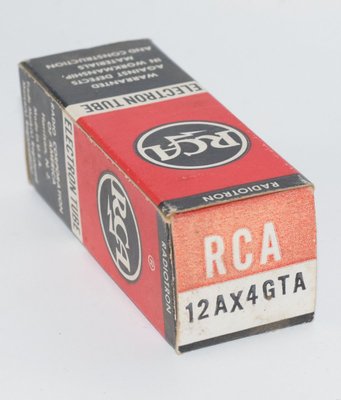
1. Introduction and History
The 12AX4GTA is an indirectly heated half-wave vacuum tube rectifier designed primarily for use as a damper diode in television receiver horizontal deflection circuits and direct drive sweep circuits. Manufactured by major American tube companies including Sylvania, RCA, and others during the 1950s and 1960s, the 12AX4GTA represents a refinement of the earlier 12AX4GT design, with the key addition of a controlled heater warm-up time feature specifically engineered for series heater string television receivers.
The 12AX4GTA is part of a family of related types: the 6AX4GT (6.3V heater version), the 12AX4GT, and the 12AX4GTA. According to the Sylvania engineering data service bulletin of September 1955, except for heater characteristics, the 6AX4GT, 12AX4GT, and 12AX4GTA are electrically identical. The 12AX4GTA's distinguishing feature is its controlled heater warm-up time of 11 seconds, which was critical for reliable operation in series-string heater configurations common in transformerless television sets of the era.
While originally designed for television service, the 12AX4GTA has found a secondary life in the audio community, where it is employed as a rectifier tube in power supply circuits for tube amplifiers and preamplifiers. Its robust construction, high peak inverse voltage rating, and relatively generous current handling capability make it a practical choice for certain audio power supply designs.
2. Technical Specifications and Design
Mechanical Data
| Parameter | Value |
|---|---|
| Bulb Type | T-9 |
| Base | Intermediate Shell Octal 6-Pin / Short Intermediate Shell Octal 6-Pin |
| Outline | 9-11 or 9-41 |
| Basing | 4CG |
| Cathode | Unipotential (indirectly heated) |
| Mounting Position | Any |
Heater Characteristics
| Parameter | 12AX4GTA |
|---|---|
| Heater Voltage | 12.6 V |
| Heater Current | 600 mA (0.6 A) |
| Heater Warm-up Time | 11 Seconds |
Heater-Cathode Voltage Ratings (Design Center Values)
| Parameter | Value |
|---|---|
| Heater Negative with Respect to Cathode — DC | 900 V Abs. Max. |
| Heater Negative with Respect to Cathode — Total DC and Peak | 4400 V Abs. Max. |
| Heater Positive with Respect to Cathode — DC | 100 V Max. |
| Heater Positive with Respect to Cathode — Total DC and Peak | 300 V Max. |
Ratings — Damper Service (Design Center Values)
| Parameter | Value |
|---|---|
| Peak Inverse Voltage (PIV) | 4400 V Abs. Max. |
| Plate Dissipation | 4.8 W Max. |
| Steady State Peak Current | 750 mA Max. |
| Average Tube Drop (at 250 mA) | 32 V |
| DC Plate Current | 125 mA Max. |
Note on Amplification Parameters: As a diode rectifier, the 12AX4GTA does not have amplification factor (μ), transconductance (gm), or plate resistance (rp) specifications. These parameters apply to triodes, pentodes, and other amplifying tubes. The 12AX4GTA is a two-element device (diode) with only a cathode and plate — it conducts current in one direction only and is used solely for rectification, not signal amplification. There is no control grid and therefore no grid bias range.
Pin Configuration (Basing 4CG — Octal)
Viewed from the bottom of the socket:
| Pin | Connection |
|---|---|
| Pin 1 | No Connection (NC) — shall not be used as tie point |
| Pin 2 | No Connection (NC) — internal connection, shall not be used as tie point |
| Pin 3 | Plate (Anode) |
| Pin 4 | No Connection — shall not be used as tie point |
| Pin 5 | Cathode (P) |
| Pin 6 | No Connection — shall not be used as tie point |
| Pin 7 | Heater (H) |
| Pin 8 | Heater (H) |
Important Note: Pins 1, 2, 4, and 6 shall not be used as tie points. Pin 2 is specifically noted as an internal connection and must not be externally wired.
Average Plate Characteristics
The plate characteristic curve for the 12AX4GTA (at rated heater voltage) shows a typical diode characteristic with current rising in a roughly exponential fashion as plate voltage increases. At approximately 40V plate voltage, the tube passes around 400 mA; at 60V, current approaches 700 mA; and at 80V, current exceeds 800 mA. The average tube drop of 32V at 250 mA DC plate current indicates a moderate forward voltage drop, which is typical for indirectly heated rectifier diodes of this class.
3. Applications and Usage
Original Television Applications
The 12AX4GTA was designed primarily for two roles in television receivers:
- Damper Diode: In horizontal deflection circuits, the 12AX4GTA served as a damper diode, absorbing the energy stored in the deflection yoke and flyback transformer during the retrace period. This function was critical for proper horizontal linearity and for recovering energy that would otherwise be wasted. The tube's high PIV rating of 4400V was essential for withstanding the large voltage pulses generated during flyback.
- Direct Drive Sweep Circuits: The tube was also used in direct drive sweep circuit configurations where it performed a combined damping and partial rectification role.
The 12AX4GTA's controlled 11-second heater warm-up time was specifically designed for series heater string television receivers. In these sets, all tube heaters were connected in series and powered directly from the AC mains without a power transformer. The controlled warm-up time ensured that all tubes in the series string reached operating temperature at approximately the same rate, preventing excessive voltage from appearing across tubes that heated up more slowly — a condition that could damage heater-cathode insulation or cause premature tube failure.
Power Supply Rectification
Beyond its television origins, the 12AX4GTA can serve as a half-wave rectifier in power supply circuits. With a DC plate current rating of 125 mA and a PIV of 4400V, it is suitable for moderate-current, high-voltage power supply applications. Its 32V average tube drop at 250 mA must be accounted for in power supply design, as this represents a voltage loss and a source of heat dissipation within the tube.
Heater Warm-up Time Test Conditions
Per the Sylvania datasheet, the heater warm-up time is defined as the time required in a specific test circuit for the voltage across the heater terminals to increase from zero to the heater test voltage (V1). For the 12AX4GTA, the test conditions are: E = 50 Volts, R = 63 Ohms, V1 = 10.0 Volts, where E is the applied voltage (RMS or DC), R is the total series resistance, and V1 is the heater test voltage (80% of rated heater voltage, RMS or DC).
4. Sound Characteristics
As a rectifier tube, the 12AX4GTA does not directly amplify or process the audio signal. However, rectifier tubes have a well-documented influence on the overall sonic character of a tube amplifier because they form the power supply — the foundation upon which the entire amplifier's performance rests. The characteristics of the rectifier tube affect voltage regulation, ripple content, and transient response of the B+ supply, all of which influence the amplifier's sound.
Sonic Influence as a Rectifier
- Soft and Gradual Power Delivery: Like most tube rectifiers, the 12AX4GTA introduces a degree of "sag" in the power supply under dynamic load conditions. When the amplifier demands sudden bursts of current during loud transients, the rectifier tube's internal impedance causes a momentary dip in B+ voltage. This sag compresses the dynamic range slightly, producing a characteristic "softness" or "give" that many musicians and audiophiles find musically pleasing. The effect is subtle but contributes to the organic, breathing quality often attributed to tube amplifiers.
- Warm Tonal Character: The 32V average tube drop and the inherent impedance of the 12AX4GTA contribute to a slightly warmer, less aggressive tonal character compared to solid-state rectification. The B+ voltage is inherently softer and less stiff, which tends to round off harsh transients.
- Controlled Warm-up: The 11-second controlled warm-up time of the 12AX4GTA provides a gentle, gradual application of B+ voltage to the amplifier circuit as the tube reaches operating temperature. This slow-start characteristic is actually beneficial in audio applications, as it reduces thermal shock to other components and provides a natural soft-start function.
- Half-Wave Limitations: Being a half-wave rectifier, the 12AX4GTA produces more ripple than a full-wave rectifier configuration. This requires more aggressive filtering in the power supply (larger filter capacitors and/or choke input filters). If filtering is inadequate, residual hum may be audible. However, when properly filtered, the half-wave configuration can still deliver clean, quiet power.
It should be noted that the sonic differences between rectifier tubes are generally more subtle than differences between signal tubes. The 12AX4GTA's influence on sound is primarily through its effect on power supply regulation and impedance rather than through any direct interaction with the audio signal.
5. Equivalent or Substitute Types
Closely Related Types
| Type | Heater Voltage | Heater Current | Warm-up Time | Notes |
|---|---|---|---|---|
| 12AX4GT | 12.6 V | 600 mA | Not controlled | Electrically identical except lacks controlled warm-up time. Can substitute in non-series-string applications. Not a drop-in replacement in series heater string circuits where controlled warm-up is required. |
| 6AX4GT | 6.3 V | 1200 mA | Not controlled | Electrically identical in all ratings except heater voltage and current. NOT a drop-in substitute — requires different heater supply voltage. Suitable only where a 6.3V heater supply is available. |
| 6AX4GTA | 6.3 V | 1200 mA | Controlled | NOT a drop-in substitute — different heater voltage. The 6.3V equivalent with controlled warm-up. |
Substitution Notes
The 12AX4GT is the closest substitute for the 12AX4GTA. Both share the same heater voltage (12.6V) and current (600 mA), the same basing (4CG octal), and identical electrical ratings in all respects. The only difference is the controlled heater warm-up time feature of the 12AX4GTA. In audio power supply applications where series heater strings are not used (i.e., where each tube has its own heater winding or parallel heater supply), the 12AX4GT can generally be used interchangeably with the 12AX4GTA without issue.
The 6AX4GT and 6AX4GTA are not drop-in replacements due to their different heater voltage (6.3V vs. 12.6V) and correspondingly different heater current (1200 mA vs. 600 mA). However, they are functionally equivalent in terms of rectification performance and can be used in circuits designed for 6.3V heater supplies.
Other half-wave damper diodes from the same era (such as the 6AU4GTA, 6AX4GTB, 6CJ3, 12CJ3, 17AX4GT, etc.) may have similar functions but differ in ratings, basing, or heater requirements. These should not be substituted without careful comparison of all specifications.
6. Notable Characteristics
- Exceptionally High PIV Rating: The 4400V peak inverse voltage rating is remarkably high for a tube of this size and class. This was necessary for television damper service but also makes the 12AX4GTA useful in high-voltage power supply applications where other rectifiers might be overstressed.
- Controlled Warm-up Time: The 11-second controlled heater warm-up time is a distinctive feature of the "A" suffix version. This was achieved through careful engineering of the heater element's thermal mass and resistance characteristics. The warm-up time is precisely defined and tested under specific circuit conditions (E = 50V, R = 63 Ohms, V1 = 10.0V).
- Pin 2 Internal Connection: Pin 2 is noted as an internal connection (NC) and must not be used as a tie point. This is an important consideration during socket wiring — inadvertently connecting anything to pin 2 could cause damage or erratic operation.
- Unused Pins as Non-Tie Points: The datasheet explicitly states that pins 1, 2, 4, and 6 shall not be used as tie points. This is more restrictive than many tube types and must be observed in chassis wiring.
- Moderate Tube Drop: The 32V average tube drop at 250 mA is a significant consideration in power supply design. This voltage is dissipated as heat within the tube and must be subtracted from the available output voltage. At the maximum DC plate current of 125 mA, the tube drop will be somewhat lower.
- Unipotential Cathode: The indirectly heated unipotential cathode provides uniform electron emission and allows the cathode to be at a different potential from the heater — essential for both television damper service (where the cathode may be at high potential) and for flexible power supply design.
- Robust Construction: The T-9 glass envelope and octal base provide a mechanically robust package. The tube can be mounted in any position, offering flexibility in chassis layout.
7. Usage in the Audio Community
Power Supply Rectification in Audio Amplifiers
In the audio community, the 12AX4GTA finds use primarily as a rectifier tube in power supply circuits for tube amplifiers and preamplifiers. While it was never designed with audio in mind, its electrical characteristics make it suitable for certain applications:
- Single-Ended Amplifier Power Supplies: The half-wave rectification topology of the 12AX4GTA naturally suits single-ended (SE) amplifier designs, where a single rectifier is sometimes preferred for simplicity. The 125 mA DC plate current rating is adequate for many small to medium single-ended amplifiers using tubes like the EL84, 6V6, or 6L6 in single-ended configuration.
- Preamplifier Power Supplies: The 12AX4GTA is well-suited for preamplifier power supplies where current demands are modest but voltage requirements may be significant. Its high PIV rating provides generous safety margins.
- DIY and Hobbyist Projects: The 12AX4GTA is popular among DIY tube audio enthusiasts due to its availability, low cost, and straightforward application. NOS (New Old Stock) examples from manufacturers like RCA, Sylvania, GE, and others are readily available from tube dealers and online marketplaces.
Practical Considerations for Audio Use
When using the 12AX4GTA in audio power supply circuits, several practical considerations apply:
- Filtering Requirements: Half-wave rectification produces a ripple frequency equal to the mains frequency (50 or 60 Hz), which is more difficult to filter than the doubled ripple frequency of full-wave rectification. Adequate filtering — typically a pi-filter with a choke or RC filter stages — is essential to achieve acceptably low hum levels in audio applications.
- Voltage Drop Compensation: The 32V tube drop must be accounted for in the power supply design. The transformer secondary voltage must be increased accordingly to achieve the desired B+ voltage at the amplifier.
- Current Limitations: The 125 mA maximum DC plate current limits the 12AX4GTA to relatively modest power amplifier designs. For higher-current applications, a different rectifier tube or solid-state rectification would be more appropriate.
- Heater Supply: The 12.6V, 600 mA heater requirement is convenient for designs using a 12.6V heater winding or a series heater string. For amplifiers with 6.3V heater supplies, the 6AX4GT or 6AX4GTA would be the appropriate choice instead.
Collector and NOS Market
The 12AX4GTA is not a particularly rare or expensive tube on the NOS market, as millions were produced for the television industry. RCA, Sylvania, GE, Raytheon, Tung-Sol, and Westinghouse all manufactured versions of this tube. For audio use, brand preferences are less pronounced than with signal tubes, though some builders report subtle differences between manufacturers — likely attributable to variations in construction quality, cathode coating composition, and internal geometry. NOS examples in original boxes from reputable manufacturers like RCA and Sylvania are generally preferred for their consistent quality and known provenance.
The 12AX4GTA remains a practical, affordable, and reliable rectifier tube for audio applications where its specifications are a good match for the circuit requirements. While it may lack the cachet of more famous audio rectifier tubes like the 5U4, 5AR4/GZ34, or 5Y3, it offers solid performance and excellent value for the audio experimenter and builder.