Introduction and History
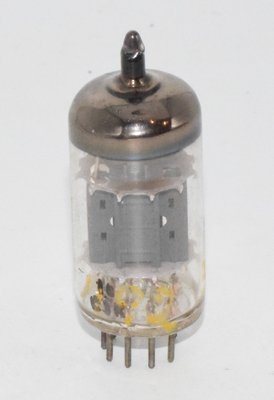
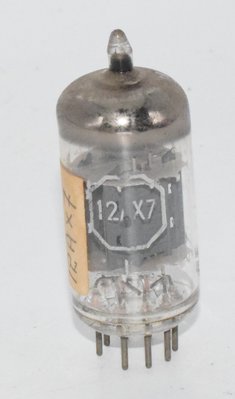
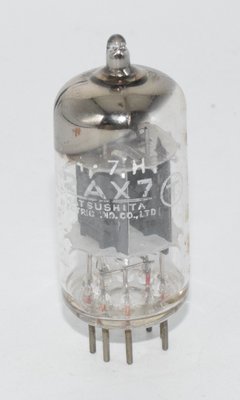
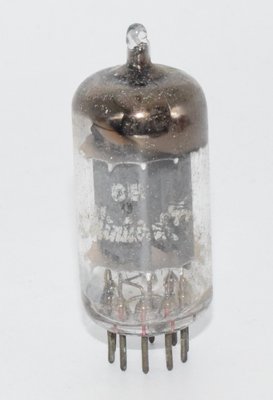
The 12AX7 is arguably the most iconic and widely used small-signal vacuum tube in the history of audio electronics. Designated as the ECC83 in European nomenclature, this miniature dual triode was introduced by RCA in 1947 and quickly became the industry standard for high-gain voltage amplification in preamplifier circuits. Its combination of high amplification factor, low noise, and the convenience of two independent triode sections in a single compact envelope made it an immediate success in both consumer and professional audio equipment.
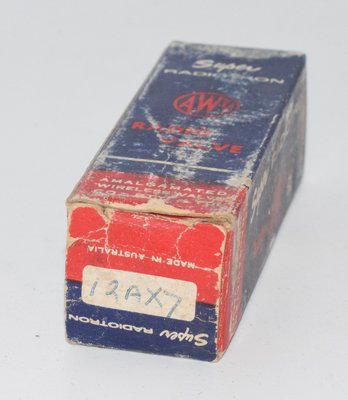
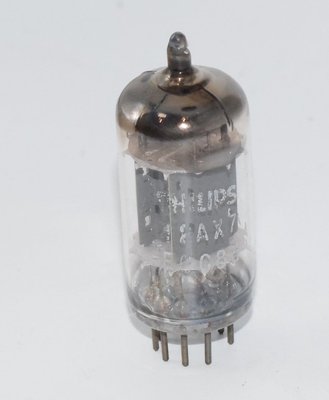
The tube was manufactured under the Brimar brand by Standard Telephones and Cables Pty. Ltd. (STC) in Australia, as documented in their Application Report VAD/513.5 issued 1 January 1962. It was also produced by virtually every major tube manufacturer worldwide, including Philips (at their Heerlen factory in Holland and in Australia under the Miniwatt and Super Radiotron brands), Mullard, Telefunken, Siemens, GE, Sylvania, Tung-Sol, Matsushita (Japan), and many others. Each manufacturer's version developed its own following among audiophiles and musicians, with subtle differences in construction and materials contributing to distinct sonic signatures.
The 12AX7 was designed as a direct replacement for the older 6SL7 octal-based dual triode, offering similar electrical characteristics in a much smaller noval (B9A) package. Its development was part of the broader industry transition from octal to miniature tube types in the post-war era. The "12" prefix in the American designation indicates the 12.6-volt series heater rating, while the tube can also operate with a 6.3-volt parallel heater configuration thanks to its center-tapped heater design.
More than seven decades after its introduction, the 12AX7 remains in active production by several manufacturers and continues to be the preamp tube of choice in guitar amplifiers, high-fidelity audio equipment, recording studio gear, and a wide range of audiophile products.
Technical Specifications and Design
General Description
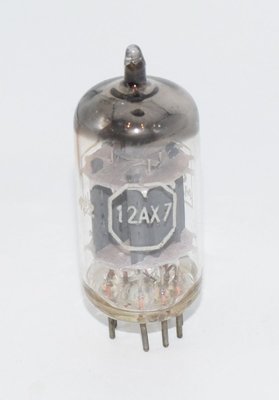
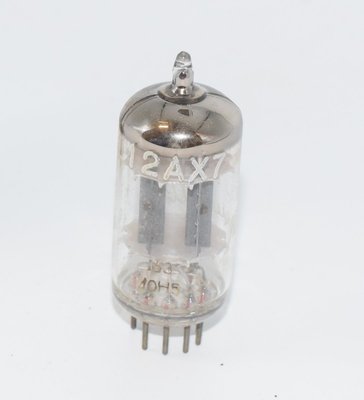
The 12AX7 is a miniature indirectly-heated twin triode with an oxide-coated cathode. As described in the Brimar datasheet, each triode unit is a separate structure, with the heater connections being common, allowing each unit to be used for different functions, or both in cascade. The valve comprises two triode units mounted side by side having separate heaters but common heater pin connections. Each triode unit has characteristics somewhat similar to a 6F5G/GT. The units are mounted in a standard T6½ bulb and based with a BVA standard B9A base.
Heater / Filament Ratings
| Parameter | Series Operation | Parallel Operation |
|---|---|---|
| Heater Voltage | 12.6 V | 6.3 V |
| Heater Current (nominal) | 0.15 A | 0.3 A |
The heater centre tap (Pin 9) enables the valve to be used in both A.C. or A.C./D.C. equipment. For 6.3V parallel operation, both heater sections are connected in parallel via the centre tap. For 12.6V series operation, the heaters are connected in series.
Maximum D.C. Heater-Cathode Potential: 250 volts
Maximum Ratings (Each Triode Unit — Absolute Maxima)
| Parameter | Value |
|---|---|
| Max. Plate Voltage | 300 volts |
| Max. Plate Dissipation | 1.0 watt |
| Max. Cathode Current | 8 mA |
| Max. Negative Control Grid Voltage | 50 volts |
| Max. Positive Control Grid Voltage | 0 volts |
Note: The maximum ratings given in the Brimar datasheet are absolute maxima and should not be exceeded in any circumstances.
Typical Operating Conditions — Class A Amplifier
| Parameter | Condition 1 | Condition 2 |
|---|---|---|
| Plate Voltage (Va) | 100 V | 250 V |
| Grid Voltage (Vg1) | −1 V | −2 V |
| Amplification Factor (μ) | 100 | 100 |
| Plate Impedance (Ra / rp) | 80,000 Ω | 62,500 Ω |
| Mutual Conductance (gm / S) | 1.25 mA/V | 1.6 mA/V |
| Plate Current (Ia) | 0.5 mA | 1.2 mA |
Physical Dimensions
| Parameter | Value |
|---|---|
| Max. Overall Length | 2 1/16 inches |
| Max. Diameter | 7/8 inch |
| Max. Seated Height | 1 11/16 inches |
| Envelope | Standard T6½ bulb |
| Base | Noval type B9A (9-pin miniature) |
Pin Configuration (Base Connections)
| Pin | Function |
|---|---|
| Pin 1 | Plate — Second Triode Unit |
| Pin 2 | Grid — Second Triode Unit |
| Pin 3 | Cathode — Second Triode Unit |
| Pin 4 | Heater |
| Pin 5 | Heater |
| Pin 6 | Plate — First Triode Unit |
| Pin 7 | Grid — First Triode Unit |
| Pin 8 | Cathode — First Triode Unit |
| Pin 9 | Heater Tap (centre tap) |
Note: The getter is attached to the plate of the first triode unit. The heater centre tap on Pin 9 is essential for enabling series (12.6V) or parallel (6.3V) heater operation.
Interelectrode Capacitances (Approximate, Measured Without Shield)
| Capacitance | First Triode Unit | Second Triode Unit |
|---|---|---|
| Grid — Plate | 1.7 pF | 1.7 pF |
| Grid — Cathode | 1.6 pF | 1.6 pF |
| Plate — Cathode | 0.46 pF | 0.34 pF |
| Heater — Cathode | 4.0 pF | 4.0 pF |
| Inter-Section Capacitance | Value |
|---|---|
| Plate (1) — Plate (2) | 0.75 pF |
| Grid (1) — Grid (2) | 0.008 pF |
| Grid (1) — Plate (2) | 0.03 pF |
| Grid (2) — Plate (1) | 0.06 pF |
Applications and Usage
Resistance-Capacity Coupled Amplifier
The 12AX7 is very suitable for use as a resistance-capacity coupled amplifier. The Brimar datasheet provides extensive tables of useful values at two different supply voltages (100V and 250V) with various plate load resistances ranging from 100 kΩ to 470 kΩ. At a plate supply voltage of 250 volts with a 470 kΩ plate load and 470 kΩ grid leak, voltage gains of 57 to 61 are achievable, with output voltages of 51 to 64 volts peak.
The datasheet provides a detailed worked example: with a supply voltage of 250V, a plate load of 470,000 ohms, and a succeeding valve grid leak of 470,000 ohms, the amplification factor is 97, the plate impedance is 109,000 ohms, and the effective signal value of the plate load is 235,000 ohms (470 kΩ in parallel with 470 kΩ). The resulting stage gain is approximately 66.
Cascade Resistance-Capacity Coupled Amplifier
The two triode units may be used in cascade, providing an overall voltage gain of the order of 3,000 and a frequency response within 5 dB from 50 cycles to 20 Kc/s, with an output of approximately 30 volts peak. The Brimar datasheet notes that precautions are necessary to avoid instability: a separate bias resistor suitably decoupled must be used for each cathode (not a common resistor), grid and plate leads should not be unduly long or close together, and adequate plate supply decoupling is required.
The cascade amplifier circuit (Ref. No. 313·64) uses a +250V supply with a 22 kΩ decoupling resistor and provides the following performance with various plate load and grid leak combinations:
- With 100 kΩ plate load and 220 kΩ grid leak: voltage gain of 2,080 at 1 Kc/s
- With 220 kΩ plate load and 1 MΩ grid leak: voltage gain of 3,370 at 1 Kc/s
- With 470 kΩ plate load and 2.2 MΩ grid leak: voltage gain of 3,590 at 1 Kc/s
Paraphase Amplifier (Normal Paraphase)
The 12AX7 is very suitable for generating push-pull output from a single-ended input without the need for a transformer. In the normal paraphase configuration (Ref. No. 313·65), one triode unit is fed from the output of the other unit in order to reverse the phase, with the input being adjusted so that the gain is the same. With a 220 kΩ plate load, the circuit provides a voltage gain of 90 at 1 Kc/s and a maximum R.M.S. output voltage grid-to-grid of 78V for 5% total harmonic distortion. With a 100 kΩ plate load, the gain is 73.5 with 64V maximum output.
Plate-Cathode Load Phase Splitter
In this application (Ref. No. 313·66), the push-pull output is obtained by dividing the load into two equal parts, one half being in the plate and one half in the cathode of the same triode unit. This triode unit gives no gain, and the other unit is used as a straight amplifier before it. This circuit provides a voltage gain of 108 at 1 Kc/s, a maximum R.M.S. output voltage grid-to-grid of 54V for 5% total harmonic distortion, and excellent frequency response (−0.2 dB at 50 c/s, −0.4 dB at 10 Kc/s, −1.5 dB at 20 Kc/s compared with 1 Kc/s).
General Applications
Beyond these specific circuits detailed in the Brimar datasheet, the 12AX7 has found widespread use in:
- Guitar amplifier preamp stages — the dominant application in modern times, used in virtually every tube guitar amplifier ever made
- Hi-fi preamplifiers — phono stages (RIAA equalization), line stages, and tone control circuits
- Microphone preamplifiers — in recording studio equipment
- Mixing consoles — vintage and modern boutique designs
- Compressors and limiters — as gain elements in dynamic processing equipment
- Headphone amplifiers — in hybrid and all-tube designs
- DAC output stages — in modern hybrid digital-to-analog converters
Sound Characteristics
The 12AX7 / ECC83 is renowned for its distinctive sonic character, which has made it the tube of choice for audio applications demanding warmth, musicality, and harmonic richness. While the specific sound varies considerably between manufacturers and production eras, several general characteristics are widely recognized by audiophiles and engineers:
General Tonal Character
The 12AX7 is typically described as producing a warm, smooth, and harmonically rich sound. Its high amplification factor of 100 means it provides substantial gain, but the nature of that gain — shaped by the tube's relatively high plate impedance (62,500 to 80,000 ohms) and moderate transconductance (1.25 to 1.6 mA/V) — tends to produce a sound that is full-bodied and musically engaging rather than clinically precise.
The tube's transfer characteristics produce predominantly even-order harmonics (particularly second harmonic) when driven into mild nonlinearity, which the human ear perceives as warmth and richness. This is in contrast to solid-state devices, which tend to produce odd-order harmonics that are perceived as harsh or brittle.
Frequency Response Character
In typical RC-coupled circuits, the 12AX7 exhibits a natural high-frequency roll-off that many listeners find pleasing. The Brimar cascade amplifier data shows this clearly: with a 470 kΩ plate load, the response is down 7.2 dB at 10 Kc/s and 12.0 dB at 20 Kc/s relative to 1 Kc/s. While this roll-off is largely a function of the circuit (stray capacitances interacting with the high-impedance load), it contributes to the perception of a smooth, non-fatiguing treble. With lower plate load resistances (100 kΩ), the bandwidth extends significantly, with only 1.4 dB loss at 10 Kc/s.
Overdrive and Clipping Behavior
When overdriven — particularly in guitar amplifier applications — the 12AX7 produces a smooth, gradual transition into clipping that is musically expressive. The soft clipping characteristic adds sustain and compression without the abrupt, harsh distortion associated with hard clipping. This is one of the primary reasons the tube has remained the standard in guitar amplifier preamp stages for over 70 years.
Microphonics and Noise
Due to its high gain, the 12AX7 can be susceptible to microphonic behavior — mechanical vibrations being converted into audible signal. The quality of construction varies significantly between manufacturers, and low-microphonic examples are particularly prized for sensitive phono stage and microphone preamplifier applications. The best examples exhibit very low hum and noise, making them suitable for the most demanding high-fidelity applications.
Manufacturer Variations
Audiophiles and engineers have long noted significant sonic differences between 12AX7 tubes from different manufacturers:
- Telefunken ECC83 — Often considered the benchmark, prized for clarity, detail, and a balanced tonal presentation with excellent dynamics
- Mullard ECC83 — Known for a rich, warm midrange with a lush, romantic character favored in hi-fi applications
- Philips Heerlen (Holland) — Highly regarded for their construction quality and balanced, detailed sound; examples from the Heerlen factory dating to 1956 and beyond are particularly sought after
- Philips Miniwatt (Australia) — Produced by STC under the Brimar/Philips Miniwatt and Super Radiotron brands, these Australian-made tubes are valued for their reliability and musical character
- RCA — The original manufacturer; known for a clean, slightly bright character with good dynamics
- GE — Typically described as bright and detailed, with a tighter bass response
- Matsushita (Japan) — Japanese-made examples offer good consistency and a smooth, neutral tonal balance
- Sylvania — Valued for a smooth, sweet top end and good overall balance
Equivalent and Substitute Types
Close / Identical Substitutes (Direct Drop-In Replacements)
The following types are classified as close or identical substitutes for the 12AX7 and can generally be used as direct replacements without circuit modifications:
- ECC83 — The European (Mullard/Philips) designation for the same tube. Electrically identical.
- 12AX7R — A ruggedized version with identical electrical specifications.
- CV492 — British military (CV) designation for the 12AX7/ECC83.
- CV10319 — Another British military designation for this type.
Different Rating Substitutes (NOT Direct Drop-In)
The following types are related to the 12AX7 but have different ratings, specifications, or selection criteria. While they share the same pinout and may work in many circuits, they are not identical and should be evaluated for compatibility with the specific application:
- 7025 — A low-noise, low-hum version of the 12AX7 originally developed for sensitive audio applications. While pin-compatible, it has different specification limits and is classified as a different rating substitute, not a direct equivalent.
- 5751 / 5751WA / CK5751 — A military-grade tube with approximately 70% of the gain of a 12AX7 (μ ≈ 70 vs. 100). Pin-compatible but the lower gain will affect circuit performance. Popular as a substitute in guitar amplifiers where reduced preamp gain is desired.
- CV4004 — A premium military-selected version with tighter tolerances. Different rating specifications from the standard 12AX7.
- M8137 — The Mullard military designation, with premium selection criteria and different rating specifications.
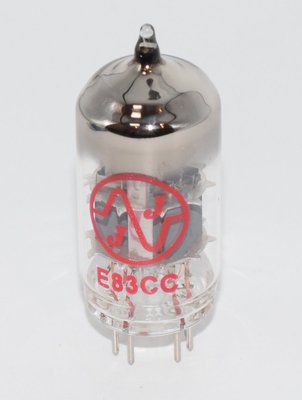
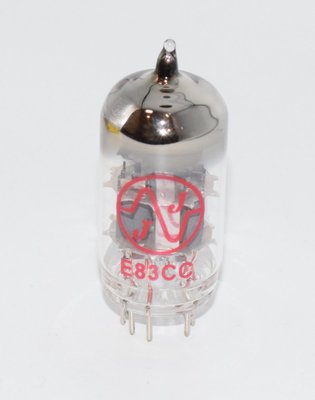
- E83CC / ECC803 / ECC803S — Premium long-life versions with enhanced specifications, particularly regarding low noise and low microphonics. Different ratings from the standard type.
- 12AX7A / 12AX7S / 12AX7WA — Variants with different rating specifications (ruggedized, military, etc.).
- 6057 — A special-quality version with different rating criteria.
- 6681 — A selected version with different specifications.
- 7382 / 7494 / 7729 — Industrial/special application variants with different ratings.
- B339 / QB339 — European designations for related types with different specifications.
- CV4017 / CV8156 / CV8222 / CV8312 — Various British military designations for related types with different selection criteria.
- ECC863 — A variant with different rating specifications.
- E2164 — A related type with different specifications.
- 6L13 — A related type with different ratings.
- 20EZ7 — A related type with a different heater voltage (20V); requires circuit modification for heater supply.
- 6AX7 — A related type with a 6.3V heater only (no series heater option); different ratings.
Note: When substituting any of the "different rating" types, always verify that the specific tube's maximum ratings, gain characteristics, and heater requirements are compatible with your circuit. The 5751 in particular, while pin-compatible, will provide noticeably less gain due to its lower amplification factor.
Notable Characteristics
High Amplification Factor
With an amplification factor (μ) of 100, the 12AX7 provides the highest gain of any common dual triode in the 9-pin miniature family. This compares to μ ≈ 70 for the 5751, μ ≈ 33 for the 12AT7, and μ ≈ 20 for the 12AU7. This high mu makes it the natural choice for first-stage voltage amplification where maximum gain per stage is required.
High Plate Impedance
The plate impedance of 62,500 ohms (at 250V) to 80,000 ohms (at 100V) is notably high for a small-signal triode. This characteristic means the tube works best with high-value plate load resistors (100 kΩ to 470 kΩ) and is not well-suited to driving low-impedance loads directly. The high plate impedance also contributes to the tube's sensitivity to load capacitance, which affects high-frequency response in RC-coupled circuits.
Dual Independent Triode Sections
As the Brimar datasheet emphasizes, each triode unit is a separate structure with only the heater connections being common. This allows each section to be used for completely different functions — for example, one section as a voltage amplifier and the other as a phase splitter, or both sections cascaded for maximum gain. The very low inter-section capacitances (Grid 1 to Grid 2: 0.008 pF) facilitate independent operation with minimal crosstalk.
Flexible Heater Configuration
The center-tapped heater (Pin 9) allows operation at either 12.6V (series, 0.15A) or 6.3V (parallel, 0.3A), making the tube compatible with virtually any equipment power supply design. This was a significant advantage in the era when both AC and AC/DC equipment were common.
Low Current Operation
The 12AX7 operates at very low plate currents — typically 0.5 mA at 100V plate voltage and 1.2 mA at 250V plate voltage in standard Class A operation. While the maximum cathode current rating is 8 mA per section, normal operating points are well below this limit. The low current draw contributes to long tube life and allows the use of high-value plate load resistors for maximum voltage gain.
Getter Placement
The Brimar datasheet notes that the getter is attached to the plate of the first triode unit (pins 6/7/8). This is a detail that can occasionally affect the performance of the two sections differently, particularly regarding microphonics, and is one reason why some circuit designers prefer to use a specific section for the most critical gain stage.
Usage in the Audio Community
Guitar Amplifiers
The 12AX7 is the undisputed king of guitar amplifier preamp tubes. Virtually every tube guitar amplifier ever produced — from the earliest Fender, Marshall, and Vox designs to modern boutique amplifiers — uses one or more 12AX7 tubes in the preamp section. The tube typically serves multiple roles within a single amplifier:
- First gain stage (V1) — The most critical position, where the tube amplifies the guitar's signal from millivolt levels. Low-noise, low-microphonic tubes are essential here.
- Second and subsequent gain stages — Additional 12AX7 stages provide further amplification and tone shaping, particularly in high-gain amplifier designs.
- Tone stack recovery — After passive tone control networks that attenuate the signal, a 12AX7 stage recovers the lost gain.
- Phase inverter / phase splitter — One of the most common applications, using both triode sections to split the single-ended signal into the balanced (push-pull) signal required to drive the power tubes. The Brimar datasheet's paraphase and cathodyne phase splitter circuits (Ref. No. 313·65 and 313·66) are directly relevant to this application.
- Reverb driver and recovery — In amplifiers with spring reverb, 12AX7 sections drive the reverb tank and amplify the returned signal.
- Effects loop — Send and return buffering in amplifiers with effects loops.
Guitar players are among the most discerning tube consumers, often experimenting with different brands and vintages of 12AX7 to fine-tune their amplifier's tone. The V1 position is considered the most tonally influential, and premium NOS (New Old Stock) tubes from manufacturers like Telefunken, Mullard, and Philips Heerlen command significant prices in this market.
High-Fidelity Audio
In the hi-fi world, the 12AX7/ECC83 is the dominant choice for phono preamplifier stages, where its high gain is essential for amplifying the very low output of moving-magnet and (with additional gain stages or step-up transformers) moving-coil phono cartridges. The tube's RIAA equalization characteristics, when combined with appropriate passive networks, provide the gain and frequency shaping required for accurate vinyl playback.
The tube is also widely used in line-stage preamplifiers, where one or both triode sections provide voltage gain and buffering between source components and power amplifiers. Many classic and modern audiophile preamplifier designs — from the Marantz 7C to contemporary designs by Audio Research, Conrad-Johnson, and numerous boutique manufacturers — are built around the 12AX7.
Audiophiles frequently engage in "tube rolling" — systematically comparing different brands and vintages of 12AX7 to optimize the sound of their systems. This practice has created a robust market for NOS tubes, with rare examples from the 1950s and 1960s fetching premium prices. Philips Heerlen tubes from 1956, for example, are particularly sought after for their construction quality and sonic refinement.
Recording Studio Equipment
The 12AX7 is found in numerous pieces of classic and modern recording studio equipment:
- Microphone preamplifiers — Many classic designs use 12AX7 tubes for their gain stages, valued for the warmth and character they impart to vocal and instrument recordings.
- Channel strips and mixing consoles — Vintage consoles and modern boutique channel strips use 12AX7 tubes for their amplification stages.
- Compressors and limiters — Classic dynamic processors use 12AX7 tubes as gain makeup stages or sidechain amplifiers.
- Equalizers — Some tube-based equalizer designs use 12AX7 sections for gain stages within the EQ circuit.
Headphone Amplifiers and DACs
A growing segment of the audio market uses the 12AX7 in headphone amplifiers and as output buffer stages in digital-to-analog converters. These hybrid designs combine the warmth and musicality of the tube with solid-state output stages capable of driving low-impedance headphones. The tube's high gain allows it to serve as an effective voltage amplification stage even in compact desktop equipment.
DIY and Hobbyist Community
The 12AX7 is one of the most popular tubes among DIY audio enthusiasts. Its wide availability, extensive documentation (including detailed application data like the Brimar report), relatively low operating voltages, and forgiving nature make it an excellent tube for hobbyist projects. Countless preamplifier, headphone amplifier, and guitar amplifier kits are designed around this tube, and it serves as many builders' introduction to vacuum tube circuit design.
Current Production
The enduring demand for the 12AX7 has ensured continued production by several manufacturers, including JJ Electronic (Slovakia), Electro-Harmonix / Sovtek / Tung-Sol (Russia — production status may vary), Shuguang and Psvane (China), and others. These current-production tubes vary in quality and sonic character, and many audio enthusiasts continue to prefer NOS examples from the golden age of tube manufacturing for critical applications.