Introduction and History
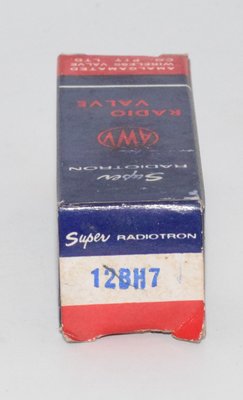
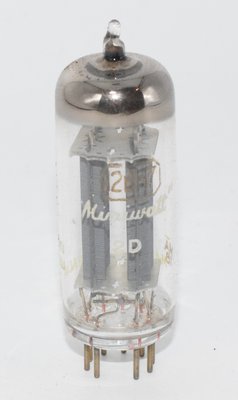
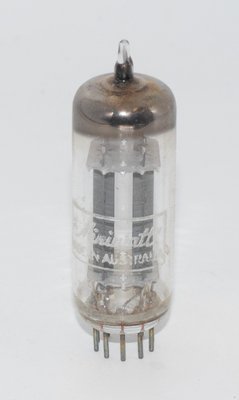
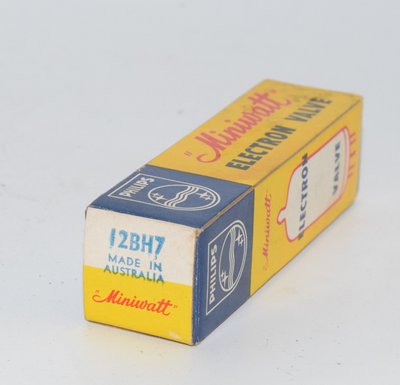
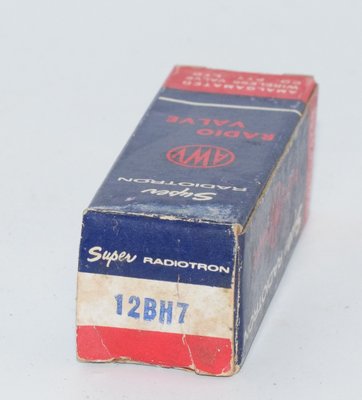
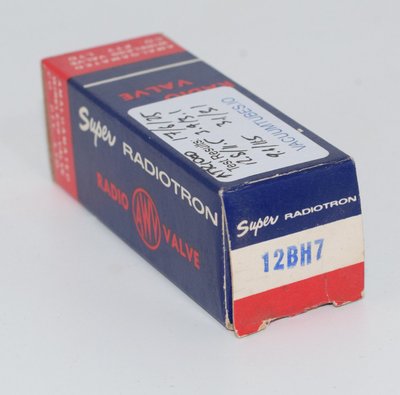
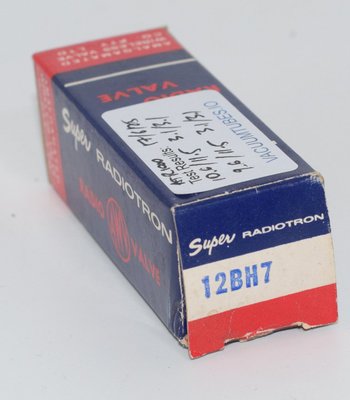
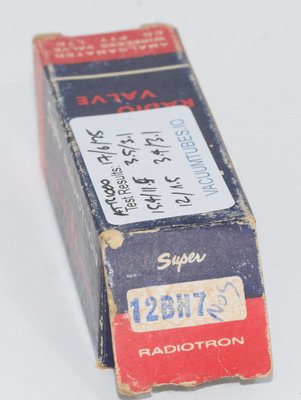
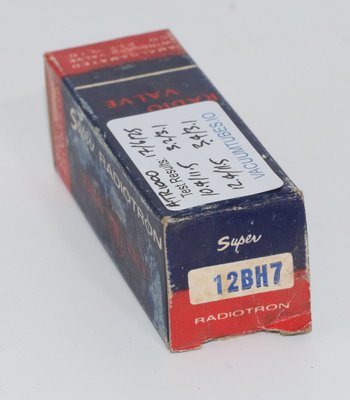
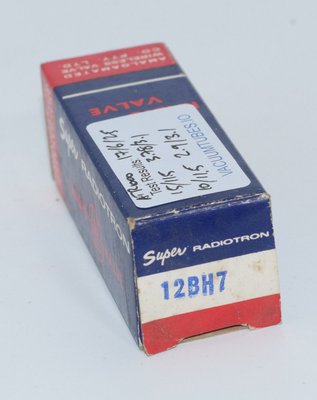
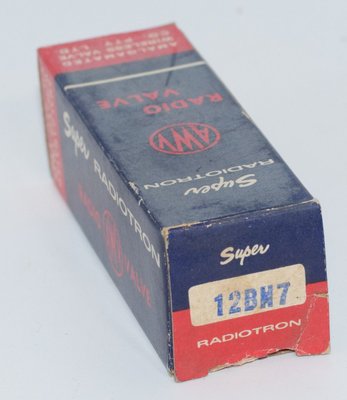
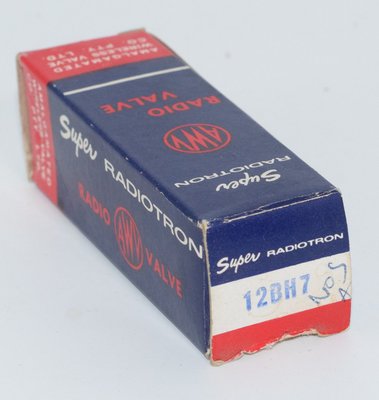
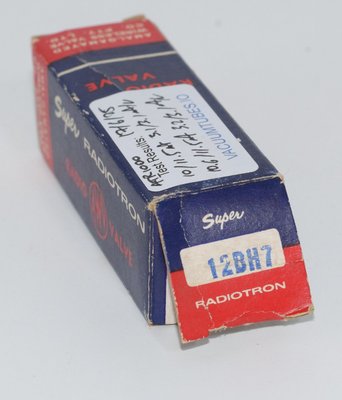
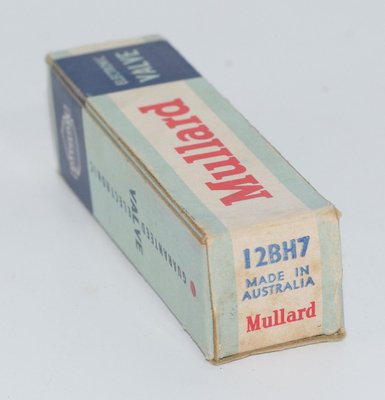
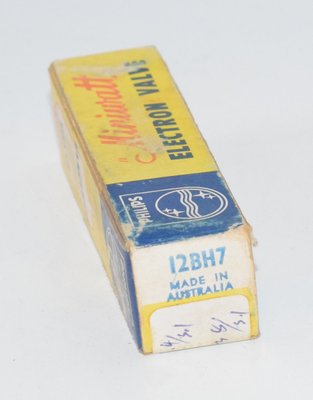
The 12BH7 is a medium-mu twin triode vacuum tube (valve) that was developed in the early 1950s primarily for use as a vertical-deflection amplifier in television receivers. Designed to deliver relatively high plate current at low plate voltages while withstanding the high pulse voltages encountered in vertical-amplifier applications, the 12BH7 quickly proved itself as a versatile general-purpose dual triode. It was manufactured by virtually every major tube maker of the era, including RCA, General Electric, Sylvania, Mullard, Philips Miniwatt, and AWV Super Radiotron in Australia, among many others.
The tube was later refined into the 12BH7-A variant, which incorporated a controlled heater warm-up characteristic making it particularly suited for television receivers employing 600-milliampere series-connected heater strings. While the original 12BH7 and the 12BH7-A share the same fundamental electrical characteristics, the 12BH7-A has slightly different maximum ratings in certain service conditions, and the two are considered related but not identical drop-in substitutes in all applications.
Though originally a television tube, the 12BH7 has enjoyed a remarkable second life in the high-fidelity audio world. Its ability to deliver substantial current, its moderate amplification factor, and its inherently linear characteristics have made it a favorite among amplifier designers and audiophiles for driver stages, phase splitters, and even low-power output stages in headphone amplifiers.
Technical Specifications and Design
General Characteristics
| Parameter | Value |
|---|---|
| Tube Type | Medium-Mu Twin Triode |
| Cathode | Coated, Unipotential (Indirectly Heated) |
| Envelope | T-6½, Glass |
| Base | Noval (B9A) — E9-1, Small Button 9-Pin |
| Mounting Position | Any |
Heater Ratings
| Parameter | Series | Parallel | Unit |
|---|---|---|---|
| Heater Voltage (AC or DC) | 12.6 | 6.3 | Volts |
| Heater Current | 0.3 | 0.6 | Amperes |
| Heater Warm-up Time* | — | 11 | Seconds |
*Heater warm-up time applies to the 12BH7-A variant with controlled warm-up characteristic.
Direct Interelectrode Capacitances (Each Section)
| Parameter | Value | Unit |
|---|---|---|
| Grid to Plate (Cga) | 2.6 | pF |
| Input / Grid to Cathode (Cgk) | 3.2 | pF |
| Output / Plate to Cathode, Section 1 (Cak) | 0.5 | pF |
| Output / Plate to Cathode, Section 2 (Cak) | 0.4 | pF |
| Plate to Plate | 0.8 | pF |
Note: Capacitance values are without external shield, per the GE datasheet.
Maximum Ratings — Class A₁ Amplifier (Each Section)
| Parameter | Value | Unit |
|---|---|---|
| DC Plate Voltage (Va max) | 300 | Volts |
| Positive DC Grid Voltage | 0 | Volts |
| Negative DC Grid Voltage | 50 | Volts |
| Plate Dissipation (Pa max) | 3.5 | Watts |
| DC Cathode Current | 20 | mA |
| Heater-Cathode Voltage (DC, Htr Positive) | 100 | Volts |
| Heater-Cathode Voltage (Total DC+Peak, Htr Positive) | 200 | Volts |
| Heater-Cathode Voltage (Total DC+Peak, Htr Negative) | 200 | Volts |
| Grid Circuit Resistance (Fixed Bias) | 0.25 | Megohms |
| Grid Circuit Resistance (Cathode Bias) | 1.0 | Megohms |
Maximum Ratings — Vertical-Deflection Amplifier (Each Section)
| Parameter | Value | Unit |
|---|---|---|
| DC Plate Voltage | 450 | Volts |
| Peak Positive Pulse Plate Voltage | 1500 (absolute max) | Volts |
| Peak Negative Grid Voltage | 250 | Volts |
| Plate Dissipation | 3.5π | Watts |
| DC Cathode Current | 20 | mA |
| Peak Cathode Current | 70 | mA |
Note: π indicates that in stages operating with grid-leak bias, an adequate cathode-bias resistor or other suitable means is required to protect the tube in the absence of excitation.
Maximum Ratings — Oscillator Service (Each Section)
| Parameter | Vertical Oscillator | Horizontal Oscillator | Unit |
|---|---|---|---|
| DC Plate Voltage | 450 | 450 | Volts |
| Peak Negative Grid Voltage | 400 | 600 | Volts |
| Plate Dissipation | 3.5 | 3.5 | Watts |
| DC Cathode Current | 20 | 20 | mA |
| Peak Cathode Current | 70 | 300 | mA |
| Grid Circuit Resistance (Fixed Bias) | 2.2 | 2.2 | Megohms |
| Grid Circuit Resistance (Cathode Bias) | 2.2 | 2.2 | Megohms |
Characteristics and Typical Operation — Class A₁ Amplifier (Each Section)
| Parameter | Condition 1 | Condition 2 | Unit |
|---|---|---|---|
| Plate Voltage | 250 | 250 | Volts |
| Grid Voltage | −14 | −10.5 | Volts |
| Amplification Factor (μ) | — | 16.5 | — |
| Plate Resistance (rp), approx. | — | 5300 | Ohms |
| Transconductance (gm) | — | 3100 | Micromhos (μS) |
| Plate Current | 4.0 | 11.5 | mA |
| Grid Voltage for Ib = 50 μA | — | −23 | Volts |
Pin Connections (RETMA 9A Basing)
| Pin | Function |
|---|---|
| 1 | Plate (Section 2) |
| 2 | Grid (Section 2) |
| 3 | Cathode (Section 2) |
| 4 | Heater |
| 5 | Heater |
| 6 | Plate (Section 1) |
| 7 | Grid (Section 1) |
| 8 | Cathode (Section 1) |
| 9 | Heater Center-Tap |
The heater center-tap on pin 9 allows the tube to be operated with a 6.3V heater supply (pins 4 and 5 in parallel via pin 9) or a 12.6V supply (pins 4 and 5 in series, pin 9 unused). This dual-voltage heater arrangement is a hallmark of the "12" prefix designation in the American tube numbering system.
Applications and Usage
Original Television Applications
The 12BH7 was designed primarily for vertical-deflection amplifier service in television receivers. In this role, the two triode sections could be employed in parallel for increased current capability, or one section could serve as a vertical oscillator while the other functioned as the vertical output amplifier. The tube's ability to handle high pulse voltages (up to 1500V peak positive pulse plate voltage in deflection service) while delivering substantial plate current made it ideal for driving deflection yokes.
The tube was also widely used as a horizontal oscillator in television sets, where its generous peak cathode current rating of 300 mA in horizontal oscillator service proved valuable.
General-Purpose Amplifier
Beyond television, the 12BH7 found use in a wide variety of general-purpose applications. Its moderate amplification factor of 16.5, combined with a relatively low plate resistance of approximately 5300 ohms and a healthy transconductance of 3100 micromhos, made it suitable for voltage amplifier stages, cathode followers, phase splitters, and buffer stages in both audio and instrumentation equipment.
Audio Amplifier Applications
The 12BH7 has become one of the most popular dual triodes in modern audio amplifier design. Common audio applications include:
- Driver/Phase Splitter: The two triode sections are frequently configured as a long-tailed pair (differential amplifier) to drive push-pull output stages. The tube's current capability and moderate gain make it an excellent driver for power tubes such as the EL34, 6L6, KT88, and 6550.
- Headphone Amplifier Output Stage: With 3.5 watts of plate dissipation per section and the ability to deliver up to 20 mA of DC cathode current, the 12BH7 can serve as a capable output tube in OTL (output-transformerless) headphone amplifiers, directly driving headphones from 32 to 600 ohms.
- Line-Level Preamplifier: The moderate gain and low plate resistance make the 12BH7 suitable for line-stage preamplifier circuits where a lower gain than a 12AX7 is desired but more current drive capability is needed.
- Cathode Follower Buffer: The low output impedance achievable with the 12BH7 in cathode-follower configuration makes it an excellent buffer stage.
Sound Characteristics
The 12BH7 occupies a distinctive sonic niche among dual triodes, and its sound character is frequently praised by audiophiles and amplifier designers alike. Its tonal qualities can be summarized as follows:
- Warmth and Body: The 12BH7 is widely regarded as having a warm, full-bodied midrange that adds a pleasing richness to vocals and acoustic instruments. It avoids the clinical or sterile quality that some higher-mu tubes can impart.
- Smooth, Extended Highs: The treble response is typically described as smooth and naturally extended without harshness or excessive brightness. The relatively low interelectrode capacitances (Cga of 2.6 pF, Cgk of 3.2 pF) contribute to good high-frequency performance without the rolloff associated with higher-capacitance types.
- Solid Bass: Thanks to its low plate resistance of approximately 5300 ohms and generous current capability, the 12BH7 delivers tight, well-controlled bass with good authority. This is one of the key characteristics that distinguishes it from higher-impedance dual triodes like the 12AX7 or 12AT7.
- Dynamic and Punchy: The tube's ability to swing significant current gives it a dynamic, lively quality. Transients are rendered with good speed and impact, making it particularly effective in driver stages where it must control demanding output tubes.
- Low Distortion Character: When operated within its linear region, the 12BH7 produces predominantly second-harmonic distortion, which is perceived as musically pleasant. The distortion spectrum is clean and simple, contributing to the tube's reputation for transparency.
- Spatial Presentation: Audiophiles frequently note that the 12BH7 presents a wide, open soundstage with good depth and imaging. The low plate-to-plate capacitance of 0.8 pF helps maintain channel separation when both sections are used in stereo applications.
Different manufacturers' versions of the 12BH7 are known to have subtly different sonic signatures. NOS (New Old Stock) examples from RCA are often considered the benchmark, prized for their balance and refinement. GE versions are noted for a slightly more forward, dynamic presentation. Mullard and Philips Miniwatt examples from Australia and Europe tend toward a warmer, more liquid midrange. Sylvania tubes are often described as having excellent clarity and detail retrieval.
Equivalent or Substitute Types
Close/Identical Substitutes
| Type | Notes |
|---|---|
| CV5042 | British military (CV) designation for the 12BH7. Direct drop-in replacement with identical specifications. |
Related Types (Not Direct Drop-In)
| Type | Notes |
|---|---|
| 12BH7-A | Enhanced version with controlled heater warm-up characteristic for series-string TV heater chains. Electrically very similar but has different ratings in some service conditions (e.g., higher plate voltage ratings in deflection service). Generally usable in place of the 12BH7 in audio applications, but technically a different rating substitute, not an identical drop-in in all circuits. |
| 12AU7 / ECC82 | Another medium-mu dual triode with similar amplification factor (~17–20) but different pinout for the second section's plate and different maximum ratings. The 12AU7 has a lower plate dissipation rating (2.75W per section vs. 3.5W) and lower current capability. Not a pin-compatible substitute — while the pinout is similar, operating points and bias requirements differ. Often compared in audio applications but should not be swapped without circuit modifications. |
Important Note: The 12BH7 has a unique combination of high current capability and moderate gain that is not exactly duplicated by any other common dual triode. While the 12AU7 is sometimes discussed as an alternative, the two tubes have different plate characteristics, different maximum ratings, and different bias requirements. Substitution without circuit adjustment is not recommended.
Notable Characteristics
- High Current Capability: With a maximum DC cathode current of 20 mA per section and peak cathode current ratings of 70 mA (deflection service) to 300 mA (horizontal oscillator service), the 12BH7 can deliver significantly more current than most other noval dual triodes. This makes it exceptionally versatile for applications requiring substantial current drive.
- Robust Plate Dissipation: At 3.5 watts per section (7 watts total for both sections), the 12BH7 offers more plate dissipation than the popular 12AX7 (1.2W/section), 12AT7 (2.5W/section), or 12AU7 (2.75W/section). This headroom contributes to both reliability and sonic performance.
- High Pulse Voltage Tolerance: The ability to withstand peak positive pulse plate voltages up to 1500V in deflection service demonstrates the robust construction of this tube, a characteristic that provides generous safety margins in audio applications.
- Dual Heater Voltage: The center-tapped heater (pin 9) allows operation at either 6.3V or 12.6V, providing flexibility in power supply design. In parallel (6.3V) operation, the heater draws 0.6A; in series (12.6V) operation, it draws 0.3A.
- Low Plate Resistance: The approximately 5300-ohm plate resistance is notably low for a small-signal dual triode, enabling the 12BH7 to drive low-impedance loads effectively and contributing to its excellent bass performance in audio circuits.
- Separate Cathodes: Unlike some dual triodes, the 12BH7 has completely independent cathode connections for each section (pins 3 and 8), allowing maximum flexibility in circuit design, including the ability to set different bias points for each section.
- Wide Manufacturer Base: The 12BH7 was produced by numerous manufacturers worldwide, including RCA, GE, Sylvania, Raytheon, Tung-Sol, Westinghouse, CBS-Hytron, Mullard, Philips Miniwatt, Amperex, Brimar, AWV Super Radiotron, and many others. This broad production base means NOS examples remain relatively available, though premium brands command increasingly high prices.
Usage in the Audio Community
The 12BH7 has carved out a significant and growing role in the audio community, valued for its unique combination of electrical characteristics that bridge the gap between small-signal voltage amplifier tubes and power tubes.
Headphone Amplifiers
Perhaps the most prominent modern audio application for the 12BH7 is in headphone amplifiers. The tube's generous plate dissipation of 3.5 watts per section, combined with its low plate resistance and high current capability, makes it ideal for OTL (Output Transformerless) headphone amplifier designs. Both sections can be paralleled to drive low-impedance headphones, or each section can drive one channel independently. Popular DIY headphone amplifier designs such as variations of the Starving Student, the Torpedo, and various Aikido-based circuits frequently specify the 12BH7. Commercial manufacturers including Woo Audio and others have featured the 12BH7 in their headphone amplifier product lines.
Integrated and Power Amplifiers
Many high-end audio amplifier manufacturers use the 12BH7 as a driver tube. Its moderate gain of 16.5 and excellent current drive capability make it an outstanding choice for driving push-pull output stages. The tube appears in amplifiers from manufacturers such as Audio Research, Conrad-Johnson, VTL, and numerous boutique builders. In some designs, the 12BH7 serves as both the input voltage amplifier and the phase splitter in a single dual-triode envelope, simplifying the signal path.
Preamplifiers
In preamplifier applications, the 12BH7 is chosen when designers want a lower-gain, higher-current alternative to the ubiquitous 12AX7. Its gain of 16.5 (compared to 100 for the 12AX7) makes it suitable for line-stage applications where excessive gain would be problematic, particularly in modern systems with high-output digital sources. The low output impedance achievable with the 12BH7 also makes it excellent for driving long interconnect cables or low-impedance loads.
Tube Rolling
The 12BH7 is a popular tube for "tube rolling" — the practice of swapping different manufacturer's versions of the same tube type to fine-tune the sound of an amplifier. Audiophiles actively seek out NOS examples from specific manufacturers and production eras, with certain variants commanding premium prices. Particularly sought-after are:
- RCA Clear-Top: Known for clarity, detail, and a balanced tonal presentation
- RCA Black Plate: Valued for warmth and rich harmonics
- GE: Appreciated for dynamics and punch
- Sylvania: Noted for detail retrieval and an open, airy top end
- Mullard / Philips Miniwatt: Prized for a lush, warm midrange and smooth treble
- Tung-Sol: Regarded for excellent bass control and overall balance
DIY Community
The 12BH7 is extremely popular in the DIY tube audio community. Its forgiving nature, wide operating range, and robust construction make it an excellent choice for builders of all experience levels. The tube's versatility means it can be used in a wide variety of circuit topologies, from simple single-stage amplifiers to complex multi-stage designs. Numerous published circuits and construction articles feature the 12BH7, and it is a staple recommendation on audio DIY forums.
Current Production and Availability
While the 12BH7 is no longer in widespread new production (unlike the 12AX7 and 12AU7, which are manufactured by several current producers), NOS stocks remain reasonably available from Australian manufacturers like AWV Super Radiotron and Philips Miniwatt, as well as American and European sources. The tube's enduring popularity in audio applications has maintained steady demand, and some current manufacturers have explored reissuing the type. Builders and audiophiles are advised to purchase from reputable dealers who test tubes on calibrated equipment to ensure quality, as decades-old NOS stock can vary in condition.