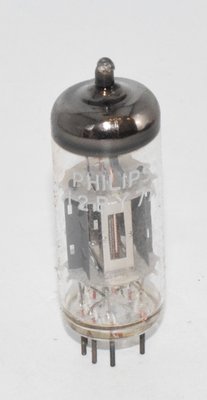
1. Introduction and History
The 12BY7 is a sharp-cutoff miniature pentode designed primarily as a video output amplifier and high-frequency driver. Introduced in the early 1950s during the golden age of television, the 12BY7 was developed to meet the demanding bandwidth requirements of video amplifier stages in television receivers. Its high transconductance and relatively low interelectrode capacitances made it an ideal choice for wideband amplification applications where both gain and frequency response were critical.
Manufactured by virtually every major tube producer of the era — including RCA, GE, Sylvania, Philips (Miniwatt), AWV (Super Radiotron in Australia), Mullard, Amperex, and numerous others — the 12BY7 became one of the most widely used video amplifier tubes in the world. Its popularity was such that it spawned several improved variants, most notably the 12BY7A, which offered enhanced ratings and reliability.
The tube was designed during a period when television was rapidly expanding into households worldwide, and manufacturers needed reliable, high-performance tubes that could handle the wide bandwidth signals required for clear picture reproduction. The 12BY7's combination of high transconductance (11 mA/V), moderate plate dissipation (6.5W), and compact noval envelope made it a workhorse of the television industry throughout the 1950s and 1960s.
Beyond its original television application, the 12BY7 found use in oscillator circuits, RF driver stages, and — in more recent decades — has been adopted by the audio community for use in guitar amplifiers and high-fidelity preamplifier designs, where its unique tonal characteristics are prized.
2. Technical Specifications and Design
Heater / Filament
| Parameter | Value |
|---|---|
| Heater Voltage (Vh) | 12.6 V |
| Heater Current (Ih) | 0.3 A |
| Heater Configuration | Series/parallel (12.6V / 6.3V center-tapped) |
Note: Like most 12-volt heater tubes, the 12BY7 features a center-tapped heater, allowing operation at either 12.6V (series, 0.3A) or 6.3V (parallel, 0.6A). This dual-voltage capability was essential for use in both series-string and parallel-heater television chassis.
Maximum Ratings (Absolute Maximum Values)
| Parameter | Value |
|---|---|
| Maximum Plate Voltage (Va max) | 330 V |
| Maximum Screen Grid Voltage (Vg2 max) | 190 V |
| Maximum Plate Dissipation (Pa max) | 6.5 W |
| Maximum Screen Grid Dissipation (Pg2 max) | 1.2 W |
Interelectrode Capacitances
| Parameter | Value |
|---|---|
| Grid-to-Cathode Capacitance (Cgk) | 10.2 pF |
| Plate-to-Cathode Capacitance (Cak) | 3.5 pF |
| Grid-to-Plate Capacitance (Cga) | 0.063 pF |
The extremely low grid-to-plate capacitance of just 0.063 pF is a hallmark of this tube's design, incorporating an effective internal electrostatic shield between the control grid and plate. This low feedback capacitance is essential for stable wideband amplification and contributes to the tube's excellent high-frequency performance.
Typical Operating Conditions (Class A Amplifier)
| Parameter | Value |
|---|---|
| Plate Voltage (Va) | 250 V |
| Screen Grid Voltage (Vg2) | 180 V |
| Plate Current (Ia) | 26.0 mA |
| Screen Grid Current (Ig2) | 5.75 mA |
| Plate Resistance (Ra / rp) | 93,000 Ω (93 kΩ) |
| Transconductance (S / gm) | 11.0 mA/V (11,000 µmhos) |
| Cathode Resistor (Rk) for self-bias | 100 Ω |
Derived Parameters
| Parameter | Value |
|---|---|
| Amplification Factor (µ) | ≈ 1,023 (calculated: µ = gm × rp = 11.0 × 93 = 1,023) |
| Grid Bias (estimated from Rk) | ≈ −3.2 V (calculated: Ik × Rk ≈ 31.75 mA × 100 Ω ≈ −3.2 V) |
Note: The amplification factor (µ) is derived from the relationship µ = gm × rp. The high µ of approximately 1,023 is characteristic of a sharp-cutoff pentode with high plate resistance. The grid bias is estimated from the total cathode current (plate + screen) flowing through the specified 100Ω cathode resistor. Exact bias values should be confirmed against the specific manufacturer's datasheet for your application.
Physical Construction
| Parameter | Detail |
|---|---|
| Base Type | Noval (B9A) — 9-pin miniature |
| Envelope Type | T-6½ miniature glass envelope |
| Mounting Position | Any (designed for universal mounting) |
| Overall Length | Approximately 56 mm (2.2 inches) |
| Maximum Diameter | Approximately 20 mm (0.8 inches) |
Pin Configuration (Noval B9A Base — Bottom View)
| Pin | Connection |
|---|---|
| Pin 1 | Grid 1 (Control Grid) |
| Pin 2 | Cathode |
| Pin 3 | Heater |
| Pin 4 | Heater (center-tap) |
| Pin 5 | Suppressor Grid (Grid 3) — internally connected to cathode |
| Pin 6 | Plate (Anode) |
| Pin 7 | Screen Grid (Grid 2) |
| Pin 8 | Internal Shield / No Connection |
| Pin 9 | Heater |
Note: The suppressor grid (g3) is internally connected to the cathode in the 12BY7. Pin 8 may serve as an internal shield connection in some variants. Always verify the pinout against the specific manufacturer's datasheet, as minor variations can exist between manufacturers. Some datasheets show pin 5 as the plate and pin 6 as a different connection — confirm with your specific source.
3. Applications and Usage
Original Design Applications
The 12BY7 was designed primarily for the following applications:
- Television Video Output Amplifier: This was the tube's primary intended application. Its high transconductance of 11 mA/V allowed it to drive the relatively high-capacitance load of a CRT cathode while maintaining adequate bandwidth for video signals (typically 3–4 MHz in NTSC systems). The low grid-to-plate capacitance of 0.063 pF minimized Miller effect, preserving high-frequency response.
- Wideband Amplifier Stages: The combination of high gm and low capacitances made the 12BY7 suitable for instrumentation amplifiers, oscilloscope vertical amplifiers, and other wideband applications requiring flat frequency response.
- RF Driver and Oscillator Circuits: The tube's sharp-cutoff characteristic and high transconductance made it useful in VHF oscillator and driver stages, particularly in amateur radio transmitters where it served as a crystal oscillator or buffer amplifier.
- Sync Separator and AGC Circuits: In television receivers, the 12BY7 was sometimes employed in sync separator and automatic gain control circuits where its sharp cutoff characteristic provided clean switching behavior.
Industrial and Military Applications
The 12BY7 saw use in various industrial and military electronics, including:
- Radar display amplifiers
- Communications equipment driver stages
- Test and measurement instrumentation
- Servo amplifier systems
Amateur Radio
Ham radio operators adopted the 12BY7 as a popular VHF oscillator and driver tube. Its high transconductance and good performance at VHF frequencies made it an excellent choice for transmitter exciter stages, particularly in the 2-meter (144 MHz) band. Many classic amateur radio transmitter designs from the 1950s and 1960s featured the 12BY7 or its improved variant, the 12BY7A, in their oscillator/multiplier chains.
4. Sound Characteristics
While the 12BY7 was never originally intended as an audio tube, its adoption by the audio community — particularly in guitar amplifiers — has led to a well-documented body of subjective listening impressions. Here is how audiophiles and engineers typically describe the 12BY7's tonal qualities:
General Tonal Character
The 12BY7 is often described as having a bold, aggressive, and harmonically rich sound. Its high transconductance contributes to a strong, punchy signal with considerable drive capability. Compared to the ubiquitous 12AX7 preamp tube, the 12BY7 delivers a distinctly different flavor — less refined and polished, but with a raw energy that many players and listeners find compelling.
Harmonic Content
The 12BY7 tends to produce a complex harmonic spectrum when driven into non-linear operation. Users report a blend of even and odd harmonics that gives the tube a characteristically thick, crunchy overdrive tone. The harmonic content is often described as more "aggressive" than typical small-signal triodes, owing to the pentode's different distortion characteristics. When operated in pentode mode, the tube produces more odd-order harmonics, contributing to a grittier, more assertive tone.
Dynamic Response
The high transconductance of 11 mA/V gives the 12BY7 excellent dynamic sensitivity — it responds quickly and dramatically to changes in input signal level. This makes it particularly expressive in guitar amplifier applications, where players value a tube that "feels" responsive under their fingers. The sharp-cutoff characteristic means the tube transitions cleanly from linear operation to clipping, providing a well-defined breakup point.
Frequency Response
Given its video amplifier heritage, the 12BY7 naturally excels at wide bandwidth reproduction. In audio applications, this translates to excellent high-frequency extension and clarity. The low grid-to-plate capacitance ensures minimal high-frequency rolloff, giving the tube a bright, detailed top end. Some users describe the treble response as "sparkling" or "crystalline," though in certain circuit configurations it can tend toward brightness that may need taming with appropriate circuit design.
Low-Frequency Performance
The 12BY7 delivers tight, well-defined bass rather than the warm, loose low end associated with some triode types. The high plate resistance of 93 kΩ means that the tube's output impedance is relatively high, which can interact with the following stage's input capacitance to shape the low-frequency response. In well-designed circuits, the bass is articulate and punchy.
Comparison to Common Audio Tubes
Compared to the 12AX7 (ECC83), the 12BY7 sounds more forward and aggressive. Compared to the 12AT7 (ECC81), it offers higher gain with a different harmonic character. The pentode topology gives it a fundamentally different distortion signature than dual-triode preamp tubes, which is precisely why some designers seek it out for specific tonal goals.
5. Equivalent or Substitute Types
Finding true drop-in replacements for the 12BY7 requires careful attention to specifications, as several related types exist with varying degrees of compatibility:
Close Equivalents (Generally Interchangeable with Caution)
| Type | Compatibility Notes |
|---|---|
| 12BY7A | Improved version of the 12BY7 with tighter specifications and enhanced reliability. Generally considered a direct upgrade and is interchangeable in most circuits. The 12BY7A may have slightly different maximum ratings — always verify. This is the most common and safest substitute. |
| 12DQ7 | A related type designed for similar video amplifier applications. While sharing the same base and similar characteristics, there may be differences in specific ratings. Check the datasheet before substituting. |
Different Rating Substitutes (NOT Drop-In Replacements)
The following types are related to the 12BY7 but have different ratings, pinouts, or operating parameters that prevent them from being simple drop-in replacements. Circuit modifications may be required:
| Type | Notes |
|---|---|
| 12BV7 | Similar pentode type but with different ratings. Not a direct drop-in; verify all specifications before attempting substitution. |
| 7733 | An industrial/premium version with different specifications. May require circuit modifications for proper operation. |
| EL180 | European designation for a related type. Different ratings apply; not a simple drop-in replacement. |
6.3V Heater Equivalents
For circuits operating with 6.3V heater supplies, the 6BY7 (where available) would be the 6.3V heater equivalent. However, this type is less commonly encountered. The 12BY7's center-tapped heater allows 6.3V operation by connecting pins 3 and 9 in parallel.
Important: When substituting any tube type, always verify the complete pinout, maximum ratings, and operating conditions against the manufacturer's datasheet. Even tubes listed as "equivalents" may have subtle differences that affect circuit performance or reliability.
6. Notable Characteristics
Exceptionally Low Grid-to-Plate Capacitance
At just 0.063 pF, the 12BY7's grid-to-plate capacitance is remarkably low, even by video amplifier tube standards. This is achieved through careful internal shielding between the control grid and plate structures. This low feedback capacitance is the key to the tube's excellent high-frequency performance and stable operation at VHF frequencies.
High Transconductance for Its Size
The 11 mA/V transconductance is impressive for a miniature noval tube with only 6.5W plate dissipation. This high gm means the tube can deliver substantial voltage gain with relatively small input signals, making it an efficient amplifier stage.
Sharp-Cutoff Characteristic
Unlike remote-cutoff (variable-mu) pentodes, the 12BY7 features a sharp-cutoff grid characteristic. This means that plate current drops to zero relatively abruptly as the grid bias is increased negatively. This characteristic is important for applications requiring clean signal handling and well-defined clipping behavior.
Robust Construction
The 12BY7 was designed for the demanding environment of consumer television receivers, where tubes were expected to operate reliably for thousands of hours in hot, confined chassis. The tube's construction reflects this requirement, with sturdy internal elements and good thermal design. Many NOS (New Old Stock) 12BY7 tubes from quality manufacturers like Philips Miniwatt, RCA, and GE continue to test and perform well decades after manufacture.
Versatile Heater Configuration
The center-tapped heater design allows operation at either 12.6V (series, 300 mA) or 6.3V (parallel, 600 mA), providing maximum flexibility for circuit designers. This dual-voltage capability was essential during the era when both series-string and transformer-powered television designs were common.
Internal Shield
Many versions of the 12BY7 incorporate an internal electrostatic shield connected to a dedicated pin (typically pin 8). This shield contributes to the tube's low interelectrode capacitances and helps reduce unwanted coupling between elements, improving stability in high-gain, high-frequency applications.
Manufacturer Variations
As with most popular tube types, the 12BY7 was produced by numerous manufacturers worldwide, and subtle construction differences exist between brands. Notable manufacturers include:
- Philips Miniwatt (Australia): Known for high-quality construction and consistent performance. Australian-made Miniwatt tubes are particularly sought after by collectors and audio enthusiasts.
- AWV Super Radiotron (Australia): Another premium Australian manufacturer producing tubes under the Super Radiotron brand, known for robust construction.
- RCA: The American original, with several construction variations over the production run.
- GE (General Electric): Produced reliable, well-regarded versions throughout the tube era.
- Sylvania: Known for consistent quality and good performance.
7. Usage in the Audio Community
Guitar Amplifiers
The 12BY7 has found its most significant audio application in guitar amplifiers, where it serves as a high-gain driver tube. Several notable amplifier manufacturers have incorporated the 12BY7 into their designs:
- Magnatone Amplifiers: Perhaps the most famous audio application of the 12BY7, Magnatone used this tube in several of their amplifier models from the late 1950s and 1960s. These amplifiers are prized for their distinctive vibrato circuits and warm, complex tone, with the 12BY7 contributing significantly to their sonic character.
- Custom and Boutique Amplifiers: Modern boutique amplifier builders have rediscovered the 12BY7 and incorporate it into custom designs where its unique pentode voicing provides a tonal alternative to the standard 12AX7/12AT7/12AU7 preamp tube palette.
- Amplifier Modifications: Some guitar amplifier enthusiasts modify existing amplifier circuits to accommodate the 12BY7, seeking its distinctive tonal characteristics as an alternative to conventional preamp tubes. Such modifications require careful circuit redesign, as the 12BY7's pentode topology and different operating requirements mean it cannot simply be plugged into a socket designed for a dual triode.
High-Fidelity Audio
In the hi-fi world, the 12BY7 has a smaller but dedicated following:
- Phono Preamplifiers: Some designers have experimented with the 12BY7 in phono preamp stages, where its high transconductance provides excellent gain for low-output moving-coil cartridges. The tube's wide bandwidth ensures accurate reproduction of the full audio spectrum from vinyl records.
- Line-Stage Preamplifiers: The 12BY7 has been used in experimental and custom line-stage designs where a pentode's characteristics are desired. Its high gain capability means fewer stages may be needed, potentially simplifying the signal path.
- Headphone Amplifiers: DIY audio enthusiasts have built headphone amplifiers around the 12BY7, taking advantage of its high transconductance to drive headphones with authority and dynamic impact.
NOS Tube Market
The 12BY7 occupies an interesting position in the NOS (New Old Stock) tube market. Because it was primarily a television tube rather than a traditional audio tube, large quantities were manufactured, and significant stocks remain available. This means that high-quality NOS examples from premium manufacturers like Philips Miniwatt, RCA, and GE can often be obtained at more reasonable prices than comparable audio-specific tubes. However, as awareness of the 12BY7's audio potential grows, prices for premium examples have been gradually increasing.
Sought-After Brands for Audio Use
Among audio enthusiasts, the following brands of 12BY7 are particularly sought after:
- Philips Miniwatt (Australian manufacture): Considered among the finest examples, with excellent construction quality and reportedly smooth, detailed sound.
- AWV Super Radiotron: Australian-made tubes with a reputation for robust performance and musical tone.
- RCA Black Plate: Early RCA production with black-coated plates, valued for their warm, rich sound quality.
- Sylvania Green Label: Known for clarity and extended frequency response.
- GE Five-Star: Military-grade versions with enhanced reliability and consistent performance.
Practical Considerations for Audio Use
Engineers and hobbyists considering the 12BY7 for audio applications should keep the following points in mind:
- Pentode vs. Triode Operation: The 12BY7 can be operated in either pentode mode (with a separate screen supply) or triode-strapped mode (screen tied to plate). Triode mode reduces gain and plate resistance while producing a more even-order harmonic distortion spectrum that many listeners prefer for audio. Pentode mode provides maximum gain and a more aggressive harmonic character.
- Screen Supply Design: When operating in pentode mode, careful attention must be paid to the screen grid supply. The screen dissipation limit of 1.2W must be respected, and a well-regulated or properly decoupled screen supply is essential for low-noise audio performance.
- Microphonics: As a tube designed for video amplifier service rather than audio, some examples of the 12BY7 may exhibit more microphonic behavior than tubes specifically designed for audio preamplifier service. Selecting low-microphonic examples and using appropriate vibration isolation can mitigate this issue.
- Circuit Design: The 12BY7 cannot be substituted into circuits designed for dual-triode preamp tubes (12AX7, 12AT7, 12AU7) without significant circuit redesign. It is a single pentode with a completely different pinout and operating requirements.
The 12BY7 in the DIY Community
The DIY audio community has embraced the 12BY7 as an affordable and interesting tube for experimentation. Its wide availability, reasonable cost, and unique sonic characteristics make it an attractive option for builders looking to explore pentode-based audio circuits. Numerous schematics and project descriptions can be found on audio forums and DIY websites, ranging from simple single-stage amplifiers to more complex multi-stage designs.