1. Introduction and History
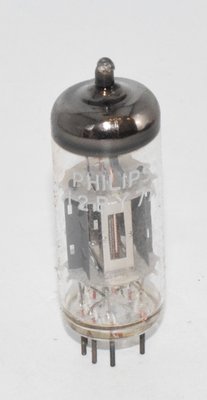
The 12BY7-A (also written 12BY7A) is a miniature power pentode originally designed by General Electric for use as a video output amplifier in television receivers. Introduced in the mid-1950s (the GE datasheet ET-T943 is dated June 1955), the tube was engineered to deliver extremely high transconductance, low interelectrode capacitances, and high power sensitivity — all critical requirements for wideband video amplification in the television sets of the era.
The 12BY7-A is an improved version of the earlier 12BY7, being electrically and mechanically interchangeable with it. The key improvement in the "-A" variant is a controlled heater warm-up characteristic, which made the tube particularly well-suited for television receivers employing series-connected heaters. When used alongside other 600-milliampere heater types exhibiting similar warm-up behavior, heater voltage surges across individual tubes are minimized during the warm-up period, improving reliability and extending tube life.
Manufactured by virtually every major tube producer — including General Electric, RCA, Sylvania, Philips (Miniwatt), Amperex, Mullard, and numerous others — the 12BY7-A became one of the most widely produced miniature pentodes of the television age. Millions were manufactured throughout the 1950s and 1960s. While its original application was strictly in video amplification, the tube has found a vibrant second life in the audio community, particularly as a driver tube in guitar amplifiers.
2. Technical Specifications and Design
General Description
- Type: Miniature Power Pentode
- Cathode: Coated, Unipotential (indirectly heated)
- Intended Service: TV Video Output Amplifier
- Mounting Position: Any
Mechanical Data
- Envelope: T-6½, Glass
- Base: E9-1, Small Button 9-Pin (Noval / B9A)
- RETMA Basing: 9BF
- Outline: RETMA 6-3
- Maximum Diameter: 7/8 inch (approximately 22 mm)
- Maximum Seated Height: 2-3/8 inch (approximately 60 mm)
- Maximum Overall Height: 2 inches + 1-3/32 inch (approximately 78 mm total)
Heater Ratings
| Parameter | Series Connection | Parallel Connection |
|---|---|---|
| Heater Voltage (AC or DC) | 12.6 V | 6.3 V |
| Heater Current | 0.3 A | 0.6 A |
| Heater Warm-up Time* | — | 11 Seconds |
* Heater warm-up time is defined as the time required in a specified test circuit for the voltage across the heater terminals to increase from zero to the heater test voltage (V₁). For this type, E = 25 volts (RMS or DC), V₁ = 5.0 volts (RMS or DC), and R = 31.5 ohms.
Direct Interelectrode Capacitances (without external shield)
- Grid-Number 1 to Plate (Cga), maximum: 0.063 pF
- Input (Cgk): 10.2 pF
- Output (Cak): 3.5 pF
Maximum Ratings (Design-Center Values)
| Parameter | Value |
|---|---|
| Plate Voltage | 300 V |
| Screen Voltage (Grid-Number 2) | 180 V |
| Positive DC Grid-Number 1 Voltage | 0 V |
| Negative DC Grid-Number 1 Voltage | 50 V |
| Plate Dissipation | 6.5 W |
| Screen Dissipation (Grid-Number 2) | 1.1 W |
| Heater-Cathode Voltage (Heater Positive w.r.t. Cathode) | 200 V |
| Heater-Cathode Voltage (Heater Negative w.r.t. Cathode) | 200 V |
| Grid-Number 1 Circuit Resistance (Fixed Bias) | 0.25 MΩ |
| Grid-Number 1 Circuit Resistance (Cathode Bias) | 1.0 MΩ |
Note: The TDSL reference data lists maximum plate voltage as 330 V and maximum screen voltage as 190 V, with screen dissipation of 1.2 W. The GE datasheet specifies 300 V, 180 V, and 1.1 W respectively. These minor differences likely reflect different manufacturers' ratings or absolute maximum vs. design-center values. Designers should consult the specific manufacturer's datasheet for the tubes they are using.
Characteristics and Typical Operation — Class A₁ Amplifier
| Parameter | Value |
|---|---|
| Plate Voltage | 250 V |
| Screen Voltage (Grid-Number 2) | 180 V |
| Suppressor (Grid-Number 3) | Connected to Cathode at Socket |
| Cathode-Bias Resistor | 100 Ω |
| Plate Resistance (rp), approximate | 0.093 MΩ (93,000 Ω) |
| Transconductance (gm) | 11,000 µmhos (11.0 mA/V) |
| Plate Current (Ib) | 26 mA |
| Screen Current (Ic2) | 5.75 mA |
| Grid-Number 1 Voltage (approx., at Ig = 20 µA) | −11.6 V |
| Triode Amplification Factor (µ) | 28.5 |
Pin Connections (Bottom View of Socket)
| Pin | Connection |
|---|---|
| 1 | Cathode |
| 2 | Grid Number 1 (Control Grid) |
| 3 | Internal Shield and Grid Number 3 (Suppressor) |
| 4 | Heater |
| 5 | Heater |
| 6 | Heater Center-Tap |
| 7 | Plate (Anode) |
| 8 | Grid Number 2 (Screen) |
| 9 | Internal Shield and Grid Number 3 (Suppressor) |
The basing follows the RETMA 9BF designation. Note that the suppressor grid and internal shield are brought out to two pins (3 and 9), which should both be connected to cathode at the socket for proper operation and shielding. The heater center-tap on pin 6 allows the tube to be operated at either 12.6 V (using pins 4 and 5) or 6.3 V (connecting pins 4 and 5 in parallel, with pin 6 as the common return).
3. Applications and Usage
Original Television Application
The 12BY7-A was designed specifically as a video output amplifier in television receivers. Its extraordinarily high transconductance of 11,000 µmhos made it ideal for driving the relatively low-impedance loads presented by CRT cathode circuits, while its low grid-to-plate capacitance of only 0.063 pF ensured stable wideband operation without excessive Miller effect. The combination of high gain and low capacitance allowed television designers to achieve the wide bandwidth necessary for good picture quality (typically 3–4 MHz in the video amplifier stage).
The controlled heater warm-up characteristic of the "-A" version was specifically engineered for series-string heater configurations common in AC/DC television receivers, where all tube heaters were connected in series across the mains supply. Without controlled warm-up, tubes with faster-heating filaments would see excessive voltage across their heaters until the slower tubes warmed up, leading to premature heater failure.
RF and IF Amplification
The 12BY7-A's high transconductance and low capacitances also made it useful in certain RF and IF amplifier applications, particularly in amateur radio equipment. Several commercial amateur radio receivers and transmitters of the 1950s and 1960s employed the 12BY7-A or its 6.3V equivalent as an IF amplifier or as a driver stage.
Guitar Amplifiers
Perhaps the most enduring application of the 12BY7-A has been in guitar amplifiers, most notably in certain Fender amplifier models. The tube's high gain and ability to drive power tubes effectively made it an excellent choice as a driver/phase-inverter tube in push-pull amplifier circuits. Its use in this role will be discussed in greater detail in the audio community section below.
4. Sound Characteristics
The 12BY7-A has a distinctive sonic signature that sets it apart from the more commonly discussed small-signal tubes like the 12AX7 or 12AT7. Its sound characteristics are shaped by its fundamental design as a high-transconductance pentode with very high gain capability.
Clean Tones
When operated within its linear region, the 12BY7-A delivers a bold, punchy, and dynamically responsive clean tone. The extremely high transconductance (11,000 µmhos) means the tube responds very quickly and decisively to input signals, producing a sound that players and engineers often describe as having excellent attack and transient response. Clean tones tend to have a full-bodied, slightly forward midrange character with tight, well-defined bass. The high-frequency response is crisp without being harsh, a legacy of the tube's wideband video amplifier heritage.
Overdrive and Distortion
When pushed into overdrive, the 12BY7-A produces a thick, aggressive, and harmonically rich distortion character. As a pentode, its clipping behavior differs fundamentally from triode-based preamp tubes. The distortion tends to be harder-edged and more compressed than triode distortion, with a greater proportion of odd-order harmonics. This gives overdriven tones a grittier, more aggressive texture that many rock and blues players find appealing. The transition from clean to distorted is relatively abrupt compared to triodes, which contributes to a "snappier" feel under the fingers.
Dynamic Response
Players frequently note the 12BY7-A's exceptional touch sensitivity and dynamic range. The tube responds expressively to picking dynamics — light picking yields clean, articulate tones while harder attack drives the tube into a satisfying crunch. This dynamic behavior is partly attributable to the tube's sharp transfer characteristics, as visible in the datasheet's transfer curves.
Comparison to Common Preamp Tubes
Compared to the ubiquitous 12AX7, the 12BY7-A sounds bolder, more direct, and less "refined" in the traditional hi-fi sense. Where the 12AX7 offers smooth, gradually increasing distortion with predominantly even-order harmonics, the 12BY7-A delivers a more immediate, punchy, and raw character. It lacks the soft, warm compression of triode preamp tubes but compensates with superior transient speed and a more visceral, "in-your-face" presentation.
Microphonics and Noise
Being a pentode with relatively high gain, the 12BY7-A can be somewhat microphonic, particularly in high-gain audio applications for which it was not originally designed. Careful tube selection and the use of damping rings can mitigate this. Noise performance varies significantly between manufacturers and production eras — NOS examples from Philips, Amperex, and GE are generally regarded as quieter and more consistent than later production tubes.
5. Equivalent or Substitute Types
The following tubes are related to the 12BY7-A, but care must be taken when substituting, as not all are true drop-in replacements:
Direct Replacement
- 12BY7: The original version without the controlled heater warm-up characteristic. Electrically and mechanically identical to the 12BY7-A; the 12BY7-A is a direct drop-in replacement for the 12BY7. The reverse substitution (12BY7 for 12BY7-A) is acceptable in most audio applications but may not be ideal in series-string heater television circuits.
Different Rating Substitutes (NOT Drop-In)
The following types are related but have different ratings, pinouts, or operating parameters. They should not be considered direct drop-in replacements without careful circuit analysis:
- 12BV7: A similar high-transconductance pentode with different operating characteristics. Not a direct substitute without circuit modifications.
- 12DQ7: Another TV video amplifier pentode with different ratings. Verify pinout and operating conditions before substituting.
- 7733: An industrial/professional version with potentially different specifications. Check datasheet carefully before use.
- EL180: The European designation for a related type. Different rating parameters apply; not a direct drop-in replacement.
6.3V Heater Equivalents
The 12BY7-A can be operated at 6.3V by connecting the heater pins in parallel (pins 4 and 5 tied together, with pin 6 as the return). In circuits designed for 6.3V heater supplies, the tube functions identically. Some related 6.3V-only types may exist under different designations depending on the manufacturer.
Important Note: When substituting any tube, always verify the pinout, heater requirements, maximum ratings, and bias conditions against the specific manufacturer's datasheet. Even tubes listed as "equivalents" in substitution guides may have subtle differences in maximum ratings or interelectrode capacitances that affect circuit performance.
6. Notable Characteristics
Exceptionally High Transconductance
At 11,000 µmhos (11.0 mA/V), the 12BY7-A boasts one of the highest transconductance figures of any miniature receiving tube. This is roughly 7× higher than a 12AX7 (approximately 1,600 µmhos) and significantly higher than most other small-signal pentodes. This extreme transconductance is the tube's defining electrical characteristic and the primary reason for its selection in both video and audio applications.
Very Low Grid-to-Plate Capacitance
The grid-to-plate capacitance of only 0.063 pF is remarkably low, even by pentode standards. This was achieved through careful internal shielding — note that the internal shield is brought out to two separate pins (3 and 9) along with the suppressor grid. This extremely low feedback capacitance ensures stable operation at high frequencies and minimizes Miller effect, making the tube inherently suitable for wideband amplification.
Internal Shielding
The 12BY7-A features an internal electrostatic shield connected to the suppressor grid and brought out to pins 3 and 9. This internal shield is a key design feature that contributes to the tube's low interelectrode capacitances and stable high-frequency performance. For optimal performance, both shield/suppressor pins should be connected to cathode at the socket.
Controlled Heater Warm-Up
The controlled heater warm-up characteristic (11 seconds to reach test voltage in the specified circuit) was a significant reliability improvement for series-string heater applications. This feature distinguishes the 12BY7-A from the original 12BY7 and was important enough to warrant a new type designation.
High Plate Resistance
The plate resistance of approximately 93,000 Ω (0.093 MΩ) is characteristic of a pentode and means the tube behaves as a relatively high-impedance current source. This high plate resistance, combined with the high transconductance, yields the triode amplification factor (µ) of 28.5 (since µ = gm × rp = 11,000 × 10⁻⁶ × 93,000 ≈ 1,023 — note that the triode µ of 28.5 listed in the datasheet refers to the triode-connected amplification factor, not the pentode µ, which would be much higher).
Moderate Power Handling
With a maximum plate dissipation of 6.5 W and screen dissipation of 1.1 W, the 12BY7-A sits in an interesting middle ground between small-signal preamp tubes and true power tubes. It can handle significantly more power than a 12AX7 (rated at approximately 1.2 W plate dissipation) while remaining in the miniature 9-pin envelope. This moderate power capability makes it useful as a driver tube capable of delivering substantial voltage swing to power tube grids.
Manufacturer Variations
The 12BY7-A was produced by numerous manufacturers worldwide, and sonic differences between brands are well-documented by audio enthusiasts. NOS (New Old Stock) examples from premium manufacturers such as Philips, Amperex (Bugle Boy), GE, RCA, and Sylvania are particularly sought after. Construction details — plate material, grid winding pitch, getter type and placement, and internal shield design — vary between manufacturers and can influence both electrical performance and sonic character.
7. Usage in the Audio Community
Guitar Amplifiers — The Fender Connection
The 12BY7-A is most famously associated with certain Fender guitar amplifier models from the late 1950s and 1960s. Fender used the 12BY7-A (and the earlier 12BY7) as a first-stage amplifier/driver tube in several amplifier designs, taking advantage of its high transconductance to provide substantial voltage gain in a single stage. The tube's ability to deliver high gain with excellent bandwidth made it an ideal front-end tube for guitar amplifiers where a strong, dynamic signal was needed to drive subsequent stages.
Notable Fender amplifiers that used the 12BY7/12BY7-A include certain versions of the Fender Pro and other professional-series models. In these circuits, the 12BY7-A typically operates as a pentode voltage amplifier, providing significantly more gain than a triode preamp stage would deliver. This high gain contributes to the distinctive tonal character of these amplifiers — a bold, aggressive sound with excellent note definition and dynamic response.
Hi-Fi and Audiophile Applications
While less common in high-fidelity audio than in guitar amplification, the 12BY7-A has found niche applications in audiophile equipment. Some DIY amplifier builders have experimented with the tube as a driver stage in power amplifier designs, exploiting its high transconductance to achieve excellent drive capability for power tubes such as the EL34, 6L6, or KT88. The tube's wideband characteristics — a direct result of its video amplifier heritage — translate into excellent high-frequency extension and transient response in audio circuits.
In phono preamplifier and line-stage applications, the 12BY7-A is occasionally used by adventurous designers seeking a different tonal palette from the standard 12AX7/12AU7/12AT7 family. Its pentode operation offers higher gain per stage, and the sonic character — more immediate and dynamic than typical triode stages — appeals to listeners who prefer a more vivid, less "romanticized" presentation of music.
Tube Rolling and NOS Market
The 12BY7-A has developed a dedicated following among tube rollers — enthusiasts who swap different tube brands and vintages to fine-tune the sound of their amplifiers. Because the tube was produced in enormous quantities for the television industry, NOS examples remain relatively available and affordable compared to more sought-after audio tubes like the 12AX7 or EL34.
Among the most prized NOS examples are:
- Philips / Amperex (Holland): Known for a smooth, detailed sound with excellent dynamics. Philips NOS 12BY7-A tubes are particularly well-regarded.
- GE (USA): Valued for reliability and a bold, punchy tonal character. GE was the original designer of the type.
- RCA (USA): Appreciated for a warm, full-bodied sound with smooth highs.
- Sylvania (USA): Known for clarity and detail, with a slightly brighter tonal balance.
- Miniwatt (Philips brand): Essentially Philips production under a different brand name; equally well-regarded.
Practical Considerations for Audio Use
When using the 12BY7-A in audio circuits, several practical considerations apply:
- Shielding: Both suppressor/shield pins (3 and 9) should be connected to cathode for optimal noise performance and stability.
- Bias: The tube operates with relatively low grid bias voltages (approximately −11.6 V at the typical operating point). A 100 Ω cathode resistor provides appropriate self-bias at the standard operating conditions.
- Screen Supply: The screen voltage must be carefully regulated and should not exceed 180 V (design-center maximum). Screen dissipation is limited to 1.1 W, so proper screen resistor values must be calculated to prevent exceeding this limit.
- Microphonics: As with any high-gain tube used in audio, microphonic sensitivity should be tested. Rubber damping rings and careful mechanical mounting can help.
- Grid Resistor: With fixed bias, the grid circuit resistance should not exceed 0.25 MΩ; with cathode bias, up to 1.0 MΩ is permissible.
DIY and Modification Community
The 12BY7-A has attracted interest from the DIY audio community for several reasons: its unique sonic character, its relative affordability in NOS form, its high gain capability in a single stage, and the engineering challenge of designing audio circuits around a tube originally intended for video service. Online forums and communities dedicated to tube audio frequently feature discussions of 12BY7-A-based amplifier designs, modifications to vintage Fender amplifiers using this tube, and comparative listening tests between different manufacturers' versions.
The tube's combination of high transconductance, moderate power handling, and compact 9-pin miniature format makes it a versatile building block for creative amplifier designers who are willing to look beyond the conventional audio tube types.