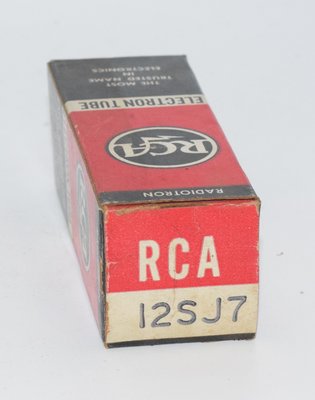
1. Introduction and History
The 12SJ7 is a sharp-cutoff pentode vacuum tube that emerged during the golden age of tube electronics in the mid-20th century. Originally developed for radio and audio applications, the 12SJ7 gained recognition as a versatile amplification device capable of delivering robust performance across multiple frequency ranges. The tube designation follows the RMA (Radio Manufacturers Association) numbering system, where the "12" indicates a 12-volt heater design, making it suitable for both AC and battery-powered applications.
The 12SJ7 was manufactured by numerous companies including RCA, Sylvania, GE (General Electric), Mullard, and Telefunken, establishing itself as a reliable workhorse in both professional and consumer electronics throughout the 1940s, 1950s, and 1960s. Its reputation for durability and consistent performance made it a favorite among equipment designers seeking dependable amplification stages.
2. Technical Specifications and Design
Basic Tube Characteristics
| Parameter | Value |
|---|---|
| Tube Type | Sharp-Cutoff Pentode |
| Heater Voltage | 12.6V AC/DC |
| Heater Current | 150mA (0.15A) |
| Maximum Plate Voltage | 330V |
| Maximum Plate Dissipation | 1.75W |
| Maximum Screen Grid Voltage | 330V |
| Maximum Screen Dissipation | 0.5W |
| Typical Plate Current | 50mA |
| Typical Screen Current | 8mA |
| Amplification Factor (μ) | 1400-1800 |
| Plate Resistance (rp) | Approximately 0.8MΩ |
| Transconductance (gm) | 4000-5000 μmhos |
| Number of Grids | 3 (Control Grid, Screen Grid, Suppressor Grid) |
| Socket Type | Octal (8-pin) |
Structural Design
The 12SJ7 features a traditional octal base configuration with eight pins arranged in a circular pattern. The tube employs an indirectly heated cathode design, allowing for AC or DC heater operation without introducing hum into the audio signal path—a critical advantage in audio applications.
The pentode configuration includes five active elements: the cathode, control grid, screen grid, suppressor grid, and plate (anode). This multi-grid design enables exceptional control over electron flow, resulting in high gain and excellent linearity compared to simpler triode designs. The sharp-cutoff characteristic means the tube exhibits minimal plate current when the control grid is biased to cutoff, making it ideal for RF amplification and audio pre-amplification stages.
Pin Configuration
The octal base pinout is as follows:
- Pin 1: Plate (Anode)
- Pin 2: Suppressor Grid (Grid 3)
- Pin 3: Screen Grid (Grid 2)
- Pin 4: Cathode
- Pin 5: Cathode
- Pin 6: Control Grid (Grid 1)
- Pin 7: Heater
- Pin 8: Heater
- Center Pin: Mechanical Alignment Key
3. Applications and Usage
Historical Applications
The 12SJ7 found widespread use in mid-20th century consumer and professional electronics:
- Radio Receivers: Served as an IF (Intermediate Frequency) amplifier in AM/FM radio sets, providing stable gain and selectivity.
- Television: Utilized in video amplification circuits and AGC (Automatic Gain Control) stages.
- Audio Equipment: Employed in microphone preamplifiers, mixing consoles, and early tape recorder amplification stages.
- Military and Professional Equipment: Used in test equipment, radar systems, and communication devices requiring reliable RF amplification.
Modern Applications
Today, the 12SJ7 enjoys renewed interest among vintage equipment enthusiasts, audio restoration specialists, and tube amplifier designers:
- Tube Amplifier Restoration: Essential for restoring vintage guitar and audio amplifiers to original specifications.
- Preamplifier Design: Valued in custom tube preamplifiers where its high gain and low noise characteristics enhance signal quality.
- Vintage Equipment Repair: Critical replacement component for restoring 1940s-1960s radio and audio equipment.
- Experimental Audio Projects: Chosen by DIY enthusiasts for building custom amplifiers and audio circuits.
4. Sound Characteristics of the 12SJ7
Audio Signature
The 12SJ7 possesses distinctive sonic qualities that have made it prized among audio professionals and enthusiasts. When properly biased and operated within its design parameters, the tube delivers:
Frequency Response and Tonal Balance
The 12SJ7 exhibits a relatively flat frequency response across the audio spectrum (20Hz-20kHz), with a slight presence peak in the upper midrange (2-5kHz). This characteristic makes it particularly effective at conveying vocal clarity and instrumental detail. The tube's natural roll-off above 15kHz imparts a smooth, refined quality to high frequencies without introducing harshness or fatigue—a quality highly valued in audio applications.
Harmonic Content
The pentode configuration of the 12SJ7 generates harmonic distortion predominantly in the 2nd and 3rd harmonics when driven moderately hard, creating a musically pleasant coloration rather than harsh distortion. This natural harmonic enhancement adds warmth and presence to audio signals, which many listeners find more engaging than the clinical accuracy of solid-state amplification. At low signal levels, harmonic distortion remains minimal, preserving signal integrity for delicate audio material.
Dynamics and Transient Response
The 12SJ7's high transconductance enables rapid transient response, allowing the tube to faithfully reproduce quick attack characteristics of percussion instruments and plucked strings. The tube's inherent compression characteristics are gentle and musical, imparting a subtle "glue" to audio that enhances cohesion without sacrificing dynamic range.
Noise Performance
Well-manufactured 12SJ7 tubes, particularly NOS (New Old Stock) examples from reputable manufacturers like RCA, exhibit excellent noise characteristics with noise floor typically below -80dB. This low-noise performance makes the 12SJ7 ideal for microphone preamplifier applications where noise performance is critical.
Impedance Characteristics
The 12SJ7's relatively high plate resistance (approximately 0.8MΩ) requires careful output transformer design or coupling network implementation. When properly coupled, this impedance characteristic contributes to the tube's ability to drive capacitive loads and maintain stability across complex audio circuits.
5. The 12SJ7 in the Audio Community
Tube Audio Enthusiast Culture
The 12SJ7 holds a special place in the tube audio community, particularly among vintage audio restoration specialists and high-end audio designers. Its reputation for combining high gain with musical character has made it a sought-after component for custom amplifier projects.
Preamplifier Applications
Audio engineers frequently specify the 12SJ7 in tube microphone preamplifiers and line-level preamps. The combination of high gain (approximately 600-700V/V in typical configurations), low noise, and musical harmonic character makes it ideal for capturing and enhancing vocal and instrumental recordings. Many professional recording studios maintain stocks of NOS 12SJ7 tubes specifically for maintaining vintage equipment and designing new pieces with vintage-inspired character.
Guitar and Bass Amplification
While less common than 12AX7 or EL84 tubes in guitar amplifiers, the 12SJ7 appears in select vintage amplifiers and has gained interest among boutique amplifier manufacturers seeking alternative gain stages with unique sonic characteristics. The tube's natural harmonic generation appeals to musicians seeking organic overdrive and sustain characteristics.
Collector and Restoration Community
The vintage radio and audio equipment restoration community considers the 12SJ7 an essential tube type. Collectors of 1940s-1960s radio receivers, tape recorders, and audio amplifiers rely on NOS 12SJ7 tubes to restore equipment to original performance specifications. The tube's widespread original use means many restoration projects require multiple examples in good condition.
Market and Availability
NOS 12SJ7 tubes remain available from specialized tube retailers, though quality varies significantly. RCA-branded examples command premium prices due to RCA's reputation for consistent manufacturing and superior performance. Mullard and Telefunken examples also maintain strong collector interest. Prices for premium NOS tubes typically range from $15-40 per tube, reflecting the rarity of high-quality examples.
Design Philosophy
Contemporary tube audio designers often choose the 12SJ7 specifically for its "vintage sound" characteristics. The tube embodies design philosophy from an era when tonal coloration and musicality were prioritized over technical specifications. This philosophical alignment has made the 12SJ7 a natural choice for designers creating modern equipment with vintage-inspired sonic character.
6. Equivalent or Substitute Types
Direct Equivalents
- 12SJ7GT: Glass version of the same tube with identical electrical characteristics (GT = Glass Tubular).
- 12SJ7-A: Improved version with enhanced specifications and extended lifespan.
Functional Substitutes
- 12SK7: Similar pentode with slightly different characteristics; can substitute in many applications but with different gain and frequency response.
- 6SJ7: 6.3V heater version of the same tube design; electrically equivalent when heater supply is adjusted.
- 6SJ7GT: Glass version of the 6SJ7.
Approximate Substitutes
- 12AX7: Higher-gain triode; cannot directly substitute but can replace in some preamplifier applications with circuit modifications.
- EF86: European pentode with similar characteristics; popular substitute in audio applications with appropriate biasing.
Important Note: Substituting tube types requires careful consideration of heater voltage, pin configuration, and operating parameters. Always consult original equipment specifications and tube data sheets before attempting substitutions.
7. Notable Characteristics and Considerations
Advantages
- High gain (approximately 600-700V/V in typical audio configurations)
- Excellent linearity and low distortion at normal operating levels
- Low noise floor suitable for critical audio applications
- Musical harmonic character valued in audio applications
- Robust construction with excellent reliability
- Wide availability of NOS examples from reputable manufacturers
- Versatile frequency response suitable for audio and RF applications
Limitations
- Requires precise biasing for optimal performance
- Higher plate resistance necessitates careful output coupling design
- Relatively high plate dissipation limits power output compared to output tubes
- Microphonic characteristics can be problematic in sensitive applications (mechanical vibration sensitivity)
- NOS tube quality varies significantly; careful selection from reputable sources is essential
Operating Considerations
For optimal performance, the 12SJ7 should be operated with proper heater voltage (12.6V ±5%), screen grid voltage regulation, and appropriate load impedance (typically 100kΩ-1MΩ). Plate voltage should not exceed 330V, and the tube should never be operated without adequate load impedance to prevent plate damage.
When used in audio applications, the 12SJ7 benefits from quality output coupling components and careful circuit layout to minimize microphonic effects. Many audio professionals prefer to use the 12SJ7 in circuits that mechanically isolate the tube from vibration sources.
Conclusion
The 12SJ7 represents a pinnacle of mid-20th century tube design, combining high gain, low noise, and musical character in a robust, reliable package. Its continued relevance in modern audio applications—from vintage equipment restoration to contemporary high-end audio design—testifies to the enduring qualities of well-engineered tube technology. For audio professionals and enthusiasts seeking authentic vintage character combined with technical excellence, the 12SJ7 remains an outstanding choice. When sourcing examples, prioritize NOS tubes from reputable manufacturers such as RCA, ensuring maximum performance and reliability for critical audio applications.