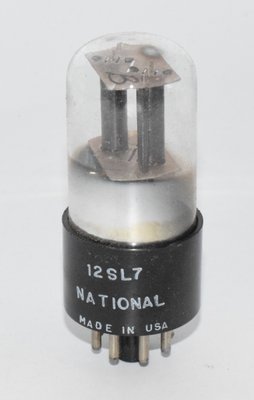
1. Introduction and History
The 12SL7 is a medium-mu dual triode vacuum tube that emerged during the golden age of tube electronics in the mid-20th century. Developed as an improved variant in the 12-volt heater series, the 12SL7 represents a significant advancement in triode design, offering superior performance characteristics compared to its predecessors. The tube was engineered to provide excellent linearity, low distortion, and robust construction suitable for both consumer and professional audio equipment.
The designation "12SL7" breaks down as follows: the "12" indicates a 12-volt heater supply requirement, "S" denotes a medium-mu triode configuration, "L" signifies a loctal base (an improvement over older designs), and "7" is simply the type identifier. This tube gained particular popularity in the 1950s and 1960s, appearing in high-quality amplifiers, preamps, and audio equipment where fidelity was paramount.
2. Technical Specifications and Design
Physical Characteristics
- Tube Type: Dual Triode (Two independent triodes in one envelope)
- Base Type: Loctal (8-pin base with center key)
- Bulb Style: ST (straight glass envelope)
- Overall Height: Approximately 3.75 inches (95mm)
- Heater Voltage: 12.6V AC or DC
- Heater Current: 300mA per triode (600mA total)
Electrical Specifications
- Maximum Plate Voltage: 660V DC
- Maximum Plate Dissipation: 2.5W per triode
- Amplification Factor (μ): 70 (medium-mu)
- Plate Resistance (rp): Approximately 10,000 ohms
- Transconductance (gm): Approximately 7,000 microhos
- Grid Bias for Class A Operation: -2 to -8V depending on application
Design Features
The 12SL7 features a carefully engineered internal structure with robust cathodes, nickel-plated grids, and precision-wound heater coils. The dual-triode configuration allows for balanced operation in push-pull amplifier stages or independent use of each triode for different circuit functions. The medium-mu rating (amplification factor of 70) provides an optimal balance between voltage gain and linearity, making it particularly suitable for driver stages and high-fidelity preamplifier applications.
The loctal base design incorporates a center key that prevents incorrect insertion, a safety feature that was revolutionary for its time. The internal construction includes mica spacers that maintain precise electrode spacing, critical for stable operation and low microphonics. Quality examples feature oxide-coated cathodes that provide excellent emission stability over extended service life.
3. Applications and Usage
Traditional Applications
The 12SL7 was originally designed for use in:
- Radio receivers as intermediate frequency (IF) amplifiers
- Preamplifier stages in tube-based audio equipment
- Driver stages in push-pull power amplifier configurations
- Phase inverter circuits in audio amplifiers
- Cathode follower (buffer) stages
- Oscillator circuits in vintage test equipment
Audio Community Usage
In contemporary audio enthusiast circles, the 12SL7 occupies a special niche as a premium preamp tube and driver tube. High-end audio designers favor the 12SL7 for several compelling reasons:
Preamp Applications: The 12SL7 is highly sought after for use in tube preamplifiers, where its low noise floor, excellent linearity, and smooth frequency response characteristics contribute to transparent signal reproduction. Many vintage preamps from the 1950s-1970s employed 12SL7s in their first gain stages, and contemporary tube preamp designers continue to specify this tube for new designs.
Driver Stages: Audio amplifier designers use the 12SL7 as a driver tube feeding the grids of power tubes (such as EL84, 6L6, or 300B). The tube's moderate gain and excellent linearity make it ideal for this critical stage, where it must deliver sufficient voltage swing to fully drive power tubes while maintaining minimal distortion.
Restoration and Vintage Equipment: Audiophiles restoring vintage tube equipment frequently seek NOS (New Old Stock) 12SL7 tubes, as original equipment often employed this tube type. The sonic character of original tubes is prized by vintage enthusiasts who value authenticity and the particular sonic signature of equipment as originally designed.
DIY Tube Audio Projects: The tube's availability, relatively modest power requirements, and excellent performance characteristics make it popular in DIY audio projects, from simple tube preamps to more complex integrated amplifier designs.
4. Sound Characteristics
Tonal Profile
The 12SL7 is renowned in the audio community for its refined, articulate sonic character. When properly implemented, the tube exhibits several desirable acoustic properties:
Midrange Clarity: The 12SL7 delivers exceptional midrange definition with excellent vocal reproduction. The medium-mu design contributes to a naturally linear frequency response in the critical midband region, resulting in clear, present vocals and instruments without excessive coloration.
Bass Response: The tube produces tight, well-defined bass with good transient response. The relatively low plate resistance contributes to good damping characteristics when used as a driver tube, resulting in controlled low-frequency reproduction without bloat or excessive resonance.
Treble Extension: High-frequency response is smooth and extended, with minimal harshness or grain. The tube's low-noise characteristics mean that fine detail and high-frequency nuances are preserved without introducing hiss or background noise.
Dynamics and Transients: The 12SL7 excels at reproducing dynamic contrasts and transient information. The tube responds quickly to signal changes, contributing to a sense of immediacy and liveliness in musical reproduction.
Harmonic Character
The 12SL7 produces a musically pleasing harmonic signature with predominantly even-order harmonics when operated in linear regions. This characteristic contributes to a warm, slightly euphonic quality that many audiophiles find engaging. The harmonic distortion is minimal when the tube is operated within its rated parameters, and the distortion products that do occur are of a character that is generally perceived as musical rather than fatiguing.
Noise and Microphonics
Quality 12SL7 examples exhibit exceptionally low noise floors, making them ideal for sensitive preamp applications. The robust internal construction of well-made examples results in low microphonic sensitivity, meaning the tube is relatively immune to vibration-induced noise—an important characteristic for audio applications.
5. Equivalent or Substitute Types
Several tubes can serve as substitutes or equivalents for the 12SL7, though each brings slightly different characteristics:
- 12AU7: A lower-mu version with higher plate current capability. More commonly available, but with different gain characteristics. Can be used in some applications but may require circuit modifications.
- 12AT7: A higher-mu triode with lower plate current rating. Provides more voltage gain but is less suitable for driver applications requiring higher current capacity.
- 6SN7: A directly heated triode with similar electrical characteristics but different heater requirements (6.3V, 900mA). Offers similar sonic character but requires different circuit design.
- ECC33: A European equivalent dual triode with similar specifications, sometimes used as a substitute though less commonly available.
Important note: Substitution should only be attempted by experienced tube technicians, as improper substitution can result in circuit malfunction or component damage.
6. Notable Characteristics
- Reliability: The 12SL7 is known for exceptional longevity. Many examples from the 1950s remain fully functional, with some showing minimal aging characteristics.
- Availability of NOS Stock: Despite being discontinued from manufacture decades ago, quality NOS examples remain available, though prices have risen significantly due to collector demand.
- Manufacturing Variations: Different manufacturers (RCA, Sylvania, GE, Mullard, etc.) produced tubes with subtle sonic differences, leading to ongoing discussion among audiophiles about preferred variants.
- Heater Polarity Tolerance: The 12SL7 can operate with either AC or DC heater supply, offering flexibility in circuit design.
- Rugged Construction: The loctal base and internal support structure make the 12SL7 mechanically robust, suitable for equipment that may be subject to vibration or movement.
Conclusion
The 12SL7 represents a pinnacle of mid-20th century triode design, combining excellent electrical characteristics with refined sonic properties. Whether in original vintage equipment or contemporary audio designs, this tube continues to deliver transparent, articulate performance that satisfies demanding audiophiles. The combination of technical excellence, sonic character, and historical significance ensures that the 12SL7 will remain a valued component in tube audio for generations to come.