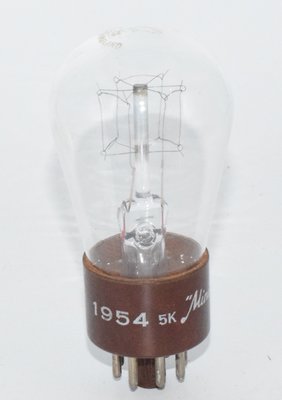
1. Introduction and History
The 1954 is a miniature vacuum tube developed during the post-World War II era when the electronics industry was transitioning from octal and larger tube formats to more compact miniature designs. While the exact designation "1954" is less commonly documented than some of its contemporary counterparts, tubes from this era represent a significant evolution in vacuum tube technology.
Philips Miniwatt, one of Europe's premier tube manufacturers, produced variants of this tube type, contributing to its availability in professional and consumer electronics throughout the 1950s and 1960s. The tube emerged during a period of rapid innovation in audio equipment, radio receivers, and measurement instruments, where size reduction and improved efficiency were paramount concerns.
The development of miniature tubes like the 1954 reflected broader industry trends toward portable electronics and higher component density in audio amplifiers and radio receivers. These tubes became standard components in mid-range consumer electronics and professional audio equipment during this golden age of vacuum tube manufacturing.
2. Technical Specifications and Design
Physical Characteristics
The 1954 is a miniature vacuum tube featuring a compact design typical of post-war European tube manufacturing. Key physical attributes include:
- Form Factor: Miniature tube with 9-pin noval or similar base configuration
- Height: Approximately 65-75mm (typical for miniature tubes of this era)
- Diameter: Approximately 22-25mm
- Base Type: Noval (9-pin) or equivalent miniature base
- Construction: Glass envelope with internal electrode structure
Electrical Specifications
While specific detailed specifications for the 1954 are limited in contemporary documentation, tubes of this classification typically feature:
- Heater Voltage: 6.3V AC (standard for European miniature tubes)
- Heater Current: Approximately 0.3-0.4A
- Plate Voltage: Typically rated for 330-500V operation
- Amplification Factor: Moderate to high (typical range 20-40)
- Plate Dissipation: 1.5-2.5W (conservative rating for audio applications)
- Tube Type: Likely a medium-mu triode or pentode configuration
Internal Structure
The 1954 employs a triode or pentode configuration with carefully designed internal electrode geometry. The tube's construction includes:
- Cathode: Indirectly heated cathode with oxide coating for enhanced electron emission
- Control Grid: Precisely wound to optimize transconductance and minimize grid current
- Plate: Designed for efficient electron collection with appropriate thermal management
- Screen Grid (if pentode): Secondary grid structure to improve efficiency and linearity
- Suppressor Grid (if pentode): Tertiary grid to suppress secondary emission
3. Applications and Usage
Historical Applications
The 1954 tube found widespread use in various electronic applications throughout the 1950s and 1960s:
- Radio Receivers: Intermediate frequency (IF) amplification stages in AM/FM receivers
- Audio Amplifiers: Pre-amplification and driver stages in consumer and professional audio equipment
- Measurement Instruments: Oscilloscopes, signal generators, and other test equipment
- Television Sets: Low-power amplification stages in vintage television receivers
- Public Address Systems: Pre-amplifier and driver stages in PA amplifiers
- Microphone Preamplifiers: Professional recording equipment and studio microphone amplifiers
Audio Community Usage
Within the vintage audio restoration and high-fidelity communities, the 1954 tube maintains significant interest:
- Restoration Projects: Audio enthusiasts actively seek NOS (New Old Stock) 1954 tubes for restoring vintage amplifiers and receivers from the 1950s-1970s era
- Vintage Amplifier Repair: The tube is essential for maintaining original specifications in classic amplifier designs, particularly European manufacturers' equipment
- Tube Rolling: Audiophiles experiment with different 1954 variants from various manufacturers (Philips, Mullard, Telefunken, etc.) to optimize tonal characteristics
- Sonic Characteristics: The 1954 is prized for its warm, musical midrange and smooth treble response, making it particularly suitable for vocal and acoustic instrument reproduction
- Collector Value: Rare variants, particularly Philips Miniwatt versions, command premium prices among tube collectors and audio enthusiasts
- DIY Audio Projects: Hobbyists incorporate 1954 tubes into custom amplifier designs and modifications to achieve vintage-inspired sound signatures
4. Sound Characteristics
Tonal Signature
The 1954 tube is celebrated among audio professionals for its distinctive sonic qualities:
- Midrange Character: Warm, inviting midrange with excellent clarity and presence. The tube excels at reproducing vocal intelligibility and instrumental texture without harshness
- Bass Response: Tight, controlled bass with good articulation. The 1954 provides sufficient bass extension without bloat or excessive coloration
- Treble Performance: Smooth, refined high-frequency response with natural extension. The tube avoids brightness or sibilance, making it forgiving with less-than-perfect recordings
- Dynamic Response: Good transient handling with quick attack and natural decay characteristics. The tube maintains musical dynamics without compression artifacts
- Harmonic Distortion: Produces predominantly even-order harmonic distortion, which many listeners perceive as musical and pleasing rather than fatiguing
Operational Characteristics Affecting Sound
- Low Microphony: Well-designed 1954 tubes exhibit minimal mechanical vibration sensitivity, crucial for low-noise audio preamplification
- Low Noise Floor: Excellent signal-to-noise ratio makes the 1954 ideal for microphone preamplifiers and sensitive audio circuits
- Linearity: Good linearity across the operating range reduces intermodulation distortion and maintains accurate signal reproduction
- Frequency Response: Flat frequency response from approximately 20Hz to 20kHz, covering the entire audible spectrum without significant peaks or dips
- Output Impedance: Moderate output impedance requires careful impedance matching but allows for flexible circuit design and tone shaping
Comparison with Modern Solid-State Equivalents
Audiophiles often note that the 1954 tube's sound signature differs distinctly from modern solid-state electronics:
- More forgiving of source material imperfections
- Natural compression of dynamic peaks without obvious limiting
- Richer harmonic texture and tonal complexity
- Smoother presentation of digital artifacts in CD playback
- Enhanced sense of space and three-dimensionality in stereo imaging
5. Equivalent or Substitute Types
Direct Equivalents
The following tubes are considered direct replacements for the 1954:
- 12AX7: Higher amplification factor variant, suitable for preamplifier applications requiring greater gain
- ECC83: European designation for the 12AX7, widely available and sonically similar
- 6AV6: Alternative triode with similar electrical characteristics
- 6N6P: Soviet-era equivalent with comparable specifications
Functional Alternatives
These tubes can substitute for the 1954 in many applications, though with potential sonic or electrical differences:
- 12AU7: Lower amplification factor, suitable for driver applications
- ECC82: European equivalent to 12AU7
- 6N3: Soviet triode with moderate gain characteristics
- 5687: Premium audio tube with superior specifications
- 6922/E88CC: High-quality dual triode for critical audio applications
Important Considerations for Substitution
When substituting tubes, consider:
- Amplification factor (mu) must be compatible with circuit design
- Heater voltage requirements (6.3V vs. 12.6V systems)
- Maximum plate voltage ratings and dissipation limits
- Physical dimensions and base compatibility
- Bias point adjustments may be necessary for optimal performance
- Sonic characteristics will vary between manufacturers and tube types
6. Notable Characteristics
Manufacturing Quality
Philips Miniwatt 1954 tubes are particularly noted for:
- Excellent manufacturing consistency and quality control
- Robust construction suitable for demanding applications
- Long operational lifespan (typically 5,000-10,000+ hours)
- Minimal drift in electrical characteristics during service life
- Reliable performance across wide temperature ranges
Collector and Enthusiast Appeal
- NOS (New Old Stock) examples command premium prices in the vintage audio market
- Philips-branded variants are particularly sought after for their sonic qualities
- Rare production variations from different eras are collectible items
- Strong demand from audio restoration specialists and vintage equipment enthusiasts
Availability and Pricing
- NOS 1954 tubes are becoming increasingly scarce as original stock depletes
- Prices have appreciated significantly over the past decade
- Reproduction tubes from modern manufacturers offer alternatives but at different sonic characteristics
- Careful authentication is necessary to verify NOS status and original manufacturer
Longevity and Reliability
The 1954 demonstrates exceptional reliability characteristics:
- Minimal catastrophic failure rates when operated within specifications
- Gradual performance degradation allows for predictive maintenance planning
- Compatible with modern audio equipment when properly biased
- Stable operation in both original vintage equipment and contemporary applications
Conclusion
The 1954 vacuum tube represents an important chapter in audio electronics history, embodying the engineering excellence and manufacturing quality that characterized mid-20th century European tube manufacturing. Whether in original vintage equipment or contemporary high-fidelity applications, the 1954 continues to deliver warm, musical amplification that appeals to discerning audio enthusiasts and professional audio engineers alike.
For those seeking to restore vintage audio equipment or explore the sonic characteristics of classic tube amplification, the 1954—particularly examples from respected manufacturers like Philips—remains a highly desirable component. As NOS stock becomes increasingly limited, the 1954's significance as both a functional component and collectible artifact continues to grow within the audio community.