Introduction and History
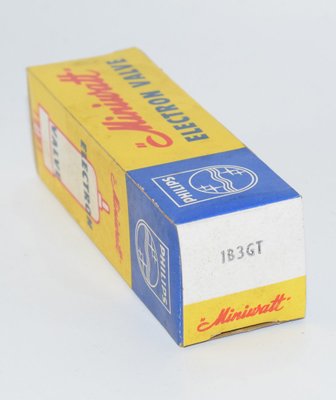
The 1B3-GT is a half-wave rectifier diode designed specifically for high-voltage, low-current applications. Developed during the golden age of television in the late 1940s and 1950s, this tube was engineered to serve as the high-voltage rectifier in television receivers, supplying the anode voltage necessary to accelerate the electron beam in cathode ray picture tubes (CRTs). Manufactured by major companies including General Electric (Owensboro, Kentucky), RCA, Sylvania, Philips/Miniwatt, and many others, the 1B3-GT became one of the most widely produced and universally recognized TV rectifier tubes of its era.
The tube's designation follows the American RETMA naming convention: the "1" indicates a filament voltage of approximately 1.25 volts, the "B" is a sequential design identifier, the "3" denotes the number of useful elements (though as a diode it has two active electrodes, the numbering convention counts differently), and "GT" refers to the "Glass Tubular" envelope style conforming to the T-9 glass envelope standard. The General Electric datasheet (ET-T448D, dated 12-61) provides the definitive specifications for this tube type.
The 1B3-GT was a critical component in virtually every black-and-white television set produced during the 1950s and into the 1960s. Its ability to withstand extremely high peak inverse voltages while operating from a low-voltage filament supply — typically derived from a winding on the flyback transformer — made it ideally suited for this demanding application. The tube remained in widespread service use well into the 1970s as older television sets continued to require replacement parts.
Technical Specifications and Design
General Description
The 1B3-GT is a high-voltage half-wave rectifier diode with a coated filament serving as the cathode. It uses a directly heated cathode design, meaning the filament itself is the electron-emitting element. The plate connection is brought out through a top cap (small cap, type C1-34) to maintain adequate insulation between the high-voltage plate terminal and the low-voltage base pins — a critical safety and performance requirement given the extreme voltages involved.
Filament (Heater) Characteristics and Ratings
| Parameter | Value |
|---|---|
| Cathode Type | Coated Filament (directly heated) |
| Filament Voltage (AC or DC) | 1.25 ±0.2 Volts |
| Filament Current | 0.2 Amperes |
Note: The filament current of 0.2A is specified for a bogey tube at Ef = 1.25 volts. Equipment designers were advised to center the filament voltage at the specified bogey value, with supply variations restricted to maintain filament voltage within the ±0.2V tolerance.
Direct Interelectrode Capacitances (Approximate, Without External Shield)
| Parameter | Value |
|---|---|
| Plate to All (filament + internal shield) | 1.3 pF |
Maximum Ratings — Design-Maximum Values
The 1B3-GT has two distinct sets of maximum ratings depending on the application: Flyback Rectifier service (its primary intended use in television horizontal output circuits) and RF Voltage Rectifier service.
| Parameter | Flyback Rectifier | RF Voltage Rectifier | Units |
|---|---|---|---|
| Peak Inverse Plate Voltage | — | 33,000 | Volts |
| DC Component (Plate Voltage) | 22,000 | — | Volts |
| Total DC and Peak (Plate Voltage) | 26,000 | — | Volts |
| Steady-State Peak Plate Current | 50 | 35 | Milliamperes |
| DC Output Current | 0.5 | 1.1 | Milliamperes |
| Frequency of Supply Voltage — Maximum | — | 100 | Kilocycles |
| Frequency of Supply Voltage — Minimum | — | 1.5 | Kilocycles |
Important: For flyback rectifier service, the duty cycle of the voltage pulse must not exceed 15 percent of one scanning cycle. This specification is defined for operation in a 525-line, 30-frame television system as described in the FCC "Standards of Good Engineering Practice Concerning Television Broadcast Stations."
Note regarding parameters not applicable to this tube type: As a diode (rectifier), the 1B3-GT has no control grid. Therefore, specifications such as amplification factor (μ), transconductance (gm), plate resistance (rp), grid bias range, and maximum plate dissipation in the traditional triode/pentode sense do not apply to this tube. The relevant performance metric is the tube voltage drop.
Average Characteristics
| Parameter | Value |
|---|---|
| Tube Voltage Drop (approximate, at Ib = 7.0 mA) | 100 Volts |
The average plate characteristics curve (provided in the GE datasheet at Ef = 1.25 Volts) shows the relationship between plate voltage and plate current, with the tube exhibiting a forward voltage drop that increases with current. At 7.0 milliamperes of plate current, the approximate tube voltage drop is 100 volts.
Mechanical Specifications
| Parameter | Specification |
|---|---|
| Mounting Position | Any |
| Envelope | T-9, Glass |
| Base | Octal (multiple base variants: B8-6, B6-8, B8-58, B6-60, B5-82, B6-144, B7-166, B7-211; Octal 5, 6, 7, or 8-Pin) |
| Top Cap | C1-34, Small |
| Outline Drawing | EIA 9-51 or 9-52 |
| Maximum Overall Length | 4-1/16 inches |
| Maximum Seated Height | 3-5/16 inches (plus 4-3/16 inches total) |
| Maximum Diameter | 1-3/16 inches |
| Maximum Base Width | 1-9/32 inches |
Pin Connections (EIA 3C Basing — Octal Base, Bottom View)
| Pin | Connection |
|---|---|
| Pin 1 | Internal Connection (IC) |
| Pin 2 | Filament |
| Pin 3 | Internal Connection (IC) |
| Pin 4 | No Connection |
| Pin 5 | Internal Connection (IC) |
| Pin 6 | No Connection |
| Pin 7 | Filament and Internal Shield |
| Pin 8 | Internal Connection (IC) |
| Top Cap | Plate |
Socket wiring notes: Socket terminals 1, 3, 4, 5, 6, and 8 may be connected to terminal 7 or to a corona shield which connects to terminal 7. Terminals 4 and 6 may be used as tie points for components at or near filament potential. The filament connections are pins 2 and 7, with pin 7 also serving as the internal shield connection.
Applications and Usage
Primary Application: Television High-Voltage Rectifier
The 1B3-GT was designed first and foremost as the high-voltage rectifier in television receivers. In a typical television horizontal deflection circuit, the flyback transformer generates a high-voltage pulse during the horizontal retrace interval. The 1B3-GT rectifies this pulse to produce the DC high voltage (typically 10,000 to 20,000 volts in black-and-white sets) required by the CRT's second anode (ultor). The tube's filament is powered by a dedicated low-voltage winding on the flyback transformer, which provides the required 1.25 volts AC.
The circuit topology is elegantly simple: the high-voltage pulse from the flyback transformer is applied to the plate (via the top cap), and the rectified DC output is taken from the filament/cathode side, filtered by a small capacitor (often the internal capacitance of the CRT's aquadag coating), and fed directly to the picture tube's anode connection.
RF Voltage Rectifier
The 1B3-GT also found application as an RF voltage rectifier, where it could operate with supply frequencies between 1.5 and 100 kilocycles. In this service, the tube could handle a peak inverse plate voltage of 33,000 volts and deliver up to 1.1 milliamperes of DC output current. This made it useful in certain test equipment, high-voltage power supplies, and specialized RF applications.
Safety Considerations
The GE datasheet includes an important safety note: the voltages employed in television receivers and other high-voltage equipment are sufficiently high that high-voltage rectifier tubes may produce soft X-rays, which can constitute a health hazard unless the tubes are adequately shielded. Equipment designers were advised to incorporate shielding into their designs, though the datasheet notes that "relatively simple shielding should prove adequate." This X-ray emission concern was a well-known characteristic of high-voltage rectifier tubes operating at voltages above approximately 15,000 volts.
Sound Characteristics
The 1B3-GT is a rectifier diode, not an amplifying tube, and as such it does not have "sound characteristics" in the way that signal tubes (triodes, pentodes) or even power supply rectifiers used in audio amplifiers are typically evaluated. The tube was never designed for, nor commonly used in, audio signal paths.
That said, in the broader context of how rectifier tubes can influence the sonic character of equipment they power:
- Voltage regulation: The 1B3-GT exhibits a relatively high forward voltage drop (approximately 100V at 7mA), and this drop varies with current as shown in the plate characteristics curve. In any theoretical audio application, this would result in relatively soft regulation — meaning the output voltage would sag under load. In audio rectifier terms, this characteristic is sometimes described as contributing to a "softer" or more "compressed" dynamic response, though this description is more relevant to rectifiers like the 5U4, 5AR4, or 5Y3 that are actually used in audio power supplies.
- The tube's extremely low current capability (0.5 mA DC in flyback service, 1.1 mA in RF rectifier service) makes it entirely unsuitable for powering audio amplifier circuits, which typically require tens or hundreds of milliamperes of B+ current.
- Filament characteristics: The directly heated filament cathode, operating at only 1.25V and 0.2A (0.25 watts), means the tube has very low thermal mass and reaches operating temperature quickly, but also means it was designed for a very specific, low-power application environment.
In summary, the 1B3-GT does not have meaningful "sound characteristics" because it was not designed for audio use and its electrical ratings make it impractical for audio power supply applications. Any sonic evaluation would be purely academic.
Equivalent or Substitute Types
The 1B3-GT belongs to a family of high-voltage television rectifier diodes. The following types are generally considered equivalent or closely related substitutes:
| Type | Relationship | Notes |
|---|---|---|
| 1B3-GT / 1B3GT | Identical | Same tube, different formatting of the type designation |
| 1G3-GT / 1G3GT | Near equivalent | Similar high-voltage rectifier; verify ratings for specific application. Often listed as a direct substitute in service literature. |
| 1K3-GT / 1K3GT | Near equivalent | Another member of the same family of TV HV rectifiers. Check peak inverse voltage ratings for your specific application. |
| 1J3 / 1J3GT | Near equivalent | Similar type; confirm pin compatibility and voltage ratings. |
| 1B3 (without GT suffix) | Earlier version | The non-GT version in a different envelope style; electrically similar but physically different. |
Important substitution notes: While these tubes share similar filament ratings (1.25V) and are designed for the same general application, the maximum voltage ratings and current capabilities may differ between types. Always verify the specific maximum ratings against the manufacturer's datasheet for the substitute type before installation. The base type (Octal with top cap) and pinout should be confirmed as identical before substitution. Some later equivalents may have been produced with different base configurations.
The European equivalent designation should be confirmed against cross-reference guides, as the European naming conventions differ. Some sources list the DY51 or similar European types as functional equivalents, but pin configurations may differ and should be verified.
Notable Characteristics
- Extreme voltage handling: The 1B3-GT's ability to withstand peak inverse voltages of up to 33,000 volts (in RF rectifier service) and DC components up to 22,000 volts (in flyback service) places it among the highest-voltage-rated receiving tubes ever mass-produced. This extraordinary voltage capability was achieved through careful internal geometry, the use of a top cap for the plate connection (maximizing the physical distance between high-voltage and low-voltage terminals), and the T-9 glass envelope providing adequate insulation.
- Ultra-low filament power: Operating at only 1.25V and 0.2A, the filament consumes just 0.25 watts — an extremely low power level that allowed the filament supply to be derived from a small winding on the flyback transformer without significant power loss or transformer design complications.
- Top cap plate connection: The use of a small top cap (C1-34) for the plate connection is a defining physical characteristic. This design was essential to maintain adequate creepage distance between the high-voltage plate terminal and the grounded or low-voltage base pins. The top cap connection also facilitated the use of high-voltage clip leads with adequate insulation.
- Corona shield provisions: The datasheet notes that socket terminals 1, 3, 4, 5, 6, and 8 may be connected to terminal 7 or to a corona shield. This provision was important for suppressing corona discharge (partial electrical breakdown of the air) around the tube socket, which could cause interference, power loss, and eventual insulation breakdown at the high voltages involved.
- X-ray emission: At the operating voltages typical of television service, the 1B3-GT can produce soft X-rays. This was a recognized characteristic that required equipment designers to incorporate shielding — a concern that became increasingly important as regulatory awareness of radiation hazards grew during the 1960s.
- Universal mounting: The tube can be mounted in any position, providing flexibility in television chassis layout design.
- Multiple base variants: The datasheet lists an unusually large number of base type designations (B8-6, B6-8, B8-58, B6-60, B5-82, B6-144, B7-166, B7-211), reflecting the tube's production by many manufacturers worldwide over a long period, with minor variations in base construction while maintaining electrical compatibility.
Usage in the Audio Community
The 1B3-GT has essentially no presence in the audio community, and for good reason: its electrical characteristics make it entirely unsuitable for audio applications.
Why the 1B3-GT Is Not Used in Audio
- Insufficient current capability: With a maximum DC output current of only 0.5 mA (flyback service) or 1.1 mA (RF rectifier service), the 1B3-GT cannot supply anywhere near the current required by even the smallest audio amplifier. A typical single-ended triode amplifier using a single 2A3 or 300B output tube requires 40-80 mA of B+ current, and push-pull amplifiers require considerably more. The 1B3-GT's maximum output is roughly 1/50th to 1/100th of what would be needed.
- Extreme voltage ratings are unnecessary: Audio amplifiers typically operate with B+ voltages between 250V and 600V. The 1B3-GT's ability to handle 22,000-33,000 volts is massively over-specified for audio use, while its current handling is massively under-specified.
- High forward voltage drop: The approximately 100V drop at 7mA represents a significant and wasteful voltage loss that would be unacceptable in an audio power supply context, even if the current ratings were adequate.
- No signal amplification capability: As a simple diode with no control grid, the 1B3-GT cannot be used in any signal amplification role.
Collector and Restoration Interest
Where the 1B3-GT does intersect with the broader vacuum tube enthusiast community is in the area of vintage television restoration. Collectors and restorers of vintage television sets from the 1950s and 1960s frequently need replacement 1B3-GT tubes to restore their sets to working condition. NOS (New Old Stock) examples, such as the Philips Miniwatt USA production, are sought after by restorers who want to use period-correct components.
The tube also appears in vintage electronics collections and tube displays, where its distinctive top-cap design and association with the golden age of television make it an interesting historical artifact. Some tube testers from the era, such as those made by Hickok, B&K, and others, include test settings for the 1B3-GT, and testing these tubes is part of the vintage test equipment hobby.
In summary, while the 1B3-GT is an important and historically significant vacuum tube, its role is firmly in the domain of television technology rather than audio. Audio enthusiasts and engineers will encounter this tube only in the context of vintage TV restoration or as a historical curiosity in tube collections.