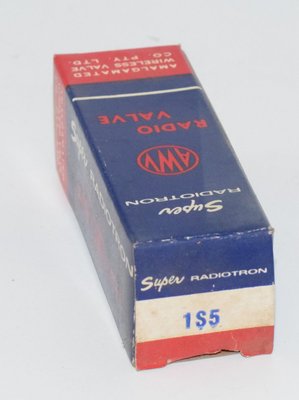
Introduction and History
The 1S5 is a miniature diode-pentode vacuum tube designed primarily for use as a combined detector and audio-frequency voltage amplifier in compact battery-operated equipment. Developed during the late 1940s as part of the post-war miniaturization effort, the 1S5 belongs to the family of 1.4-volt filament tubes that powered a generation of portable radios before transistors became widely available.
Manufactured by General Electric (under both the GE and Ken-Rad brands), as well as by other major tube manufacturers worldwide, the 1S5 combined a signal diode and a sharp-cutoff pentode in a single miniature glass envelope. This integration was a key advantage in portable receiver design, where space, weight, and battery drain were critical constraints. The tube was typically used alongside other 1.4-volt battery types such as the 1R5 (converter), 1T4 (IF amplifier), and 3V4 or 3S4 (output stage) in the classic "All American Five" portable radio configuration adapted for battery operation.
The General Electric datasheet ET-T231B, dated September 1951 (superseding ET-T231A dated June 1946), documents the tube's specifications and provides comprehensive characteristic curves for both the pentode and diode sections.
Technical Specifications and Design
General Construction
| Parameter | Value |
|---|---|
| Type | Diode-Pentode |
| Cathode | Coated Filament (directly heated) |
| Envelope | T-5½, Glass |
| Base | E7-1, Miniature Button 7-Pin (B7G) |
| Basing Designation | RTMA 6AU |
| Mounting Position | Any |
Physical Dimensions
- Maximum diameter: ¾ inch (19 mm)
- Maximum seated height: 1⅞ inches (47.6 mm)
- Maximum overall height: approximately 2⅝ inches (66.7 mm)
Heater (Filament) Ratings
| Parameter | Value |
|---|---|
| Filament Voltage (D-C) | 1.4 Volts |
| Filament Current | 0.05 Amperes (50 mA) |
| Filament Power | 0.07 Watts |
Interelectrode Capacitances
| Parameter | Value |
|---|---|
| Grid-to-Cathode (Cgk) | 2.2 pF |
| Anode-to-Cathode (Cak) | 2.4 pF |
| Grid-to-Anode (Cga) | 0.2 pF |
| Diode Plate to Grid 1 (Max) | 0.1 pF |
Note: Capacitance values measured with or without external shield #316 connected to pin 1.
Maximum Ratings (Design Center Values)
| Parameter | Maximum Value |
|---|---|
| Plate Voltage | 90 Volts |
| Screen Voltage | 90 Volts |
| Positive D-C Grid Number 1 Voltage | 0 Volts |
| Negative D-C Grid Number 1 Voltage | −50 Volts |
| Total Cathode Current | 3 Milliamperes |
| Diode Current for Continuous Operation | 0.25 Milliamperes |
Characteristics and Typical Operation — Class A₁ Amplifier
| Parameter | Value |
|---|---|
| Plate Voltage | 67.5 Volts |
| Screen Voltage | 67.5 Volts |
| Grid Number 1 Voltage | 0 Volts |
| Plate Resistance (Approx.) | 0.6 Megohm (600,000 Ω) |
| Transconductance (gm) | 625 Micromhos (0.625 mA/V) |
| Plate Current | 1.6 Milliamperes |
| Screen Current | 0.4 Milliamperes |
| Grid Number 1 Voltage for Ib = 10 µA (Approx.) | −5 Volts |
Diode Section
| Parameter | Value |
|---|---|
| Average Diode Current (measured with 10V D-C applied) | 1.5 Milliamperes |
Note: The diode is located at the negative end of the filament.
Derived Parameters
The amplification factor (µ) can be estimated from the relationship µ = gm × rp. With gm = 625 µmhos and rp = 600,000 Ω, the amplification factor is approximately 375. Note that this is a calculated value and should be confirmed against additional manufacturer data if critical precision is required.
Maximum plate dissipation is not explicitly stated in the GE datasheet but can be inferred from the maximum ratings. With a maximum plate voltage of 90V and maximum total cathode current of 3 mA, the practical plate dissipation is quite low — on the order of a few hundred milliwatts. This is consistent with the tube's role as a voltage amplifier rather than a power stage.
Pin Configuration (Bottom View)
| Pin | Connection |
|---|---|
| Pin 1 | Negative Filament and Grid Number 3 (Suppressor) |
| Pin 2 | No Connection |
| Pin 3 | Diode Plate |
| Pin 4 | Grid Number 2 (Screen) |
| Pin 5 | Plate |
| Pin 6 | Grid Number 1 (Control Grid) |
| Pin 7 | Positive Filament |
Class A Resistance-Coupled Amplifier Data
The GE datasheet provides extensive resistance-coupled amplifier design data for three B+ supply voltages (45V, 90V, and 135V). Representative examples at Ebb = 90 Volts:
| Ro (MΩ) | Rs (MΩ) | Rg1 (MΩ) | Rk (kΩ) | Rsg (kΩ) | Gain | Eo (V RMS) |
|---|---|---|---|---|---|---|
| 0.24 | 0.24 | 10 | 0.8 | 29 | 13 | — |
| 0.51 | 0.51 | 10 | 1.9 | 40 | 12 | — |
| 0.75 | 0.75 | 10 | 2.9 | 47 | 11 | — |
| 1.0 | 1.0 | 10 | 3.9 | 50 | 9 | — |
Notes from datasheet: Eo is maximum RMS voltage output for 5% total harmonic distortion. Gain measured at 2.0 volts RMS output. For zero-bias data, generator impedance is negligible.
Applications and Usage
The 1S5 was designed specifically for battery-operated portable radio receivers, where it served a dual function:
Primary Applications
- AM Detector: The diode section was used for envelope detection of amplitude-modulated IF signals, typically at 455 kHz. The diode plate (pin 3) connects to the last IF transformer, and the detected audio appears across the diode load resistor.
- Audio Voltage Amplifier: The pentode section amplified the detected audio signal to a level sufficient to drive an output tube such as the 3V4 or 3S4. With a transconductance of 625 µmhos and plate resistance of 600 kΩ, the pentode section provided useful voltage gain in resistance-coupled configurations.
- AVC (Automatic Volume Control): The diode section simultaneously provided an AVC voltage derived from the detected signal, which was fed back to control the gain of the IF amplifier stage(s).
Typical Portable Radio Line-Up
The 1S5 was commonly found in the following battery portable radio tube complement:
- 1R5 — Pentagrid converter (oscillator/mixer)
- 1T4 — IF amplifier
- 1S5 — Detector and first audio amplifier
- 3V4 or 3S4 — Audio output
This combination was powered by a single 1.5V "A" cell (for filaments in parallel) and a 67.5V or 90V "B" battery for plate supply, sometimes supplemented by a small "C" battery for grid bias on the output stage.
Circuit Design Considerations
The extremely low filament current of 50 mA made the 1S5 ideal for extending battery life in portable equipment. The sharp-cutoff characteristic of the pentode section ensured clean signal handling without the crossover distortion that could occur with remote-cutoff types in audio applications. The internal connection of the suppressor grid (Grid 3) to the negative filament (pin 1) simplified circuit design and reduced the pin count requirement.
Sound Characteristics
The 1S5, being a low-power battery pentode designed for voltage amplification rather than output duty, has a distinctive sonic character that reflects its design constraints and operating parameters:
Tonal Qualities
- Warm and Intimate: Operating at very low plate currents (1.6 mA typical) and modest voltages (67.5V), the 1S5 produces a characteristically warm, intimate sound. The low operating voltages contribute to a softer, more rounded tonal quality compared to tubes operating at higher voltages.
- Gentle Harmonic Content: As a sharp-cutoff pentode, the 1S5 generates a mix of even and odd harmonics when driven into mild nonlinearity. The harmonic signature tends to be gentle and musically pleasant at low signal levels, though it can become harsh if overdriven — a characteristic common to small-signal pentodes.
- Limited Bandwidth: The relatively high plate resistance of 600 kΩ, combined with typical circuit capacitances, naturally rolls off the high-frequency response. This gives the 1S5 a somewhat mellow, treble-softened character that many listeners find pleasant for vocal and acoustic material.
- Microphonic Sensitivity: Like many miniature battery tubes with directly heated filaments, the 1S5 can exhibit some microphonic behavior, which can add a subtle "liveness" to the sound but can also be problematic in high-gain applications if the tube is not properly isolated from vibration.
- Low-Voltage Character: The sound of the 1S5 at its design operating point has a quality often described as "vintage" or "lo-fi" — not in a pejorative sense, but reflecting the particular compression characteristics and harmonic behavior of a tube operating with very limited headroom. Signal peaks are handled with a gradual, graceful compression rather than hard clipping.
Comparison to Other Types
Compared to higher-powered pentodes like the EF86 or 6AU6, the 1S5 has a softer, more compressed sound with less dynamic range. Its sonic character is more akin to other battery pentodes in the 1.4V filament family. The pentode section, when used as a voltage amplifier, imparts a character that is distinctly different from triode-connected operation — brighter and more detailed in the midrange, but with the characteristic pentode "edge" that some listeners find adds presence and clarity to the sound.
Equivalent or Substitute Types
The following types are genuinely interchangeable with the 1S5:
| Type | Origin/Standard | Notes |
|---|---|---|
| DAF91 | European (Mullard/Philips designation) | Direct equivalent. The European Pro-Electron designation for the same tube. Identical pinout and electrical characteristics. Widely manufactured by Mullard, Philips, Valvo, Amperex, and others. |
| CV784 | British military (Common Valve designation) | Direct equivalent. The British military services designation for the 1S5/DAF91. Manufactured to tighter tolerances and more rigorous quality control standards for military applications. |
| VT172 | US military designation | Direct equivalent. The US military Signal Corps designation for the 1S5. |
Related but Not Directly Interchangeable Types
- 1S4: A different tube type — not a substitute for the 1S5.
- DAF96 (1AH5): A later-generation diode-pentode with similar function but different pinout and electrical characteristics. Not a drop-in replacement.
- DK91, DK96: These are converter tubes, not diode-pentodes, despite similar naming conventions.
Notable Characteristics
Sharp-Cutoff Pentode Design
The 1S5 employs a sharp-cutoff (as opposed to remote-cutoff/variable-mu) pentode section. This means the tube's mutual conductance drops rapidly and uniformly as the grid voltage becomes more negative. The grid voltage required to reduce plate current to 10 µA is approximately −5 volts. This sharp-cutoff characteristic makes the tube well-suited for audio amplification where linear signal handling is desired, as opposed to remote-cutoff types which are preferred for AGC-controlled RF/IF stages.
Directly Heated Filament
As a battery tube, the 1S5 uses a directly heated (filamentary) cathode rather than an indirectly heated cathode. The filament serves as both the heater and the electron-emitting surface. This design choice minimizes power consumption but introduces some unique considerations:
- The filament must be operated on DC to avoid hum modulation of the signal.
- There is a voltage gradient along the filament, meaning the cathode potential varies from one end to the other. The diode is located at the negative end of the filament.
- The suppressor grid (Grid 3) is internally connected to the negative filament terminal (pin 1).
Integrated Diode Section
The diode plate (pin 3) is a separate electrode within the same envelope, positioned at the negative end of the filament. The very low interelectrode capacitance between the diode plate and Grid 1 (maximum 0.1 pF) ensures minimal coupling between the detector and amplifier sections, which is critical for preventing unwanted feedback and oscillation.
Extremely Low Power Consumption
With a filament power of only 70 milliwatts (1.4V × 50 mA) and total cathode current of 2 mA typical (1.6 mA plate + 0.4 mA screen), the 1S5 is remarkably efficient. The total B+ current drain of approximately 2 mA made it possible to operate portable radios for many hours on small dry-cell batteries.
Resistance-Coupled Amplifier Performance
The datasheet provides detailed resistance-coupled amplifier data showing that the 1S5 can achieve voltage gains ranging from approximately 9 to 66, depending on the plate load resistance, screen dropping resistor, and B+ voltage. At Ebb = 90V with moderate load resistances (0.5 to 1.0 MΩ), gains of 9 to 13 are typical. Higher gains are achievable at Ebb = 135V, where gains up to 66 are documented.
Usage in the Audio Community
While the 1S5 was never designed as an audiophile component, it has found a dedicated following in several niches of the audio community:
Vintage Radio Restoration
The most common audio-related use of the 1S5 today is in the restoration and maintenance of vintage battery-operated portable radios from the late 1940s and 1950s. Collectors and restorers of sets by Zenith, Philco, Emerson, RCA, and other manufacturers regularly seek out NOS (New Old Stock) 1S5 tubes. The tube's equivalents — particularly the DAF91 manufactured by European companies like Mullard, Philips, and Valvo — are often more readily available and are sought after for their perceived quality.
Low-Voltage Tube Audio Projects
The 1S5 has attracted interest from DIY audio enthusiasts who build low-voltage tube amplifiers and preamplifiers. The tube's ability to operate at plate voltages as low as 45 volts (as documented in the resistance-coupled amplifier data) makes it attractive for "starved plate" designs and projects where high-voltage power supplies are undesirable or impractical. Some builders have created headphone amplifiers and small preamplifiers using the 1S5 and its battery-tube siblings, powered by modest DC supplies or even batteries.
Crystal Radio and Detector Projects
The diode section of the 1S5 has been used by experimenters as a detector in regenerative receivers and enhanced crystal radio designs, where the pentode section provides audio amplification of the detected signal — replicating the tube's original intended function in a hobbyist context.
Guitar Effects and Lo-Fi Audio
A small number of boutique effects pedal builders and lo-fi audio enthusiasts have experimented with the 1S5 in stompbox and preamp designs. The tube's low voltage requirements make it compatible with battery-powered effects pedals, and its characteristic compression and harmonic generation at low voltages can produce interesting tonal effects. The sharp-cutoff characteristic provides a different distortion texture compared to remote-cutoff battery pentodes.
Availability and Pricing
The 1S5 and its equivalents (DAF91, CV784) are still available as NOS from various vintage tube dealers, though supplies are gradually diminishing. Brands such as AWV (Amalgamated Wireless Valve Company, Australia), Mullard, Philips, RCA, GE, and Sylvania are commonly encountered. Military-grade CV784 examples are particularly prized for their consistent quality. Pricing remains moderate compared to more sought-after audio tubes, making the 1S5 an accessible entry point for experimenters interested in low-voltage tube audio.
Practical Considerations for Audio Use
Builders working with the 1S5 in audio applications should note several practical considerations:
- The filament must be powered by DC — AC operation will introduce unacceptable hum levels.
- The high plate resistance (600 kΩ) means the tube works best with high-impedance loads; it is not suitable for driving low-impedance loads directly.
- The directly heated filament can be microphonic; proper mounting and vibration isolation are recommended.
- The tube's low transconductance (625 µmhos) limits the achievable gain-bandwidth product, making it best suited for audio-frequency applications rather than wideband use.
- Screen grid supply should be well-filtered and decoupled, as the tube's performance is sensitive to screen voltage variations.