1. Introduction and History
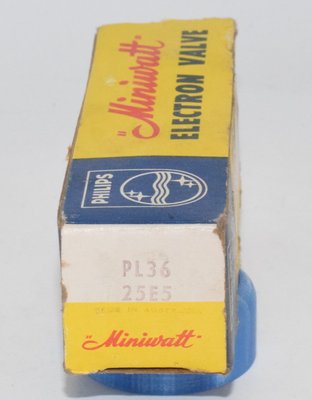
The 25E5, also known by its Philips designation PL36, is a compact power pentode vacuum tube that emerged during the golden age of valve electronics in the mid-20th century. Manufactured by Philips Miniwatt and other European tube makers, the 25E5 represents an important chapter in the evolution of miniaturized tube technology designed for portable and space-constrained applications.
The tube was developed as part of the broader trend toward smaller, more efficient vacuum tubes that could operate at lower plate voltages while maintaining reasonable power output. This made it particularly suitable for battery-powered portable radios and compact audio amplifiers that were becoming increasingly popular in the 1950s and 1960s. The 25E5 shares its lineage with other compact power tubes of the era, reflecting the engineering priorities of post-war consumer electronics.
2. Technical Specifications and Design
Basic Electrical Characteristics
The 25E5 is a small, compact power pentode with the following primary specifications:
- Tube Type: Power Pentode
- Heater Voltage: 25V AC/DC (nominal)
- Heater Current: Approximately 0.3A
- Maximum Plate Voltage: 330V
- Typical Operating Plate Voltage: 250-300V
- Maximum Plate Dissipation: 5-6 watts
- Typical Output Power: 1.5-2.5 watts (depending on configuration)
- Amplification Factor (μ): Approximately 20-25
- Plate Resistance (rp): Approximately 15,000-20,000 ohms
- Transconductance (gm): Approximately 1,200-1,500 micromhos
Physical Design
The 25E5 features a compact octal or noval base configuration (depending on variant), measuring approximately 2.5 inches in height. The tube's small envelope design was intentional, allowing manufacturers to create more portable and space-efficient equipment. The internal structure consists of a directly heated cathode, control grid, screen grid, suppressor grid, and plate arranged in the classic pentode configuration.
The heater design is particularly noteworthy: the 25V specification allowed for direct connection to battery supplies or simple transformer-based heater circuits, eliminating the need for complex voltage regulation schemes. This made the tube economical to use in consumer applications where cost and simplicity were paramount concerns.
Operating Characteristics
The 25E5 operates most efficiently in Class A or Class AB1 configurations, making it suitable for both linear amplification and moderate power output applications. The tube exhibits good linearity across its operating range, with relatively low distortion when properly biased and loaded. The pentode configuration provides excellent gain and power output compared to equivalent triodes, making it an efficient choice for the heater power budget constraints of portable equipment.
3. Applications and Usage
Historical Applications
The 25E5 found its primary application in portable battery-powered radio receivers manufactured throughout Europe and Australia during the 1950s and 1960s. Its low heater current and moderate power output made it ideal for the final amplification stage in compact AM/FM receivers. The tube was particularly popular in Philips-manufactured portable radios and similar consumer electronics.
Beyond radios, the 25E5 appeared in small public address systems, portable phonograph amplifiers, and various other consumer audio devices where space and power consumption were critical constraints. Its ability to deliver reasonable output power from a compact package made it valuable in applications where tube count and physical size directly impacted product cost and portability.
Modern Usage in the Vintage Audio Community
Today, the 25E5 occupies a specialized niche in the vintage audio restoration and enthusiast community. Collectors and restorers seek these tubes primarily for authentic restoration of period-correct equipment rather than for new construction projects. The tube's relatively modest specifications mean it is rarely chosen for high-fidelity applications when more capable alternatives exist.
However, the 25E5 has experienced a modest resurgence of interest among tube enthusiasts exploring vintage portable radio restoration. Dedicated communities focused on transistor-era and early tube-era portable radios actively seek NOS (New Old Stock) 25E5 tubes to restore original equipment to working condition. The tube's historical significance and the nostalgia associated with vintage portable radios has created steady, if modest, demand among collectors.
Some audiophiles and hobbyists have experimented with the 25E5 in minimalist tube amplifier designs, taking advantage of its low heater current draw for battery-powered applications. These projects typically aim to capture the aesthetic and sonic qualities of vintage portable audio equipment rather than achieve modern high-fidelity standards.
4. Sound Characteristics in Audio Applications
Tonal Quality
The 25E5, when operating in audio applications, produces a characteristically warm and colored sound signature typical of small power pentodes from its era. The tube exhibits a subtle compression characteristic in the midrange frequencies, which many listeners describe as adding a pleasant "vintage character" to audio reproduction. This compression is not aggressive but rather imparts a gentle, slightly soft-focused quality to the midrange.
The low-frequency response tends toward slight emphasis, particularly in the 60-200Hz region, which can contribute to a sense of fullness and body in the reproduced sound. This characteristic made the 25E5 particularly suitable for the limited frequency response capabilities of portable radio speakers, where the tube's tonal coloration could mask the limitations of small loudspeakers.
Harmonic Distortion Profile
The harmonic distortion produced by the 25E5 is dominated by second and third-order harmonics, which are generally considered musically pleasant by many audio enthusiasts. This even-order harmonic emphasis contributes to the tube's warm, slightly euphonic character. At moderate operating levels, total harmonic distortion typically ranges from 3-8%, depending on output loading and bias conditions.
The distortion increases gracefully as the tube approaches its limits, producing a natural compression and soft clipping characteristic that many vintage audio enthusiasts find appealing. This contrasts with the harsher distortion characteristics of some modern solid-state devices, which can produce more aggressive higher-order harmonics.
Frequency Response and Transient Behavior
The 25E5's frequency response in typical applications spans approximately 50Hz to 10kHz, reflecting the limitations of its era and design priorities. The tube exhibits gentle roll-off characteristics at frequency extremes rather than sharp cutoffs, which contributes to its smooth, non-fatiguing sound character.
Transient response is moderate; the tube does not exhibit the snappy, fast attack characteristics of modern high-frequency tubes or solid-state devices. Instead, transients are slightly rounded and softened, which some listeners appreciate for reducing harshness in reproduced music, while others may perceive this as a lack of detail or impact.
Noise and Microphonicity
Well-maintained 25E5 tubes typically exhibit low noise floors, though older specimens may develop increased hum and noise due to cathode depletion or internal contamination. The tube is moderately microphonic, meaning mechanical vibration can be coupled into the audio signal. In high-gain audio applications, microphonicity can become a concern, requiring careful mechanical damping and isolation.
5. Notable Characteristics
Heater Design Innovation
One of the most distinctive features of the 25E5 is its 25V heater specification, which was a significant design innovation for its time. This allowed direct connection to battery supplies without complex voltage regulation, a critical advantage in portable battery-powered equipment. The heater design reflects the engineering priorities of the portable electronics era, where every component choice had to justify its impact on battery life and equipment size.
Compact Form Factor
The 25E5's small physical size was achieved without significant compromise in performance, making it an efficient use of space in equipment design. This compactness is particularly notable when compared to earlier power tubes, demonstrating the rapid progress in miniaturization during the tube era.
Robustness and Reliability
The 25E5 demonstrates good long-term reliability when operated within specifications. Many examples from the 1950s and 1960s remain functional today, testament to the build quality of tubes from this era. The tube's modest power requirements and operating stresses contributed to its longevity compared to higher-power tubes that experienced greater thermal and electrical stress.
Availability and Collectibility
NOS 25E5 tubes remain moderately available through tube dealers specializing in vintage stock, though prices have increased modestly in recent years due to renewed interest in vintage portable radio restoration. Used examples are relatively common and inexpensive, making the tube accessible to hobbyists and restorers. The Philips Miniwatt branding adds to the collectibility for enthusiasts of that particular manufacturer's products.
6. Equivalent or Substitute Types
The 25E5 shares similar characteristics with several other compact power pentodes from the same era:
- PL36 (Philips designation): Electrically identical; this is the same tube under Philips's internal nomenclature system
- 25L6: American equivalent with similar specifications, though with slightly different operating characteristics
- 6V6: American compact power pentode with somewhat higher power output but requiring different heater voltage
- EL84: European compact power pentode offering higher power output and better high-frequency response, though requiring different operating conditions
Direct substitution with other types should be approached carefully, as heater voltage requirements and maximum plate voltage ratings differ. The 25E5 should not be arbitrarily substituted without careful verification of circuit compatibility and maximum ratings.
Conclusion
The 25E5 / PL36 represents an important chapter in vacuum tube history, embodying the engineering priorities of the portable electronics era. While its specifications are modest by modern standards, its efficient design, low heater current, and warm sonic characteristics continue to appeal to vintage audio enthusiasts and restoration specialists. The tube's presence in iconic portable radios and early compact amplifiers ensures its continued relevance to collectors and historians of consumer electronics. For those seeking to restore original equipment or explore vintage portable audio aesthetics, the 25E5 remains a historically significant and sonically interesting component.