1. Introduction and History
The 26E6 is a medium-mu triode vacuum tube that emerged during the golden age of vacuum tube development in the mid-20th century. Designed primarily for use in audio amplification and radio frequency applications, the 26E6 represents a significant evolution in triode design, offering improved performance characteristics compared to earlier tube types.
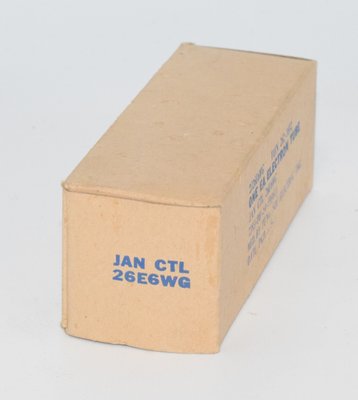
The tube gained particular prominence during the 1950s, when manufacturers like Tungsol produced high-quality examples such as the 26E6WG variant. The designation "26E6" follows the RCA numbering system, where the initial digits indicate the heater voltage requirement, and the subsequent letters and numbers identify the tube's functional classification and characteristics. The JAN (Joint Army-Navy) specification versions, such as the JAN CTL variants from 1954, were manufactured to military standards, ensuring exceptional reliability and consistency.
During this era, the 26E6 found its way into numerous consumer audio applications, including guitar amplifiers, hi-fi preamplifiers, and professional audio equipment. Its development coincided with the post-World War II expansion of consumer electronics and the growing demand for higher-fidelity audio reproduction.
2. Technical Specifications and Design
Basic Parameters
Heater Specifications:
- Heater Voltage: 26 volts AC (nominal)
- Heater Current: Approximately 0.15 amperes
- Heater Type: Directly heated cathode
- Warm-up Time: Approximately 10-15 seconds to full operating parameters
Plate Characteristics:
- Maximum Plate Voltage: 330 volts
- Maximum Plate Dissipation: 8 watts
- Plate Resistance (rp): Approximately 1,000 ohms
- Amplification Factor (μ): Approximately 20
- Transconductance (gm): Approximately 20 millimhos
Grid Characteristics:
- Grid Bias Range: -2 to -6 volts (typical operating range)
- Grid Leak Bias: Commonly used in audio applications
- Maximum Grid Voltage: -10 volts
Physical Design and Construction
The 26E6 features a robust octal base (8-pin) configuration, providing secure mechanical and electrical connections. The tube's internal structure consists of a directly heated cathode, a control grid, a plate, and sometimes a suppressor grid, depending on the specific variant. The directly heated cathode design, characteristic of the "26" family of tubes, contributes to the tube's distinctive sonic properties and is a key differentiator from indirectly heated alternatives.
The tube's envelope is constructed from borosilicate glass, which provides excellent thermal stability and allows for efficient cooling. The internal elements are precisely aligned to maintain consistent electrical characteristics across production batches, particularly in military-grade JAN versions.
Operating Characteristics
At typical operating conditions (250 volts plate, -3 volts bias), the 26E6 exhibits:
- Plate Current: Approximately 30-40 milliamperes
- Gain: Approximately 20 dB in standard configurations
- Frequency Response: Essentially flat from 20 Hz to 20 kHz in properly designed circuits
- Noise Figure: Approximately 15-18 dB (relatively low for a power triode)
3. Applications and Usage
Historical Applications
The 26E6 was originally designed for use in radio frequency amplification and audio power amplification circuits. Its moderate power handling capability and relatively high amplification factor made it suitable for intermediate power stages in consumer electronics.
Audio Amplification
In audio applications, the 26E6 has been employed in:
- Preamplifier Stages: The tube's low noise characteristics and moderate gain make it suitable for microphone and line-level preamplification
- Driver Stages: In push-pull output configurations, the 26E6 serves as an effective driver tube for larger output tubes
- Single-Ended Amplifiers: Some boutique amplifier manufacturers have designed high-quality single-ended amplifiers utilizing the 26E6 as an output tube, producing 2-4 watts of clean audio power
- Guitar Amplifiers: Vintage and modern guitar amplifiers occasionally employ 26E6 tubes in preamp or low-power output stages
Modern Audio Community Usage
In contemporary audio circles, the 26E6 has experienced a renaissance among audiophiles and vintage audio enthusiasts. Several factors have contributed to this renewed interest:
- Vintage Restoration: As mid-century audio equipment gains collector value, demand for original 26E6 tubes has increased. Restoration specialists seek NOS (New Old Stock) examples to maintain historical accuracy and preserve original sonic characteristics
- High-End Audio Design: Some boutique amplifier manufacturers have incorporated 26E6 tubes into limited-edition designs, leveraging their unique sonic properties and historical significance
- DIY and Hobbyist Community: Amateur tube amplifier designers appreciate the 26E6 for its moderate power requirements, availability of design information, and distinctive character
- Tube Rolling: Audio enthusiasts engaged in "tube rolling" (systematic experimentation with different tube brands and variants) frequently explore 26E6 options to achieve desired tonal characteristics
- Vintage Guitar Amplifier Market: Musicians seeking vintage-authentic tone in classic guitar amplifier designs often prioritize original or period-correct 26E6 tubes
4. Sound Characteristics of the 26E6
Tonal Profile
The 26E6 is renowned among audio professionals and enthusiasts for its distinctive sonic signature. Several characteristics define its sound:
Midrange Presence: The 26E6 exhibits a naturally forward midrange presence, which many audio professionals attribute to its directly heated cathode design. This characteristic makes it particularly valued in applications where vocal clarity and instrument definition are priorities. The midrange emphasis is gentle and musical rather than aggressive, contributing to a naturally engaging presentation.
Harmonic Character: The tube produces a rich harmonic structure with a slight emphasis on even-order harmonics, which are generally perceived as musically pleasing and warm. This harmonic signature is less pronounced than in larger power tubes like the 300B, but more pronounced than in many modern semiconductor devices, providing a subtle but noticeable enhancement to program material.
Bass Response: The 26E6 delivers controlled, articulate bass response. The bass is present and well-defined without being bloated or overly prominent. This characteristic makes it suitable for applications requiring accurate bass reproduction, from classical music to contemporary recordings.
Treble Characteristics: The high-frequency response is smooth and extended, without excessive brightness or harshness. The treble exhibits a gentle rolloff above 10 kHz, which some describe as "forgiving" of poorly recorded source material while still maintaining excellent clarity and detail.
Dynamics: The 26E6 demonstrates excellent dynamic capability relative to its size. The tube responds quickly to dynamic transients, making it particularly suitable for music with significant dynamic range. The dynamic performance is crisp without being fatiguing, allowing for extended listening sessions without listener fatigue.
Comparison to Other Triodes
When compared to other triodes of similar era:
- vs. 12AX7: The 26E6 offers greater power handling and a warmer, more colored sonic character compared to the relatively neutral 12AX7
- vs. 300B: While the 300B is more powerful and offers greater harmonic richness, the 26E6 provides a more neutral presentation with less coloration
- vs. 2A3: The 26E6 exhibits similar warmth to the 2A3 but with greater clarity and less emphasis on lower midrange coloration
Factors Affecting Sound Quality
The sonic characteristics of any 26E6 tube are influenced by several factors:
- Manufacturing Origin: Tungsol examples from the 1950s are particularly prized for their consistency and musical character. RCA, Sylvania, and other manufacturers produced tubes with slightly different sonic signatures
- Age and Condition: NOS (New Old Stock) tubes typically exhibit superior performance compared to used examples. Tubes that have been properly stored in controlled environments maintain their original characteristics better than those subjected to temperature fluctuations or humidity
- Circuit Design: The sonic character of the 26E6 is significantly influenced by the surrounding circuit topology. Proper impedance matching, biasing, and load resistance all affect the tube's tonal output
- Bias Setting: Class A biasing produces warmer, more harmonic-rich tones, while higher bias settings yield cleaner, more linear response
5. Equivalent or Substitute Types
Direct Equivalents
Several tubes share similar electrical characteristics and can serve as direct replacements in most applications:
- 26E7: A higher-power variant with increased plate dissipation rating, suitable for applications requiring greater output
- 26 (European designation): The European equivalent, with identical electrical specifications but different base construction in some variants
Functional Substitutes
While not perfect replacements, these tubes can work in many 26E6 applications with circuit modifications:
- 12B4: Lower heater voltage requirement but similar power handling; requires power supply modification
- 45: Similar directly heated cathode design with comparable power output; different heater voltage
- 2A3: Greater power output with similar sonic character; requires circuit redesign
Substitution Considerations
When substituting tubes, several factors must be considered:
- Heater voltage compatibility with existing power supplies
- Plate voltage and current requirements
- Physical dimensions and base compatibility
- Sonic character differences that may affect overall system performance
- Bias adjustment requirements
Notable Characteristics
Reliability and Longevity
The 26E6, particularly military-grade JAN versions, is renowned for exceptional reliability. Many examples from the 1950s remain in full working condition today, testament to the robust design and quality manufacturing standards of the era. Typical tube life expectancy ranges from 5,000 to 10,000 hours of continuous operation, though well-maintained examples often exceed these estimates.
Directly Heated Cathode Advantage
The directly heated cathode design contributes several advantages:
- Faster warm-up time compared to indirectly heated alternatives
- Lower microphonic noise in some applications
- Unique sonic character prized by audio professionals
- Simpler heater circuit requirements
Tungsol Manufacturing Heritage
Tungsol's 1954 production of JAN CTL 26E6 tubes represents the pinnacle of this tube type's manufacturing quality. Tungsol was renowned for:
- Rigorous quality control standards
- Consistent performance across production batches
- Superior internal construction techniques
- Exceptional longevity and reliability
These characteristics make Tungsol 26E6 tubes particularly sought after by audio professionals and collectors.
NOS (New Old Stock) Availability
Original NOS 26E6 tubes, particularly Tungsol examples, have become increasingly valuable as vintage audio equipment gains collector recognition. The scarcity of unused examples, combined with their superior sonic and technical characteristics, has established them as premium components in high-end audio circles. Proper storage and handling of NOS tubes is essential to preserve their original characteristics.
Design Flexibility
The 26E6's moderate specifications allow for considerable design flexibility. Audio engineers can employ the tube in various circuit topologies, from simple triode stages to complex push-pull configurations, making it a versatile component for both vintage restoration and contemporary audio design.
Conclusion
The 26E6 vacuum tube represents a significant achievement in mid-20th century audio engineering. Its combination of moderate power handling, low noise characteristics, distinctive sonic signature, and exceptional reliability has secured its place in audio history. Whether in vintage equipment restoration or contemporary boutique audio design, the 26E6 continues to deliver musical, engaging audio reproduction that justifies its enduring popularity among audio professionals and enthusiasts. The Tungsol 1954 JAN CTL examples represent the finest expression of this tube type's capabilities, offering both technical excellence and sonic distinction that remains relevant decades after their manufacture.