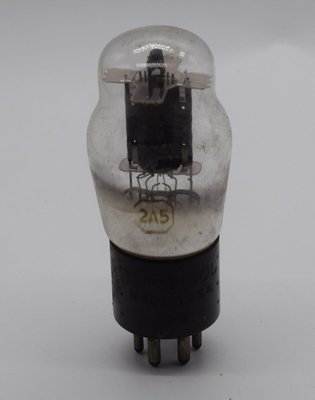
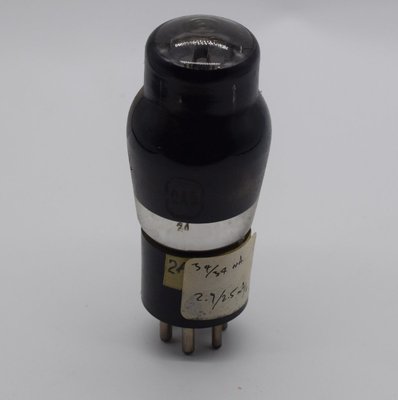
Introduction and History
The 2A5 is a power amplifier pentode designed for audio output service, introduced by RCA in the early 1930s during a period of rapid evolution in vacuum tube technology. It belongs to the 2.5-volt heater family of tubes that were standard in many American radio receivers of the era, particularly those using power transformers with dedicated 2.5-volt heater windings.
The 2A5 was part of RCA's effort to provide improved power output pentodes for consumer radio sets. It succeeded earlier power output tubes like the Type 47 pentode, offering better performance characteristics and improved construction. The tube was manufactured by RCA's Radiotron Division (as documented in the September 2, 1941 datasheet) as well as by other major manufacturers including Tungsol, Sylvania, and various European licensees.
The 2A5 shares its maximum ratings, typical operating characteristics, and curves with the 6P6 — a tube with identical internal construction but designed for a 6.3-volt heater supply. This relationship is explicitly noted in the RCA datasheet, which states: "Maximum Ratings, Typical Operation, Characteristics and Curves are the same as for the 6P6." The 2A5 occupies an important place in the lineage of American power pentodes, bridging the gap between the earliest pentode designs and the later octal-based types that would dominate through the 1940s and 1950s.
Technical Specifications and Design
Heater Ratings
| Parameter | Value |
| Heater Type | Coated Unipotential Cathode (indirectly heated) |
| Heater Voltage | 2.5 volts (a-c or d-c) |
| Heater Current | 1.75 amperes |
Maximum Ratings (Absolute)
| Parameter | Value |
| Maximum Plate (Anode) Voltage | 375 volts |
| Maximum Screen Grid (G2) Voltage | 285 volts |
| Maximum Plate Dissipation | 11 watts |
| Maximum Screen Grid Dissipation | 3.75 watts |
Note: Typical operating plate voltages in period radio circuits were commonly 250 volts, but the absolute maximum plate voltage rating is 375 volts as specified in the manufacturer datasheet. Similarly, typical screen grid operating voltages were around 250 volts, but the absolute maximum screen grid voltage is 285 volts. Designers must not confuse typical operating conditions with maximum ratings.
Typical Operating Characteristics
The RCA datasheet specifies that the 2A5's typical operation, characteristics, and curves are the same as for the 6P6. Based on standard published data for this tube family, the following typical operating conditions apply:
| Parameter | Typical Value |
| Plate Voltage | 250 volts |
| Screen Grid Voltage | 250 volts |
| Grid Bias (Vg1) | −16.5 volts |
| Plate Current | 32 mA (approx.) |
| Screen Current | 6.5 mA (approx.) |
| Transconductance (gm) | 2,200 µmhos (approx.) |
| Plate Resistance (rp) | 100 kΩ (approx.) |
| Power Output (pentode, single-ended) | 3.0 watts (approx.) |
| Total Harmonic Distortion | ~7–10% at full output |
Note: The transconductance, plate resistance, power output, and distortion figures above are approximate values consistent with published data for the 2A5/6P6 family. Users should confirm exact values against a complete manufacturer datasheet for their specific operating conditions.
Physical Characteristics
| Parameter | Value |
| Bulb (Envelope) | ST-12 |
| Base | Medium 6-Pin (6B) |
| Maximum Overall Length | 4-11/16 inches |
| Maximum Seated Height | 4-1/16 inches |
| Maximum Diameter | 1-13/16 inches |
| Mounting Position | Any |
Pin Configuration (Bottom View, 6B Base)
| Pin | Connection |
| Pin 1 | Heater |
| Pin 2 | Plate (Anode) |
| Pin 3 | Screen Grid (G2) |
| Pin 4 | Control Grid (G1) |
| Pin 5 | Cathode |
| Pin 6 | Heater |
The base diagram is viewed from the bottom of the tube (pin side), as shown in the RCA datasheet.
Applications and Usage
The 2A5 was designed primarily as an audio-frequency power amplifier for use in the output stages of radio receivers, phonograph amplifiers, and public address systems of the 1930s and early 1940s. Its principal applications include:
- Single-Ended Audio Output: The most common application, where a single 2A5 drives a loudspeaker through an output transformer. In typical pentode operation at 250V plate and screen voltage with a −16.5V grid bias, the tube delivers approximately 3 watts of audio power — sufficient for domestic radio receivers of the era.
- Push-Pull Audio Output: Two 2A5 tubes in push-pull configuration can deliver significantly higher power output with reduced even-order harmonic distortion. Push-pull operation was used in higher-quality radio receivers and small public address amplifiers.
- Triode-Connected Operation: By connecting the screen grid to the plate, the 2A5 can be operated as a triode, trading power output for lower distortion and a more linear transfer characteristic. This mode produces approximately 1.2–1.5 watts of output power but with substantially lower harmonic distortion.
- Radio Receiver Output Stages: The 2A5 was widely used in AC-powered superheterodyne and TRF radio receivers that employed 2.5-volt heater supplies. It was commonly paired with tubes such as the 2A7 (pentagrid converter), 2B7 (duplex-diode pentode), and 2A6 (duplex-diode triode) in complete receiver designs.
The tube's ability to operate in any mounting position made it versatile for various chassis layouts. Its 11-watt plate dissipation rating and 375-volt maximum plate voltage provided comfortable margins for reliable operation in typical consumer equipment.
Sound Characteristics
The 2A5, like many power pentodes of its generation, has a distinctive sonic signature that has been appreciated by vintage audio enthusiasts and tone seekers. Here is how audiophiles and engineers typically describe the 2A5's tonal qualities:
In Pentode Mode
- Warm and Full Midrange: The 2A5 produces a characteristically warm, rich midrange that is typical of early power pentodes. Vocals and acoustic instruments are rendered with a pleasing body and presence.
- Prominent Upper Harmonics: As a pentode, the 2A5 generates a noticeable amount of odd-order harmonics (particularly third and fifth), which contribute to a bright, lively character. At moderate drive levels, these harmonics add sparkle and detail; at higher levels approaching clipping, the sound takes on a more aggressive, edgy quality.
- Soft Clipping Behavior: When overdriven, the 2A5 transitions into clipping relatively gracefully compared to later beam tetrodes, producing a compressed, saturated tone that guitar amplifier enthusiasts find musically pleasing.
- Limited Bass Authority: With approximately 3 watts of output power and the high output impedance characteristic of pentode operation (~100 kΩ plate resistance), bass response is somewhat loose and lacks the tight damping factor of higher-powered amplifiers or triode-connected stages. This gives the low end a "pillowy" or "vintage" quality.
- Dynamic and Responsive: The 2A5 is praised for its touch sensitivity and dynamic responsiveness. Small changes in input signal level produce clearly audible changes in tone and volume, making it feel "alive" and interactive to musicians and listeners.
In Triode Mode
- Smoother and More Refined: Triode connection dramatically reduces the odd-order harmonic content, producing a smoother, more refined sound with predominantly second-harmonic distortion — widely considered more musically pleasant.
- Better Bass Damping: The much lower plate resistance in triode mode provides better loudspeaker damping, resulting in tighter, more controlled bass response.
- Reduced Power Output: The trade-off is significantly lower power output (roughly 1.2–1.5 watts), which limits the tube's usefulness to near-field listening or high-efficiency speaker systems.
- "Intimate" Presentation: Listeners describe the triode-mode sound as intimate, detailed, and three-dimensional, with excellent imaging in stereo applications.
Overall Sonic Character
The 2A5 is generally described as having a classic "vintage American" sound — warm, slightly colored, with a romantic quality that flatters vocal and acoustic music. It lacks the clinical precision of modern solid-state amplification but compensates with a musical, emotionally engaging presentation. Compared to later beam tetrodes like the 6V6 or 6L6, the 2A5 has a softer, more delicate character with less raw power but arguably more charm and nuance at low listening levels.
Equivalent or Substitute Types
Finding genuine substitutes for the 2A5 requires careful attention to heater voltage, base type, and operating characteristics. The following are verified or commonly cited equivalents:
Verified Close/Identical Substitutes
| Type | Relationship | Notes |
| CV1834 | Close/identical substitute | British military (CV) designation. This is the verified close/identical substitute per reference data. Direct replacement for the 2A5. |
| 6P6 | Electrically identical (different heater) | The RCA datasheet explicitly states that the 2A5's ratings, typical operation, characteristics, and curves are the same as for the 6P6. However, the 6P6 has a 6.3-volt heater and uses an octal base, so it is not a direct plug-in replacement. It requires a different socket and heater supply. |
Related Types (Not Direct Plug-In Replacements)
The following tubes are related in function and share similar characteristics but differ in heater voltage, base type, or both. They are not drop-in substitutes without circuit modifications:
| Type | Relationship | Key Differences |
| 42 | Similar power pentode, 6.3V heater | 6.3V heater, 6-pin base. Similar performance class but different heater voltage. |
| 6F6 | Octal-based equivalent of the 42 | 6.3V heater, octal base. Widely available; similar power output class. |
| 6K6GT | Later octal power pentode | 6.3V heater, octal base. Lower plate dissipation than the 2A5. |
| 47 | Earlier power pentode, 2.5V heater | Same heater voltage but different base (5-pin UY) and different characteristics. The 2A5 was designed as an improvement over the 47. |
Important: None of the 6.3-volt heater types listed above can be substituted directly for a 2A5 without modifying the heater supply and, in most cases, changing the socket. Only the CV1834 is a verified direct substitute.
Notable Characteristics
- Coated Unipotential Cathode: The 2A5 uses an indirectly heated cathode with a coated emissive surface, which was a significant advancement over the directly heated (filament-type) cathodes used in earlier power tubes like the Type 45 and Type 47. This design eliminates hum caused by AC heater current modulating the electron emission, resulting in quieter operation.
- ST-12 Envelope: The shouldered "ST" (shoulder-top) glass envelope was characteristic of American tubes from the 1930s and gives the 2A5 its distinctive vintage appearance. The ST-12 designation indicates a maximum diameter of approximately 1-1/2 inches (38mm), consistent with the datasheet's specified maximum diameter of 1-13/16 inches.
- Medium 6-Pin Base: The 2A5 uses the older medium 6-pin (6B) base, which predates the octal base system introduced in 1935. This base type is less mechanically robust than the later octal design but was standard for the 2.5-volt tube series.
- Any Mounting Position: The tube is rated for operation in any mounting position, providing design flexibility for equipment manufacturers.
- Shared Characteristics with 6P6: As explicitly noted in the RCA datasheet, the 2A5 shares all electrical ratings, typical operating conditions, and characteristic curves with the 6P6. This makes 6P6 data sheets a valuable supplementary reference for detailed operating curves and application information.
- Generous Maximum Ratings: With a 375V maximum plate voltage and 11W plate dissipation, the 2A5 has comfortable operating margins for typical 250V applications, contributing to long tube life and reliable operation.
- Historical Significance: The 2A5 represents a transitional period in tube design — more advanced than the first-generation pentodes but predating the standardized octal-base tubes that would become universal. It is a snapshot of 1930s American radio engineering at its peak.
Usage in the Audio Community
The 2A5 occupies a niche but enthusiastic following in the modern audio community. Its appeal spans several areas:
Vintage Radio Restoration
The primary demand for 2A5 tubes comes from vintage radio collectors and restorers. Many classic American radio receivers from the early-to-mid 1930s — including models from RCA, Philco, Zenith, and others — used the 2A5 as their audio output tube. Restorers seek tested, functional 2A5 tubes to return these radios to original operating condition. The availability of NOS (New Old Stock) 2A5 tubes from manufacturers like RCA, Tungsol, Sylvania, and National Union remains reasonable, though supplies are gradually diminishing.
Single-Ended Triode (SET) and Pentode Amplifiers
DIY audio enthusiasts and boutique amplifier builders have discovered the 2A5 as a charming tube for low-powered single-ended amplifiers. In triode-connected mode, a single-ended 2A5 amplifier produces roughly 1.2–1.5 watts — ideal for pairing with high-efficiency speakers (95 dB/W/m or higher) in small listening rooms. In pentode mode, approximately 3 watts is available, which is sufficient for moderately efficient speakers in near-field setups.
The 2A5's appeal in this context includes:
- Affordability: Compared to highly sought-after directly heated triodes like the 2A3 or 300B, the 2A5 remains relatively affordable, making it an accessible entry point for SET amplifier experimentation.
- Aesthetic Appeal: The ST-12 glass envelope with its distinctive shouldered shape is visually striking, and the warm glow of the 2.5-volt heater adds to the visual experience of a tube amplifier.
- Sonic Character: As described in the Sound Characteristics section, the 2A5 offers a warm, musical presentation that appeals to listeners who prioritize tonal beauty over raw power or analytical precision.
Guitar Amplifier Experimentation
A small number of guitar amplifier builders have experimented with the 2A5 in low-wattage practice amplifiers and recording amplifiers. The tube's soft clipping characteristics and touch sensitivity make it responsive to playing dynamics. However, the 2.5-volt heater requirement and the non-standard 6-pin base limit its practicality compared to more readily available octal tubes like the 6V6 or 6F6.
Tube Collection and Display
The 2A5 is collected as a representative example of 1930s American tube design. Its ST-12 envelope, medium 6-pin base, and historical significance make it an attractive display piece. Tubes with original boxes from manufacturers like RCA Radiotron and Tungsol command premium prices among collectors.
Practical Considerations for Modern Use
Audio enthusiasts considering the 2A5 for new amplifier projects should be aware of several practical factors:
- Heater Supply: The 2.5-volt, 1.75-ampere heater requires a dedicated transformer winding or a regulated DC supply. Standard 6.3V heater transformers cannot be used.
- Socket Availability: Medium 6-pin sockets are less commonly available than octal sockets but can still be sourced from vintage electronics suppliers.
- Tube Availability: While NOS stocks exist, the 2A5 is no longer manufactured. Buyers should seek tubes that have been tested on a reliable tube tester (such as an AVO valve tester) to ensure adequate emission and freedom from shorts or gas.
- Output Transformer Matching: In pentode mode, the 2A5 requires a relatively high primary impedance output transformer (typically 7,000–10,000 ohms for single-ended operation). In triode mode, a lower impedance is appropriate.
Despite these considerations, the 2A5 rewards the dedicated builder with a uniquely charming and musical amplifier that connects the listener to the golden age of radio.