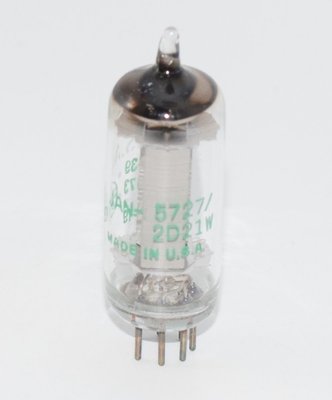
Introduction and History
The 2D21W is a ruggedized, xenon-filled, four-electrode thyratron manufactured originally by Tung-Sol Electric Inc. at their Electron Tube Division in Bloomfield, New Jersey. The datasheet is dated December 1, 1958, and was published as Plate #5371/#5372 under the heading "Tentative Data," indicating it was a relatively new or recently revised type at the time of publication.
The 2D21W is electrically equivalent to the popular type 2D21 but has been specifically ruggedized through the use of ceramic insulators and stronger internal elements to permit the tube to withstand high impact shocks and vibration. This ruggedization made it ideal for military and industrial applications where reliability under harsh conditions was paramount. The 'W' suffix typically denotes a ruggedized military-grade version in the American tube designation system.
As a thyratron, the 2D21W belongs to a class of gas-filled tubes that function as high-speed switches rather than linear amplifiers. Once the tube is triggered (fired) by a positive-going signal on the control grid, the xenon gas ionizes and the tube conducts heavily — and critically, the grid loses control of conduction. The tube can only be turned off by removing or reversing the anode voltage. This characteristic makes thyratrons fundamentally different from vacuum tubes used in audio amplification, and places them in the realm of switching, relay, pulse modulation, and grid-controlled rectifier applications.
The tube was manufactured by several companies over its production life, including Tung-Sol, General Electric (GE), and Mullard in the United Kingdom. JAN (Joint Army-Navy) specification versions were produced for military procurement, and NOS (New Old Stock) examples from GE and Mullard remain available on the surplus market today.
Technical Specifications and Design
Heater / Filament Data
| Parameter | Value |
|---|---|
| Heater Voltage | 6.3 ±10% Volts (AC or DC) |
| Heater Current (at Ef = 6.3V) | 0.600 Amps |
| Minimum Cathode Heating Time | 10 seconds |
Note: The ±10% heater voltage tolerance applies specifically to pulse modulator service. For standard relay and grid-controlled rectifier service, the standard 6.3V nominal applies.
Interelectrode Capacitances
| Parameter | Value |
|---|---|
| Anode to Control Grid Capacitance | 0.026 µµF |
| Control Grid to Cathode (& Shield Grid) Capacitance | 2.4 µµF |
| Anode to Cathode (& Shield Grid) Capacitance | 1.6 µµF |
Timing Characteristics
| Parameter | Conditions | Value |
|---|---|---|
| De-ionization Time (approx.) | Shield tied to cathode, Grid Volts = −100, Grid Res. = 1000Ω, Anode Volts = 125, Anode Cur. = 0.1A | 35 µseconds |
| De-ionization Time (approx.) | Grid Volts = −10, Grid Res. = 1000Ω, Anode Volts = 125, Anode Cur. = 0.1A | 75 µseconds |
| Ionization Time (approx.) | — | 0.5 µseconds |
Other Electrical Data
| Parameter | Value |
|---|---|
| Anode Voltage Drop (approx.) | 8 Volts |
| Maximum Critical Grid Current (at Ebb = 460V, RMS) | 0.5 µAmps |
Absolute Maximum Ratings
Relay & Grid Controlled Rectifier Service
| Parameter | Value |
|---|---|
| Max Peak Inverse Anode Voltage | 1300 Volts |
| Max Peak Forward Anode Voltage | 650 Volts |
| Max Peak Cathode Current | 0.5 Amps |
| Max Average Cathode Current | 100 mA |
| Max Surge Current (0.1 sec duration) | 10 Amps |
| Max Average Time | 30 seconds |
| Max Negative Control Grid Voltage (before conduction) | −100 Volts |
| Max Negative Control Grid Voltage (during conduction, avg. over 30 sec) | −10 Volts |
| Max Positive Control Grid Current (average) | 10 mA |
| Max Negative Shield Grid Voltage (before conduction) | −100 Volts |
| Max Negative Shield Grid Voltage (during conduction, avg. over 30 sec) | −10 Volts |
| Max Positive Shield Grid Current (average) | 10 mA |
| Max Heater-Cathode Voltage (negative) | −100 Volts |
| Max Heater-Cathode Voltage (positive) | 25 Volts |
| Ambient Temperature Limits | −75 to +90 °C |
| Max Control Grid (G1) Circuit Resistance | 10 Megohms |
Pulse Modulator Service
| Parameter | Value |
|---|---|
| Max Peak Inverse Anode Voltage | 100 Volts |
| Max Peak Forward Anode Voltage | 500 Volts |
| Max Peak Cathode Current | 10 Amps |
| Max Average Cathode Current | 10 mA |
| Max Negative Control Grid Voltage (before conduction) | −100 Volts |
| Max Negative Control Grid Voltage (during conduction, avg. over 30 sec) | −10 Volts |
| Max Positive Control Grid Current (peak) | 20 mA |
| Max Negative Shield Grid Voltage (before conduction) | −50 Volts |
| Max Negative Shield Grid Voltage (during conduction, avg. over 30 sec) | −10 Volts |
| Max Positive Shield Grid Current (peak) | 20 mA |
| Max Frequency | 500 PPS |
| Max Pulse Time | 5 µseconds |
| Max Rate of Rise | 100 Amps per µsecond |
| Max Heater-Cathode Voltage (negative) | 0 Volts |
| Max Heater-Cathode Voltage (positive) | 0 Volts |
| Ambient Temperature Limits | −75 to +90 °C |
| Max Control Grid (G1) Circuit Resistance | 0.5 Megohms |
| Max Shield Grid (G2) Circuit Resistance | 25,000 Ohms |
| Min Shield Grid (G2) Circuit Resistance | 2,000 Ohms |
Important Note: As a thyratron, the 2D21W does not have conventional amplification parameters such as amplification factor (µ), transconductance (gm), or plate resistance (rp). These parameters are meaningful for vacuum tubes operating in the linear amplification region. Thyratrons are gas-filled switching devices — once ionized, the grid has no control over the magnitude of current flow, and the tube presents a near-constant voltage drop (approximately 8 volts for the 2D21W) regardless of current. The concept of "gain" does not apply in the conventional sense.
Physical / Mechanical Data
| Parameter | Value |
|---|---|
| Bulb Type | T-5 1/2 |
| Base Type | Miniature Button 7-Pin (B7G / 7BN) |
| Maximum Overall Length | 2.13 inches |
| Maximum Seated Length | 1.88 inches |
| Maximum Diameter | 0.75 inches |
| Maximum Shock Rating | 720 G |
| Mounting Position | Any |
| Weight (net) | 0.5 ounces |
Pinout (Bottom View, 7-Pin Miniature Base)
Based on the Tung-Sol datasheet base diagram (7BN base):
- Pin 1: Shield Grid (G2)
- Pin 2: Heater (H)
- Pin 3: Anode (Plate) (P)
- Pin 4: Control Grid (G1) — (Note: Pins 5 and 7 may be connected to reduce effective anode-to-control-grid capacitance by connecting the grid resistor directly at the socket terminal)
- Pin 5: Control Grid (G1) connection
- Pin 6: Shield Grid (G2)
- Pin 7: Heater (H)
- Center: Cathode (K)
Note: The datasheet indicates that the effective anode to control grid capacity may be reduced by connecting pins #5 & #7 to #2 and connecting the grid resistor directly at the socket terminal. Users should verify pin assignments against the specific manufacturer's datasheet for their production lot.
Applications and Usage
The 2D21W was designed for three primary categories of service, as detailed in the Tung-Sol datasheet:
1. Relay and Switching Service
The thyratron's ability to switch from a non-conducting to a fully conducting state with a very small grid signal made it ideal as an electronic relay. A tiny control signal (in the microampere range) on the grid could switch hundreds of milliamps of anode current. This was particularly valuable in industrial control systems, automated machinery, and instrumentation where a high-impedance sensor (such as a phototube) needed to control a relatively high-current load.
2. Grid-Controlled Rectifier Service
In this application, the 2D21W was used in AC power control circuits. By varying the phase angle at which the grid signal fires the thyratron during each positive half-cycle of the AC supply, the average DC output voltage could be precisely controlled. This is conceptually similar to modern SCR (Silicon Controlled Rectifier) phase-angle control. The tube could handle peak inverse voltages up to 1300 volts in this service.
3. Pulse Modulator Service
The 2D21W's fast ionization time (approximately 0.5 µseconds) and relatively fast de-ionization time (35–75 µseconds depending on conditions) made it suitable for generating short, high-current pulses. In pulse modulator service, the tube could deliver peak cathode currents up to 10 amps with pulse durations up to 5 µseconds at repetition rates up to 500 pulses per second. This was critical in radar transmitter modulators and other pulsed RF applications.
4. Phototube Interface
The datasheet specifically notes that because of its shield grid construction, the input of the 2D21W will work directly from a high impedance source such as a phototube. The extremely low anode-to-control-grid capacitance (0.026 µµF) minimizes feedback from the anode circuit to the sensitive grid input, allowing reliable triggering from very weak signals.
5. Military and Ruggedized Applications
With a shock rating of 720 G and an operating temperature range of −75 to +90°C, the 2D21W was specifically designed for military equipment, airborne electronics, shipboard systems, and any application subject to severe mechanical stress. The JAN (Joint Army-Navy) specification versions were standard procurement items for U.S. military electronics.
Sound Characteristics
It is important to state clearly that the 2D21W is not an audio amplification tube. As a gas-filled thyratron, it operates as a binary switch — either fully off or fully conducting — and does not possess the linear transfer characteristics required for audio signal amplification. There is no meaningful way to describe its "sound" in the way one would characterize a 12AX7, 6L6, or EL34.
That said, thyratrons like the 2D21W do produce characteristic sounds in certain contexts:
- Firing noise: The ionization event produces a brief, sharp electrical transient. In circuits where this transient couples into audio paths, it manifests as a distinctive "tick" or "snap" — a sharp, percussive artifact.
- Gas discharge glow: While not a sound characteristic per se, the visible purple-blue xenon glow during conduction is an iconic visual element that has attracted interest from experimental artists and musicians.
- Relaxation oscillator tones: When used in simple relaxation oscillator circuits (a common experimental configuration), the 2D21W produces sawtooth waveforms with a raw, buzzy, harmonically rich character. The ionization and de-ionization cycle creates waveforms with sharp transitions and significant harmonic content, producing tones that are often described as aggressive, raspy, and distinctly "electronic" in a vintage sense.
- Noise characteristics: Gas tubes inherently produce more electrical noise than high-vacuum tubes. The random nature of gas ionization introduces a broadband noise component that some experimental sound designers find useful as a texture element.
In summary, while the 2D21W has no role as a conventional audio amplifier, its switching behavior and gas-discharge characteristics give it a unique sonic fingerprint when deliberately employed in sound-generating circuits.
Equivalent or Substitute Types
| Type | Notes |
|---|---|
| 2D21 | The direct non-ruggedized equivalent. Electrically identical but uses standard (non-ruggedized) construction. Fully interchangeable in terms of pinout and electrical characteristics, but not suitable for high-shock or high-vibration environments. |
| CV2876 | British CV (Common Valve) designation equivalent to the 2D21W. Direct substitute with identical specifications. |
| CV4018 | Another British CV designation for the ruggedized 2D21W. Mullard UK production examples are known under this designation. Direct substitute. |
All of the above types share the same miniature 7-pin (B7G) base and identical pinout. No adapter or bias changes are required when substituting between these types.
Note: The 2D21/2D21W should not be confused with other small thyratrons such as the 2050 or 884, which have different base types (octal), different gas fills, and different electrical ratings. While they serve similar functional roles, they are not pin-compatible or directly interchangeable.
Notable Characteristics
- Exceptional ruggedness: The 720 G shock rating is remarkable for a glass-envelope tube and reflects the ceramic insulator and reinforced element construction. This made the 2D21W one of the most mechanically robust miniature thyratrons available.
- Extreme temperature range: Operating from −75°C to +90°C, the 2D21W could function in arctic, desert, and high-altitude environments without derating.
- Very low control grid capacitance: At 0.026 µµF anode-to-control-grid, the shield grid construction provides exceptional isolation, enabling direct interfacing with high-impedance sources like phototubes without buffer amplifiers.
- Xenon gas fill: Unlike hydrogen or mercury-vapor thyratrons, the xenon fill provides stable operation across a wide temperature range without the warm-up and condensation issues associated with mercury vapor types.
- Fast ionization: The 0.5 µsecond ionization time enabled use in pulse circuits requiring rapid switching.
- Tiny form factor: At only 0.75 inches in diameter, 2.13 inches tall, and weighing just 0.5 ounces, the 2D21W packed significant switching capability into a remarkably small package.
- Any mounting position: Unlike mercury-vapor thyratrons which required specific orientations, the xenon-filled 2D21W could be mounted in any position — a critical advantage for airborne and mobile equipment.
- Shield grid construction: The four-electrode design (cathode, control grid, shield grid, anode) provides an additional degree of control and isolation not available in simpler three-electrode thyratrons.
Usage in the Audio Community
Despite being fundamentally a switching device rather than an audio tube, the 2D21W has found a niche following in the experimental audio and electronic music communities:
Relaxation Oscillators and Tone Generators
The most common audio application for the 2D21W is in thyratron relaxation oscillator circuits. In this configuration, a capacitor charges through a resistor until the voltage reaches the thyratron's firing point, at which point the tube ionizes and rapidly discharges the capacitor. The cycle then repeats, producing a sawtooth waveform. The frequency is determined by the RC time constant and the tube's firing voltage, which can be adjusted via the control grid bias. These oscillators produce raw, harmonically rich tones that are prized by experimental musicians and synthesizer enthusiasts for their distinctly vintage electronic character.
Experimental Synthesizer Modules
DIY synthesizer builders have incorporated the 2D21W and its non-ruggedized sibling the 2D21 into custom oscillator modules, trigger generators, and clock sources. The visible xenon glow adds a dramatic visual element to modular synthesizer setups, and the tube's switching behavior can generate gate and trigger signals with characteristics different from solid-state equivalents.
Sound Art and Installation Work
Sound artists have used banks of thyratrons including the 2D21W in installations where the visual spectacle of glowing gas tubes is combined with the electrical artifacts of their switching behavior to create audiovisual experiences. The unpredictable micro-timing variations inherent in gas ionization add an organic, non-deterministic quality that appeals to artists working at the intersection of electronics and sound.
Vintage Equipment Restoration
The 2D21W appears in various pieces of vintage test equipment, early computer systems, and industrial control equipment that audio enthusiasts sometimes repurpose or restore. NOS examples from GE (JAN specification) and Mullard (CV4018 designation) remain available from surplus dealers and are sought after for maintaining these vintage systems in operational condition.
Collectibility
Among tube collectors, the 2D21W is a moderately collectible type. Mullard CV4018 examples with their distinctive branding command a modest premium. JAN-specification GE examples are more commonly available. The tube's small size, attractive xenon glow, and military heritage make it an appealing display piece even for collectors who have no immediate application for it.
It must be emphasized that the 2D21W is not suitable as a substitute for conventional audio amplifier tubes. It cannot be used in place of signal tubes like the 12AX7 or power tubes like the 6V6, despite sharing the same 7-pin miniature base format. Attempting to use a thyratron in an audio amplifier circuit designed for a vacuum tube would result in no useful audio output and could potentially damage the associated circuitry due to the thyratron's high-current switching behavior.