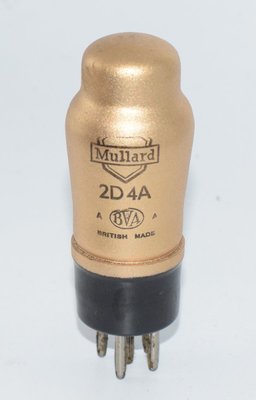
1. Introduction and History
The 2D4A is a miniature gas-filled thyratron tube (valve) developed primarily in the United Kingdom. Manufactured by Mullard among other British and European valve makers, the 2D4A was designed as a small, reliable gas-discharge switching device intended for use in timing circuits, relay-replacement applications, and industrial control systems. The tube carries the UK military/government cross-reference designation CV795, confirming its adoption into British military and telecommunications equipment where proven reliability was essential.
Thyratrons like the 2D4A occupy a unique niche in vacuum tube history. Unlike conventional amplifying valves (triodes, pentodes, etc.), thyratrons are gas-filled devices that function as electronic switches. Once the grid triggers conduction, the tube "fires" and the grid loses control — current flow can only be stopped by removing or reducing the anode (plate) voltage below the ionization sustaining level. This behavior made thyratrons indispensable in early electronic control systems, motor drives, radar modulators, and timing circuits before the advent of solid-state thyristors (SCRs).
The 2D4A represents a later-generation miniature thyratron, benefiting from advances in gas-fill technology and miniature glass envelope construction that emerged in the post-World War II era. Its compact form factor and relatively modest power requirements made it suitable for integration into smaller equipment where earlier, larger thyratrons would have been impractical.
2. Technical Specifications and Design
The 2D4A is a gas-filled triode thyratron. Below are the key specifications. Note: Because detailed manufacturer datasheets for this relatively obscure type are not widely digitized, some values below are based on available references and cross-referencing with the CV795 military specification. Values marked with an asterisk (*) should be confirmed against an original Mullard or CV795 datasheet for critical applications.
General Characteristics
| Parameter | Value |
|---|---|
| Tube Type | Gas-filled Triode Thyratron |
| Manufacturer(s) | Mullard (UK), others under CV795 specification |
| Military/CV Designation | CV795 |
| Gas Fill | Inert gas (likely xenon or argon-based)* |
| Envelope Type | Miniature glass envelope (similar to B7G/miniature noval family)* |
| Base Type | B7G (miniature 7-pin) — to be confirmed against original datasheet* |
| Mounting Position | Typically any, consult datasheet for specific restrictions* |
Heater / Filament Ratings
| Parameter | Value |
|---|---|
| Heater Voltage (Vf) | Approximately 6.3 V* |
| Heater Current (If) | Approximately 0.6 A* |
| Heater Type | Indirectly heated cathode |
Maximum Ratings (Absolute Maximum)
| Parameter | Value |
|---|---|
| Peak Anode (Plate) Voltage | Approximately 650 V peak (forward)* |
| Peak Inverse Anode Voltage | Approximately 1300 V* |
| Mean Anode Current | Approximately 25–50 mA* |
| Peak Anode Current | Approximately 200–500 mA* |
| Grid Voltage (pre-conduction) | Negative bias range, typically −2 V to −10 V for firing control* |
Important Note: As a thyratron, the 2D4A does not have conventional amplification parameters (μ, gm, rp) in the way that linear amplifying tubes do. The grid in a thyratron serves only to initiate conduction — once the tube fires, the grid has no further control over plate current. Therefore, specifications like amplification factor (μ), transconductance (gm), and plate resistance (rp) are not applicable in the traditional sense. Instead, thyratrons are characterized by their grid-control characteristics (the relationship between grid voltage and the anode voltage at which firing occurs), deionization time, and anode delay time.
Pin-Out
The 2D4A is believed to use a B7G (miniature 7-pin) base. A typical thyratron pin assignment on this base would be:
- Pin 1: Not connected or internal shield*
- Pin 2: Grid
- Pin 3: Cathode / Heater
- Pin 4: Heater
- Pin 5: Anode (Plate)
- Pins 6, 7: Various connections (cathode, shield, or NC)*
The exact pin-out should be verified against the original Mullard 2D4A or CV795 datasheet, as thyratron pinouts can vary from standard triode conventions.
3. Applications and Usage
The 2D4A thyratron was designed for and used in a variety of electronic switching and control applications:
- Timing Circuits: Thyratrons were widely used in time-delay and timing circuits. The 2D4A could be configured with an RC network on the grid to provide precise, repeatable time delays before firing.
- Relay Replacement: In applications where mechanical relays were too slow, unreliable, or subject to contact bounce, the 2D4A provided a solid (no moving parts) electronic switching solution.
- Motor Control and Power Switching: Used in phase-controlled circuits for controlling AC power to motors, heaters, and other loads — functioning in a role analogous to modern SCRs (silicon-controlled rectifiers).
- Radar and Pulse Circuits: Small thyratrons like the 2D4A found use in radar modulators and pulse-forming networks where fast, high-current switching was required.
- Counting and Scaling Circuits: Before digital electronics, thyratrons were used in electronic counters and decade scaling circuits, particularly in nuclear instrumentation.
- Military and Telecommunications Equipment: The CV795 designation confirms its use in British military electronics, likely in fire control systems, communication equipment, and instrumentation.
- Crowbar Protection Circuits: Thyratrons could serve as overvoltage protection devices, rapidly shorting a power supply to protect sensitive downstream equipment.
4. Sound Characteristics
It is important to note that the 2D4A is not a linear amplifying tube — it is a gas-filled thyratron designed for switching applications. As such, it does not have "sound characteristics" in the way that audio triodes (e.g., 300B, 12AX7) or pentodes (e.g., EL34, 6L6) do. The tube operates in a binary fashion: it is either non-conducting or fully conducting, with no linear region suitable for audio amplification.
That said, thyratrons have found niche use in the experimental audio and electronic music communities, where their unique properties are exploited for creative purposes:
- Relaxation Oscillators: When used in sawtooth or relaxation oscillator circuits, thyratrons produce a distinctive raw, buzzy tone. The waveform is rich in harmonics due to the sharp, abrupt discharge characteristic of the gas-filled tube. The sound is often described as aggressive, raspy, and primitive — quite different from the smooth sine-wave oscillations of conventional vacuum tube oscillators.
- Characteristic "Snap": The ionization and deionization of the gas fill produces a characteristic snapping or clicking sound when used at audio-rate frequencies, which some electronic musicians find appealing for percussive synthesis.
- Warm, Unstable Character: Gas-filled tubes are inherently less stable than their vacuum counterparts. Temperature, aging, and gas pressure variations cause subtle pitch and timing drift, lending an organic, unpredictable quality that appeals to experimental musicians seeking "living" electronic sounds.
- Purple/Blue Glow: While not a sonic characteristic, the visible ionization glow of a firing thyratron adds a dramatic visual element to any audio installation or performance.
In summary, the 2D4A's "sound" is not one of hi-fi audio reproduction but rather of raw electronic tone generation — a tool for sound synthesis rather than sound amplification.
5. Equivalent or Substitute Types
| Type | Relationship | Notes |
|---|---|---|
| CV795 | Direct equivalent (military designation) | This is the UK military/government specification number for the 2D4A. Electrically and physically identical; fully interchangeable. |
Caution: Other miniature thyratrons exist (e.g., 2D21, 5727, PL21, etc.), and while they may share similar base types and general operating principles, they are not confirmed as direct substitutes for the 2D4A without careful comparison of grid-control characteristics, maximum ratings, and pin-out. The 2D21/5727 family, for example, is a well-known American miniature thyratron with a B7G base, but differences in gas fill, firing characteristics, and maximum ratings may exist. Do not assume interchangeability without consulting both datasheets.
Potentially related types that warrant investigation (but are not confirmed as drop-in replacements):
- 2D21 / 5727: American miniature gas thyratron, B7G base. Similar class of device but verify specifications before substituting.
- PL21: European designation for a similar miniature thyratron. Cross-reference carefully.
6. Notable Characteristics
- Gas-Filled Operation: Unlike vacuum tubes, the 2D4A contains a controlled gas fill that ionizes during conduction. This gives the tube its characteristic switching behavior and visible glow during operation.
- Grid Loses Control After Firing: This is the defining characteristic of all thyratrons. Once the anode voltage exceeds the firing threshold (as determined by the grid bias), the gas ionizes and current flows. The grid cannot stop conduction — only reducing the anode current below the holding level (or reversing/removing anode voltage) will extinguish the discharge.
- Warm-Up Time: The 2D4A requires a warm-up period (typically 30 seconds to several minutes) for the cathode to reach operating temperature before the tube can reliably fire. Applying anode voltage before the cathode is fully heated can damage the cathode coating.
- Deionization Time: After the anode current is interrupted, the gas requires a finite time to deionize before the grid can regain control. This limits the maximum operating frequency of the thyratron and is a critical parameter in AC phase-control and pulse applications.
- Limited Lifetime Under Heavy Use: Gas-filled tubes have a finite life that is heavily dependent on operating conditions. Excessive peak currents, improper warm-up procedures, or operation outside rated conditions can accelerate gas cleanup (absorption of gas by tube elements), leading to erratic firing and eventual failure.
- Miniature Construction: The 2D4A's compact B7G-based design represented an advancement over earlier, larger thyratrons, enabling its use in space-constrained military and industrial equipment.
- NOS Availability: The 2D4A is available as New Old Stock (NOS), primarily from Mullard UK production. As a relatively specialized type, it is less commonly encountered than mainstream audio tubes but can be found through specialist vintage component dealers.
7. Usage in the Audio Community
The 2D4A's role in the audio community is decidedly unconventional. It is not a tube that audiophiles use in hi-fi amplifiers or preamplifiers. However, it has found a dedicated following in several niche areas:
Electronic Music and Sound Synthesis
The most significant audio application of thyratrons like the 2D4A is in vintage-style electronic sound synthesis. Pioneering electronic musicians and instrument builders in the mid-20th century used thyratron relaxation oscillators as tone generators. The 2D4A can be configured as a sawtooth oscillator by connecting it with a capacitor and resistor network — the capacitor charges through the resistor until the thyratron fires, rapidly discharging the capacitor, and the cycle repeats. This produces a sawtooth waveform whose frequency is determined by the RC time constant and the tube's firing voltage.
Modern builders of "tube synthesizers" and experimental electronic instruments sometimes seek out thyratrons like the 2D4A specifically for their raw, unpredictable tonal character. The sound is fundamentally different from transistor or op-amp-based oscillators — it carries the inherent instability and warmth associated with gas-discharge physics.
Art Installations and Visual/Audio Projects
The visible gas discharge glow of a firing thyratron makes the 2D4A appealing for audio-visual art installations where the visual behavior of the tube is synchronized with or responsive to sound. Artists working at the intersection of electronics, sound, and visual art appreciate the tangible, physical nature of gas-tube electronics.
Historical Restoration
Collectors and restorers of vintage military and industrial electronic equipment may need 2D4A / CV795 tubes to restore original equipment to working condition. While not strictly an "audio" application, some of this equipment (e.g., vintage test oscillators, signal generators) has audio-related functions.
Educational and Hobbyist Use
Electronics hobbyists and educators use thyratrons like the 2D4A to demonstrate gas-discharge physics, thyratron switching principles, and the historical foundations of power electronics (the thyratron being the direct ancestor of the silicon-controlled rectifier). Building a simple thyratron oscillator is an engaging project that produces both audible and visible results.
Community Perception
Within the broader audio tube community, the 2D4A is regarded as a curiosity — a fascinating piece of electronic history rather than a practical audio component. It does not appear in amplifier tube rolling discussions or audiophile equipment reviews. Its appeal lies in its uniqueness, its connection to the early history of electronic music, and the sheer satisfaction of working with a technology that bridges the gap between vacuum tubes and modern semiconductor power switches.
For those interested in acquiring 2D4A tubes, NOS Mullard examples occasionally appear from UK-based vintage valve dealers. The CV795 military equivalent may also be found through surplus electronics channels. As with all NOS gas-filled tubes, it is advisable to test before use, as gas cleanup during long storage periods can occasionally affect performance.