Introduction and History
The 30A5 is an output pentode vacuum tube (valve) designed specifically for use in receivers operating from low mains voltages. It was registered under JETEC release #1699, dated July 30, 1956, with Rogers Electronic Tubes of Toronto, Canada serving as the sponsor. The datasheet was published on April 28, 1956, placing this tube firmly in the mid-1950s era of consumer electronics design.
The 30A5 belongs to a family of tubes engineered for series-string heater operation in AC/DC radio and television receivers, where a power transformer was omitted to reduce cost and weight. Its 30-volt heater was designed to be wired in series with other tubes in the receiver's heater chain, drawing current directly from the mains supply. This approach was common in economical consumer sets of the 1950s and early 1960s, particularly in portable and table-model radios and small television sets sold in North America and other markets with 117V AC mains.
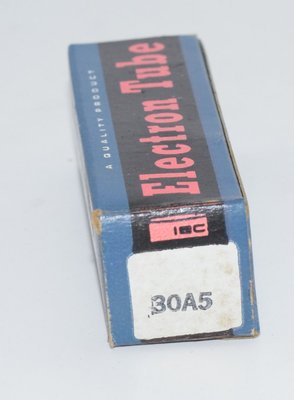
The tube was manufactured by several companies, including Japanese manufacturers who produced NOS (New Old Stock) examples that remain available on the surplus market today. As a purpose-built output stage for modest power applications, the 30A5 represents a practical and efficient design philosophy typical of its era.
Technical Specifications and Design
Mechanical Data
| Parameter | Value |
|---|---|
| Tube Type | Output Pentode |
| Cathode | Coated unipotential |
| Base | E7-1 |
| Bulb | T5½ |
| RETMA Basing Designation | 7 CV |
| Mounting Position | Any |
| Maximum Overall Diameter | ¾ inch |
| Maximum Overall Height | 2⅝ inches |
| Maximum Seated Height | 2⅛ inches |
Pin Configuration (Bottom View of Base)
| Pin Number | Element |
|---|---|
| 1 | Cathode, Grid No. 3 |
| 2 | Grid No. 1 (Control Grid) |
| 3 | Heater |
| 4 | Heater |
| 5 | Grid No. 1 (Control Grid) |
| 6 | Grid No. 2 (Screen Grid) |
| 7 | Plate |
Note that Grid No. 1 (the control grid) is connected to both pins 2 and 5, and the cathode is internally tied to Grid No. 3 (the suppressor grid) at pin 1.
Heater Data
| Parameter | Value |
|---|---|
| Heater Voltage | 30 volts |
| Heater Current | 150 mA |
Direct Interelectrode Capacitances
| Parameter | Value |
|---|---|
| Plate to all other elements | 5.8 pF |
| Grid No. 1 to all other elements | 12 pF |
| Plate to Grid No. 1 | 0.3 pF |
| Grid No. 1 to heater | 0.4 pF |
Maximum Ratings (Design Center Values)
| Parameter | Value |
|---|---|
| Plate Voltage | 150 volts |
| Plate Voltage (without current) | 550 volts |
| Plate Dissipation | 7.5 watts |
| Grid No. 2 Voltage | 150 volts |
| Grid No. 2 Voltage (without current) | 550 volts |
| Grid No. 2 Dissipation | 1.5 watts |
| Peak Grid No. 2 Dissipation During Drive | 2.5 watts |
| Cathode Current | 100 mA |
| Grid No. 1 Circuit Resistance (with automatic bias) | 1 megohm |
| Voltage Between Heater and Cathode | 150 volts |
Operating Characteristics
The following operating characteristics are specified at the design center operating point:
| Parameter | Value |
|---|---|
| Plate Voltage | 100 volts |
| Grid No. 2 Voltage | 100 volts |
| Grid No. 1 Voltage | −6.7 volts |
| Zero Signal Plate Current | 43.0 mA |
| Maximum Signal Plate Current | 43.0 mA |
| Zero Signal Grid No. 2 Current | 3.0 mA |
| Maximum Signal Grid No. 2 Current | 11 mA |
| Transconductance (gm) | 9200 micromhos (9.2 mA/V) |
| Plate Resistance (rp) | 22,000 ohms |
| Amplification Factor of Grid No. 2 with respect to Grid No. 1 | 7.8 |
| Plate Load Resistance | 2400 ohms |
| Output Power at 10% Distortion | 1.9 watts |
| Required Input A.F. Voltage | 4.3 volts rms |
| Required Input A.F. Voltage at 50 mW Output | 0.55 volts rms |
The amplification factor (μ) of the tube can be derived from the relationship μ = gm × rp, which yields approximately 202. However, the datasheet specifies the amplification factor of Grid No. 2 with respect to Grid No. 1 as 7.8, which represents the screen-to-control-grid mu factor characteristic of pentode operation.
Applications and Usage
The 30A5 was designed as an audio output pentode for use in receivers operating from low mains voltages. Its primary applications included:
- AC/DC Radio Receivers: The tube's 30-volt, 150 mA heater made it ideal for series-string heater circuits in transformerless radio receivers. These sets were common in the 1950s as economical table radios and portable receivers.
- Small Television Audio Output: In compact television receivers of the era, the 30A5 could serve as the audio output stage, delivering nearly 2 watts of audio power — sufficient for the small speakers used in these sets.
- Low-Voltage Equipment: The tube's ability to operate with plate and screen voltages as low as 100 volts made it suitable for equipment powered from low-voltage DC supplies or rectified low-voltage AC mains, such as those found in some international markets.
In its typical operating configuration with 100V on both the plate and screen grid, a bias of −6.7V on the control grid, and a 2400-ohm plate load resistance, the 30A5 delivers 1.9 watts of output power at 10% total harmonic distortion. At lower drive levels, the tube requires only 0.55 volts rms input to produce 50 milliwatts of output — demonstrating good sensitivity for use with simple detector or preamplifier stages.
The plate characteristic curves provided in the datasheet show the tube's behavior with Grid No. 2 voltage at 100 volts, with the 7.5-watt plate dissipation limit clearly marked. The performance curves also detail the relationship between input AF voltage, plate current, grid No. 2 current, total harmonic distortion, and power output at the specified operating point with a 2400-ohm AC load resistance.
Sound Characteristics
The 30A5, like many output pentodes designed for consumer radio service, has a distinctive sonic character that reflects both its electrical design and its intended application in modest audio systems. While it was never designed as a high-fidelity output tube, its sonic qualities are noteworthy:
- Warm Midrange Presence: Operating at relatively low plate voltages (100V), the 30A5 produces a characteristically warm midrange that is typical of pentodes running in this voltage range. The midrange has a forward, present quality that suits voice reproduction — exactly what was needed in AM radio receivers.
- Harmonic Distortion Character: At its rated 1.9 watts output, the tube operates at 10% THD, which is substantial by high-fidelity standards. However, at lower power levels the distortion drops considerably. The harmonic content is predominantly second and third order, lending a musical quality to the distortion that many listeners find pleasant rather than harsh.
- Limited Bass Extension: The relatively low plate voltage and modest plate dissipation (7.5 watts maximum) mean that the 30A5 does not deliver the deep, authoritative bass response of larger output tubes. Bass tends to be warm but somewhat soft and lacking in ultimate extension and control.
- Treble Roll-Off: The interelectrode capacitances (plate to all other elements at 5.8 pF, grid No. 1 to all other elements at 12 pF) contribute to a natural high-frequency roll-off that softens the treble. This gives the tube a smooth, non-fatiguing top end that is forgiving of poor source material.
- Dynamic Character: With a transconductance of 9200 micromhos, the 30A5 is quite responsive to input signals. It has a lively, dynamic quality at low to moderate listening levels, though it compresses noticeably as it approaches its maximum output capability.
- Overall Tonal Signature: The 30A5 is best described as having a "vintage radio" sound — warm, intimate, and slightly colored. It excels at reproducing voice and simple musical material with a nostalgic, engaging quality. It lacks the transparency and linearity of premium audio output tubes but compensates with character and charm.
Equivalent or Substitute Types
Finding direct substitutes for the 30A5 requires careful attention to specifications, as this tube occupies a somewhat specialized niche:
- 30C5: This is listed as a different-rating substitute for the 30A5. The 30C5 shares the same 30-volt heater voltage and similar general application as an output tube for series-string receivers. However, it is not a direct drop-in replacement — there are differences in ratings and possibly pinout that must be verified against the specific circuit requirements. The 30C5 may have different bias requirements and operating characteristics.
- HL94: Also listed as a different-rating substitute. The HL94 is a European designation tube that shares some functional overlap with the 30A5 but again is not a direct drop-in equivalent. Pin configuration and electrical ratings should be carefully compared before substitution.
Important Note: Neither the 30C5 nor the HL94 should be considered true drop-in replacements for the 30A5 without careful verification of pinout, heater ratings, bias requirements, and maximum ratings in the specific circuit application. Designers and hobbyists should consult the datasheets for all three types before attempting any substitution.
There are no widely recognized direct, pin-compatible equivalents for the 30A5 with identical ratings. If sourcing this tube, NOS examples manufactured in Japan are known to exist on the surplus market.
Notable Characteristics
- Series-String Heater Design: The 30-volt, 150 mA heater is specifically designed for series-string operation in transformerless receivers. The 150 mA heater current was a common standard in the 150 mA heater string family of tubes, allowing it to be wired in series with other 150 mA tubes such as the 12BE6, 12BA6, 12AV6, and 35W4.
- High Transconductance: At 9200 micromhos, the 30A5 offers excellent transconductance for its class, providing good sensitivity and gain. This high gm means the tube requires relatively little input signal to produce useful output power.
- Low Operating Voltages: The design center operating point of only 100 volts on both plate and screen makes this tube well-suited to simple, low-voltage power supply designs. The 550-volt rating for plate and screen voltage without current flow provides a generous safety margin during warm-up in series-string circuits.
- Dual Control Grid Pins: Grid No. 1 is brought out to two pins (2 and 5), which is a common technique in output tubes to reduce lead inductance and improve high-frequency performance. This dual connection also provides circuit design flexibility.
- Internal Suppressor Grid Connection: Grid No. 3 (the suppressor grid) is internally connected to the cathode at pin 1, simplifying external circuit connections while maintaining proper pentode operation.
- Compact Envelope: The T5½ bulb and E7-1 base make this a physically small tube, well-suited to the compact chassis designs of portable and table-model receivers.
- Generous Heater-Cathode Voltage Rating: The 150-volt maximum between heater and cathode allows flexible placement in the heater string, accommodating the voltage differences that accumulate in series-connected heater chains.
- Constant Plate Current: Notably, the zero signal and maximum signal plate currents are both specified at 43.0 mA, indicating that the tube operates in a near-constant current mode — the plate current does not increase significantly with signal drive, which is characteristic of a well-designed Class A pentode output stage.
Usage in the Audio Community
The 30A5 occupies a niche position in the modern audio community. It was never a mainstream choice for high-fidelity amplifier construction, but it has found a dedicated following among certain groups of enthusiasts:
Vintage Radio Restoration
The primary demand for 30A5 tubes today comes from vintage radio collectors and restorers. The tube was widely used in American and Canadian AC/DC table radios of the late 1950s and early 1960s, and functioning examples are needed to keep these sets operational. Restorers value NOS (New Old Stock) examples, particularly those manufactured in Japan, for their reliability and consistent performance.
Low-Voltage Experimental Amplifiers
The 30A5's ability to operate at only 100 volts on the plate makes it attractive to hobbyists and DIY audio builders who want to experiment with tube amplification without the hazards of high-voltage power supplies. A simple amplifier built around the 30A5 can operate from a modest, relatively safe power supply while still delivering nearly 2 watts of output — enough to drive efficient speakers to comfortable listening levels in a small room.
"Lo-Fi" and Character Amplifiers
A small but enthusiastic community of audio experimenters deliberately seeks out tubes like the 30A5 for their distinctive sonic character. The warm, colored sound of a low-voltage pentode output stage has an appeal for certain musical applications, particularly for guitar practice amplifiers, desktop listening setups, and experimental sound art. The 10% THD at full output, while unacceptable for high-fidelity reproduction, can be musically useful when the harmonic content is predominantly low-order.
Educational Projects
The 30A5's low operating voltages and simple circuit requirements make it an excellent choice for educational projects introducing students to vacuum tube technology. A complete amplifier can be built with safe voltage levels while demonstrating all the fundamental principles of thermionic amplification.
Limitations in Audio Use
It should be noted that the 30A5 has significant limitations for serious audio applications. Its maximum output of 1.9 watts (at 10% distortion) is modest even by single-ended tube amplifier standards. The relatively high distortion at full output, the limited plate dissipation of 7.5 watts, and the low maximum plate voltage of 150 volts all constrain its performance envelope. For high-fidelity applications, tubes such as the EL84/6BQ5, 6V6, or 6AQ5 are generally preferred, as they offer higher output power, lower distortion, and better-established audio circuit designs.
Nevertheless, the 30A5 retains a certain charm and practicality that ensures its continued relevance in the broader vacuum tube audio community, particularly among those who value simplicity, safety, and vintage character over ultimate performance specifications.