1. Introduction and History
The 30AE3, also known by its European designation PY88, is a miniature booster diode vacuum tube designed primarily for use in line-timebase circuits of transformerless (AC/DC) television receivers. Developed during the late 1950s and into the 1960s, this tube was part of the extensive family of series-heater valves that allowed television manufacturers to eliminate the costly mains transformer from their receiver designs. The "30" prefix in the American designation indicates a 30-volt heater, designed to be wired in series with other tubes in the heater chain of AC/DC television sets.
The PY88 designation follows the Mullard–Philips European Pro Electron naming convention: "P" denotes a 300 mA series heater, "Y" indicates a half-wave rectifier (booster diode), and "88" places it in the miniature noval envelope family. The tube was manufactured by numerous companies including Philips/Miniwatt, Mullard, Valvo, Amperex, and various Eastern European manufacturers. It served as a critical component in the horizontal deflection circuits of millions of television receivers throughout Europe and other markets where transformerless TV designs were prevalent.
The 30AE3/PY88 was assigned the NATO/military codification CV10460, indicating its acceptance for use in military and government equipment specifications.
2. Technical Specifications and Design
General Description
The 30AE3/PY88 is a miniature-type half-wave rectifier (booster diode) used in line-timebase circuits of transformerless television receivers. It features a noval (B9A) miniature 9-contact base and a compact glass envelope classified under Outlines section 7D.
Heater Ratings
| Parameter | Value | Unit |
|---|---|---|
| Heater Voltage (AC/DC) | 30 | volts |
| Heater Current | 0.3 | ampere |
| Maximum Heater-Cathode Voltage (Peak) | ±6600 | volts |
The exceptionally high heater-cathode voltage rating of 6600 volts peak is a defining characteristic of this tube, reflecting its role in circuits where large voltage swings are present across the booster diode during horizontal flyback pulses.
Maximum Ratings (Design-Center Values)
| Parameter | Value | Unit |
|---|---|---|
| Supply Voltage at Zero Current | 550 | volts |
| Supply Voltage | 250 | volts |
| Peak Plate Current | 550 | mA |
| Average Plate Current | 220 | mA |
| Plate Dissipation | 5 | watts |
| Peak Negative-Pulse Plate Voltage* | 6000# | volts |
* Under no conditions should an absolute maximum value of 7500 volts be exceeded.
# The pulse duration must not exceed 22 per cent of a cycle, or a maximum of 18 microseconds.
Pin Configuration (9-Pin Noval / B9A Base — Socket designation 9CB)
| Pin | Connection |
|---|---|
| 1 | Internal Connection (IC) |
| 2 | Internal Connection (IC) |
| 3 | Internal Connection (IC) |
| 4 | Heater (H) |
| 5 | Cathode (K) |
| 6 | Internal Connection (IC) |
| 7 | Internal Connection (IC) |
| 8 | Internal Connection (IC) |
| 9 | Plate (P) |
Important: Pins 1, 2, 3, 6, 7, and 8 are internal connections and must not be connected to external circuitry. These internal connections serve as electrostatic shields and structural supports within the tube, and also help maintain the high voltage insulation required between the heater-cathode and plate structures.
Physical Characteristics
- Base Type: Noval (B9A) — miniature 9-contact
- Envelope: Miniature glass (Outlines section 7D)
- Socket Required: Miniature 9-contact noval socket
- Mounting Position: Any (unless otherwise specified by equipment manufacturer)
Note: As a diode, the 30AE3/PY88 does not have amplification factor (μ), transconductance (gm), or plate resistance (rp) ratings — these parameters apply only to amplifying tubes (triodes, pentodes, etc.). The key performance metric for this tube is its forward voltage drop and peak inverse voltage capability.
3. Applications and Usage
Primary Application: Television Line-Timebase Booster Diode
The 30AE3/PY88 was designed specifically as a booster diode (also called an "efficiency diode" or "damper diode") in the horizontal deflection (line-timebase) circuits of transformerless television receivers. In this role, the tube performs several critical functions:
- Damping: After each horizontal flyback pulse, the deflection yoke and associated circuitry tend to oscillate ("ring"). The booster diode conducts during the first half of the trace period, effectively damping these oscillations and ensuring a clean, linear scan.
- Boosted B+ Supply: During conduction, the booster diode charges a "boost capacitor" to a voltage significantly higher than the main B+ supply. This "boosted B+" voltage is used to supply the horizontal output tube's plate circuit, improving scanning efficiency and enabling adequate deflection with lower B+ supply voltages — particularly important in transformerless designs.
- Energy Recovery: The tube recovers energy stored in the deflection yoke's magnetic field during flyback, returning it to the circuit rather than dissipating it as heat.
Circuit Context
In a typical transformerless television receiver, the 30AE3/PY88 works in conjunction with a horizontal output tube (such as the PL36/25E5 or similar beam power tube) and the horizontal output transformer (flyback transformer). The booster diode is connected between the cathode of the horizontal output tube and the B+ supply, with the boost capacitor completing the circuit. The tube must withstand the large negative-going flyback pulses that appear at its plate — hence the 6000-volt peak negative-pulse plate voltage rating.
Design Considerations
The 30AE3/PY88's 30-volt, 300 mA heater is specifically designed for series-string heater chains in AC/DC (transformerless) television receivers. The heater chain typically includes all tubes in the receiver wired in series, with the total heater voltage drop approximating the mains supply voltage. The extraordinary heater-cathode voltage rating of ±6600 volts peak is essential because the cathode of the booster diode operates at the boosted B+ potential, which can be several hundred volts above chassis ground, while the heater chain is referenced to a different potential.
4. Sound Characteristics
The 30AE3/PY88 is a diode — a rectifier — and as such, it does not amplify audio signals in the conventional sense. It has no control grid and therefore no gain or tonal coloration in the way that triodes, pentodes, or beam power tubes do. Discussions of "sound characteristics" for this tube type must be understood in the specific context of its use as a rectifier in power supply or signal rectification applications.
When used as a rectifier in audio power supplies (a non-standard but occasionally explored application), diodes like the PY88 can influence the overall sound of an amplifier in subtle ways:
- Soft Recovery: Like all vacuum tube rectifiers, the 30AE3/PY88 exhibits a "soft" turn-on characteristic compared to silicon diodes. This means the B+ voltage rises gradually as the tube warms up, providing a gentle start-up for other tubes in the circuit — a feature valued by guitarists and audiophiles for tube longevity.
- Voltage Sag: Under dynamic signal conditions, tube rectifiers exhibit a slight voltage drop ("sag") under heavy current draw. This can create a subtle compression effect that some musicians and listeners find musically pleasing, particularly in guitar amplifier applications.
- Forward Voltage Drop: The tube's forward voltage drop characteristics affect the stiffness of the power supply. A tube rectifier like the PY88 will produce a "softer" power supply compared to solid-state rectification, which can contribute to a perception of warmth and dynamic responsiveness.
However, it must be emphasized that the 30AE3/PY88 was not designed for audio applications, and any sonic assessments in audio contexts are based on experimental or non-standard usage. The tube's high heater-cathode voltage rating and robust construction make it theoretically interesting for certain high-voltage rectification scenarios, but its 30-volt series heater makes it impractical for most conventional audio amplifier designs without special heater supply arrangements.
5. Equivalent and Substitute Types
| Type | Relationship | Notes |
|---|---|---|
| PY88 | Identical (European designation) | Direct equivalent; same tube, different naming convention. The PY88 is the Pro Electron (European) designation for the same device. |
| CV10460 | Identical (Military designation) | NATO/British military codification for the same tube. Fully interchangeable. |
Related but NOT Directly Interchangeable Types
- PY81 / 30AE3's predecessor: An earlier booster diode with similar function but different ratings and potentially different base connections. Not a direct substitute without circuit verification.
- PY800: A later-generation booster diode with improved ratings for color television receivers. While functionally similar, it has different maximum ratings and should not be substituted without consulting the equipment service manual.
- PY801: Similar to PY800 but with different heater-cathode voltage ratings. Not directly interchangeable.
- 6AU4GTA, 6AX4GT, 6DE4: American-type damper diodes with 6.3V heaters — completely different heater requirements and not interchangeable in series-string circuits.
Caution: When substituting tubes in horizontal deflection circuits, exact equivalence is critical. The high voltages and currents involved mean that using an incorrect substitute can result in tube failure, damage to the flyback transformer, or other serious circuit damage. Always verify substitution suitability against the equipment manufacturer's service documentation.
6. Notable Characteristics
Exceptional Heater-Cathode Insulation
The most remarkable specification of the 30AE3/PY88 is its ±6600 volt peak heater-cathode voltage rating. This extraordinary insulation capability is achieved through careful internal construction, including extended leakage paths between the heater/cathode assembly and the use of high-quality insulating materials. The multiple internal connection pins (1, 2, 3, 6, 7, 8) serve partly as electrostatic shields that help maintain this insulation under the extreme voltage stress conditions encountered during horizontal flyback pulses.
High Peak Current Capability
With a peak plate current rating of 550 mA and an average plate current rating of 220 mA, the 30AE3/PY88 is a robust rectifier capable of handling the substantial current demands of television horizontal deflection circuits. The tube must conduct heavily during the first portion of each horizontal scan line to properly damp the deflection yoke oscillations.
Compact Miniature Construction
Despite its high-voltage ratings, the 30AE3/PY88 is housed in a standard miniature noval envelope (7D outline), making it remarkably compact for a tube handling such extreme voltage conditions. This miniaturization was essential for the increasingly compact television receiver designs of the 1960s.
Series-Heater Design
The 30-volt, 300 mA heater is specifically optimized for series-string operation. The 300 mA heater current was a common standard for European transformerless television tube lineups, allowing the 30AE3/PY88 to be used alongside other "P"-series tubes (PL36, PCL82, PCL84, PCF80, etc.) in a single series heater chain.
Reliability Considerations
The booster diode position in a television receiver is one of the most demanding, as the tube is subjected to high peak voltages, significant average currents, and substantial thermal stress. The 30AE3/PY88 was engineered for long life under these conditions, but it was nonetheless one of the more frequently replaced tubes in television service, as degradation of the cathode emission or breakdown of the heater-cathode insulation would cause visible picture defects (reduced width, poor linearity, or complete loss of horizontal scan).
7. Usage in the Audio Community
The 30AE3/PY88 occupies a very niche position in the audio community, as it was never designed or intended for audio applications. However, the creative and experimental nature of the DIY tube audio community has led to some interesting, if unconventional, explorations of this tube type:
Power Supply Rectification (Experimental)
Some adventurous DIY builders have experimented with using the PY88/30AE3 as a rectifier in tube amplifier power supplies. The tube's high peak inverse voltage rating (up to 6000 volts) and substantial current handling capability (220 mA average, 550 mA peak) make it theoretically suitable for rectification duties in high-voltage amplifier power supplies. However, the 30-volt heater presents a significant practical obstacle — it requires either a dedicated heater winding on the power transformer or a separate heater supply, negating much of the convenience of using a standard rectifier tube like the 5U4, 5AR4/GZ34, or 5Y3.
Availability and Cost
One factor that occasionally draws attention to the PY88/30AE3 in audio circles is its relative abundance and low cost. Millions of these tubes were manufactured for the television industry, and large quantities of NOS (New Old Stock) examples remain available from European sources, often at very modest prices compared to sought-after audio tubes. Philips Miniwatt, Mullard, and other premium manufacturers produced high-quality examples that remain readily available.
Guitar Amplifier Modifications
In the guitar amplifier community, where experimentation with rectifier tubes is common to achieve different "sag" and dynamic response characteristics, the PY88 has occasionally been discussed as an alternative rectifier. The tube's robust construction and high voltage ratings are appealing, but again, the 30-volt heater requirement makes practical implementation awkward in most standard guitar amplifier circuits.
Collector and Aesthetic Interest
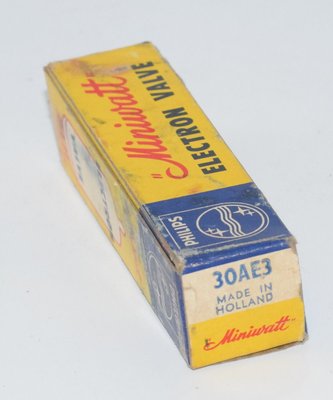
The 30AE3/PY88 is sometimes collected by tube enthusiasts for its historical significance as a representative of the transformerless television era. Philips Miniwatt branded examples, in particular, are appreciated for their quality construction and attractive packaging. Some audio enthusiasts display these tubes as part of broader vacuum tube collections, even if they are not used in active audio circuits.
Practical Limitations for Audio Use
For most practical audio applications, the 30AE3/PY88 remains an impractical choice due to:
- The 30-volt, 300 mA series heater is incompatible with standard 6.3V or 5V audio amplifier heater supplies
- As a diode, it cannot amplify signals — it can only rectify
- Superior purpose-designed audio rectifier tubes (5U4, 5AR4/GZ34, 5Y3, EZ81, etc.) are readily available and designed for audio power supply service
- The tube's internal construction is optimized for pulse service rather than continuous DC rectification
In summary, while the 30AE3/PY88 is an interesting and well-engineered vacuum tube, its place in the audio community remains largely as a curiosity and collector's item rather than a practical audio component. Its true legacy lies in the millions of television receivers it helped bring to life during the golden age of vacuum tube television.