1. Introduction and History
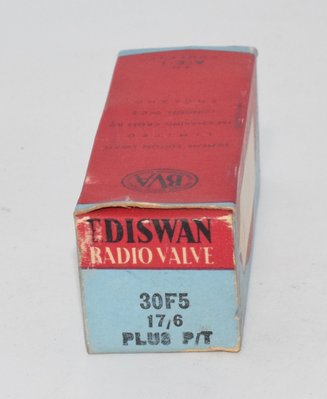
The 30F5 is a medium-power pentode vacuum tube that emerged during the mid-20th century as a versatile output stage component in consumer audio equipment and radio receivers. Developed during an era when vacuum tube technology dominated consumer electronics, the 30F5 represents a practical solution for moderate-power audio amplification requirements.
The tube designation "30F5" follows the RCA numbering system, where "30" indicates the heater voltage (approximately 30V), "F" denotes the tube type (pentode), and "5" signifies the specific design variant. The 30F5 was manufactured by major tube producers including RCA, Mullard, Telefunken, and Ediswan, with production peaking during the 1950s and 1960s before declining with the advent of solid-state electronics.
While not as iconic as some larger power tubes like the 6L6 or EL34, the 30F5 occupied an important niche in compact audio amplifiers, portable radio receivers, and small integrated amplifiers where its moderate power output and reasonable efficiency made it an economical choice for manufacturers.
2. Technical Specifications and Design
Basic Electrical Parameters
- Tube Type: Medium-power pentode
- Heater Voltage: 30V AC/DC
- Heater Current: Approximately 0.15A
- Maximum Plate Voltage: 500V
- Maximum Plate Dissipation: 8-10 watts
- Typical Output Power (Class A): 2-3 watts
- Typical Output Power (Class AB): 3-5 watts
- Plate Resistance: Approximately 10,000-12,000 ohms
- Amplification Factor: Approximately 80-100
Tube Construction
The 30F5 features a standard pentode configuration with five active elements: a heated cathode, control grid, screen grid, suppressor grid, and anode (plate). The tube is housed in a compactoctal (9-pin) or octal (8-pin) base configuration, depending on the manufacturer and production variant. The glass envelope is typically a medium-sized bulb design, optimized for heat dissipation in compact applications.
The pentode design provides superior output impedance and reduced plate resistance compared to triodes of similar power rating, making the 30F5 particularly useful in transformer-coupled output stages. The suppressor grid effectively prevents secondary emission, resulting in cleaner output characteristics and reduced distortion across the operating range.
Operating Characteristics
In typical Class A operation, the 30F5 operates with approximately 300-400V plate voltage and 60-80mA plate current at idle. The tube exhibits good linearity across its operating range, with relatively predictable gain characteristics. The screen grid typically operates at 150-200V, significantly lower than the plate voltage, which helps control dissipation and improve stability.
The 30F5 is relatively rugged and forgiving in circuit design, tolerating moderate variations in bias voltage and load impedance without catastrophic failure. This characteristic made it popular in portable equipment where circuit optimization was less critical than reliability and cost considerations.
3. Applications and Usage
Historical Applications
The 30F5 found widespread use in several categories of consumer electronics:
- Portable Radio Receivers: The 30F5 was frequently employed as the output tube in battery-powered and AC-powered portable radios, where its moderate power requirements and reasonable efficiency made it ideal for driving small loudspeakers.
- Small Integrated Amplifiers: Compact tabletop amplifiers and integrated radio-phonographs often utilized the 30F5 as the output stage, typically in push-pull configuration with another 30F5 or similar tube.
- Musical Instrument Amplifiers: The tube appeared in some vintage guitar and bass amplifiers, particularly lower-wattage models designed for practice or small venue use.
- Public Address Systems: Small PA amplifiers and public address drivers sometimes incorporated 30F5 tubes for modest power output requirements.
- Test Equipment: The tube was occasionally used in audio test generators and measurement equipment requiring moderate audio output levels.
Modern Applications
Today, the 30F5 primarily appears in restoration and repair of vintage audio equipment. Enthusiasts and professional technicians seek NOS (New Old Stock) 30F5 tubes to restore original equipment to working condition. The relatively low output power and specific heater voltage limit new design applications, though some boutique amplifier manufacturers have incorporated the 30F5 into retro-styled designs.
4. Sound Characteristics of the 30F5
Tonal Qualities
The 30F5 exhibits the characteristic warmth and harmonic coloration typical of pentode output stages. The tube's inherent non-linearity produces a gentle, natural compression of dynamic peaks, contributing to a forgiving and musical presentation. Compared to more aggressive power tubes, the 30F5 produces a softer, less edgy tone with smooth midrange characteristics.
In push-pull configuration, the 30F5 demonstrates excellent cancellation of even-order harmonics, resulting in relatively low distortion at moderate output levels. However, at higher drive levels, the tube exhibits a pleasant, musical saturation characteristic that adds subtle harmonic enhancement without becoming harsh or fatiguing.
Frequency Response
The 30F5 typically delivers a relatively flat frequency response from approximately 20Hz to 15kHz in well-designed circuits. The tube does not exhibit the pronounced low-frequency extension of larger power tubes, nor the extended high-frequency response of smaller signal tubes. This balanced characteristic makes the 30F5 well-suited to vocal and acoustic music reproduction.
Distortion Characteristics
At rated output levels (2-3 watts), the 30F5 produces approximately 3-5% total harmonic distortion in push-pull configuration. The distortion profile is dominated by second and third harmonics, which are generally considered musically pleasant and less fatiguing than higher-order distortion products. As the tube approaches its maximum power output, the distortion increases gracefully, with the harmonic spectrum remaining relatively rich and musical.
Dynamics and Transient Response
The 30F5's moderate output impedance and reasonable plate resistance result in good transient response, though not as fast as solid-state amplifiers. The tube exhibits excellent control over dynamic peaks, with a natural soft-clipping behavior that prevents harsh distortion on sudden transients. This characteristic makes the 30F5 particularly well-suited to string instruments and percussion, where the natural compression prevents excessive harshness.
5. Use in the Audio Community
Vintage Audio Restoration
The 30F5 occupies a respected niche in the vintage audio restoration community. Collectors and restoration specialists actively seek NOS Ediswan, RCA, Mullard, and Telefunken 30F5 tubes for period-correct restoration of classic portable radios, small amplifiers, and integrated amplifier-receivers. The availability of original tubes significantly impacts the value and desirability of vintage equipment, making quality 30F5 tubes relatively sought-after components.
Boutique Amplifier Design
A small but dedicated segment of boutique amplifier manufacturers has embraced the 30F5 for retro-styled, low-wattage designs. These modern amplifiers typically feature 30F5 output tubes in push-pull configuration, delivering 3-5 watts of output power. The aesthetic appeal of vintage tube technology combined with the practical advantages of low power consumption and modest heat generation has made these designs popular with certain audiophiles, particularly those in small listening rooms or seeking to minimize environmental impact.
Guitar and Bass Amplification
While not common in modern guitar amplifier design, the 30F5 has found a small following among players seeking vintage-inspired, low-wattage amplifiers. The tube's natural compression and harmonic coloration appeal to musicians seeking the tonal characteristics of 1950s-era amplifiers. Some boutique amp builders have incorporated 30F5 tubes in compact practice amplifiers and small combo units designed for bedroom recording and low-volume performance.
Audiophile Community Perspectives
Within the broader audiophile community, opinions on the 30F5 vary considerably. Traditionalists and vintage equipment enthusiasts appreciate the tube's historical significance and characteristic sound. Proponents of low-power amplification cite the 30F5's efficiency and modest power consumption as advantages in an era of increasing environmental consciousness. However, some audiophiles dismiss the tube as too limited in power output and too colored in its frequency response for serious music reproduction, preferring larger power tubes with extended frequency response and lower distortion.
Tube Rolling and Experimentation
The 30F5's moderate cost and relative availability make it an accessible tube for audio enthusiasts interested in tube rolling experiments. Many vintage amplifiers can accommodate the 30F5 in output stage positions, allowing experimenters to compare different manufacturers' versions. Ediswan, RCA, Mullard, and Telefunken variants each exhibit subtle sonic differences, making the 30F5 popular for exploring how tube manufacturing variations affect amplifier sound.
Market and Availability
The 30F5 remains reasonably available on the used and NOS markets, with prices reflecting the tube's moderate desirability and relative abundance compared to rarer power tubes. Ediswan variants command slight premiums due to their reputation for reliability and consistent performance. NOS tubes in original boxes with documentation typically cost between $20-$50 per tube, making the 30F5 an economical choice for equipment restoration compared to larger power tubes.
6. Equivalent or Substitute Types
Direct Equivalents
- 30F5-GT: The "GT" (glass tube) variant of the 30F5, functionally identical but with different envelope construction.
- 30A5: A similar pentode with slightly different electrical characteristics, sometimes used as a substitute in less critical applications.
- 35A5: A higher-powered variant with 35V heater rating, occasionally used as a substitute with appropriate circuit modifications.
Functional Alternatives
- 6V6GT/6V6: A more common American pentode with similar power output but different heater voltage (6.3V), requiring power supply modifications.
- EL84: A European pentode with comparable power output and similar tonal characteristics, though with different electrical parameters.
- 6L6: A larger pentode with significantly higher power output, suitable for applications requiring greater output power.
Substitution Considerations
While some substitutions are technically possible, they typically require circuit modifications to accommodate different heater voltages and electrical parameters. The 30F5's unique 30V heater voltage limits substitution options without significant power supply redesign. For authentic restoration, original 30F5 tubes are strongly recommended.
7. Notable Characteristics
Reliability and Longevity
The 30F5 is renowned for its reliability and extended operating life. Well-manufactured examples, particularly those from Ediswan and Mullard, frequently operate for thousands of hours without degradation. The tube's moderate power dissipation and robust construction contribute to its longevity, making it an excellent choice for equipment intended for extended service.
Thermal Stability
The 30F5 exhibits excellent thermal stability, with relatively predictable performance across varying ambient temperatures. This characteristic made it particularly valuable in portable equipment that might be subjected to temperature extremes. The moderate heat output also made the tube practical for compact equipment designs where thermal management was challenging.
Manufacturing Variations
Different manufacturers produced the 30F5 with subtle variations in construction, materials, and performance characteristics. Ediswan tubes are generally regarded as particularly robust and reliable. RCA variants typically offer excellent midrange clarity. Mullard and Telefunken versions exhibit slightly extended high-frequency response. These variations, while subtle, contribute to the enduring interest in tube rolling among vintage audio enthusiasts.
Conclusion
The 30F5 vacuum tube represents an important chapter in audio amplification history, bridging the gap between small signal tubes and large power tubes. While its modest output power and specific heater voltage limit contemporary applications, the tube remains valued by vintage audio enthusiasts, restoration specialists, and a dedicated community of low-power amplifier advocates. The 30F5's characteristic warmth, harmonic richness, and reliable performance continue to attract those seeking authentic vintage audio experiences or exploring the sonic possibilities of low-power amplification. Whether restoring classic portable radios, powering boutique amplifiers, or simply exploring tube-based audio, the 30F5 offers a window into the golden age of vacuum tube technology.