Introduction and History
The 3S4, also designated DL92 in the European Mullard-Philips naming convention, is a miniature power output pentode designed primarily for battery-operated portable radio receivers. Developed in the late 1940s, this tube emerged during a period of intense innovation in miniature valve design, as manufacturers sought to create compact, low-power tubes suitable for personal portable equipment powered by dry-cell batteries.
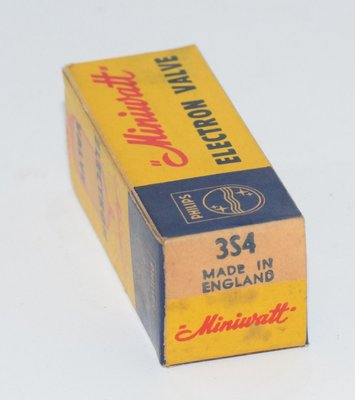
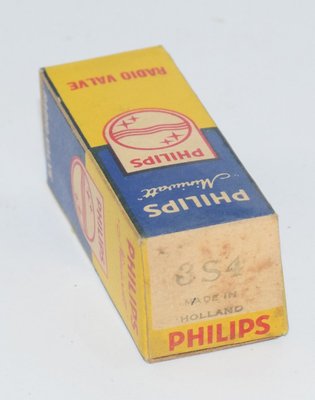
The 3S4 was manufactured by virtually every major valve producer of the era, including Philips (Miniwatt), Mullard, Mazda-Belvu (CIFTE), RCA, Sylvania, Tung-Sol, and many others. The Mazda-Belvu datasheet from CIFTE (January 1968) provides particularly detailed specifications for this type. The tube was a cornerstone of the portable radio market throughout the 1950s, often appearing in the classic "All American Five"-style battery portable sets alongside types such as the 1R5, 1T4, 1S5, and 3V4.
The "3" in the American designation 3S4 indicates the rounded filament voltage (2.8V in series, or 1.4V in parallel operation), while "S" denotes the pentode type and "4" is the design sequence number. The European designation DL92 follows the Mullard-Philips system: "D" for a directly heated filament with Vf = 1.4V, "L" for an output pentode, and "92" indicating a B7G miniature glass envelope.
Technical Specifications and Design
General Characteristics
| Parameter | Value |
|---|---|
| Type | Power Output Pentode (Pentode de Puissance) |
| Heating | Direct (filamentary cathode) |
| Filament Voltage (parallel) | 1.4 V |
| Filament Current (parallel) | 100 mA |
| Filament Voltage (series) | 2.8 V |
| Filament Current (series) | 50 mA |
| Envelope | Miniature glass, A 19-2 |
| Base | Miniature 7-pin (B7G / 7C10) |
| Mounting Position | Any (quelconque) |
| Maximum Envelope Diameter | 19 mm |
| Maximum Overall Height | 47.6 mm (above base) + 7.14 mm (pins) |
Maximum Ratings (Average Limits System)
| Parameter | Symbol | Maximum Value |
|---|---|---|
| Anode Voltage | Va | 90 V max |
| Screen Grid (G2) Voltage | Vg2 | 67.5 V max |
| Anode Dissipation | Pa | 0.7 W max |
| Screen Grid Dissipation | Pg2 | 0.15 W max |
| Cathode Current (filaments parallel) | Ik | 11 mA max |
| Cathode Current (filaments series) | Ik | 5.5 mA max |
Note: When operating with filaments in series, a resistor must be placed between pins 5 and 1 to divert the fraction of cathode current exceeding the 5.5 mA maximum.
Normal Operating Conditions — Filaments in Parallel (1.4V)
| Parameter | Symbol | Condition 1 | Condition 2 |
|---|---|---|---|
| Anode Voltage | Va | 67.5 V | 90 V |
| Screen Grid Voltage | Vg2 | 67.5 V | 67.5 V |
| Control Grid Voltage | Vg1 | -7 V | -7 V |
| Anode Current | Ia | 7.2 mA | 7.4 mA |
| Screen Grid Current | Ig2 | 1.5 mA | 1.4 mA |
| Internal Resistance | ρ (rp) | 0.1 MΩ (100 kΩ) | 0.1 MΩ (100 kΩ) |
| Transconductance | S (gm) | 1.55 mA/V | 1.57 mA/V |
| Power Output | Ps | 180 mW | 270 mW |
| Distortion (THD) | D | 10% | 12% |
| Anode Load Impedance | Za | 5 kΩ | 8 kΩ |
Normal Operating Conditions — Filaments in Series (2.8V)
| Parameter | Symbol | Condition 1 | Condition 2 |
|---|---|---|---|
| Anode Voltage | Va | 67.5 V | 90 V |
| Screen Grid Voltage | Vg2 | 67.5 V | 67.5 V |
| Control Grid Voltage | Vg1 | -7 V | -7 V |
| Anode Current | Ia | 6 mA | 6.1 mA |
| Screen Grid Current | Ig2 | 1.2 mA | 1.1 mA |
| Internal Resistance | ρ (rp) | 0.1 MΩ (100 kΩ) | 0.1 MΩ (100 kΩ) |
| Transconductance | S (gm) | 1.4 mA/V | 1.42 mA/V |
| Power Output | Ps | 160 mW | 235 mW |
| Distortion (THD) | D | 12% | 13% |
| Anode Load Impedance | Za | 5 kΩ | 8 kΩ |
Derived Parameters
From the datasheet values at Va = 90V, Vg2 = 67.5V (parallel filament operation):
- Transconductance (gm): 1.57 mA/V
- Plate Resistance (rp): 100 kΩ (0.1 MΩ)
- Amplification Factor (μ): Approximately 157 (calculated as μ = gm × rp = 1.57 × 100 = 157). Note: This is a derived value; the amplification factor is very high as is typical for pentodes, and the actual value should be confirmed against additional manufacturer data.
Pin Configuration (B7G Base — Bottom View)
| Pin Number | Connection |
|---|---|
| 1 | Filament (−) |
| 2 | Anode (Plate) |
| 3 | Grid No. 1 (Control Grid) |
| 4 | Grid No. 2 (Screen Grid) |
| 5 | Filament Center Tap |
| 6 | Anode (Plate) — connected internally to Pin 2 |
| 7 | Filament (+) |
The dual anode connection (pins 2 and 6) reduces internal lead inductance and provides a more robust current path for the output stage. The filament center tap on pin 5 serves as the effective cathode connection point and is essential for proper bias operation, particularly in series-filament configurations where a bleeder resistor is required between pins 5 and 1.
Applications and Usage
The 3S4/DL92 was designed as an audio frequency (A.F.) output amplifier — specifically as the power output stage in battery-operated portable radio receivers. Its primary applications included:
- Battery Portable Radios: The 3S4 was the standard output tube in countless portable AM receivers of the 1950s. It typically drove a small loudspeaker through a matching output transformer, delivering up to 270 mW of audio power — sufficient for personal listening in a quiet environment.
- Personal and "Lunch Box" Radios: The low filament power consumption (1.4V at 100 mA, or just 140 mW for the heater) made it ideal for sets powered by a single 1.5V dry cell (A battery) and a 67.5V or 90V B battery.
- Hearing Aids and Compact Audio Equipment: Some early hearing aid designs and compact audio amplifiers employed the 3S4 due to its small size and low power requirements.
- Military and Field Equipment: The tube received military designations CV2370 and CV484, indicating its use in British military communications and field equipment where battery operation was essential.
In a typical portable radio circuit, the 3S4 would be preceded by a 1S5 (DAF91) detector/AF amplifier, with the signal chain beginning at a 1R5 (DK91) converter and passing through a 1T4 (DF91) IF amplifier. The entire set could operate from a 67.5V B battery and a 1.5V A cell, with total filament drain carefully managed by connecting the filaments of all tubes in parallel.
Sound Characteristics
The 3S4/DL92, being a low-power battery pentode, has a distinctive sonic signature that sets it apart from larger output pentodes and beam tetrodes:
- Warm and Intimate Midrange: The 3S4 is frequently described as having a warm, slightly compressed midrange character. At low power levels (below 100 mW), the tube operates in its most linear region and produces a surprisingly sweet, detailed sound that belies its humble origins as a portable radio tube.
- Soft Clipping and Gentle Compression: As the tube approaches its maximum output of 270 mW, the clipping behavior is gradual and musically forgiving. The transition from clean to overdriven is smooth, adding a pleasant harmonic richness rather than harsh distortion. The datasheet-specified THD of 12% at full rated output (90V, 8 kΩ load) is relatively high, but much of this distortion is composed of lower-order harmonics that the ear perceives as warmth rather than harshness.
- Limited Bass Authority: Due to the low plate voltage (90V max) and modest power output, the 3S4 does not deliver deep, authoritative bass. The low end tends to be polite and somewhat rolled off, particularly when driving speakers through small output transformers. However, this characteristic can be appealing for vocal and acoustic music reproduction.
- Airy but Constrained Treble: The high-frequency response is pleasant but not extended. The relatively high plate resistance of 100 kΩ means that the tube's output impedance is high, and the damping factor through typical output transformers is low. This can result in a slightly loose, resonant quality in the upper frequencies that some listeners find charming.
- Microphonic Character: Being a directly heated type with a miniature glass envelope, the 3S4 can exhibit some microphonic behavior. In quiet listening environments, this is rarely an issue, but it contributes to a subtle "liveness" in the sound that some enthusiasts appreciate.
- Pentode vs. Triode-Strapped Operation: When triode-connected (screen grid tied to plate), the 3S4 produces significantly less power but with lower distortion and a more refined, triode-like tonal quality. The sound becomes more linear and transparent, though at the cost of already-limited output power.
Equivalent and Substitute Types
| Type Designation | Relationship | Notes |
|---|---|---|
| DL92 | Direct equivalent (European designation) | Identical tube, different naming convention. Fully interchangeable. |
| CV2370 | Direct equivalent (British military) | Military-grade version with tighter tolerances. Drop-in replacement. |
| CV484 | Direct equivalent (British military) | Earlier military designation. Fully interchangeable. |
| 3S4 (various manufacturers) | Identical | Produced by RCA, Sylvania, Philips Miniwatt, Mullard, Mazda-Belvu, Tung-Sol, and others. All are interchangeable, though sonic characteristics may vary slightly between manufacturers. |
| DL94 / 3V4 | Similar but NOT identical | The 3V4/DL94 is a related output pentode with the same base and similar ratings but is designed for slightly different operating conditions. It is sometimes listed as a substitute but should be verified for the specific circuit. Not a guaranteed drop-in replacement. |
Important: The 3S4/DL92 should not be confused with the 3Q4, 3Q5GT, or other battery output tubes that use different bases or have significantly different characteristics. Always verify pin connections and operating conditions before substitution.
Notable Characteristics
- Dual Filament Configuration: One of the most notable features of the 3S4 is its flexible filament arrangement. The filament can be operated at 1.4V/100 mA (parallel) or 2.8V/50 mA (series), allowing designers to optimize battery configurations. The center-tapped filament (pin 5) serves as the cathode reference point in both modes. Performance differs slightly between the two modes — parallel operation yields higher transconductance (1.57 vs. 1.42 mA/V) and greater power output (270 mW vs. 235 mW at 90V).
- Dual Plate Pins: The anode is brought out to two pins (2 and 6), which reduces lead inductance and provides a more reliable connection for the output current path.
- Series Filament Current Limiting: When operated in series filament mode, the maximum cathode current is limited to 5.5 mA. A resistor must be placed between pins 5 and 1 to shunt excess current away from the filament section, preventing damage. This is a critical design consideration often overlooked in amateur constructions.
- High Plate Resistance: At 100 kΩ, the plate resistance is very high even by pentode standards. This means the tube behaves almost as a constant-current source, and the output power and frequency response are heavily dependent on the load impedance and output transformer quality.
- Low Power, High Efficiency: The total B+ current consumption (anode + screen) is only about 8.8 mA at the 90V operating point, making the 3S4 remarkably efficient for battery operation. Combined with the 140 mW filament power, the entire tube consumes well under 1 watt of total input power while delivering 270 mW of audio output.
- Compact Physical Size: With a maximum diameter of only 19 mm and a total height of approximately 55 mm including pins, the 3S4 is one of the smallest power output tubes ever produced. This miniature size made it ideal for the compact portable radios of the 1950s.
Usage in the Audio Community
Despite its origins as a humble battery radio tube, the 3S4/DL92 has found a dedicated following in the modern audio community, particularly among builders and enthusiasts who appreciate ultra-low-power amplifier designs:
Desktop and Nearfield Amplifiers
The 3S4 is a popular choice for DIY desktop amplifier projects. With 270 mW of output power, it can drive high-efficiency speakers (95 dB/W/m and above) to comfortable listening levels in a nearfield or desktop setup. Builders appreciate the low voltage requirements — a 90V B+ supply is far less dangerous than the 250V-400V supplies required by larger output tubes, making the 3S4 an excellent choice for beginners in tube amplifier construction.
Battery-Powered Tube Amplifiers
The 3S4's original battery-powered heritage makes it a natural choice for modern portable tube amplifier projects. Some builders have created entirely battery-powered amplifier systems using the 3S4, powered by combinations of rechargeable cells and DC-DC converters. The 1.4V filament can be powered directly from a single NiMH cell, and the B+ voltage can be generated from a small boost converter.
Headphone Amplifiers
The 3S4 has gained particular popularity in the headphone amplifier community. Its power output of 180-270 mW is well-matched to the requirements of many headphones, and the warm, intimate sonic character of the tube is highly valued for personal listening. The 5-8 kΩ optimal load impedance can be matched to headphones using small, high-quality output transformers, or in some designs, the tube is used to drive high-impedance headphones (300-600Ω) through a simplified output stage.
Vintage Radio Restoration
A significant portion of 3S4 demand comes from the vintage radio restoration community. The tube remains essential for restoring the many portable receivers from the 1950s that used this type. NOS (New Old Stock) examples from quality manufacturers such as Philips Miniwatt (both Holland and UK production) are particularly sought after for restorations where authenticity and reliability are paramount.
Guitar and Musical Instrument Use
Some experimental guitar amplifier builders have used the 3S4 in ultra-low-wattage practice amplifiers. The soft clipping characteristics and harmonic distortion profile of the tube produce pleasant overdrive tones at extremely low volume levels — ideal for bedroom practice. The 12% THD at full output, while high for hi-fi applications, is musically useful in guitar amplification contexts.
Collectibility and Availability
The 3S4/DL92 remains reasonably available as NOS stock, though premium examples from manufacturers like Philips Miniwatt (Holland production) command higher prices. The tube was produced in enormous quantities during the 1950s and 1960s, ensuring adequate supply for the foreseeable future. Collectors particularly value examples from Philips Miniwatt Holland, Mullard UK, and early Mazda-Belvu production for their consistent quality and reportedly superior sonic characteristics. Current production of this type has ceased, so all available stock is NOS or used pulls from vintage equipment.