1. Introduction and History
The 3V4 is a miniature power-amplifier pentode designed by General Electric for use in compact, battery-operated equipment. It was developed during the late 1940s and early 1950s — an era when portable radio receivers were transitioning from large octal-based tubes to the smaller miniature glass envelope types that would define the final golden age of consumer tube electronics before the transistor revolution.
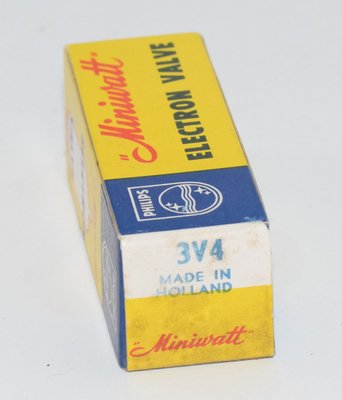
The 3V4 was specifically engineered for the power output stage of three-way portable receivers employing 90-volt B+ batteries. Its center-tapped filament was a key design feature, allowing operation from either a 2.8-volt or 1.4-volt filament supply. This flexibility made it ideal for battery-powered radios where different cell configurations might be used. The tube was manufactured by General Electric (documented in their ET-T453B datasheet, dated June 1953, superseding ET-T453A from March 1950), as well as by Philips (under the Miniwatt brand in Holland), Mullard, and numerous other manufacturers worldwide.
The 3V4 belongs to a family of battery-type output pentodes that includes the closely related DL94 (European designation). These tubes were workhorses in millions of portable radios produced throughout the 1950s and into the early 1960s, until solid-state devices rendered them obsolete for mainstream consumer electronics. Today, the 3V4 enjoys a second life among vintage radio restorers, DIY audio enthusiasts, and builders of low-power amplifiers.
2. Technical Specifications and Design
General Characteristics
| Parameter | Value |
|---|---|
| Tube Type | Power Amplifier Pentode |
| Cathode | Coated Filament (directly heated) |
| Envelope | T-5½, Glass |
| Base | E7-1, Miniature Button 7-Pin (B7G) |
| Mounting Position | Any |
Filament (Heater) Ratings
| Parameter | Series Filament | Parallel Filament |
|---|---|---|
| Filament Voltage, D-C | 2.8 V | 1.4 V |
| Filament Current | 0.05 A | 0.1 A |
The center-tapped filament design allows two modes of operation. For series-filament operation, the positive filament voltage is connected to pin 7 and the negative filament voltage is connected to pin 1. For parallel-filament operation, the positive filament voltage is connected to pins 1 and 7 tied together, and the negative filament voltage is connected to pin 5 (the center-tap). In either case, all voltages are referred to the negative terminal of the filament.
Direct Interelectrode Capacitances (without external shield)
| Capacitance | Value |
|---|---|
| Grid-Number 1 to Plate | 0.2 µµF |
| Input | 5.5 µµF |
| Output | 3.8 µµF |
Maximum Ratings
| Parameter | Series Filament | Parallel Filament |
|---|---|---|
| Plate Voltage | 90 V | 90 V |
| Screen Voltage | 90 V | 90 V |
| D-C Cathode Current | 6.0 mA* | 12 mA |
* The 6.0 mA value is for each filament section. With series-filament operation, a resistor must be connected across the negative filament section to bypass any cathode current in excess of the rated maximum.
Note: The maximum plate dissipation is not explicitly stated in the General Electric datasheet for the 3V4. Based on the operating conditions (90V plate, 9.5 mA plate current) and the tube's design as a battery output pentode, the maximum plate dissipation should be confirmed against additional manufacturer data but is generally understood to be in the range of approximately 1 watt. This value should be verified against a complete manufacturer datasheet if critical to your design.
Characteristics and Typical Operation — Class A₁ Amplifier
| Parameter | Series Filament | Parallel Filament |
|---|---|---|
| Plate Voltage | 90 V | 90 V |
| Screen Voltage | 90 V | 90 V |
| Grid-Number 1 Voltage | −4.5 V | −4.5 V |
| Peak AF Grid-Number 1 Voltage | 4.5 V | 4.5 V |
| Plate Resistance, approximate | 0.12 MΩ (series), 0.12 MΩ (parallel*) | 0.1 MΩ |
| Transconductance (gm) | 2000 µmhos | 2150 µmhos |
| Zero-Signal Plate Current | 7.7 mA | 9.5 mA |
| Zero-Signal Screen Current | 1.7 mA | 2.1 mA |
| Load Resistance | 10,000 Ω | 10,000 Ω |
| Total Harmonic Distortion, approximate | 7% | 7% |
| Maximum-Signal Power Output | 0.24 W (series), 0.25 W (parallel*) | 0.27 W |
* The parallel filament column for series filament operation shows slightly different values (screen voltage 85V) in the GE datasheet. The values shown in the "Parallel Filament" column represent the standard parallel-filament operating point.
For the series-filament configuration with screen voltage at 85V, the GE datasheet shows: plate current of 6.9 mA, screen current of 1.5 mA, transconductance of 1975 µmhos, peak AF grid voltage of 5V, and power output of 0.25W at 10% THD with a 10,000 Ω load.
Note on amplification factor (µ): The amplification factor is not directly specified in the GE datasheet. It can be estimated from the relationship µ = gm × rp. Using the parallel-filament values: µ ≈ 2150 µmhos × 100,000 Ω = 215. This is a calculated estimate and should be confirmed against additional manufacturer data.
Pin Connections (RTMA 6BX, Bottom View)
| Pin | Connection |
|---|---|
| Pin 1 | Filament |
| Pin 2 | Plate |
| Pin 3 | Grid Number 2 (Screen) |
| Pin 4 | No Connection (internal connection — see note) |
| Pin 5 | Filament Center-Tap and Grid Number 3 (Suppressor) |
| Pin 6 | Grid Number 1 (Control Grid) |
| Pin 7 | Filament |
Important Note: Pin 4 is listed as "No Connection" in the GE datasheet but is noted as an internal connection in some references. This pin should not be connected to any external circuit.
Physical Dimensions
The 3V4 uses the RTMA 5-2 outline. The tube has a maximum diameter of 2⅛ inches (including the base) and a maximum overall height of approximately 1⅞ inches. The seated height maximum is 1 23/32 inches. These are compact dimensions consistent with the T-5½ miniature glass envelope.
3. Applications and Usage
The 3V4 was designed primarily for one purpose: serving as the audio power output stage in compact, battery-operated portable radio receivers. Its design parameters reflect this mission perfectly:
- Portable Battery Radios: The 3V4's primary application was in three-way portable receivers (AC/DC/battery) using 90-volt B+ batteries. The typical radio lineup of the era might include a 1R5 converter, 1T4 IF amplifier, 1S5 detector/first audio, and the 3V4 as the audio output stage. This "All-American Five" battery equivalent was found in millions of portable radios from manufacturers like Zenith, Philco, RCA, Emerson, and Admiral.
- Low-Voltage Audio Amplifiers: With its ability to deliver 270 milliwatts of audio power from just 90 volts of B+, the 3V4 was well-suited to any application requiring modest audio output from a low-voltage supply.
- Hearing Aids and Personal Amplifiers: The extremely low filament power consumption (only 140 milliwatts in parallel mode) made the 3V4 suitable for personal amplification devices where battery life was critical.
- Military and Field Equipment: The tube's military equivalents (CV1633, CV2983) indicate its use in British and NATO military portable communications equipment where battery operation was essential.
The center-tapped filament was a particularly clever design feature. In series-filament strings (common in AC/DC portable radios), the tube could operate at 2.8V/50mA, while in pure battery operation it could run at 1.4V/100mA from a single dry cell. This dual-voltage capability gave radio designers significant flexibility in power supply architecture.
4. Sound Characteristics
The 3V4, while designed as a utilitarian battery output tube rather than a high-fidelity component, possesses sonic characteristics that have earned it a modest but devoted following among audio experimenters:
- Warm and Intimate Tonality: Like most directly-heated pentodes operating at low voltages, the 3V4 produces a characteristically warm, slightly soft sound. The directly-heated filamentary cathode contributes a subtle richness that indirectly-heated tubes sometimes lack. At its design operating point, the tube has a gentle, rounded quality that is pleasant for casual listening.
- Soft Clipping Behavior: With only 270 milliwatts of output power, the 3V4 is easily driven into clipping. However, the clipping behavior is relatively graceful for a pentode — the onset of distortion is gradual rather than abrupt. The 7% THD at rated output is predominantly second and third harmonic, which the ear perceives as warmth and fullness rather than harshness.
- Limited Bandwidth and Dynamics: The 3V4 was designed to drive small portable radio speakers, and its sonic character reflects this. Bass response is modest, and the overall dynamic range is limited. However, within its operating envelope, the tube produces a coherent, musically engaging sound that many listeners find charming.
- Midrange Presence: The 3V4 excels in the midrange frequencies, delivering vocals and acoustic instruments with a directness and presence that belies its humble origins. This midrange-forward character makes it particularly appealing for voice reproduction and small-ensemble acoustic music.
- Pentode vs. Triode-Strapped Operation: When triode-connected (screen tied to plate), the 3V4 produces an even softer, more refined sound with lower distortion, though at the cost of reduced output power (typically under 100 milliwatts). Some builders prefer this mode for headphone amplifiers where the lower power is not a limitation.
- Microphonics: As a miniature tube with a directly-heated cathode, the 3V4 can exhibit some microphonic behavior, particularly in high-gain applications. This is generally not problematic in output stage use but should be considered in amplifier layout and mounting.
Overall, the 3V4's sound is best described as "vintage radio charm" — it won't compete with high-end output tubes for audiophile-grade reproduction, but it delivers a uniquely engaging listening experience that connects the listener to the golden age of portable radio.
5. Equivalent and Substitute Types
| Type | Relationship | Notes |
|---|---|---|
| DL94 | Direct equivalent (European designation) | Identical tube manufactured under the European naming convention. Fully interchangeable with the 3V4 in all respects. Widely manufactured by Philips, Mullard, Valvo, Siemens, and others. |
| CV1633 | Direct equivalent (British military) | British military (Common Valve) designation for the same tube. Meets military quality and testing standards. Pin-for-pin compatible. |
| CV2983 | Direct equivalent (British military) | Another British CV designation for the 3V4/DL94 type. Fully interchangeable. |
| 3S4 | Similar but NOT identical | An older battery output pentode with similar ratings but different internal construction and slightly different characteristics. May work as a substitute in some circuits but is not a guaranteed drop-in replacement. Verify circuit compatibility before substituting. |
Important: The DL94, CV1633, and CV2983 are the only genuinely interchangeable substitutes for the 3V4. All share the same miniature 7-pin (B7G) base, identical pinout, and equivalent electrical characteristics. Other battery pentodes (such as the 3Q4, 3Q5GT, or 3S4) may appear similar in function but have different pin configurations, base types, or electrical ratings and should not be substituted without careful circuit analysis.
6. Notable Characteristics
- Center-Tapped Filament Design: The 3V4's most distinctive feature is its center-tapped filament, allowing operation at either 1.4V (parallel) or 2.8V (series). This was an elegant engineering solution that gave radio designers maximum flexibility in battery-powered designs. The filament center-tap also serves as the connection point for Grid Number 3 (suppressor grid), tying the suppressor to the cathode internally through pin 5.
- Extremely Low Power Consumption: The total filament power is only 140 milliwatts regardless of series or parallel operation (2.8V × 0.05A = 1.4V × 0.1A = 0.14W). This made the 3V4 one of the most efficient output tubes ever produced in terms of heater power versus audio output.
- High Plate Resistance: The plate resistance of approximately 100,000 to 120,000 ohms (0.1 to 0.12 megohms) is notably high, even for a pentode. This means the tube's output impedance is dominated by the load resistance rather than the tube's internal resistance, which has implications for output transformer matching and damping factor.
- Pin 4 Internal Connection: Pin 4 is noted as having an internal connection in some references, though the GE datasheet lists it as "No Connection." Builders should leave this pin unconnected in all external circuits to avoid potential problems.
- Cathode Current Limitations in Series Operation: When operating in series-filament mode, each filament section is limited to 6.0 mA of cathode current. This requires careful biasing and may necessitate a bypass resistor across the negative filament section. In parallel mode, the full 12 mA cathode current rating is available.
- Operation Characteristics: The GE datasheet provides detailed operation characteristic curves showing power output and total harmonic distortion versus load resistance. At the optimal 10,000 Ω load, the tube delivers its rated 270 mW at 7% THD. The curves show that distortion rises steeply above 10,000 Ω load resistance while power output continues to increase, suggesting that the 10,000 Ω value represents an optimal compromise between power and distortion.
- Average Plate Characteristics: The plate characteristic curves show well-defined pentode behavior with good separation between grid voltage lines. The curves are plotted for Ef = 1.4V DC and Ec2 = 90V, with grid voltages ranging from 0V to −10.5V.
7. Usage in the Audio Community
While the 3V4 was never intended as a high-fidelity audio tube, it has found a dedicated niche in the modern audio community, particularly among DIY builders and experimenters who appreciate its unique combination of characteristics:
Low-Power Single-Ended Amplifiers
The 3V4 is a popular choice for ultra-low-power single-ended (SE) amplifiers, typically producing 200–270 milliwatts of output. These tiny amplifiers are paired with high-efficiency speakers (95 dB/W/m or higher) to create surprisingly musical desktop or near-field listening systems. The appeal lies in the simplicity of the circuit — a single 3V4 output stage requires only a 90-volt B+ supply, making it one of the most accessible tube amplifier projects for beginners.
Battery-Powered Tube Amplifiers
The 3V4's battery heritage makes it a natural choice for builders creating truly portable tube amplifiers. With its 1.4V filament and 90V plate supply, the tube can be powered entirely by batteries — a D cell for the filament and a stack of 9V batteries or vintage B batteries for the plate supply. These "campfire amplifiers" have a devoted following among makers and audio hobbyists.
Headphone Amplifiers
At 270 milliwatts, the 3V4 produces more than enough power to drive most headphones to satisfying levels. Headphone amplifier designs using the 3V4 (often triode-strapped for lower distortion) have appeared in numerous DIY audio forums and publications. The tube's warm, intimate character is particularly well-suited to headphone listening, where the close coupling between driver and ear makes the most of the tube's midrange strengths.
Guitar Practice Amplifiers
The 3V4 has found use in ultra-low-wattage guitar practice amplifiers. At bedroom volumes, the tube's natural compression and harmonic distortion characteristics produce pleasing overdrive tones. Some builders have created battery-powered guitar amplifiers using the 3V4 that can be played anywhere without access to mains power.
Vintage Radio Restoration
The largest demand for 3V4 tubes comes from vintage radio collectors and restorers. Millions of portable radios from the 1950s used the 3V4 as their output tube, and maintaining these radios requires a steady supply of replacement tubes. NOS (New Old Stock) examples from manufacturers like Philips Miniwatt (Holland), GE, RCA, Sylvania, and Mullard are actively traded among collectors. The Philips Miniwatt Holland NOS examples are particularly sought after for their consistent quality and longevity.
Educational Projects
The 3V4's low operating voltages (90V B+ versus the 250–400V typical of most audio tubes) make it significantly safer for educational projects and for builders who are new to vacuum tube electronics. Many "first tube amplifier" projects feature the 3V4 or its DL94 equivalent precisely because the voltages involved, while still requiring respect and caution, are less immediately dangerous than those found in conventional tube amplifier designs.
Availability and Pricing
As of the 2020s, the 3V4 and its DL94 equivalent remain reasonably available as NOS stock. Prices are moderate compared to more sought-after audio tubes, making the 3V4 an economical choice for experimentation. European-made DL94 examples (particularly Mullard and Philips) tend to command a slight premium over American-made 3V4 tubes, though the electrical differences between manufacturers are minimal. The military-grade CV1633 and CV2983 versions, when available, are prized for their rigorous quality control and testing standards.