1. Introduction and History
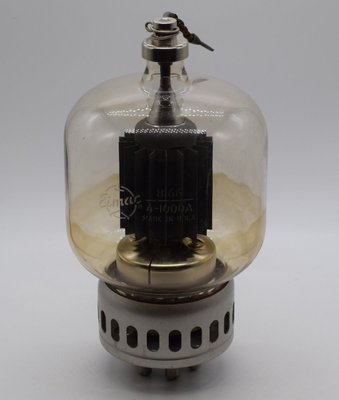
The Eimac 4-1000A is a high-power, forced-air-cooled power tetrode designed primarily for radio-frequency amplification in transmitting service. Developed by Eitel-McCullough, Inc. (Eimac) of San Bruno, California, the 4-1000A emerged during the post-World War II era when the demand for reliable, high-power transmitting tubes surged for broadcast, industrial, and military communications applications.
Eimac had established itself as a premier manufacturer of high-power transmitting tubes during the war years, and the 4-1000A represented a continuation of their engineering philosophy: robust ceramic-metal construction, high power capability, and excellent reliability. The tube's designation follows Eimac's systematic naming convention — the "4" denotes a tetrode (four active elements), and "1000A" indicates a nominal plate dissipation of 1000 watts in the "A" design iteration.
The 4-1000A became a workhorse in commercial broadcast transmitters, amateur radio amplifiers, industrial RF heating equipment, and scientific apparatus throughout the 1950s, 1960s, and beyond. Its ceramic-metal construction — a hallmark of Eimac's advanced manufacturing techniques — provided superior mechanical strength, thermal stability, and vacuum integrity compared to earlier all-glass envelope designs. This construction allowed the tube to operate reliably at high temperatures and power levels, making it a favorite among broadcast engineers and advanced amateur radio operators.
Production of the 4-1000A continued for decades, and the tube remains available today as new-old-stock (NOS) and occasionally as current production. Its legacy endures in vintage broadcast equipment restoration, high-power amateur radio stations, and — more recently — in the world of exotic high-power audio amplifiers.
2. Technical Specifications and Design
The following specifications are drawn from the Eimac datasheet for the 4-1000A. Where CCS (Continuous Commercial Service) and ICAS (Intermittent Commercial and Amateur Service) ratings differ, both are noted. All values should be cross-referenced with the official Eimac/CPI datasheet for the most authoritative figures.
General Characteristics
| Tube Type | Power Tetrode |
| Manufacturer | Eitel-McCullough, Inc. (Eimac) |
| Construction | Ceramic-metal envelope with external anode cooler (forced-air cooled) |
| Cooling | Forced air (mandatory) |
| Mounting Position | Vertical, base down (preferred); other positions with adequate airflow |
Heater (Filament) Ratings
| Filament Voltage | 7.5 V AC or DC |
| Filament Current | 21.0 A |
| Filament Type | Thoriated tungsten |
Maximum Ratings
| Parameter | CCS Rating | ICAS Rating |
|---|---|---|
| Maximum DC Plate Voltage | 6,000 V | 8,000 V |
| Maximum DC Plate Current | 500 mA | 600 mA |
| Maximum Plate Dissipation | 1,000 W | 1,000 W |
| Maximum Screen Grid Voltage (DC) | 500 V | 500 V |
| Maximum Screen Grid Dissipation | 25 W | 35 W |
| Maximum Control Grid Dissipation | 10 W | 10 W |
Note: The plate dissipation rating of 1,000 W is contingent upon adequate forced-air cooling. Without proper airflow, the tube will be destroyed rapidly. The ICAS ratings permit higher plate voltage (8,000 V) and screen dissipation (35 W) for intermittent duty cycles typical of amateur and some commercial service.
Typical Operating Characteristics
| Amplification Factor (μ) | Approximately 5.5 |
| Transconductance (gm) | Approximately 6,000–7,000 μmhos (under normal operating conditions) |
| Plate Resistance (rp) | Varies with operating point; typically in the range of several hundred ohms to low kilohms depending on bias and plate voltage. Consult the Eimac datasheet curves for specific operating conditions. |
| Grid Bias Range | Dependent on class of operation; typical Class AB1 bias is in the range of −60 V to −120 V; Class C operation may require significantly more negative bias. Refer to Eimac application data for specific service classes. |
Interelectrode Capacitances
| Grid-to-Plate (Cgp) | Approximately 0.03–0.04 pF |
| Input Capacitance (Cin) | Approximately 29 pF |
| Output Capacitance (Cout) | Approximately 4.0 pF |
The extremely low grid-to-plate capacitance is a hallmark of the 4-1000A's internal shielding design and is one of the reasons the tube is well-suited for high-frequency operation with excellent stability.
Physical and Mechanical Details
| Envelope | Ceramic-metal construction with integral anode cooler fins |
| Base Type | Special Eimac 4-pin base (filament and control grid connections) with a separate ring/collet for the screen grid connection. This is not a standard 5-pin base — the screen grid is brought out via a separate concentric ring terminal surrounding the base, requiring a dedicated Eimac socket assembly. |
| Plate Connection | Top cap / anode cooler assembly at the top of the tube |
| Overall Length | Approximately 8.5 inches (216 mm) — confirm against datasheet dimensional drawing |
| Maximum Diameter | Approximately 5.125 inches (130 mm) across the anode cooler — confirm against datasheet |
| Weight | Approximately 3.5 lbs (1.6 kg) — confirm against datasheet |
| Socket | Eimac special socket (e.g., Eimac SK-410 or equivalent) designed for the 4-1000A base configuration with integral screen ring contact and air chimney provisions |
Pin-Out Description
The 4-1000A uses a proprietary Eimac base arrangement:
- Base pins (4 pins): Two pins for the filament (heater) connections and connections for the control grid (grid 1). The exact pin assignment should be confirmed against the Eimac socket wiring diagram.
- Screen grid (grid 2): Connected via a separate concentric ring or collet that surrounds the base assembly. This ring makes contact with a corresponding ring in the dedicated socket.
- Plate (anode): Connected at the top of the tube through the anode cooler/cap assembly.
Because of this non-standard base arrangement, the 4-1000A requires its dedicated Eimac socket and cannot be plugged into generic tube sockets. Builders must use the correct socket assembly that accommodates both the base pins and the screen ring contact.
Cooling Requirements
The 4-1000A absolutely requires forced-air cooling. Eimac specifies minimum airflow requirements (typically 13 CFM at a back-pressure of 0.3 inches of water for full rated dissipation — confirm exact figures against the Eimac datasheet). The air chimney and socket assembly are designed to direct cooling air over the ceramic seals and through the anode cooler fins. Operating without adequate cooling will result in rapid tube failure.
3. Applications and Usage
The 4-1000A was designed for and has been widely used in the following applications:
Broadcast Transmitters
The 4-1000A found extensive use in AM and FM broadcast transmitters, both as a driver stage and as a final power amplifier. Its 1,000-watt plate dissipation capability and ability to operate at plate voltages up to 6,000 V (CCS) or 8,000 V (ICAS) made it suitable for medium-power broadcast stations. Many commercial transmitters from manufacturers such as Collins, Gates, RCA, and Continental Electronics employed the 4-1000A or operated it in push-pull or parallel configurations for higher power output.
Amateur Radio
The 4-1000A became legendary in the amateur radio community as the tube of choice for high-power "legal limit" amplifiers. Under ICAS conditions, a single 4-1000A can deliver well over 1,000 watts of RF output on the HF bands, and with proper design, useful output can be obtained through VHF frequencies. Many homebrew and commercial amateur amplifiers have been built around this tube, and it remains a sought-after component for vintage and new amateur radio amplifier projects.
Industrial RF Heating
The tube's high power capability and rugged construction made it suitable for industrial RF heating and induction heating applications, where reliability under continuous heavy-duty operation is essential.
Scientific and Military
The 4-1000A has been used in particle accelerator RF systems, radar transmitters, and various military communications equipment where high power and reliability are paramount.
Linear Amplifier Service
The 4-1000A performs well in Class AB1 and AB2 linear amplifier service for single-sideband (SSB) and other linear modes. Its relatively high transconductance and good linearity characteristics make it capable of clean amplification with low intermodulation distortion when properly designed and operated.
4. Sound Characteristics
It must be acknowledged at the outset that the 4-1000A was never designed as an audio tube — it is a radio-frequency power tetrode. However, in the rare instances where it has been pressed into audio service (typically in experimental or extreme high-power audio amplifiers), the following observations have been made by engineers and adventurous audiophiles:
Tonal Qualities
- Authority and Headroom: With 1,000 watts of plate dissipation available, amplifiers built around the 4-1000A have virtually unlimited headroom for any conceivable audio application. The sheer power reserve translates to an effortless, uncompressed presentation even at extremely high playback levels. Transient peaks are handled without any sense of strain.
- Tetrode Character: As a tetrode, the 4-1000A exhibits characteristics somewhat different from the triode tubes more commonly used in audio. Without careful circuit design (including proper screen regulation and feedback), tetrodes can exhibit a slightly harder, more analytical sound compared to triodes. However, with well-designed circuitry, the 4-1000A can produce a sound that is clean, detailed, and dynamic.
- Bass Control: The relatively low plate resistance of a tetrode operating with screen feedback or in ultralinear configuration can provide excellent damping factor and bass control, yielding tight, well-defined low frequencies.
- Midrange Clarity: Engineers who have experimented with the 4-1000A in audio report a clear, transparent midrange with excellent resolution of detail, though perhaps lacking the lush warmth associated with directly heated triodes like the 300B or 845.
- High-Frequency Extension: The tube's RF heritage — with its low interelectrode capacitances and fast electron transit time — translates to excellent high-frequency extension and air in audio applications.
Caveats
The 4-1000A's thoriated-tungsten filament, drawing 21 amps at 7.5 volts (approximately 157 watts of heater power alone), introduces practical challenges for audio use. The filament power supply must be extremely well-regulated and filtered to avoid introducing hum. The mandatory forced-air cooling also introduces acoustic noise from the blower, which can be problematic in a listening environment. These practical considerations mean that the 4-1000A is more of a curiosity than a practical choice for high-fidelity audio, but those who have heard well-executed designs report an impressive and unique listening experience.
5. Equivalent or Substitute Types
True drop-in equivalents for the 4-1000A are limited due to its proprietary base and specific design characteristics:
| Type | Relationship to 4-1000A | Notes |
|---|---|---|
| 4-1000A (various manufacturers) | Direct equivalent | The 4-1000A was manufactured by Eimac and also produced by other manufacturers (e.g., Amperex, Svetlana/SED). Tubes from different manufacturers should be interchangeable, though quality and longevity may vary. |
| 8166 | JEDEC designation for the 4-1000A | The 8166 is the JEDEC registered number for the Eimac 4-1000A. They are the same tube. |
| 4CX1000A (8168) | NOT a direct substitute | The 4CX1000A is a fundamentally different tube design. While also a 1000-watt tetrode, it features an external anode (requiring a different cooling arrangement — typically a separate anode cooler or water jacket), a different socket, and different operating characteristics. It is not pin-compatible or socket-compatible with the 4-1000A and cannot be substituted without a complete redesign of the amplifier. |
| 4CX1000K | NOT a direct substitute | Another Eimac tetrode in the 1000-watt class but with different base, socket, and cooling requirements. |
In summary, the only true substitute for a 4-1000A is another 4-1000A (or its JEDEC equivalent, the 8166). Other tubes in the 1000-watt tetrode family require different sockets, cooling systems, and circuit designs.
6. Notable Characteristics
Ceramic-Metal Construction
The 4-1000A was one of the pioneering ceramic-metal tube designs. Unlike conventional glass-envelope tubes, the 4-1000A uses high-alumina ceramic insulators bonded to metal components (Kovar and copper) through precision metallurgical processes. This construction provides:
- Superior mechanical strength and resistance to vibration and shock
- Excellent thermal conductivity and ability to withstand high operating temperatures
- Outstanding vacuum integrity and long operational life
- Compact size relative to glass-envelope tubes of similar power rating
Extremely Low Grid-to-Plate Capacitance
The 4-1000A's grid-to-plate capacitance of approximately 0.03–0.04 pF is remarkably low for a tube of this power level. This is achieved through careful internal shielding and electrode geometry, and it enables stable operation at high frequencies without neutralization in many circuit configurations.
High Gain
With a transconductance of approximately 6,000–7,000 μmhos and an amplification factor of approximately 5.5, the 4-1000A provides substantial power gain, reducing the drive power requirements for the preceding stage. In Class AB1 service, the tube can be driven to full output with virtually no grid current, meaning the driver stage needs only to supply voltage swing, not power.
Thoriated-Tungsten Filament
The thoriated-tungsten filament provides excellent emission capability and long life when operated within ratings. However, it requires careful attention to filament voltage — both over-voltage and under-voltage operation can significantly reduce tube life. The filament should be brought up to operating temperature before plate voltage is applied (a warm-up period of approximately 3 minutes is typically recommended), and filament voltage should be maintained after plate voltage is removed to allow the tube to cool gradually.
Forced-Air Cooling Requirement
The 4-1000A's anode cooler is an integral part of the tube structure, with machined copper fins designed to dissipate up to 1,000 watts of heat when adequate airflow is provided. The cooling system — including the socket-mounted air chimney — must be properly designed and maintained. Blocked or restricted airflow will result in overheating of the ceramic-metal seals and rapid tube failure.
Ruggedness and Longevity
The 4-1000A has earned a reputation for exceptional ruggedness and long service life. In properly designed and maintained equipment, tube life of 10,000 hours or more is not uncommon. Many specimens from the 1960s and 1970s remain in service or test as good today, a testament to Eimac's manufacturing quality.
7. Usage in the Audio Community
The 4-1000A occupies a unique and decidedly niche position in the audio world. It was never intended for audio amplification, and its practical challenges — enormous heater power consumption, mandatory forced-air cooling with attendant blower noise, lethal plate voltages, and the need for specialized sockets and power supplies — make it an impractical choice for most audio applications. Nevertheless, the tube has attracted attention from several corners of the audio community:
Extreme High-Power Audio Amplifiers
A small number of ambitious builders have constructed audio amplifiers using the 4-1000A, typically for public address, concert sound reinforcement, or simply as engineering challenges. These amplifiers can deliver hundreds of watts of audio power from a single tube, rivaling or exceeding solid-state amplifiers in output capability while maintaining the tube amplifier's characteristic sound.
Guitar Amplifier Experimentation
Some experimental guitar amplifier builders have explored the 4-1000A for extreme-power guitar amplification. While entirely impractical for normal use, these projects generate interest in the DIY and boutique amplifier communities as demonstrations of tube technology pushed to its limits.
Collector and Display Appeal
The 4-1000A is a visually striking tube. Its ceramic-metal construction, machined copper anode cooler, and substantial physical presence make it a popular display piece among tube collectors and audio enthusiasts. The tube's industrial aesthetic appeals to those who appreciate the craftsmanship and engineering of mid-20th-century electronic components.
Transmitter Audio Sections
In vintage AM broadcast transmitters, the 4-1000A sometimes served in the modulator stage — essentially a high-power audio amplifier that modulated the RF carrier. In this role, the tube was indeed functioning as an audio amplifier, and the audio quality of these modulator stages was critical to broadcast quality. Restoration of vintage broadcast transmitters has brought renewed attention to the 4-1000A's audio capabilities in this specific context.
Practical Considerations for Audio Use
For anyone considering the 4-1000A for audio applications, the following practical points must be addressed:
- Power Supply: Plate supplies of 3,000–6,000 V DC at several hundred milliamps are required. These voltages are immediately lethal, and the power supply design must incorporate comprehensive safety measures.
- Filament Supply: A regulated 7.5 V supply capable of delivering 21 amps (approximately 157 watts) is needed. For audio use, this supply must be exceptionally clean to avoid filament-induced hum.
- Screen Supply: A well-regulated screen supply (typically 350–500 V) with appropriate current capability and protection is essential. Screen voltage regulation is critical for good audio performance from a tetrode.
- Cooling: The forced-air blower must be acoustically isolated from the listening environment, or the amplifier must be located in a separate equipment room.
- Output Transformer: Finding or commissioning an output transformer suitable for the 4-1000A's operating impedance and power level is a significant challenge. Custom-wound transformers from specialists are typically required.
- Socket: The specialized Eimac socket must be obtained, which can be difficult and expensive on the used market.
Market and Availability
The 4-1000A is available on the surplus and NOS market, with prices varying widely based on condition, manufacturer, and testing status. Untested specimens (as noted in the related product listing — "Sold as is / untested") carry inherent risk, as the tube's emission and vacuum integrity cannot be guaranteed without proper testing on a suitable tube tester or in-circuit evaluation. Buyers should be aware that testing a 4-1000A requires specialized equipment capable of handling the tube's high power levels — standard hobbyist tube testers cannot accommodate this tube.
Despite its impracticality for mainstream audio use, the 4-1000A remains a fascinating and impressive piece of vacuum tube engineering. For those with the technical expertise, resources, and determination to build around it, the 4-1000A offers a unique and unforgettable audio experience — one measured not in subtle tonal nuances but in sheer, overwhelming power delivered with the unmistakable character of thermionic amplification.