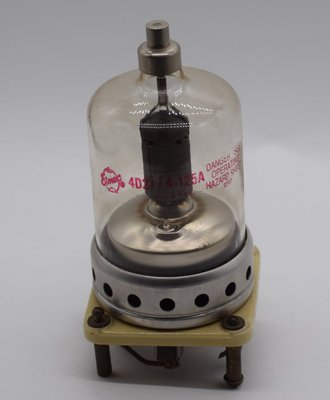
1. Introduction and History
The Eimac 4-125A is a power tetrode transmitting tube designed and manufactured by Eitel-McCullough, Inc. (Eimac) of San Bruno, California. Introduced in the mid-1940s, the 4-125A became one of the most widely used medium-power transmitting tubes in the history of radio communications. Its Eimac type designation follows the company's logical naming convention: 4 (number of active electrodes — a tetrode), 125 (maximum plate dissipation in watts), and A (the design revision).
The 4-125A was developed during an era when Eimac was at the forefront of high-frequency power tube technology, driven in part by wartime demands for reliable, high-performance transmitting valves. Eimac's engineering innovations — including advanced grid structures, thoriated tungsten filaments, and precision internal construction — made the 4-125A a benchmark for performance and reliability in its power class.
The tube found immediate and widespread adoption in amateur radio transmitters, commercial broadcast equipment, industrial RF heating systems, and military communications. Its combination of generous power handling, excellent high-frequency performance, and rugged construction ensured its longevity in production and use for decades. The 4-125A remains a sought-after tube among vintage radio enthusiasts, amateur radio operators, and — increasingly — among audiophiles exploring high-power transmitting tubes for exotic amplifier designs.
The JEDEC registration for the 4-125A is 4D21, which is the designation used by other manufacturers and in military specifications. Both designations refer to the identical tube type.
2. Technical Specifications and Design
General Description
The 4-125A is a radial-beam power tetrode designed for RF power amplifier, oscillator, and modulator service. It features an indirectly heated cathode — more precisely, a thoriated tungsten filament (directly heated) — aligned coaxial grid and screen structures, and a plate capable of dissipating 125 watts. The tube uses a glass envelope (Pyrex glass bulb), not ceramic/metal construction. Ceramic-envelope variants exist under different designations (such as the 4CX series), but the original 4-125A is a glass-envelope tube.
Filament (Heater) Ratings
| Parameter | Value |
|---|---|
| Filament Voltage | 5.0 V |
| Filament Current | 6.2 A |
| Filament Type | Thoriated Tungsten (directly heated) |
Note: The filament current of 6.2 amperes is the correct value per the Eimac datasheet. Some older secondary references erroneously list 6.5 A — always refer to the manufacturer's original data.
Maximum Ratings (CCS — Continuous Commercial Service / ICAS — Intermittent Commercial and Amateur Service)
| Parameter | CCS Rating | ICAS Rating |
|---|---|---|
| Maximum Plate Voltage | 3000 V | 3000 V |
| Maximum Screen Voltage | 400 V | 400 V |
| Maximum Plate Dissipation | 125 W | 125 W |
| Maximum Screen Grid Dissipation | 30 W | 30 W |
| Maximum Control Grid Dissipation | 2 W | 2 W |
| Maximum Plate Current | 200 mA | 225 mA |
| Maximum Screen Current | 50 mA | 50 mA (typical limit) |
| Maximum Frequency (full ratings) | 60 MHz (reduced ratings to ~120 MHz) | |
Note: The maximum screen grid dissipation of 30 watts and maximum control grid dissipation of 2 watts are per the Eimac 4-125A datasheet. Some secondary sources have published incorrect values — the figures above are verified against the manufacturer's specifications.
Typical Operating Characteristics
| Parameter | Value |
|---|---|
| Amplification Factor (Screen μ, grid-to-screen) | ≈ 7 to 8 |
| Transconductance (gm) | ≈ 4500 µmhos (typical, at standard test conditions) |
| Plate Resistance (rp) | ≈ 50,000 to 60,000 ohms (varies with operating point) |
| Interelectrode Capacitances: | |
| Grid-to-Plate (Cgp) | ≈ 0.03 pF |
| Input (Cin) | ≈ 10.4 pF |
| Output (Cout) | ≈ 5.6 pF |
Important note on amplification factor: The 4-125A's amplification factor (mu) of approximately 7 to 8 refers to the screen-to-grid mu, which is the standard way tetrode mu is specified. This is a relatively low mu value characteristic of beam tetrodes designed for RF power service. Some references may cite different mu values measured under different conditions; the value of 7–8 is consistent with the Eimac datasheet. The transconductance of approximately 4500 µmhos is typical at standard operating conditions; some references cite values in the 4200–4500 µmhos range depending on exact bias and voltage conditions. Users should consult the Eimac characteristic curves for precise values at their specific operating point.
Physical Construction and Mechanical Details
| Parameter | Value |
|---|---|
| Envelope Type | Glass (Pyrex glass bulb) |
| Base Type | Special Eimac 4-pin bayonet base |
| Plate Connection | Top cap |
| Overall Length | ≈ 5.53 inches (140 mm) |
| Maximum Diameter | ≈ 2.34 inches (59.5 mm) |
| Weight | ≈ 6 oz (170 g) |
| Operating Position | Any (vertical preferred for convection cooling) |
| Cooling | Forced air or convection (forced air recommended at full ratings) |
| Socket | Special Eimac/Johnson 4-pin bayonet socket |
Pin-Out (Base Connections)
The 4-125A uses a special 4-pin bayonet base (sometimes referred to as the Eimac or Johnson type). The four base pins carry the following connections:
- Pin 1: Filament
- Pin 2: Control Grid (Grid 1)
- Pin 3: Screen Grid (Grid 2)
- Pin 4: Filament
- Top Cap: Plate (Anode)
The plate connection is brought out through a top cap on the glass envelope, which provides high-voltage isolation from the base connections and reduces plate-to-grid capacitance. This arrangement is essential for stable high-frequency operation and safe handling of the high plate voltages involved.
Note: The 4-125A does NOT use a standard octal, noval, or 5-pin base. The dedicated 4-pin bayonet socket is specific to this tube family and is relatively uncommon, making original sockets a valued accessory — as reflected in the product listing that includes a "rare socket."
3. Applications and Usage
The Eimac 4-125A was designed primarily for radio-frequency power amplifier service and has been employed across a remarkably wide range of applications:
Amateur Radio
The 4-125A became a staple of amateur radio transmitters from the late 1940s through the 1970s and beyond. Its ability to deliver several hundred watts of RF output power with relatively modest drive requirements made it ideal for single-tube or push-pull final amplifier stages. Classic amateur transmitter designs from Collins, Johnson (Viking), Heathkit, and homebrew builders frequently specified the 4-125A.
Commercial Broadcasting
Medium-power AM and FM broadcast transmitters used the 4-125A in driver stages and, in some cases, as the final amplifier in lower-power transmitters. Its excellent linearity made it suitable for amplitude-modulated service where signal fidelity was important.
Military Communications
Under the JEDEC designation 4D21, the tube saw extensive military use in ground-based and shipboard communications transmitters. Military specifications demanded the ruggedness and reliability that the 4-125A delivered consistently.
Industrial Applications
RF induction heating, dielectric heating, and other industrial RF power applications utilized the 4-125A where medium power levels were required.
Audio Amplification
While not originally designed for audio service, the 4-125A has been adopted by adventurous audio designers for high-power single-ended (SE) and push-pull amplifier designs. Its 125-watt plate dissipation allows for substantial audio output power, and its tetrode characteristics can be exploited in both tetrode and triode-strapped configurations.
4. Sound Characteristics
The 4-125A was designed as an RF transmitting tube, and its use in audio amplification is a niche but growing application. Those who have built audio amplifiers around the 4-125A report distinctive sonic qualities:
Tetrode Mode
- Dynamic and authoritative: The 4-125A in tetrode mode delivers substantial power with a sense of effortless headroom. The sound is often described as bold, punchy, and highly dynamic — characteristics valued for driving large or inefficient loudspeakers.
- Extended bandwidth: The tube's RF heritage translates to excellent high-frequency extension in audio service, with fast transient response and detailed treble reproduction.
- Slightly forward midrange: Some builders note a slight midrange emphasis compared to directly heated triodes, giving vocals and instruments a present, immediate quality.
- Tight, controlled bass: The relatively low plate resistance in tetrode mode (with appropriate feedback or ultralinear connection) provides good damping factor and bass control.
Triode-Strapped Mode
- Warmer and more liquid: Connecting the screen to the plate (triode strapping) reduces output power but yields a warmer, more harmonically rich sound with the classic triode character — smoother highs and a more relaxed presentation.
- Enhanced midrange texture: Triode mode brings out a lush, dimensional midrange that audiophiles prize for vocal and acoustic music reproduction.
- Reduced power but increased refinement: The trade-off of lower output power for improved sonic refinement is often considered worthwhile by SET (single-ended triode) enthusiasts.
General Sonic Character
Overall, the 4-125A is described as having a robust, powerful, and slightly analytical sound in tetrode mode, transitioning to a warmer, more organic character in triode mode. Its transmitting-tube heritage gives it an inherent sense of scale and authority that smaller receiving tubes cannot match. The thoriated tungsten filament contributes to a slightly different tonal signature compared to oxide-cathode tubes — some listeners describe it as having greater clarity and "air" in the upper frequencies.
Note: Sound descriptions are inherently subjective and depend heavily on circuit topology, output transformer quality, power supply design, and associated components. The 4-125A's sonic character will vary significantly between different amplifier implementations.
5. Equivalent or Substitute Types
| Type Designation | Relationship | Notes |
|---|---|---|
| 4D21 | Direct equivalent (JEDEC designation) | Identical tube under the JEDEC/EIA registration number. Fully interchangeable — same socket, same ratings, same pin-out. Military-specification versions may carry JAN (Joint Army-Navy) prefixes (e.g., JAN-4D21). |
| 4-125A (various manufacturers) | Direct equivalent | Produced by Eimac, Amperex, RCA, and others under the same type number. All are interchangeable. |
Related but NOT Directly Interchangeable Types
| Type | Relationship | Key Differences |
|---|---|---|
| 4-250A / 5D22 | Higher-rated sibling | Same family, same base and pin-out, but rated for 250W plate dissipation. Physically larger envelope. Can often be used in 4-125A sockets if the circuit can accommodate the higher ratings, but the reverse is not true — a 4-125A should not be substituted into a circuit designed to exploit the 4-250A's higher dissipation. |
| 4-400A / 8438 | Higher-rated sibling | 400W plate dissipation. Same base family but larger physical size. Not a drop-in replacement. |
| 4CX250B | Ceramic variant (different family) | Ceramic/metal construction with different base and socket. NOT interchangeable with the 4-125A despite similar power class. |
Note: Some older references mention a "4-100A" as a lower-rated variant. However, the standard Eimac product lineup does not include a tube designated 4-100A. This appears to be an erroneous or fabricated type number. No such tube exists in verified Eimac catalogs or JEDEC registrations. Do not seek a "4-100A" as a substitute.
6. Notable Characteristics
- Glass envelope construction: The 4-125A uses a Pyrex glass bulb, which is a defining feature of the original design. This distinguishes it from later ceramic-metal tubes in the Eimac lineup (such as the 4CX series). The glass envelope allows visual inspection of the internal elements and provides the characteristic warm glow prized by enthusiasts.
- Thoriated tungsten filament: Unlike oxide-cathode receiving tubes, the 4-125A uses a thoriated tungsten filament that operates at high temperature and provides excellent emission stability over a long service life. This filament type is more tolerant of momentary overloads and provides consistent performance. The filament requires a brief warm-up period and should be brought up to voltage gradually in some applications to extend life.
- Very low grid-to-plate capacitance: The internal shielding and top-cap plate connection result in an extremely low grid-to-plate capacitance of approximately 0.03 pF, enabling stable operation at frequencies up to 60 MHz at full ratings and with reduced ratings to approximately 120 MHz.
- Radial-beam design: The 4-125A's internal electrode structure focuses electron beams radially, improving efficiency and reducing screen current — a hallmark of Eimac's engineering approach.
- Rugged construction: Designed to withstand the rigors of continuous commercial service and military environments, the 4-125A is mechanically robust with well-supported internal elements resistant to vibration and shock.
- Rare dedicated socket: The special 4-pin bayonet base requires a dedicated socket (Eimac or Johnson type) that is no longer in common production. Finding these sockets in good condition is increasingly difficult, making them a valuable accessory. The product listing's inclusion of a "rare socket" significantly enhances the value of the offering.
- Long operational life: Under proper operating conditions, the 4-125A is capable of thousands of hours of service. The thoriated tungsten filament can sometimes be "reactivated" by running the filament at elevated voltage briefly, a technique well-documented in Eimac's application notes.
- Versatile operating modes: The tube can be operated as a tetrode, triode (screen tied to plate), or in ultralinear configuration, giving designers considerable flexibility in circuit topology.
7. Usage in the Audio Community
The 4-125A occupies a fascinating niche in the audio world — it is a transmitting tube repurposed for audio amplification by designers seeking extraordinary power, unique sonic character, and the visual drama of large glass-envelope valves.
Single-Ended (SE) Amplifiers
With 125 watts of plate dissipation available, a single 4-125A can deliver substantial output power in a single-ended configuration — potentially 20–40 watts in triode mode or more in tetrode/ultralinear mode, depending on the operating point and output transformer. This makes it one of the more powerful options for SE amplifier builders who want the sonic purity of single-ended topology without the power limitations of smaller tubes.
Push-Pull Amplifiers
A pair of 4-125As in push-pull can produce impressive output power levels — potentially 100 watts or more in Class AB1 tetrode mode. This makes the tube suitable for driving large, inefficient loudspeaker systems or for applications where high power reserves are desired.
Design Challenges
Building an audio amplifier around the 4-125A presents several challenges that distinguish it from typical hi-fi tube amplifier construction:
- High voltage power supply: Plate voltages of 1500–3000V require careful power supply design with appropriate safety measures. This is not a project for beginners.
- Filament supply: The 5V at 6.2A filament requires a substantial, well-regulated supply. Hum management is critical since this is a directly heated filament.
- Socket availability: The special 4-pin bayonet socket is scarce and can be expensive. Some builders fabricate custom socket arrangements.
- Output transformer: Finding or commissioning an output transformer suitable for the impedance levels and power handling of the 4-125A is a significant undertaking. Custom-wound transformers from specialists like Electra-Print, Magnequest, or Hashimoto are typically required.
- Cooling: At full audio power, adequate ventilation or forced-air cooling must be provided to keep the plate dissipation within safe limits.
- Safety: The lethal voltages involved demand proper enclosure design, bleeder resistors, interlock switches, and other safety provisions.
Community Interest and Collectibility
The 4-125A has a dedicated following among:
- DIY audio builders who enjoy the challenge of designing around unconventional tubes and appreciate the sonic results.
- Vintage radio collectors who value the tube for its historical significance and use in classic transmitter restorations.
- Amateur radio operators who continue to use the tube in homebrew and vintage transmitter equipment.
- Audio show exhibitors who use 4-125A-based amplifiers as statement pieces — the large glass envelope with its glowing filament creates a dramatic visual presentation.
Prices for NOS (New Old Stock) 4-125A tubes have risen steadily as supplies diminish. Eimac-branded examples in original packaging command premium prices. The inclusion of the correct, increasingly rare socket adds significant practical value, as the tube is essentially unusable without it.
Recommended Operating Points for Audio Service
While the Eimac datasheet provides RF operating conditions, audio designers typically adapt these for linear audio service. A common starting point for Class A single-ended operation might be:
- Plate voltage: 1000–1500V
- Screen voltage: 250–350V (regulated)
- Grid bias: adjusted for desired idle current (typically -30V to -60V range depending on plate and screen voltages)
- Idle plate current: 80–125 mA (adjusted to keep plate dissipation within the 125W limit)
Note: These are general guidelines. Actual operating conditions should be determined by careful analysis of the tube's characteristic curves and the specific circuit requirements. Always ensure that maximum ratings for plate dissipation, screen dissipation, and control grid dissipation are not exceeded.
References and Further Reading
- Eimac Division of Varian Associates, 4-125A/4D21 Power Tetrode Data Sheet
- Eimac, Care and Feeding of Power Grid Tubes (Application Bulletin)
- ARRL Handbook (various editions) — transmitter design chapters
- William Orr, Radio Handbook (various editions)