1. Introduction and History
The 5763 is a medium-mu triode vacuum tube that emerged during the mid-20th century as a versatile amplification device. Originally designed for general-purpose audio and radio applications, the 5763 became particularly valued in professional audio equipment and high-fidelity amplification circuits. The tube represents a significant evolution in triode design, offering improved performance characteristics compared to earlier triode types.
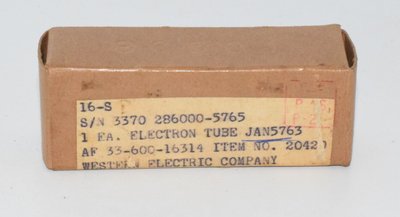
The 5763 was manufactured by several major tube producers including Western Electric, RCA, Mullard, and Telefunken. The JAN (Joint Army-Navy) specifications ensured stringent quality control and reliability standards, making military-grade 5763 tubes particularly sought after by audio enthusiasts and professionals. These NOS (New Old Stock) variants remain highly prized for their superior construction and consistent performance characteristics.
2. Technical Specifications and Design
Physical and Electrical Parameters
Tube Type: Medium-Mu Triode
Heater Voltage: 6.3V AC/DC
Heater Current: 1.0A
Plate Voltage (Maximum): 550V
Plate Dissipation: 12W
Grid Bias (Typical): -8V to -12V
Amplification Factor (μ): 20-30
Plate Resistance (rp): 800-1200 ohms
Transconductance (gm): 20-25 mA/V
Output Impedance: Approximately 10-15 ohms
Construction and Design Features
The 5763 features a rugged construction with a medium-sized glass envelope and a 9-pin miniature base (noval configuration). The internal structure includes a directly heated cathode, a control grid, and a plate, all precisely aligned within the tube envelope. The tube employs a sturdy mica spacer system that maintains electrode spacing under thermal stress, contributing to its reliability and longevity.
The plate structure is designed for efficient heat dissipation, allowing for sustained high-power operation without thermal runaway. The control grid features a carefully wound filament that provides excellent linearity across the operating range. This design philosophy prioritizes stability and low distortion, making the 5763 suitable for critical audio applications.
Operating Characteristics
The 5763 exhibits excellent linearity in its operating region, with minimal harmonic distortion when properly biased. The tube operates efficiently in both triode and pentode configurations, though it is primarily used as a triode. Its moderate amplification factor makes it suitable for both pre-amplification and driver stages, offering a good balance between gain and output impedance.
3. Applications and Usage
Audio Amplification
The 5763 finds extensive application in high-fidelity audio amplifiers, particularly in:
- Preamplifier Stages: The tube's low noise characteristics and excellent linearity make it ideal for phono preamps and line-stage amplifiers where signal integrity is paramount.
- Driver Stages: Its moderate gain and ability to deliver current make it perfect for driving output stages in push-pull amplifier configurations.
- Tone Control Circuits: The 5763 is frequently used in tone control and equalization circuits where its predictable characteristics ensure transparent signal processing.
Professional Audio Equipment
The 5763 has been widely employed in professional studio equipment, including:
- Microphone preamplifiers and mixing consoles
- Mastering amplifiers and monitoring systems
- Vintage recording equipment and analog tape machines
- Broadcast audio equipment and transmission systems
Instrument Amplification
Musicians and instrument amplifier manufacturers have incorporated the 5763 into guitar and bass amplifiers, where its warm, responsive characteristics contribute to the sought-after "tube tone" that defines vintage amplification.
4. Sound Characteristics in Audio Applications
Sonic Profile
The 5763 is renowned among audio professionals and enthusiasts for its distinctive sonic characteristics. The tube imparts a warm, slightly compressed character to the audio signal, with particular emphasis in the midrange frequencies. This coloration is often described as "musical" rather than clinical, making it highly valued in applications where sonic character is desirable.
Frequency Response and Harmonic Content
The 5763 exhibits a relatively flat frequency response across the audible spectrum, with a gentle presence peak in the upper midrange (around 2-4 kHz). The tube's natural harmonic distortion profile is predominantly second-order harmonic, which is perceived as pleasant and non-fatiguing to the human ear. Higher-order harmonics are minimal, contributing to the smooth, refined sound quality.
When operating in Class A configuration, the 5763 produces primarily even-order harmonics, which are generally considered more musical than odd-order distortion. This characteristic makes the tube particularly valued in applications where subtle harmonic enhancement is desired without obvious coloration.
Dynamic Response and Transient Handling
The 5763 demonstrates excellent transient response, with quick attack characteristics and controlled decay. The tube responds well to dynamic program material, maintaining clarity during complex musical passages. The moderate output impedance and reasonable current capability allow the 5763 to drive subsequent stages effectively without dynamic compression.
Noise and Microphonics
Quality 5763 tubes, particularly JAN-grade examples, exhibit exceptionally low noise floors. The mechanical construction minimizes microphonic effects, making the tube suitable for high-gain applications such as phono preamplification. NOS tubes from reputable manufacturers demonstrate superior noise performance compared to modern production tubes.
5. The 5763 in the Audio Community
Audiophile and Vintage Audio Enthusiasm
The 5763 occupies a special place in the hearts of tube audio enthusiasts and audiophiles. The availability of NOS (New Old Stock) examples, particularly those manufactured by Western Electric and RCA under JAN specifications, has created a dedicated community of collectors and users. These vintage tubes command premium prices due to their superior construction quality and consistent performance characteristics.
Audiophile forums and communities frequently discuss the sonic merits of different 5763 variants, with particular emphasis on the subtle differences between manufacturers. Western Electric 5763 tubes are often considered the "gold standard," commanding prices significantly higher than other variants due to their legendary reliability and sonic performance.
DIY Tube Audio Projects
The 5763 has become a favorite component in DIY (Do-It-Yourself) tube amplifier projects. The tube's forgiving nature and straightforward biasing requirements make it accessible to hobbyists, while its performance characteristics satisfy demanding audiophiles. Numerous published amplifier designs feature the 5763, from simple single-ended triode (SET) designs to more complex push-pull configurations.
Online communities dedicated to tube audio have documented extensive experience with 5763 tubes, sharing biasing techniques, circuit topologies, and sonic observations. This collective knowledge has helped establish best practices for maximizing the tube's performance potential.
Professional Audio Production
In professional recording and mastering facilities, the 5763 continues to be valued in vintage equipment and in newly designed mastering amplifiers. Studios specifically seek out NOS 5763 tubes to maintain the sonic character of classic equipment or to incorporate into modern designs that intentionally embrace tube-era aesthetics.
Microphone preamplifier manufacturers, both vintage and contemporary, have incorporated the 5763 into designs intended for critical recording applications. The tube's combination of low noise, excellent linearity, and pleasant harmonic characteristics makes it ideal for capturing the subtle details of acoustic instruments and vocals.
Market Dynamics and Tube Selection
The 5763 market reflects broader trends in tube audio enthusiasm. As modern tube production has declined, NOS tubes have become increasingly valuable. Audiophiles and professionals carefully select 5763 examples based on manufacturer, manufacturing date, and measured parameters. Testing equipment such as tube testers and curve tracers are employed to verify tube quality and ensure consistent performance.
The premium placed on quality 5763 tubes has led to careful documentation of manufacturing variations. Users report subtle sonic differences between Western Electric, RCA, Mullard, and Telefunken examples, though these differences are often subtle and context-dependent. The psychological and sonic placebo effects are acknowledged within the community, yet genuine manufacturing differences in materials and construction techniques contribute to measurable performance variations.
6. Equivalent or Substitute Types
Direct Equivalents
5763A: An improved version of the 5763 with enhanced specifications, offering slightly higher plate dissipation and improved reliability. The 5763A is a direct pin-compatible replacement with superior performance characteristics.
6L6: While not identical, the 6L6 can function as a substitute in some applications, though with different impedance and current characteristics. The 6L6 is more commonly used as an output tube rather than a driver or preamp tube.
Functional Alternatives
12AX7/ECC83: A higher-mu triode suitable for preamp applications where greater gain is required. The 12AX7 produces more harmonic coloration and is less suitable for driver stages.
6SN7: A larger triode offering greater current capability and lower output impedance. The 6SN7 is suitable for driver and output applications but differs significantly in characteristics.
EL84: A pentode with different operating characteristics, suitable for small amplifiers and instrument applications but not a true equivalent.
Modern Production Alternatives
Contemporary manufacturers including Mullard, JJ Electronics, and Genelex produce modern 5763 tubes. While these offer reliable performance and are significantly more affordable than NOS examples, many audiophiles report subtle sonic differences. Modern tubes typically exhibit slightly higher noise floors and different harmonic characteristics compared to vintage examples.
7. Notable Characteristics and Considerations
Advantages
- Excellent linearity and low distortion in Class A operation
- Warm, musical sonic character with predominantly even-order harmonics
- Low noise floor, particularly in NOS examples
- Robust construction and proven reliability
- Moderate power consumption and heat generation
- Straightforward biasing and circuit implementation
- Availability of extensive documentation and application notes
Limitations and Considerations
- NOS tubes command premium prices and availability is limited
- Modern production tubes may not match vintage sonic performance
- Requires careful matching when using multiple tubes in a circuit
- Heater current draw must be considered in power supply design
- Tube aging and parameter drift over extended use
- Sensitivity to operating conditions and bias point accuracy
Maintenance and Care
Proper tube maintenance ensures optimal performance and longevity. Tubes should be operated within specified parameters, with accurate bias point adjustment critical to preventing premature wear. Regular inspection for visible damage or discoloration, and periodic measurement of tube parameters using a tube tester, helps identify degrading tubes before failure.
Storage conditions significantly impact NOS tube longevity. Tubes should be stored in cool, dry environments away from vibration and electromagnetic interference. Proper tube dampers and isolation techniques minimize microphonic effects and mechanical stress during operation.
Conclusion
The 5763 vacuum tube represents a pinnacle of mid-20th century tube design, combining robust construction, excellent audio performance, and remarkable reliability. Whether in vintage professional equipment, contemporary audiophile amplifiers, or DIY projects, the 5763 continues to deliver musical, warm amplification that has earned its place in audio history.
The distinction between NOS examples and modern production tubes reflects broader trends in audio philosophy, where vintage components are valued for their sonic and construction qualities. For those seeking authentic tube audio character with reliable performance, the 5763 remains an excellent choice, particularly when sourced from reputable manufacturers and properly maintained.
As tube audio experiences continued renaissance among audiophiles and professionals seeking alternative aesthetics to solid-state electronics, the 5763 will likely maintain its status as a valued and sought-after component in high-fidelity audio systems.