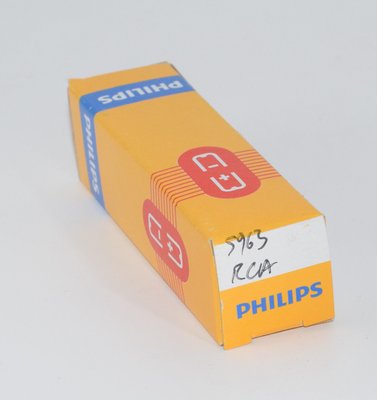
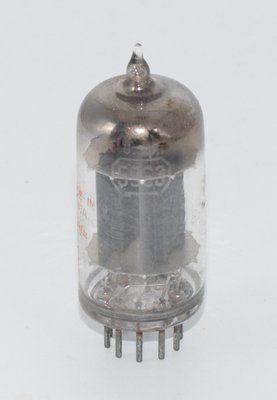
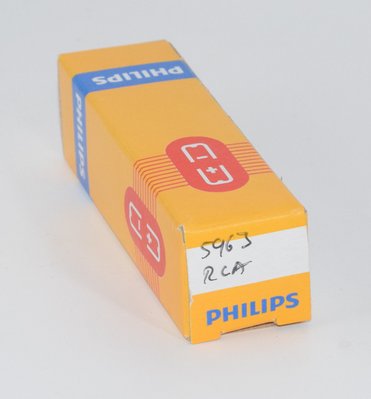
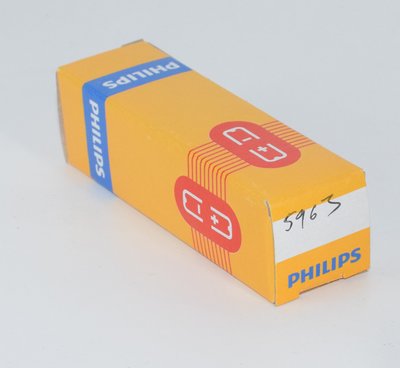
Introduction and History
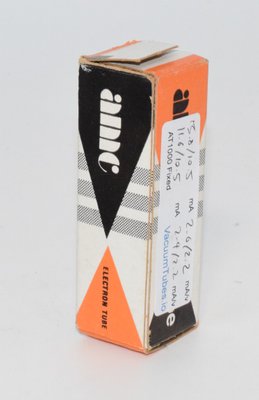
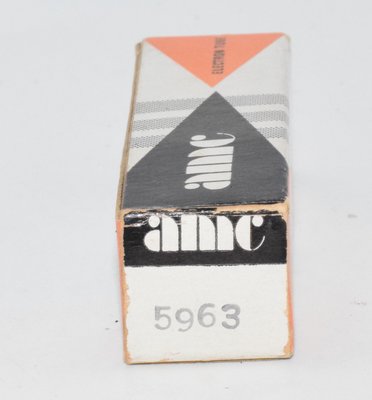
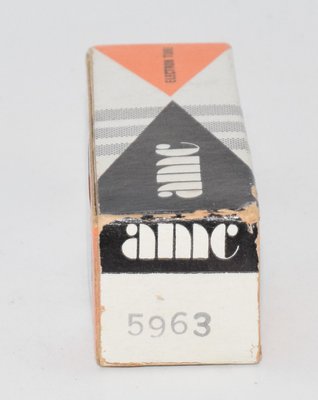
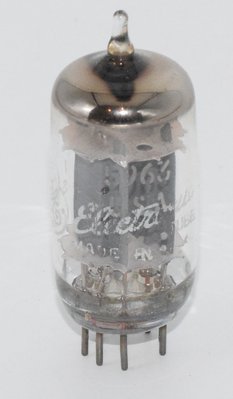
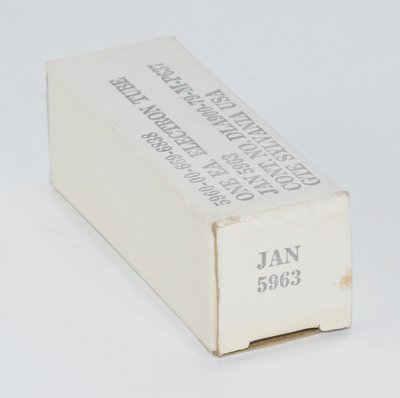
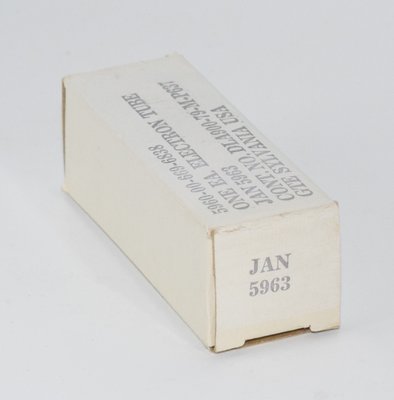
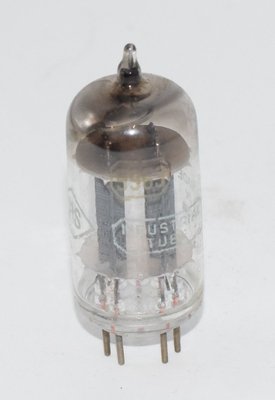
The 5963 is a ruggedized, industrial/military-grade dual triode vacuum tube developed in the early 1950s as a premium variant of the popular 12AU7 (ECC82) family. Designed to meet stringent military specifications, the 5963 was manufactured by major American tube producers including RCA, Sylvania, GE, CBS, and AMC (American Microphone Company). It carries a JAN (Joint Army-Navy) designation in many of its production runs, reflecting its origins as a tube intended for reliable service in demanding military and industrial equipment.
The 5963 differs from the standard 12AU7 in one critical respect: it is designed exclusively for parallel heater operation at 6.3 volts, whereas the standard 12AU7 features a center-tapped heater that can be wired for either 6.3V parallel or 12.6V series operation. This design choice allowed the 5963's heater structure to be optimized for a single voltage, contributing to improved reliability, lower microphonics, and tighter manufacturing tolerances. The tube was widely used in military communications equipment, test instruments, early computers, and industrial control systems throughout the 1950s and 1960s.
Today, the 5963 is prized by audiophiles and guitar amplifier enthusiasts as a high-quality substitute in circuits designed for the 12AU7/ECC82, provided the equipment uses 6.3V heater supplies. NOS (New Old Stock) examples from RCA, Sylvania, and GE command premium prices on the vintage tube market.
Technical Specifications and Design
Heater / Filament
| Parameter | Value |
|---|---|
| Heater Voltage (Vh) | 6.3 V (parallel only) |
| Heater Current (Ih) | 0.3 A |
| Heater Configuration | Parallel only (no series/12.6V option) |
| Cathode Type | Oxide-coated, indirectly heated |
Interelectrode Capacitances (per section)
| Parameter | Value |
|---|---|
| Grid-to-Cathode Capacitance (Cgk) | 1.9 pF |
| Plate-to-Cathode Capacitance (Cak) | 0.5 pF |
| Grid-to-Plate Capacitance (Cga) | 1.5 pF |
Characteristic Values (per section)
The 5963 shares the same fundamental electrical characteristics as the ECC82/12AU7 family. The following values are derived from the ECC82 datasheet, which represents the electrical equivalent of the 5963's triode sections:
| Parameter | Va=100V, Vg1=0V | Va=170V, Vg1=−4V | Va=200V, Vg1=−5.5V | Va=250V, Vg1=−8.5V |
|---|---|---|---|---|
| Plate Current (Ia) | 11.8 mA | 10 mA | 11 mA | 10.5 mA |
| Transconductance (gm) | 3.2 mA/V | 2.5 mA/V | 2.5 mA/V | 2.2 mA/V |
| Amplification Factor (μ) | 20 | 18 | 18 | 17 |
| Plate Resistance (rp) | 6.25 kΩ | 7.2 kΩ | 7.2 kΩ | 7.7 kΩ |
| Durchgriff (D) | 5% | 5.4% | 5.6% | 5.9% |
Maximum Ratings (per section)
| Parameter | Value |
|---|---|
| Maximum Plate Voltage (cold) | 550 V |
| Maximum Plate Voltage (operating) | 300 V |
| Maximum Plate Dissipation (Wa) | 2.75 W |
| Maximum Cathode Current (Ik) | 20 mA |
| Maximum Peak Cathode Current | 250 mA (max 10% duty, ≤2 ms) |
| Maximum Negative Grid Voltage (−Vg1) | −50 V |
| Maximum Grid Resistor (self-bias) | 1 MΩ |
| Maximum Grid Resistor (fixed bias) | 0.25 MΩ |
| Maximum Cathode-to-Heater Voltage | 180 V |
Note: Some sources indicate the 5963 may have slightly tighter maximum ratings than the standard 12AU7 in certain parameters. The values above are consistent with the ECC82 family datasheet. Designers should confirm against the specific manufacturer's 5963 datasheet for their production lot.
Physical Construction
| Parameter | Value |
|---|---|
| Base Type | Noval (B9A) 9-pin miniature |
| Envelope | T-6½ miniature glass (approximately 22.2 mm max diameter) |
| Mounting Position | Any |
| Weight | Approximately 10 g |
Pin Configuration (Noval B9A base, bottom view)
| Pin | Function |
|---|---|
| 1 | Plate I (aI) |
| 2 | Grid I (g1I) |
| 3 | Cathode I (kI) |
| 4 | Heater |
| 5 | Heater |
| 6 | Plate II (aII) |
| 7 | Grid II (g1II) |
| 8 | Cathode II (kII) |
| 9 | Heater center-tap (connected internally for 6.3V operation) |
Important: Unlike the standard 12AU7, the 5963's heater center-tap (pin 9) is internally connected, meaning the tube is designed exclusively for 6.3V parallel heater operation. It cannot be used in 12.6V series heater strings without modification or risk of damage. This is the single most important distinction between the 5963 and the 12AU7.
Applications and Usage
The 5963 was designed for use as a low-frequency amplifier, oscillator, and phase inverter — the same applications as the standard ECC82/12AU7. Per the Tesla ECC82 datasheet, typical applications include:
Class A Single-Ended Power Amplifier (one section)
| Parameter | Value |
|---|---|
| Plate Voltage (Ua) | 250 V |
| Cathode Resistor (Rk) | 1 kΩ |
| Load Resistance (Ra) | 13 kΩ |
| Grid Drive Voltage (Ug1 eff) | 5.9 V |
| Quiescent Plate Current (Ia0) | 9.2 mA |
| Signal Plate Current (Ia) | 9.6 mA |
| Output Power (Po) | 0.27 W |
| Distortion (k) | 10% |
Class AB Push-Pull Power Amplifier (both sections)
| Parameter | Value |
|---|---|
| Plate Voltage (Ua) | 250 V |
| Common Cathode Resistor (Rk) | 800 Ω |
| Anode-to-Anode Load (Ra-a) | 30 kΩ |
| Grid Drive Voltage (Ug1 eff) | 16.3 V |
| Quiescent Plate Current (Ia0) | 2 × 6.6 mA |
| Signal Plate Current (Ia) | 2 × 7.2 mA |
| Output Power (Po) | 0.715 W |
| Distortion (k) | 4% |
Cascaded Voltage Amplifier (both sections in series)
| Parameter | Ub=250V | Ub=350V |
|---|---|---|
| Combined Plate Current (IaI + IaII) | 1.66 mA | 2.33 mA |
| AC Output Voltage (Uo eff) | 15 V | 25 V |
| Voltage Gain (Uo/Ug1) | 178 | 178 |
| Total Distortion (k) | 2% | 2% |
Phase Inverter
| Parameter | Ub=250V | Ub=350V |
|---|---|---|
| Plate Current I (IaI) | 0.7 mA | 1.0 mA |
| Plate Current II (IaII) | 0.68 mA | 0.93 mA |
| AC Output Voltage (Uo eff) | 15 V | 24 V |
| Voltage Gain | 11 | 11 |
| Total Distortion | 1% | 1% |
RC-Coupled Voltage Amplifier (one section)
The datasheet provides extensive operating data for RC-coupled amplifier configurations with various plate and cathode resistor combinations:
| Ra | Rg1' | Rk | Ub | Ia | Uo eff | Gain | Distortion |
|---|---|---|---|---|---|---|---|
| 47 kΩ | 150 kΩ | 1.2 kΩ | 250 V | 3.02 mA | 34 V | 13.5 | 6.4% |
| 100 kΩ | 330 kΩ | 2.2 kΩ | 250 V | 1.63 mA | 32 V | 14 | 5.9% |
| 220 kΩ | 680 kΩ | 3.9 kΩ | 250 V | 0.82 mA | 28 V | 14.5 | 4.8% |
Grid leak resistor maximum: 1 MΩ. Coupling capacitors: 10 kpF (anode circuit), 10 kpF (grid circuit). Cathode bypass capacitor: 50 μF.
Additional Applications
- Military communications: The 5963 was widely used in military radio receivers and transmitters where reliable, low-noise amplification was essential.
- Test equipment: Oscilloscopes, signal generators, and voltmeters from manufacturers like Hewlett-Packard and Tektronix frequently specified the 5963.
- Early computing: Used in analog computing circuits and digital switching applications where the ruggedized construction improved mean time between failures.
- Industrial control: Process control instrumentation and servo amplifiers.
Sound Characteristics
The 5963 is widely regarded by audiophiles and recording engineers as one of the finest-sounding members of the 12AU7/ECC82 family. Its sonic character is shaped by its ruggedized construction, tighter manufacturing tolerances, and optimized 6.3V heater design.
Tonal Qualities
- Warmth and body: The 5963 delivers the characteristic warmth associated with the 12AU7 family, but with a slightly more refined and controlled presentation. The midrange is full and rich without becoming congested or overly thick.
- Clarity and detail: Compared to many standard 12AU7 production tubes, the 5963 is often described as having superior clarity and resolution, particularly in the upper midrange and lower treble. Fine details in recordings — the decay of cymbal hits, the texture of bowed strings, the breath of a vocalist — are rendered with greater precision.
- Low-end authority: The bass response is typically described as tight, well-defined, and controlled. The ruggedized construction and reduced microphonics contribute to a cleaner low-frequency presentation compared to standard commercial 12AU7 types.
- Treble character: The high frequencies are smooth and extended without harshness or grain. The 5963 avoids the slightly rolled-off or soft treble that some 12AU7 variants exhibit.
- Noise floor: Military-grade construction results in exceptionally low noise and microphonics, making the 5963 particularly well-suited for phono preamplifier stages and other high-gain, low-signal applications where noise is critical.
- Dynamics: The tube handles transients well, with good micro-dynamic resolution. It does not compress or soften dynamic peaks as aggressively as some softer-sounding 12AU7 variants.
Manufacturer-Specific Sonic Differences
As with most vintage tubes, the sonic character varies somewhat by manufacturer:
- RCA 5963: Often considered the most musical of the bunch, with a slightly warmer tonal balance and excellent midrange liquidity. RCA examples are among the most sought-after by audiophiles.
- Sylvania 5963 (JAN): Tends toward a more neutral, analytical presentation with excellent detail retrieval and a slightly leaner tonal balance. Favored by those seeking accuracy over coloration.
- GE 5963: Generally described as falling between the RCA and Sylvania in character — warm but detailed, with good bass control and a smooth treble.
Equivalent or Substitute Types
Directly Interchangeable (Close/Identical Substitute)
| Type | Notes |
|---|---|
| CV3900 | UK military designation for the 5963. Electrically identical, direct drop-in replacement. |
Compatible with Caveats (Different Rating Substitutes — NOT direct drop-in)
The following tubes share the same basic triode characteristics and pin configuration as the 5963, but differ in heater configuration, ratings, or specifications. They are not guaranteed drop-in replacements without verifying heater wiring compatibility:
| Type | Key Difference |
|---|---|
| 12AU7 / 12AU7A / 12AU7WA | Standard commercial and ruggedized versions. Feature center-tapped heater for 6.3V or 12.6V operation. Can substitute for 5963 in 6.3V circuits, but the 5963 cannot replace a 12AU7 in 12.6V series heater strings. |
| ECC82 | European designation equivalent to 12AU7. Same heater caveat applies. |
| ECC802 / ECC802S | Premium long-life European versions of the ECC82. Center-tapped heater. |
| E82CC | Philips/Mullard special quality version with tighter tolerances. Center-tapped heater. |
| 5814 / 5814A / CK5814 | Another ruggedized military 12AU7 variant. Unlike the 5963, the 5814 retains the center-tapped heater and can operate at 12.6V. |
| 6189 | Premium industrial version of the 12AU7A. Center-tapped heater. |
| 6680 | Military/industrial variant. Center-tapped heater. |
| 6067 | Industrial variant of the 12AU7 family. |
| 7489 / 7730 | Special versions with modified characteristics. |
| B329 / B749 | European designations within the ECC82 family. |
| CV491 / CV4003 / CV4016 | UK military equivalents of the 12AU7/ECC82 family. Center-tapped heaters. |
| M8136 | Mullard special quality equivalent. Center-tapped heater. |
| 6CC40 | Philips variant with different construction. |
| CV8155 / CV8221 / CV9092 / CV10323 / CV10666 | Various UK military registered equivalents. |
| E2163 | Telefunken designation within the family. |
Critical Substitution Warning: The 5963 is designed exclusively for 6.3V parallel heater operation. It cannot be used as a replacement for a 12AU7 in equipment that wires the heater in series for 12.6V operation (common in many consumer radios and televisions with series heater strings). Conversely, any standard 12AU7/ECC82 can replace a 5963 in 6.3V circuits without issue, as the 12AU7's center-tapped heater simply operates in parallel mode.
Notable Characteristics
Ruggedized Construction
The 5963 was built to military standards with enhanced mechanical construction. This typically includes:
- Reinforced mica spacers with tighter element alignment
- Heavier gauge internal wiring and support structures
- More rigorous quality control and testing during manufacture
- Enhanced vibration and shock resistance
- Tighter matching between the two triode sections
Dedicated 6.3V Heater
By eliminating the center-tap and designing the heater exclusively for 6.3V parallel operation, the 5963 achieves several advantages:
- Simplified heater construction with potentially lower hum and noise
- More uniform cathode heating, contributing to better section matching
- Elimination of the center-tap connection point, reducing a potential source of intermittent contact or noise
Low Interelectrode Capacitances
The 5963's interelectrode capacitances (Cgk = 1.9 pF, Cak = 0.5 pF, Cga = 1.5 pF) are comparable to the ECC82 family values (Cgk = 1.8 pF, Cak = 0.6 pF, Cga < 1.7 pF), making it suitable for the same frequency range of applications.
Moderate Amplification Factor
With a μ of approximately 17–20 depending on operating point, the 5963 provides moderate gain — lower than the 12AX7 (μ ≈ 100) or 12AT7 (μ ≈ 60), but with correspondingly lower plate resistance and higher current capability. This makes it ideal for driver stages, cathode followers, phase inverters, and applications where low output impedance and good current delivery are more important than raw voltage gain.
Excellent Linearity at Low Signal Levels
The ECC82 family, including the 5963, exhibits good linearity at moderate signal levels. The datasheet shows that in RC-coupled amplifier configurations, distortion figures of 4–7% are achievable at full output, with significantly lower distortion at reduced signal levels. In cascaded configurations, total distortion as low as 2% is specified.
Usage in the Audio Community
High-End Audio Preamplifiers
The 5963 has found a devoted following among builders and users of high-end tube preamplifiers. Its low noise floor, excellent microphonic rejection, and refined sonic character make it a premium tube rolling option in any preamplifier designed around the 12AU7/ECC82. Popular preamplifiers that can accept the 5963 include designs from Audio Research, Conrad-Johnson, Cary Audio, Rogue Audio, and many others that use 6.3V heater supplies.
Headphone Amplifiers
The 12AU7 family is extremely popular in tube headphone amplifiers, and the 5963 is considered one of the best options for these circuits. Its low output impedance (when used in cathode follower configuration) and ability to deliver clean current make it well-suited for driving headphones. The reduced microphonics are particularly valuable in headphone listening, where the intimate nature of the experience makes any tube noise more apparent. Popular headphone amplifiers from Woo Audio, Bottlehead, and Darkvoice can often accept the 5963.
DAC Output Stages
Many hybrid and tube DACs use 12AU7-type tubes in their analog output stages. The 5963 is a popular upgrade choice in units from manufacturers like Musical Fidelity, Jolida/Black Ice, and MHDT Labs, where its clarity and low noise can improve the analog output quality.
Guitar Amplifiers
While less common in guitar amplifiers than the 12AX7, the 12AU7/ECC82 family appears in phase inverter and driver positions in many classic amplifier designs. The 5963 can be used in these positions in amplifiers with 6.3V heater supplies, offering improved reliability and a slightly different tonal character. Its ruggedized construction is advantageous in the high-vibration environment of a guitar amplifier used on stage.
Tube Rolling and Collecting
The 5963 occupies an interesting niche in the tube rolling community. Because it is less well-known than premium types like the Mullard CV4003 or Amperex 7316, NOS examples can sometimes be found at more reasonable prices — though this price advantage has diminished as awareness of the type has grown. Key points for tube rollers:
- Always verify heater compatibility: The 5963 will only work in equipment with 6.3V heater supplies. Do not use it in series heater string equipment.
- RCA production is generally the most sought-after for audio use, with black plate versions from the 1950s commanding the highest prices.
- Sylvania JAN production offers excellent value, with consistent quality and good sonic performance.
- GE production is reliable and well-regarded, though less commonly encountered than RCA or Sylvania examples.
- CBS and AMC branded tubes were typically manufactured by one of the major producers (often Sylvania or RCA) and can offer excellent performance at lower prices due to less collector recognition of the brand names.
DIY Audio Projects
The 5963 is an excellent choice for DIY audio projects based on the 12AU7 topology. Its military-grade construction provides a margin of reliability that is welcome in hand-built equipment, and its consistent performance makes it easier to achieve predictable results. The Class A single-ended amplifier configuration (250V plate supply, 13 kΩ load, 1 kΩ cathode resistor) delivering 0.27W per section is a popular starting point for low-power headphone amplifier and small speaker projects. The push-pull configuration using both sections can deliver 0.715W at 4% distortion — sufficient for efficient speakers in near-field listening.
Availability
As a tube that was produced in large quantities for military contracts, NOS 5963 tubes remain available from vintage tube dealers, though supplies are gradually diminishing. The tube is not currently in production by any manufacturer. Buyers should look for tubes with strong, balanced emission readings and low noise/microphonics. JAN-marked examples with original military packaging generally command the highest confidence in terms of remaining useful life and consistent quality.