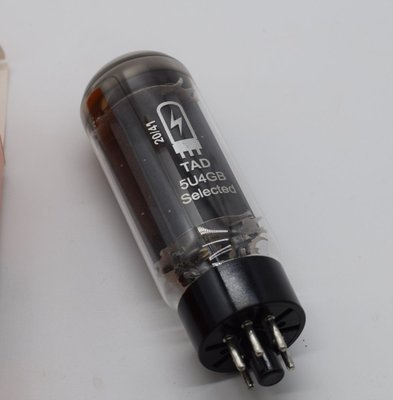
1. Introduction and History
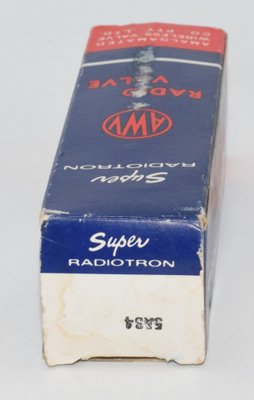
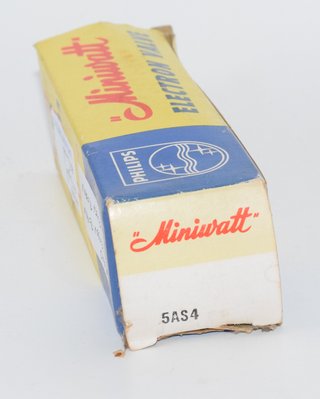
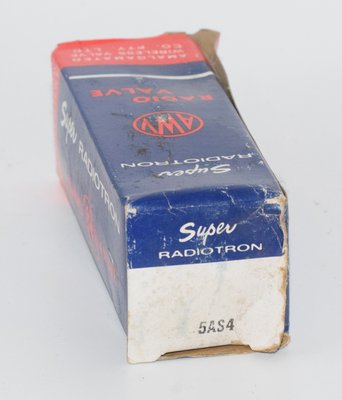
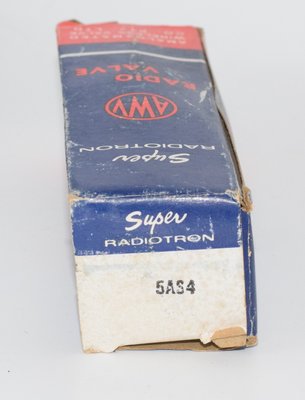
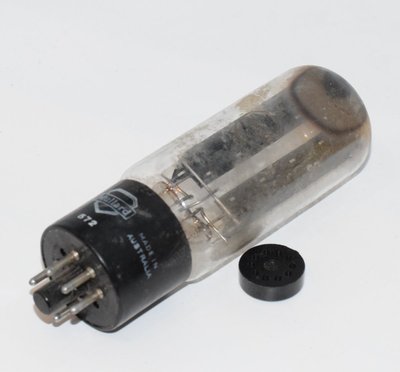
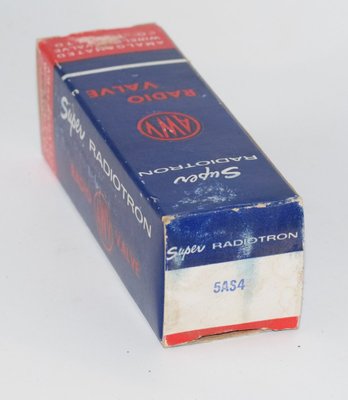
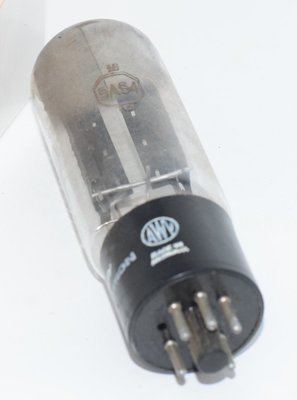
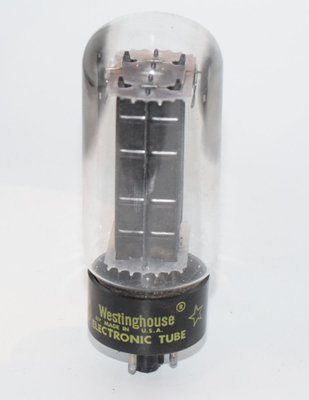
The 5AS4 is a full-wave vacuum rectifier tube designed for use in power supply circuits of audio amplifiers, radio receivers, and other electronic equipment. Manufactured by RCA (Radio Corporation of America) and subsequently produced by several other manufacturers including AWV (Amalgamated Wireless Valve Company) under the Super Radiotron brand in Australia, Mullard Australia, and Philips Miniwatt, the 5AS4 served as a reliable rectifier in a wide range of consumer and professional equipment.
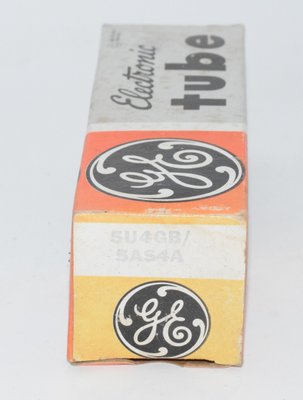
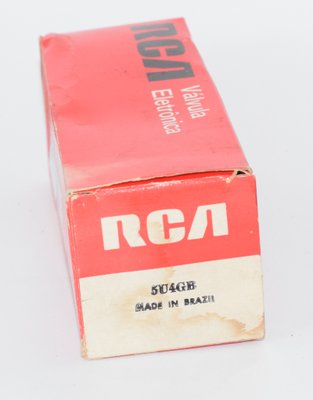
The 5AS4 is closely related to the well-known 5U4GB rectifier family, sharing the same maximum ratings, typical operating conditions, and characteristic curves as specified by RCA in their datasheet. The tube was developed during the era when indirectly heated and directly heated rectifiers were the standard means of converting AC mains voltage to the DC supply voltages required by vacuum tube circuits. Its robust construction and generous current handling capability made it a popular choice in medium- to high-power amplifier designs.
The RCA datasheet for the 5AS4 is marked as "TENTATIVE DATA," suggesting it was introduced as a newer variant or alternative designation within the 5U4 family. Its availability from Australian manufacturers such as AWV Super Radiotron, Mullard Australia, and Philips Miniwatt indicates that the type saw significant use in the Australian and broader Asia-Pacific markets, where these brands were dominant suppliers of vacuum tubes.
2. Technical Specifications and Design
Electrical Specifications
| Parameter | Value |
|---|---|
| Filament Type | Coated (directly heated cathode) |
| Filament Voltage | 5 AC volts |
| Filament Current | 3 amperes |
The RCA datasheet explicitly states that the maximum ratings, typical operation, and curves for the 5AS4 are the same as those shown for the 5U4-GB. Based on standard 5U4GB specifications, the following ratings apply:
| Parameter | Value |
|---|---|
| Maximum AC Plate Voltage (per plate, RMS) | 450 volts* |
| Maximum Peak Inverse Voltage | 1550 volts* |
| Maximum DC Output Current | 275 mA* |
| Maximum Peak Plate Current (per plate) | 825 mA* |
* These values are derived from the 5U4GB datasheet as referenced by the RCA 5AS4 data. Users should confirm exact values against a complete 5U4GB manufacturer datasheet for their specific application.
Note: As a rectifier tube, the 5AS4 does not have amplification factor (μ), transconductance (gm), plate resistance (rp), or grid bias specifications — these parameters apply to amplifying tubes (triodes, pentodes, etc.), not to rectifiers which have no control grid.
Physical and Mechanical Specifications
| Parameter | Value |
|---|---|
| Maximum Overall Length | 5-1/8 inches |
| Maximum Seated Length | 4-9/16 inches |
| Maximum Diameter | 2-1/16 inches |
| Bulb Type | ST-16 |
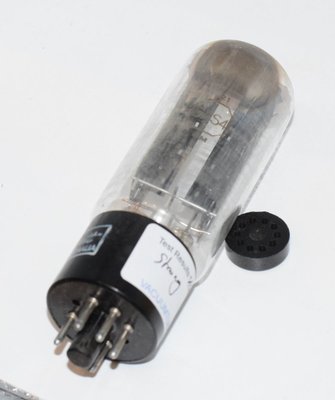
| Base Type | Medium-Shell Octal 8-Pin (JETEC No. B8-11) or Medium-Shell Octal 5-Pin (JETEC No. B5-15) |
| Basing Designation (Bottom View) | 5T |
| Mounting Position | Vertical (base up or down), or Horizontal with pins 1 and 4 in vertical plane |
Pin Configuration (Octal Base — Bottom View)
| Pin Number | Connection |
|---|---|
| Pin 1 | No Connection |
| Pin 2 | Filament |
| Pin 3 | No Connection (same as Pin 1) |
| Pin 4 | Plate No. 2 |
| Pin 5 | No Connection (same as Pin 1) |
| Pin 6 | Plate No. 1 |
| Pin 7 | No Connection (same as Pin 1) |
| Pin 8 | Filament |
The pinout follows the standard full-wave rectifier configuration with the two plate connections on pins 4 and 6, and the filament (which also serves as the cathode in this directly heated design) on pins 2 and 8. Pins 1, 3, 5, and 7 are not connected. The 5-pin base variant (JETEC B5-15) omits the unused pins entirely.
3. Applications and Usage
The 5AS4 is a full-wave vacuum rectifier designed for power supply applications. Its primary function is to convert alternating current from a power transformer's high-voltage secondary winding into pulsating direct current, which is then filtered by capacitors and chokes to provide smooth DC for the plate (B+) supply of vacuum tube circuits.
Typical Applications
- Audio Amplifier Power Supplies: The 5AS4 is well-suited for powering medium- to high-power push-pull amplifier designs using tubes such as the 6L6, EL34, KT66, 6550, and similar output tubes. Its generous current rating allows it to supply the demands of Class AB1 and Class AB2 amplifier stages.
- Radio Receiver Power Supplies: Used in larger console and communications receivers where substantial B+ current was required for multiple stages.
- Test Equipment: Found in laboratory instruments and test equipment power supplies where regulated, clean DC was needed.
- Industrial Electronics: Used in various industrial control circuits and instrumentation of the vacuum tube era.
Circuit Considerations
As a directly heated (filament-type) rectifier, the 5AS4 requires a dedicated 5-volt filament winding on the power transformer, typically with a center tap that serves as the B+ return (ground reference) for the power supply. The center-tapped high-voltage secondary feeds the two plates, and the rectified output is taken from the filament center tap.
Proper attention must be paid to the maximum AC plate voltage ratings and the capacitor input filter limitations. Like all directly heated rectifiers, the 5AS4 begins conducting almost immediately upon power-up (since the filament heats quickly), which means the B+ voltage rises before the amplifier tubes' cathodes have fully warmed up. This characteristic provides a form of soft-start behavior, as the rectifier's internal resistance drops gradually as the filament reaches full temperature, though this effect is less pronounced than with indirectly heated rectifiers.
4. Sound Characteristics
The 5AS4, being electrically equivalent to the 5U4GB, shares the sonic characteristics that have made the 5U4 family a favorite among tube audio enthusiasts. As a rectifier, the 5AS4 does not directly amplify the audio signal, but it profoundly influences the character of the power supply — and by extension, the overall sound of the amplifier.
Tonal Qualities
- Warmth and Body: The 5AS4/5U4GB family is known for imparting a warm, full-bodied character to the sound. The inherent voltage drop across the tube (typically 40–50 volts under load) and its relatively soft regulation contribute to a slightly lower and more "relaxed" B+ voltage compared to solid-state rectification, which many listeners perceive as warmth.
- Natural Sag and Dynamics: One of the most valued characteristics of tube rectifiers like the 5AS4 is their dynamic "sag" — a slight compression effect that occurs during transient peaks when the power supply momentarily dips under heavy current demand. This creates a natural, organic compression that smooths out harsh transients and gives the music a more fluid, breathing quality. Guitar amplifier players particularly prize this effect.
- Smooth Midrange: The 5U4 family, including the 5AS4, is often described as having a smooth, liquid midrange presentation. Vocals and acoustic instruments benefit from this quality, sounding natural and unforced.
- Bass Response: Compared to solid-state rectification, the 5AS4 tends to produce slightly softer, rounder bass. While this may sacrifice some ultimate tightness and slam, many audiophiles prefer this presentation for its musicality and natural decay characteristics.
- Treble Character: The high frequencies tend to be smooth and non-fatiguing, without the sometimes clinical or edgy quality that can accompany solid-state rectification in certain amplifier designs.
Comparison with Other Rectifiers
Compared to the GZ34/5AR4 rectifier, the 5AS4/5U4GB has a higher voltage drop and lower regulation, resulting in more pronounced sag and a warmer overall character. The GZ34 is often described as tighter and more controlled. Compared to the 5Y3GT, the 5AS4 offers higher current capability and somewhat better regulation, making it suitable for larger amplifiers while still retaining the desirable tube rectifier characteristics.
5. Equivalent or Substitute Types
Close/Identical Substitutes (Direct Drop-In Replacements)
| Type | Notes |
|---|---|
| 5AS4A | Improved or updated version of the 5AS4. Direct drop-in replacement with identical pinout and ratings. |
Different Rating Substitutes (NOT Direct Drop-In — Verify Compatibility)
The following types are related to the 5AS4 and share the same basic function and pinout, but may have different voltage ratings, current ratings, voltage drop characteristics, or mechanical dimensions. They should not be assumed to be direct drop-in replacements without careful verification of the specific circuit requirements:
| Type | Notes |
|---|---|
| 5U4 | Original type in the family. Check envelope size and ratings. |
| 5U4G | Globe/shouldered glass envelope version. Larger physical size (ST-19 bulb). Same electrical function but verify mechanical clearance. |
| 5U4GA | Variant of 5U4G. Verify specific ratings. |
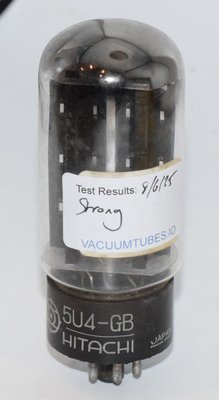
| 5U4GB | The RCA datasheet states the 5AS4 has the same ratings and curves as the 5U4GB. This is the closest electrical equivalent, though the 5AS4 uses an ST-16 bulb while the 5U4GB may differ in physical dimensions. Often listed interchangeably with the 5AS4. |
| 5U4GT | Tubular glass envelope version. May have slightly different ratings — verify before substitution. |
| CV575 | British military designation. Equivalent to a member of the 5U4 family. Verify specific ratings. |
| CV841 | British military designation. Verify specific ratings and equivalence. |
| VT244 | US military designation for the 5U4G. Verify ratings. |
| VU71 | Verify specific ratings and pinout before substitution. |
Important: While the 5AS4 is electrically specified as identical to the 5U4GB per the RCA datasheet, always verify the specific maximum ratings and voltage drop characteristics for your application. The physical envelope (ST-16 for the 5AS4) may differ from some 5U4 variants, which could affect fitment in tight chassis layouts.
6. Notable Characteristics
- Compact ST-16 Envelope: The 5AS4 uses the relatively compact ST-16 bulb shape with a maximum diameter of 2-1/16 inches and maximum overall length of 5-1/8 inches. This is notably smaller than the 5U4G's ST-19 envelope, making the 5AS4 a better fit in space-constrained chassis designs while maintaining the same electrical performance.
- Dual Base Options: Unusually, the 5AS4 was available with either an 8-pin octal base (JETEC B8-11) or a 5-pin octal base (JETEC B5-15). Since only 4 of the 8 pins are actually used (2 filament + 2 plate), the 5-pin variant simply omits the unused pins. Both variants fit standard octal sockets.
- Directly Heated Cathode: The coated filament serves as both the heater and the cathode, drawing 3 amperes at 5 volts AC. This direct-heating design means the tube reaches operating temperature quickly.
- Flexible Mounting: The tube can be mounted vertically (base up or base down) or horizontally, provided that pins 1 and 4 are oriented in the vertical plane when mounted horizontally. This flexibility accommodates various chassis designs.
- Australian Production Heritage: The 5AS4 saw significant production in Australia by AWV (under the Super Radiotron brand), Mullard Australia, and Philips Miniwatt. These Australian-made examples are sought after by collectors and audiophiles, particularly the AWV Super Radiotron branded tubes which are known for their quality construction.
- Tentative Data Status: The RCA datasheet is marked "TENTATIVE DATA," which was a designation used for newly introduced tube types or those still undergoing final characterization. This suggests the 5AS4 may have been introduced as a later addition to the 5U4 family, possibly to provide a more compact physical alternative.
7. Usage in the Audio Community
The 5AS4 occupies an interesting niche in the audio community. While it is less widely known than its 5U4GB equivalent, it has developed a dedicated following, particularly among audiophiles who appreciate its compact form factor and the quality of Australian-made examples.
Hi-Fi Amplifier Applications
The 5AS4 is used in high-fidelity amplifier power supplies where designers want the sonic benefits of tube rectification — warmth, natural dynamics, and smooth presentation — combined with sufficient current delivery for push-pull output stages. Classic amplifier designs from manufacturers such as Fisher, Scott, McIntosh, and Dynaco that originally specified the 5U4GB can typically accept the 5AS4 as a substitute, given their identical electrical specifications per the RCA datasheet.
Guitar Amplifier Use
In the guitar amplifier world, the 5U4 family (including the 5AS4) is valued for the natural compression and sag it provides. Amplifiers designed around the 5U4GB rectifier benefit from the 5AS4's identical electrical characteristics. The dynamic response of the power supply — the way it momentarily compresses during hard playing — is a key part of the "feel" that guitarists describe when playing through tube-rectified amplifiers. The 5AS4 delivers this experience faithfully.
Collector and NOS Market
New Old Stock (NOS) 5AS4 tubes, particularly those made by AWV Super Radiotron, Mullard Australia, and Philips Miniwatt, are traded among collectors and audiophiles. The Australian-made tubes are sometimes preferred for their construction quality and are considered desirable alternatives to more common American-made 5U4GB tubes. Since the 5AS4 is less well-known than the 5U4GB, NOS examples can sometimes be found at more reasonable prices, making them an attractive option for budget-conscious audiophiles seeking quality tube rectification.
DIY and Custom Amplifier Builds
The 5AS4 is a solid choice for DIY amplifier builders who are constructing power supplies for medium- to high-power tube amplifiers. Its well-documented specifications (identical to the 5U4GB), standard octal base, and manageable physical dimensions make it straightforward to design around. The ST-16 envelope is particularly advantageous in custom builds where chassis space is at a premium, as it is more compact than the larger ST-19 envelope of the 5U4G while delivering the same electrical performance.
Practical Considerations for Audio Use
- Power Transformer Requirements: A dedicated 5V @ 3A filament winding is required, center-tapped for the B+ return.
- Warm-Up Time: As a directly heated rectifier, the 5AS4 begins conducting quickly. In amplifiers without a standby switch, this means B+ voltage is applied to the circuit before the amplifier tubes are fully warmed up, which is generally not harmful but should be considered in the design.
- Capacitor Input Filter: When using a capacitor input filter (the most common configuration in audio amplifiers), the first filter capacitor value must be kept within the manufacturer's recommendations to prevent excessive peak charging currents that could damage the rectifier.
- Voltage Drop: The internal voltage drop of the 5AS4/5U4GB is higher than that of the GZ34/5AR4, resulting in a lower B+ voltage for the same transformer secondary voltage. This must be accounted for in the amplifier design.