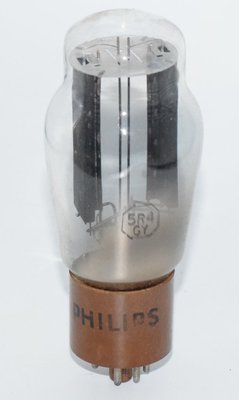
Introduction and History
The 5R4GY is a full-wave vacuum rectifier tube originally developed for industrial and military applications. Manufactured by RCA (Radio Corporation of America) and subsequently produced by numerous other manufacturers including Philips, Sylvania, and various European and Asian makers, the 5R4GY became one of the most widely used high-voltage rectifier tubes of the mid-20th century. The RCA datasheet for the closely related 5R4GYB variant is dated July 1961, placing the tube family firmly in the golden era of vacuum tube design.
The 5R4 family traces its lineage to the need for a robust, reliable full-wave rectifier capable of handling the high voltages and substantial currents demanded by military and industrial equipment. The "5" in the designation indicates the 5-volt filament, "R" denotes a rectifier, and "4" was the sequential design number. The "GY" suffix indicates the glass envelope variant with specific construction features. The tube was designed to meet stringent military specifications for reliability at altitude and under harsh environmental conditions, with ratings specified for operation at both 40,000 and 20,000 feet — a clear indicator of its aviation and military heritage.
Over the decades, the 5R4GY has found a second life in the high-fidelity audio community, where it is prized as a rectifier tube in vacuum tube amplifiers and preamplifiers. Its relatively high internal impedance and gradual voltage delivery characteristics make it a favorite among audiophiles who value the "sag" and dynamic response that tube rectification imparts to an amplifier's power supply.
Technical Specifications and Design
Electrical Specifications
| Parameter | Value |
|---|---|
| Filament Voltage (AC or DC) | 5 V |
| Filament Current | 2.0 A |
| Filament Type | Coated (indirectly implies oxide-coated cathode) |
| Peak Inverse Voltage (PIV) | 2800 V max (5R4GY) |
| Maximum DC Output Current (Ik max) | 650 mA |
| Tube Voltage Drop | 67 V @ 250 mA DC |
| Peak Plate Current per Plate (5R4GYB) | 715 mA max |
| Maximum Bulb Temperature | 230°C max (at hottest point on bulb surface) |
Note on the 5R4GYB variant: The attached RCA datasheet is specifically for the 5R4GYB, which is a higher-rated variant within the 5R4 family. The 5R4GYB has a PIV of 2650 V (at 40,000 ft) and 3100 V (at 20,000 ft), compared to the standard 5R4GY's PIV of 2800 V. The 5R4GYB is listed as a "different rating substitute" and is not a direct drop-in for the 5R4GY in all applications. The specifications below for typical operation are drawn from the 5R4GYB datasheet and are representative of the family's capabilities, though designers should verify exact ratings for the specific variant being used.
Typical Operation — Capacitor-Input Filter (5R4GYB)
| Parameter | 40,000 ft | 20,000 ft |
|---|---|---|
| AC Plate-to-Plate Supply Voltage (RMS, no load) | 1400 / 1500 V | 2000 V |
| Filter-Input Capacitor | 20 µF | 20 µF |
| Total Effective Plate Supply Impedance per Plate | 225 / 250 Ω | 375 Ω |
| DC Output Voltage (half-load, 75 mA) | 910 V | 1210 V |
| DC Output Voltage (full-load, 150 mA) | 800 V | 1040 V |
| Voltage Regulation (half-load to full-load) | 145 / 110 V | 170 V |
| DC Output Current | 250 / 150 mA | 150 mA |
Typical Operation — Choke-Input Filter (5R4GYB)
| Parameter | 40,000 ft | 20,000 ft |
|---|---|---|
| AC Plate-to-Plate Supply Voltage (RMS, no load) | 1500 V | 1900 V |
| Filter-Input Choke | 5 H | 10 H |
| DC Output Voltage (125 mA) | 600 V | — |
| DC Output Voltage (175 mA) | — | 760 V |
| DC Output Voltage (250 mA) | 560 V | — |
| DC Output Voltage (87.5 mA) | — | 800 V |
| Voltage Regulation (half-load to full-load) | 40 V | 40 V |
| DC Output Current | 250 mA | 175 mA |
Note on amplification factor, transconductance, and plate resistance: As a rectifier tube, the 5R4GY does not have the conventional amplification parameters (µ, gm, rp) associated with triodes, pentodes, or other amplifying tubes. Its key performance characteristics are its forward voltage drop (67 V at 250 mA DC for the 5R4GY), peak inverse voltage rating, maximum current capacity, and internal impedance — all of which define its behavior in a power supply circuit.
Physical Specifications
| Parameter | Value |
|---|---|
| Base Type | Octal (Short Medium-Shell Octal 5-Pin Micanol with External Barriers, Style B, Arrangement 1; JEDEC Group 1, No. B5-121) |
| Envelope / Bulb | T12 glass |
| Maximum Overall Length | 4-1/4" (108 mm) |
| Maximum Seated Length | 3-11/16" (94 mm) |
| Diameter | 1.438" to 1.562" (36.5 to 39.7 mm) |
| Operating Position | Vertical (base down or up), or Horizontal with pins 2 and 4 in vertical plane |
Pin Configuration (Bottom View)
| Pin | Connection |
|---|---|
| Pin 1 | No Connection |
| Pin 2 | Filament |
| Pin 4 | Plate No. 2 |
| Pin 6 | Plate No. 1 |
| Pin 8 | Filament |
Basing designation for bottom view: 5T. Pins 3, 5, and 7 are not used (no connection). The tube uses a standard octal socket.
Important Design Notes
The RCA datasheet specifies that for conditions where filament and plate voltage are applied simultaneously (Area I on the operating chart), certain voltage and current limits apply. For higher-voltage operation (Area II), the filament should be allowed to reach operating temperature before plate voltage is applied — for average conditions, this delay is approximately 10 seconds. When hot-switching is required in operation, choke-input circuits are recommended, limiting the hot-switching current to no higher than the peak plate current. When capacitor-input circuits are used, a maximum hot-switching value of 3 amperes should not be exceeded.
Applications and Usage
The 5R4GY was originally designed for industrial and military full-wave rectifier service. Its primary function is to convert AC voltage from a power transformer's high-voltage secondary winding into DC voltage for use in vacuum tube amplifiers, transmitters, receivers, and other electronic equipment.
Original Applications
- Military electronics: The tube's altitude ratings (up to 40,000 feet) and robust construction made it ideal for airborne radio equipment, radar systems, and military communications gear.
- Industrial power supplies: High-voltage laboratory and industrial power supplies requiring reliable, long-life rectification.
- Communications equipment: Transmitter and receiver power supplies in both military and commercial radio installations.
- Test equipment: High-voltage power supplies in oscilloscopes, signal generators, and other laboratory instruments.
Filter Configurations
The 5R4GY can be used with both capacitor-input and choke-input filter configurations:
- Capacitor-input filter: Provides higher DC output voltage but with greater voltage regulation variation and higher peak plate currents. The maximum peak plate current per plate is 715 mA. The filter-input capacitor is typically 20 µF.
- Choke-input filter: Provides better voltage regulation (approximately 40 V from half-load to full-load) and lower peak currents, at the expense of somewhat lower DC output voltage. Filter-input choke values of 5 to 10 henrys are typical.
Sound Characteristics
While a rectifier tube does not directly process the audio signal, its characteristics profoundly influence the power supply behavior of a tube amplifier, which in turn shapes the amplifier's sonic signature. The 5R4GY is particularly noted for the following sonic attributes:
Power Supply "Sag" and Dynamic Response
The 5R4GY has a relatively high internal impedance compared to some other rectifier types (such as the 5U4G or solid-state rectifiers). With a voltage drop of 67 V at 250 mA DC, the tube introduces meaningful series resistance into the power supply. This results in a characteristic "sag" — a momentary dip in B+ voltage during transient high-current demands, such as loud musical passages or hard-struck notes on a guitar. Many musicians and audiophiles describe this sag as contributing to a more "organic," "breathing," and "touch-responsive" feel in the amplifier's dynamics.
Tonal Qualities
- Warmth and body: The 5R4GY is frequently described as imparting a warm, full-bodied character to the amplifier's sound. The gradual voltage delivery smooths out transients and adds a sense of richness to the midrange.
- Soft attack and natural compression: The power supply sag creates a subtle, natural compression effect that rounds off the leading edge of transients. This is particularly valued by guitar players who find it enhances sustain and creates a more musical, less harsh overdrive character.
- Smooth highs: Compared to solid-state rectification or lower-impedance rectifier tubes, the 5R4GY tends to slightly soften the high-frequency response, resulting in a less aggressive, more refined treble presentation.
- Dimensional soundstage: In hi-fi applications, the 5R4GY is often credited with contributing to a more three-dimensional, spacious soundstage with good depth and image separation.
- Bass character: The higher impedance of the 5R4GY means that bass response may be slightly less tight and punchy compared to lower-impedance rectifiers. However, many listeners prefer this as it contributes to a more relaxed, natural bass presentation rather than an overly controlled or analytical one.
Comparison to Other Rectifiers
Compared to the 5U4G (which has lower internal impedance), the 5R4GY produces more sag and a warmer, softer sound. Compared to the GZ34/5AR4 (which has even lower impedance and higher current capability), the difference is more pronounced — the 5R4GY sounds noticeably warmer and more compressed. Compared to solid-state rectifier replacements, the 5R4GY offers the classic tube rectifier sound with all its attendant warmth, sag, and organic dynamics.
Equivalent and Substitute Types
Close / Identical Substitutes (Drop-In Replacements)
| Type | Notes |
|---|---|
| 5R4 | Original type designation; electrically identical |
| 5R4G | Same electrical specs, "G" denotes standard glass envelope variant |
| CV10330 | UK military (CV) equivalent |
| CV5181 | UK military (CV) equivalent |
| CV717 | UK military (CV) equivalent |
| CV8189 | UK military (CV) equivalent |
| WT274B | Equivalent type designation |
Different Rating Substitutes (NOT Direct Drop-In)
The following types are related but have different ratings and should not be considered direct drop-in replacements without verifying that the specific application's voltage, current, and impedance requirements are met:
| Type | Notes |
|---|---|
| 5R4GYA | Higher or different ratings variant within the 5R4GY family |
| 5R4GYB | Industrial/military variant with different PIV and current ratings (PIV 2650/3100 V depending on altitude; peak plate current 715 mA per plate) |
| 5R4GYS | Special variant with different specifications |
| 5R4WGY | Ruggedized military variant ("W" typically denotes MIL-spec ruggedized construction) |
| CV2835 | UK military equivalent with different ratings |
| CV8204 | UK military equivalent with different ratings |
Important: When substituting rectifier tubes, always verify that the replacement tube's peak inverse voltage, maximum DC output current, filament requirements, and internal impedance are compatible with the circuit. Using a rectifier with significantly different internal impedance will change the B+ voltage and may affect amplifier bias and operating conditions.
Notable Characteristics
Robust Military-Grade Construction
The 5R4GY was built to withstand the rigors of military service, including operation at high altitudes (up to 40,000 feet), vibration, and temperature extremes. This rugged construction translates to excellent reliability and long service life in civilian audio applications. The tube uses a short medium-shell octal base with external barriers (Micanol insulation), providing superior high-voltage insulation compared to standard phenolic bases.
Altitude Derating
A distinctive feature of the 5R4GY family is its dual rating system for different altitudes. At higher altitudes, the reduced air pressure decreases the external insulation capability, requiring derating of the peak inverse voltage and other parameters. This is primarily relevant to military and aviation applications but demonstrates the thoroughness of the tube's engineering.
Delayed Application of Plate Voltage
For operation in Area II of the operating chart (higher voltage conditions), the filament should be allowed to reach operating temperature before plate voltage is applied. The recommended delay is approximately 10 seconds under average conditions. This is important because applying high voltage to a cold oxide-coated cathode can cause cathode stripping, which permanently damages the tube and shortens its life. Many quality amplifier designs incorporate a standby switch or time-delay relay to protect the rectifier tube.
Voltage Drop Characteristics
The 5R4GY's voltage drop of 67 V at 250 mA DC is a defining characteristic. This relatively high drop (compared to, say, the GZ34's approximately 15 V drop at similar currents) means the tube absorbs a significant amount of energy, which must be dissipated as heat. This also means the power transformer must provide correspondingly higher secondary voltage to achieve the desired B+ output. The maximum bulb temperature of 230°C indicates that the tube runs quite hot under full-load conditions.
Hot-Switching Considerations
When hot-switching is required (applying plate voltage while the filament is already at operating temperature), choke-input circuits are recommended. The hot-switching current should be limited to no higher than the peak plate current value. With capacitor-input circuits, a maximum hot-switching current of 3 amperes should not be exceeded. This is critical for preventing cathode damage from excessive inrush current through the charging capacitor.
Usage in the Audio Community
Guitar Amplifiers
The 5R4GY is a popular rectifier choice in guitar amplifiers, particularly in designs that benefit from power supply sag. It is found in various boutique and vintage-style amplifiers where designers want a more compressed, touch-sensitive response. The tube's sag characteristics are especially valued in blues, jazz, and classic rock amplifiers where players want the amplifier to "breathe" with their playing dynamics. Some notable amplifier designs that use or can accommodate 5R4-family rectifiers include certain Fender tweed-era designs and various boutique amplifiers.
Hi-Fi and Audiophile Amplifiers
In the audiophile world, the 5R4GY is used in single-ended triode (SET) amplifiers, push-pull amplifiers, and preamplifier power supplies. Audiophiles appreciate the tube for its contribution to a warm, musical presentation with good soundstaging. It is commonly found in amplifiers using output tubes such as the 300B, 2A3, EL34, and 6L6, where the power supply requirements fall within the 5R4GY's capabilities.
Preamplifier Power Supplies
The 5R4GY is also used in standalone preamplifier power supplies, where its characteristics influence the sound of the entire preamplification chain. In this application, the tube's warm character and smooth voltage delivery are credited with enhancing the overall musicality of the system.
NOS (New Old Stock) Market
Vintage NOS 5R4GY tubes from manufacturers such as RCA, Sylvania, Tung-Sol, Ken-Rad, and various military contractors are highly sought after by audiophiles and guitar players. Different manufacturers' versions are reputed to have subtly different sonic characteristics, with RCA and Sylvania examples being particularly prized. The military-spec versions (such as the 5R4WGY) command premium prices due to their superior construction and perceived reliability.
Modern Production
Several manufacturers continue to produce 5R4GY tubes or close equivalents, including Chinese and Russian factories. While these modern production tubes are generally reliable and meet the basic electrical specifications, many audiophiles prefer NOS examples for their perceived superior sound quality and construction. The availability of both NOS and new-production tubes ensures that the 5R4GY will continue to serve the audio community for years to come.
Practical Considerations for Audio Use
- Warm-up time: Allow the filament to reach operating temperature (approximately 10 seconds) before applying B+ voltage. Use a standby switch or time-delay circuit.
- Filter capacitor size: The datasheet specifies a 20 µF filter-input capacitor. Using larger values increases peak plate current and may exceed the tube's ratings. Always verify that the total effective plate supply impedance is sufficient to limit peak currents.
- Ventilation: The 5R4GY runs hot (up to 230°C bulb temperature). Ensure adequate ventilation around the tube, and do not mount it in an enclosed space without airflow.
- Socket quality: Use high-quality ceramic or Micanol octal sockets to handle the heat and high voltages involved. Avoid cheap phenolic sockets that may degrade over time.
- Tube matching: While rectifier tubes do not require matching in the same way as output tubes, selecting tubes with similar voltage drop characteristics can be beneficial when building matched stereo power supplies.