1. Introduction and History
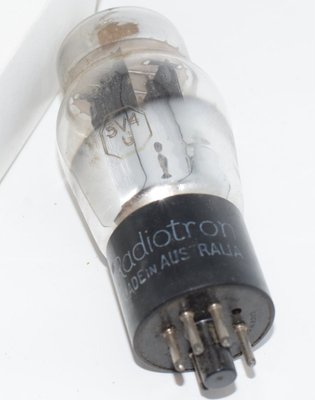
The 5V4G is an indirectly heated, full-wave vacuum rectifier tube designed for power supply applications in radio receivers, amplifiers, and electronic equipment. Developed during the late 1930s and widely produced through the 1960s, the 5V4G became one of the most popular medium-current rectifier tubes in both consumer and professional electronics. Its indirect cathode heating offered a significant advantage over directly heated rectifiers like the 5U4G and 5Y3GT: a controlled warm-up time that provided a gentle, delayed application of B+ voltage to the amplifier circuit, helping to protect sensitive components and extend the life of filter capacitors and output tubes.
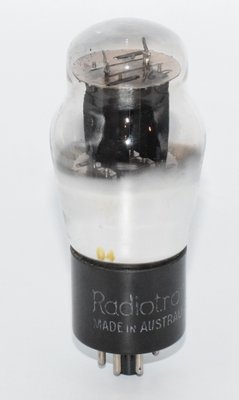
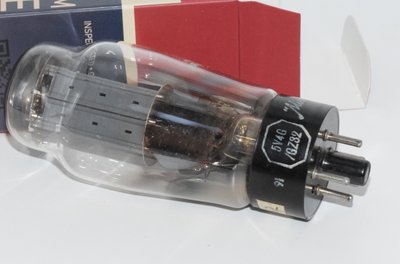
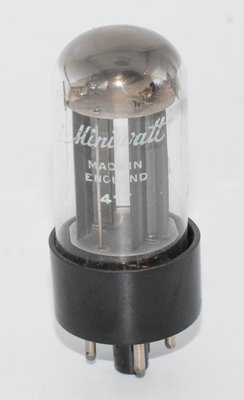
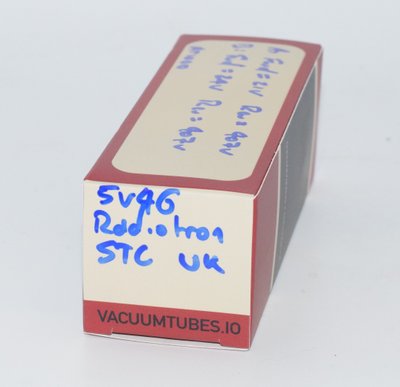
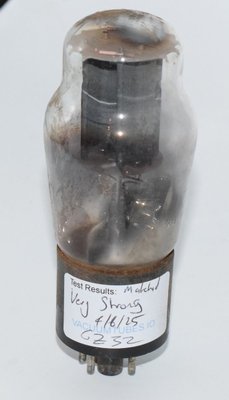
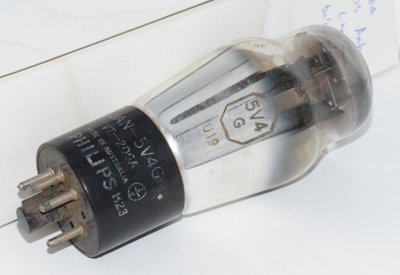
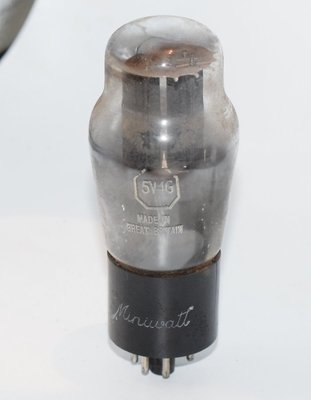
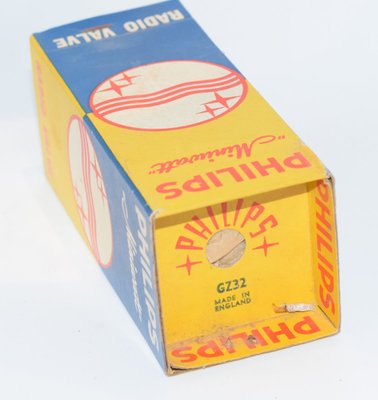
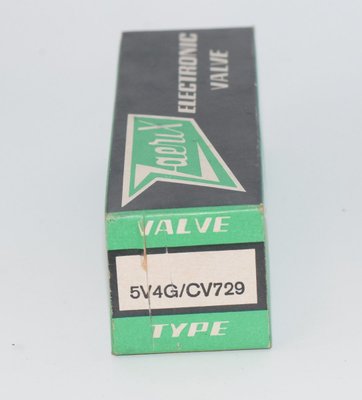
The 5V4G was manufactured by virtually every major tube producer worldwide, including RCA, Sylvania, Philips/Miniwatt, Mullard (Blackburn), Radiotron (Australia), Zaerix, and many others. The tube was produced under various designations across different naming conventions — it is known as the GZ32 in the European Mullard/Philips system, GZ31 in certain applications, and carried military designations including CV593 and VT206A. The attached Mazda-Belvu (CIFTE) datasheet for the GZ32 provides detailed French-market specifications that are directly applicable to the 5V4G family.
The 5V4G occupies an important middle ground in the rectifier tube hierarchy — it delivers more current than the popular 5Y3GT while offering the softer, more gradual power-up characteristics that indirectly heated cathodes provide, compared to the brute-force directly heated 5U4G. This combination of adequate current delivery, gentle start-up behavior, and moderate voltage drop has made it a perennial favorite among amplifier designers and audio enthusiasts alike.
2. Technical Specifications and Design
General Characteristics
| Tube Type | Full-wave rectifier (Diode Biplaque / Double diode) |
| Cathode Type | Indirectly heated (oxide-coated) |
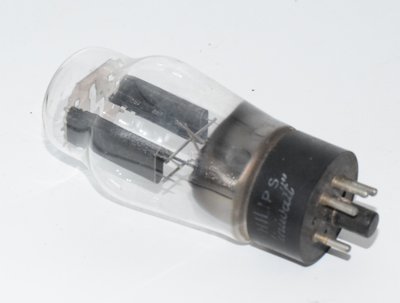
| Envelope | ST-14 (shoulder glass) for 5V4G; T12-14 for GZ32 variant |
| Base | Octal (8-pin) — 8C 18-7 (International Octal) |
| Mounting Position | Any (quelconque) |
| Maximum Diameter | 39.7 mm max (GZ32); approximately 51 mm for ST-14 envelope (5V4G) |
| Maximum Overall Length | 98.4 mm max (GZ32); approximately 120 mm for 5V4G ST-14 |
Heater / Filament Ratings
| Heater Voltage (Vf) | 5.0 V |
| Heater Current (If) | 2.0 A (5V4G); 2.3 A (GZ32 per CIFTE datasheet) |
| Filament Connection | Parallel |
Note: The heater current difference between the 5V4G (2.0 A) and the GZ32 (2.3 A) reflects minor design variations between manufacturers. When substituting, ensure the power transformer's 5V winding can accommodate the specific tube's heater current requirement.
Maximum Ratings (Absolute Limits)
| Peak Inverse Voltage (PIV / Vai) | 1,400 V max |
| Maximum Rectified Current (Ired) | 300 mA max (DC output) |
| Peak Anode Current (Ia pk) | 525 mA |
| Tube Voltage Drop | 25 V at 175 mA |
Normal Operating Conditions — Capacitor Input Filter
Per the CIFTE/Mazda-Belvu GZ32 datasheet, the following operating conditions apply with a capacitor at the filter input:
| Parameter | Condition 1 | Condition 2 | Condition 3 |
|---|---|---|---|
| Anode Voltage (Va) | 2 × 300 V eff | 2 × 350 V eff | 2 × 500 V eff |
| Rectified Current (Ired) | 300 mA | 250 mA | 125 mA max |
| Input Filter Capacitance (CL) | 60 µF | 32 µF | 16 µF max |
| Anode Resistance (Ra) | 150 Ω | 100 Ω | 50 Ω min |
Normal Operating Conditions — Choke Input Filter
With a 10 H inductance at the filter input:
| Parameter | Condition 1 | Condition 2 |
|---|---|---|
| Anode Voltage (Va) | 2 × 400 V eff | 2 × 500 V eff |
| Rectified Current (Ired) | 300 mA | 250 mA max |
Pin Configuration (Octal Base — Bottom View)
| Pin Number | Connection |
|---|---|
| Pin 1 | No connection (Manque) |
| Pin 2 | Filament / Heater |
| Pin 3 | No connection (Manque) |
| Pin 4 | Anode No. 1 (Plate 1) |
| Pin 5 | No connection (Manque) |
| Pin 6 | Anode No. 2 (Plate 2) |
| Pin 7 | No connection (Manque) |
| Pin 8 | Filament / Heater and Cathode |
Note: As a rectifier tube, the 5V4G has no control grid, and therefore specifications such as amplification factor (µ), transconductance (gm), and plate resistance (rp) are not applicable. The key performance parameters are the voltage drop across the tube, the maximum PIV rating, and the maximum rectified current capacity.
Performance Curves
The CIFTE datasheet provides two sets of characteristic curves. The first set shows DC output voltage (Vred) versus rectified current (Ired) for capacitor input filter operation at various anode voltages (2 × 250, 2 × 300, and 2 × 350 V eff), with three filter configurations:
- Curve 1: C = 16 µF, Ra = 50 Ω
- Curve 2: C = 32 µF, Ra = 100 Ω
- Curve 3: C = 60 µF, Ra = 150 Ω
The second set shows choke input filter performance with a 10 H input inductance at anode voltages of 2 × 300, 2 × 400, and 2 × 500 V eff. These curves demonstrate the characteristically flatter voltage regulation of choke input designs compared to capacitor input configurations.
3. Applications and Usage
The 5V4G was designed primarily as a power supply rectifier for equipment requiring moderate B+ current with the benefits of indirect cathode heating. Its principal applications include:
- Radio Receivers: The 5V4G was widely used in console and tabletop radio receivers of the 1940s and 1950s, particularly in higher-end models that benefited from its smooth power-up characteristics.
- Audio Amplifiers: Both commercial and high-fidelity amplifiers employed the 5V4G extensively. Its moderate voltage drop and controlled warm-up made it ideal for push-pull amplifier power supplies using tubes such as the EL34, 6L6, KT66, and 6V6.
- Test Equipment: Laboratory instruments and test equipment used the 5V4G where stable, well-regulated power supplies were essential.
- Military Equipment: Under the designation VT206A and CV593, the 5V4G served in various military electronic systems where reliability and controlled start-up were critical.
- Industrial Electronics: Process control equipment and industrial amplifiers utilized the 5V4G for its robust construction and reliable performance.
The indirectly heated cathode is the defining feature that sets the 5V4G apart from many other octal rectifiers. Because the cathode must reach operating temperature before significant emission begins, the B+ voltage rises gradually over approximately 15–30 seconds. This "soft start" behavior reduces the initial surge current through filter capacitors and provides a gentler voltage ramp to the amplifier stages, which is particularly beneficial for extending the life of electrolytic capacitors and preventing cathode stripping in output tubes that may not yet have reached full emission.
The 5V4G is suitable for both capacitor input and choke input filter designs. With capacitor input filters, higher DC output voltages are achieved but with poorer regulation and higher peak currents through the rectifier. With choke input filters (the datasheet specifies a 10 H input choke), regulation is significantly improved and peak currents are reduced, though the DC output voltage is lower. The choice between these configurations depends on the specific requirements of the amplifier circuit.
4. Sound Characteristics
While a rectifier tube does not directly process the audio signal, it profoundly influences the character of the power supply — and by extension, the sonic signature of the entire amplifier. The 5V4G / GZ32 has developed a strong reputation among audiophiles and amplifier designers for its distinctive contribution to sound quality:
- Smooth and Refined Presentation: The 5V4G is widely praised for delivering a smooth, refined tonal character. Its moderate internal impedance provides a degree of natural power supply "sag" that many listeners find musically engaging, softening transient edges without sacrificing clarity.
- Warm Midrange: Users consistently report a rich, warm midrange character when the 5V4G is employed. The tube's voltage drop characteristics contribute to a slightly lower B+ voltage compared to silicon diode rectification, which tends to push output tubes into a warmer operating region.
- Controlled, Musical Bass: The bass response with a 5V4G tends to be full and well-defined but not as tight or punchy as with solid-state rectification or lower-impedance rectifier tubes like the 5AR4/GZ34. This characteristic is often described as "musical" rather than "analytical" — the bass has body and warmth rather than razor-sharp definition.
- Natural Dynamics and Compression: The internal resistance of the 5V4G introduces a subtle, natural dynamic compression effect. During loud passages, the increased current draw causes a slight B+ voltage sag, which gently compresses the signal. This behavior is often described as making the amplifier sound more "alive" and "breathing," particularly with guitar amplifiers and single-ended or low-power push-pull hi-fi designs.
- Gentle, Extended Treble: The high-frequency response through amplifiers using the 5V4G is typically described as sweet and extended without harshness. The tube's power supply characteristics tend to reduce high-frequency hash and noise compared to some other rectifier types.
- Excellent Imaging and Soundstage: Particularly with NOS examples from premium manufacturers like Mullard, Philips Miniwatt, and RCA, the 5V4G / GZ32 is noted for contributing to a spacious, three-dimensional soundstage with excellent instrument separation.
The Mullard GZ32 (manufactured at the Blackburn factory) and Philips Miniwatt GZ32 (from the Eindhoven plant) are particularly sought after by audiophiles, who often describe these specific production variants as offering the most refined and transparent sound within the 5V4G family. The short-base Mullard Blackburn GZ32 from the late 1950s is considered by many collectors to be the pinnacle of this tube type.
5. Equivalent and Substitute Types
The following types are close or identical substitutes for the 5V4G:
| Type | Relationship | Notes |
|---|---|---|
| 5V4GA | Direct substitute | Improved version with tighter specifications; fully interchangeable. Often features a more compact tubular (T-9) envelope rather than the ST-14 glass of the original 5V4G. |
| GZ32 | Identical / Direct substitute | European (Mullard/Philips) designation for the same tube. Pin-compatible and electrically identical. The GZ32 designation is used on the attached CIFTE/Mazda-Belvu datasheet. Note the GZ32 datasheet specifies 2.3 A heater current versus 2.0 A for the 5V4G — verify transformer capability. |
| GZ31 | Close substitute | Generally considered interchangeable in most circuits. Some sources list slightly different maximum ratings; verify against specific manufacturer data for critical applications. |
| CV593 | Direct substitute | British military (CV) designation equivalent to the GZ32/5V4G. Built to military specifications with tighter tolerances and often superior construction quality. |
| VT206A | Direct substitute | US military designation for the 5V4G. Identical electrically; built to military standards. |
| CV729 | Close substitute | Another British CV designation associated with the 5V4G family. Verify specific ratings for the intended application. |
Related but NOT Directly Interchangeable Types
The following rectifier tubes are sometimes mentioned alongside the 5V4G but have important differences:
- 5AR4 / GZ34: Also an indirectly heated octal rectifier with 5V heater, but with significantly higher current capability (250 mA typical) and lower internal impedance. The GZ34 can generally replace a 5V4G (with appropriate circuit verification), but the 5V4G should not be used as a direct replacement for a GZ34 in circuits that demand the GZ34's full current capacity, as the 5V4G has a higher voltage drop and different regulation characteristics. The heater current of the GZ34 is 1.9 A versus 2.0 A for the 5V4G.
- 5U4G / 5U4GB: A directly heated rectifier with higher current capability but no delayed start-up. Different internal impedance characteristics. Not a drop-in substitute without circuit consideration.
- 5Y3GT: A directly heated rectifier with lower current capability and higher voltage drop. Physically interchangeable but electrically quite different.
6. Notable Characteristics
- Indirect Heating and Delayed B+ Rise: The most significant characteristic of the 5V4G is its indirectly heated cathode. Unlike directly heated rectifiers (5U4G, 5Y3GT) where the filament itself is the emitting surface, the 5V4G uses a separate heater element to warm an oxide-coated cathode sleeve. This results in a warm-up delay of approximately 15–30 seconds before full B+ voltage is established, providing inherent protection for the amplifier circuit.
- Moderate Voltage Drop: The 5V4G exhibits a tube drop of approximately 25 V at 175 mA. This is higher than the GZ34/5AR4 but lower than the 5Y3GT, placing it in a useful middle ground for many amplifier designs.
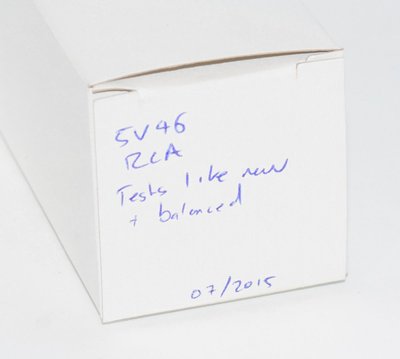
- Robust Construction: The 5V4G was built to withstand the demands of both consumer and military applications. Quality NOS examples from manufacturers like Mullard, Philips, and RCA are known for exceptional longevity, often lasting thousands of hours in normal service.
- Filter Capacitance Limitations: As shown in the CIFTE datasheet, the maximum input filter capacitance varies with operating voltage. At 2 × 500 V eff, the maximum input capacitance is limited to 16 µF, while at 2 × 300 V eff, up to 60 µF is permissible. Exceeding these limits can cause excessive peak charging currents that damage the cathode coating. This is a critical design consideration.
- Anode Resistance Requirements: The datasheet specifies minimum anode resistance values (series resistance between the rectifier and filter capacitor) that must be observed: 50 Ω minimum at 2 × 500 V, 100 Ω at 2 × 350 V, and 150 Ω at 2 × 300 V. This resistance limits peak charging current and protects the tube.
- Versatile Filter Topology Support: The 5V4G works well with both capacitor input and choke input filter designs. The datasheet provides comprehensive performance data for both configurations, with the choke input design (10 H) offering superior voltage regulation at the expense of lower output voltage.
7. Usage in the Audio Community
The 5V4G and its GZ32 equivalent hold a special place in the audio community, valued by both hi-fi enthusiasts and guitar amplifier players for their distinctive sonic contributions and practical benefits.
Hi-Fi and Audiophile Applications
The 5V4G / GZ32 is a popular rectifier choice in high-fidelity amplifier designs, both vintage and modern. It appears in numerous classic amplifier circuits and continues to be specified in contemporary boutique designs. Audiophiles appreciate the tube for several reasons:
- Tube Rolling: The 5V4G is one of the most popular rectifier tubes for "tube rolling" — the practice of swapping different tube brands and vintages to fine-tune an amplifier's sound. Because the rectifier significantly influences the power supply characteristics, changing from one brand of 5V4G to another can produce audible differences in tonal balance, dynamics, and soundstage presentation.
- Premium NOS Variants: Certain production variants command premium prices among collectors. The Mullard GZ32 manufactured at the Blackburn factory (particularly the short-base version from approximately 1958) is among the most sought-after. Philips Miniwatt GZ32 tubes from the Eindhoven factory (notably 1957-era production) are also highly prized. RCA 5V4G tubes and Australian Radiotron production are valued for their warm, full-bodied sound character.
- Amplifier Compatibility: The 5V4G is commonly used in push-pull amplifiers running EL34, 6L6GC, KT66, and similar output tubes where current demands fall within the tube's 250–300 mA capability. It is also an excellent choice for preamplifier power supplies where the gentle start-up and low noise floor are particularly beneficial.
- GZ34 Substitution: In amplifiers designed for the GZ34/5AR4 that do not require the GZ34's full current capacity, some audiophiles deliberately substitute a 5V4G / GZ32 to achieve a warmer, slightly softer sound character. The higher internal impedance of the 5V4G introduces more power supply sag, which many listeners find musically appealing. However, this substitution must be done with care — the higher voltage drop means lower B+ voltage, and the current limitations must be respected.
Guitar Amplifier Applications
Guitar amplifier enthusiasts and builders also value the 5V4G for its tonal characteristics:
- Natural Compression: The power supply sag introduced by the 5V4G's internal impedance creates a natural, touch-sensitive compression effect that many guitarists find highly desirable. Notes "bloom" and sustain in a way that feels organic and responsive to playing dynamics.
- Vintage Tone: Many classic amplifier designs from the 1950s and 1960s originally used the 5V4G, and players seeking to recreate those vintage tones specifically seek out this rectifier type.
- Overdrive Character: When pushed into overdrive, amplifiers using the 5V4G tend to produce a smoother, more compressed distortion character compared to those using lower-impedance rectifiers or solid-state rectification.
Availability and Market
New-old-stock (NOS) 5V4G and GZ32 tubes remain available from specialist dealers, though premium examples from Mullard, Philips, and RCA have become increasingly scarce and expensive. Current production of exact 5V4G equivalents is limited, though some manufacturers produce compatible types. When purchasing NOS tubes, buyers should look for tested examples from reputable dealers, as the indirectly heated cathode can lose emission over time even in unused tubes that have been stored for decades.
The 5V4G / GZ32 remains one of the most respected and musically satisfying rectifier tubes available, offering a compelling combination of practical engineering benefits and sonic excellence that continues to earn it a devoted following in the audio community.