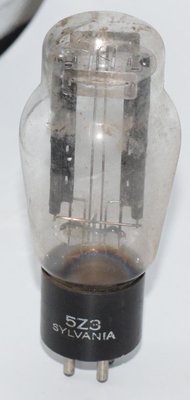
Introduction and History
The 5Z3 is a full-wave high-vacuum rectifier tube designed for use as a power rectifier in AC-operated receivers and amplifiers requiring high current capability. Introduced in the late 1930s, the 5Z3 was developed alongside its electrically identical siblings, the 5U4G and 5X4G, differing primarily in base configuration. The Tung-Sol datasheet dated January 29, 1940, explicitly states that "The Tung-Sol 5U4G, 5X4G and 5Z3 are designed for service as power rectifiers in AC operated receivers which require high currents. Their ratings and electrical characteristics are identical."
The 5Z3 utilizes a medium 4-pin (4C) base, which distinguishes it physically from the 5U4G (medium 5-pin octal base, G-5Ta) and the 5X4G (medium 8-pin octal base, G-5Q). This 4-pin base configuration connects the tube to an earlier generation of socket standards, making the 5Z3 a bridge between pre-octal and octal-era rectifier designs. The tube employs a coated filament for efficient electron emission and is housed in an ST-16 glass envelope, giving it the classic "shouldered" appearance characteristic of tubes from this era.
Manufactured by major American and international tube makers including Tung-Sol, Sylvania, RCA, and others, the 5Z3 served reliably in countless radio receivers, public address systems, and early high-fidelity amplifiers throughout the 1940s and 1950s. Its robust construction and generous current ratings made it a workhorse rectifier that earned a reputation for dependable, long-lived service.
Technical Specifications and Design
Heater / Filament
| Filament Voltage (Vf) | 5.0 Volts AC |
| Filament Current (If) | 3.0 Amperes |
| Filament Type | Coated filament (directly heated cathode) |
Maximum Ratings
| Maximum Peak Inverse Voltage (PIV) | 1,550 Volts |
| Maximum Steady-State Peak Plate Current per Plate | 675 mA |
Operating Conditions — Full-Wave Rectifier with Condenser (Capacitor) Input to Filter
| AC Plate Voltage per Plate (RMS) Max. | 450 Volts |
| DC Output Current Max. | 225 mA |
| Total Effective Plate Supply Impedance per Plate (Min.) | 75 Ohms |
Note: When filter condensers larger than 40 µF are used, it may be necessary to add additional plate supply impedance.
Operating Conditions — Full-Wave Rectifier with Choke Input to Filter
| AC Plate Voltage per Plate (RMS) Max. | 550 Volts |
| DC Output Current Max. | 225 mA |
| Value of Input Choke (Min.) | 3 Henrys |
| Tube Voltage Drop at 225 mA per Plate | 58 Volts |
Physical Characteristics
| Base Type | Medium 4-pin (4C) |
| Envelope | ST-16 glass bulb |
| Maximum Overall Length | 5⅜ inches (approx. 136 mm) |
| Maximum Diameter | 2 1/16 inches (approx. 52 mm) |
| Maximum Seated Height | 4¾ inches (approx. 121 mm) |
| Base Pin Diameter (Max.) | 1⅜ inches |
Pin Configuration (4C Base — Bottom View)
The 5Z3 uses a medium 4-pin base with the following connections:
- Pin 1: Filament (F)
- Pin 2: Plate (P)
- Pin 3: Plate (P)
- Pin 4: Filament (F)
The two filament pins are on opposite sides of the base, as are the two plate pins. This is a straightforward full-wave rectifier configuration with the center-tapped filament winding of the power transformer providing the effective cathode connection.
Additional Notes on Ratings
As the 5Z3 is a rectifier tube, specifications such as amplification factor (µ), transconductance (gm), and plate resistance (rp) — which are parameters of amplifying tubes — do not apply. The 5Z3 has no control grid; it is a pure diode rectifier with two plate elements sharing a common directly-heated cathode (filament). The key performance parameters are the voltage drop across the tube, the maximum current handling capability, and the peak inverse voltage rating.
Applications and Usage
The 5Z3 was designed primarily as a power supply rectifier for AC-operated equipment requiring substantial DC current. Its principal applications include:
Radio Receivers
The 5Z3 was widely used in console and table-top radio receivers of the late 1930s and 1940s, particularly in higher-end models that required more current than smaller rectifiers like the 80 or 5Y3 could provide. Its 225 mA maximum DC output current was sufficient for receivers employing multiple output tubes or push-pull configurations.
Audio Amplifiers
In audio power amplifiers, the 5Z3 served as the primary B+ rectifier, converting the AC secondary voltage of the power transformer into the DC high voltage needed by the amplifier stages. Its relatively low voltage drop of 58 volts at full rated current and its ability to handle 225 mA made it suitable for amplifiers in the 15–30 watt range, depending on the output tube type used.
Public Address and Industrial Equipment
The robust current handling of the 5Z3 made it a natural choice for public address amplifiers, cinema sound equipment, and various industrial electronic devices that required a reliable, high-current rectifier.
Power Supply Design Considerations
The 5Z3 can be used with either capacitor-input or choke-input filter configurations. With a capacitor-input filter, the maximum AC plate voltage is limited to 450V RMS per plate, and a minimum plate supply impedance of 75 ohms per plate must be maintained to limit peak current surges through the tube. With a choke-input filter, the allowable AC plate voltage increases to 550V RMS per plate, but a minimum input choke of 3 Henrys is required. The choke-input configuration provides better voltage regulation and lower ripple, though at a somewhat lower DC output voltage compared to capacitor-input designs at the same AC input voltage.
The performance curves from the Tung-Sol datasheet show DC output voltage versus DC load current for both condenser-input (C = 4 µF) and choke-input (L = 20 H) configurations at various AC input voltages (300V, 400V, and 500V RMS per plate). These curves clearly illustrate the superior voltage regulation of the choke-input design, which shows a much flatter output voltage curve as load current increases.
Sound Characteristics
As a rectifier tube, the 5Z3 does not amplify the audio signal directly. However, its influence on the power supply behavior has a meaningful and audible impact on the overall sonic character of an amplifier. Audiophiles and experienced amplifier designers have long recognized that the choice of rectifier tube significantly affects the "feel" and tonal quality of an amplifier.
Soft and Organic Presentation
The 5Z3, like other directly-heated vacuum rectifiers, introduces a degree of "sag" in the power supply under dynamic signal conditions. When the amplifier demands a sudden burst of current — such as during a loud transient or bass note — the voltage drop across the rectifier increases momentarily, causing the B+ voltage to dip slightly before recovering. This dynamic compression effect is often described as giving the amplifier a "softer," more organic, and less harsh character compared to amplifiers using solid-state rectification.
Warmth and Musicality
Users frequently describe amplifiers employing the 5Z3 as having a warm, rich midrange with a slightly rounded bass response. The inherent voltage drop of 58 volts at rated current means the tube absorbs a meaningful amount of energy, and the gradual, non-linear nature of this voltage drop contributes to a gentle, musical quality that many listeners find pleasing, particularly with vocal music, jazz, and acoustic instruments.
Smooth Transient Response
The slow start-up characteristic of the directly-heated filament provides a natural soft-start for the amplifier, gradually bringing the B+ voltage up to operating level. During operation, the tube's internal impedance provides a natural current-limiting effect that smooths out sharp transients. This is often perceived as a more "relaxed" and less fatiguing listening experience compared to silicon diode rectification.
Dynamic Character
The power supply sag effect means that the 5Z3 contributes a subtle dynamic compression that can make an amplifier feel more "alive" and responsive to playing dynamics, particularly valued by guitar amplifier enthusiasts. In hi-fi applications, this same characteristic lends a sense of natural dynamics that avoids the clinical precision sometimes associated with solid-state rectification.
Comparison to Other Rectifiers
Compared to the smaller 5Y3GT rectifier, the 5Z3 offers a stiffer power supply with less sag due to its higher current capability, resulting in tighter bass and more controlled dynamics. Compared to the GZ34/5AR4, the 5Z3 has a somewhat higher voltage drop and slightly more sag, giving it a warmer, softer character. The 5Z3 occupies a middle ground that many audiophiles find to be an ideal balance between the lush softness of smaller rectifiers and the taut precision of high-current types.
Equivalent or Substitute Types
Directly Equivalent Types
| Type | Equivalence | Notes |
|---|---|---|
| CV1861 | Direct equivalent | British military designation (Common Valve number) for the 5Z3. Electrically and physically identical. Drop-in replacement. |
| VT145 | Direct equivalent | US military designation for the 5Z3. Electrically and physically identical. Drop-in replacement. |
Electrically Identical but Different Base Types
| Type | Relationship | Notes |
|---|---|---|
| 5U4G | Electrically identical | Uses a medium 5-pin octal base (G-5Ta). NOT a direct plug-in substitute — requires a different socket. All electrical ratings and characteristics are identical per the Tung-Sol datasheet. |
| 5X4G | Electrically identical | Uses a medium 8-pin octal base (G-5Q). NOT a direct plug-in substitute — requires a different socket. All electrical ratings and characteristics are identical per the Tung-Sol datasheet. |
Important Substitution Warnings
While the 5Z3, 5U4G, and 5X4G share identical electrical characteristics, they use completely different base types and cannot be interchanged without socket adapters or socket replacement. The 5Z3's 4-pin base is physically incompatible with octal sockets. Always verify the socket type in your equipment before attempting any substitution.
Some sources may suggest the 5Z3 as a substitute for other rectifier types such as the 83 (mercury vapor) or the 5Z4. While these tubes may have similar voltage and current ratings, they are not identical in their characteristics, voltage drop, or base configuration, and substitution should only be attempted with careful verification of all electrical and physical parameters.
Notable Characteristics
Robust Construction
The 5Z3 is built to handle substantial currents with a peak plate current rating of 675 mA per plate. The coated filament design provides efficient electron emission while maintaining long service life. The ST-16 glass envelope provides ample internal volume for heat dissipation.
Directly Heated Cathode
The 5Z3 uses a directly heated cathode (the filament itself serves as the electron emitter). This means the tube reaches operating temperature relatively quickly and the filament winding of the power transformer must be isolated from ground, as the cathode carries the full B+ potential. The 5.0V, 3.0A filament requires a dedicated transformer winding capable of supplying 15 watts.
Voltage Drop Characteristics
The 58-volt tube drop at 225 mA per plate is a significant consideration in power supply design. This voltage is dissipated as heat within the tube and must be accounted for when calculating the expected DC output voltage. The plate current versus DC plate voltage curve from the datasheet shows a roughly linear relationship, with current increasing from near zero at low voltages to approximately 300 mA at 70V DC plate voltage (per plate).
Filter Capacitor Considerations
The Tung-Sol datasheet includes an important note regarding filter capacitors: when condensers larger than 40 µF are used with a capacitor-input filter, additional plate supply impedance may be necessary. This is because large filter capacitors draw very high peak charging currents that can exceed the tube's peak current rating and shorten its life. The minimum 75-ohm plate supply impedance per plate specification is critical for protecting the tube in capacitor-input designs.
Historical Significance
The 4-pin base of the 5Z3 connects it to an earlier era of tube design, predating the widespread adoption of the octal base system. This makes the 5Z3 an interesting transitional design — electrically modern enough to share identical specifications with octal-based tubes like the 5U4G, yet physically rooted in the older 4-pin socket standard.
Usage in the Audio Community
Vintage Amplifier Restoration
The 5Z3 is encountered in the restoration of vintage radio receivers and amplifiers from the late 1930s through the 1950s. Restorers of equipment originally designed around the 4-pin socket standard seek out NOS (New Old Stock) 5Z3 tubes to maintain originality. Quality NOS examples from manufacturers like Tung-Sol, Sylvania, RCA, and Ken-Rad are valued for their reliability and consistent performance.
Custom and DIY Amplifier Builds
In the DIY audio community, the 5Z3 is occasionally chosen for custom amplifier builds where the builder desires the sonic characteristics of a directly-heated vacuum rectifier with substantial current capability. The 4-pin base, while less common than octal sockets, is still available from specialty electronics suppliers. Some builders appreciate the aesthetic of the older base style and the vintage character it lends to a custom build.
Comparison Shopping and Tube Rolling
Because the 5Z3, 5U4G, and 5X4G are electrically identical, audiophiles with equipment that can accommodate socket adapters sometimes experiment with all three types to find the best-sounding individual specimen. While the electrical characteristics are nominally identical, subtle manufacturing differences between brands and production eras can result in slightly different sonic signatures — a practice known as "tube rolling."
Guitar Amplifier Applications
While less common than the 5U4G or 5Y3GT in guitar amplifiers (due to the prevalence of octal sockets in guitar amp designs), the 5Z3's characteristics make it theoretically well-suited for guitar amplifier use. Its power supply sag characteristics would provide the kind of dynamic compression and touch sensitivity that many guitarists prize. Builders creating vintage-inspired or custom guitar amplifiers occasionally specify the 5Z3 for its unique combination of current capability and tonal character.
Collectibility and Availability
The 5Z3 is less commonly encountered on the NOS market than its octal-based equivalents, making good examples somewhat collectible. Sylvania, Tung-Sol, and RCA-branded 5Z3 tubes are particularly sought after. Because the tube is no longer in production, the supply is limited to remaining NOS stocks. Buyers should ensure tubes are properly tested — AVO-tested examples, for instance, provide confidence in the tube's emission and leakage characteristics. The 4-pin base format means that these tubes are primarily of interest to those with specific equipment requirements or collectors of vintage tube types.
Practical Recommendations
For audio enthusiasts considering the 5Z3 for a project, the following practical points should be kept in mind:
- Ensure your power transformer has a dedicated 5.0V, 3.0A filament winding for the rectifier.
- Observe the minimum 75-ohm plate supply impedance per plate when using capacitor-input filters.
- Do not exceed 40 µF for the first filter capacitor without adding additional series resistance.
- For choke-input designs, use a minimum 3-Henry input choke.
- Account for the 58V tube voltage drop when calculating your expected B+ output voltage.
- The 4-pin socket must be properly rated for the voltages present in the circuit.