1. Introduction and History
The 5Z4GT is a full-wave high-vacuum rectifier tube designed for power supply applications in radio receivers, amplifiers, and other electronic equipment. First registered via RMA release #253 on September 27, 1940, and sponsored by National Union Radio Corp., the 5Z4GT was developed as a compact, reliable rectifier intended to replace mercury vapor types in applications where consistent performance and longer life were desired.
The 5Z4GT is the GT (Glass Tubular) version of the earlier 5Z4 metal tube, offering the same electrical characteristics in a more economical glass envelope. The 'G' suffix in 5Z4GT/G indicates compatibility with both GT and G envelope standards. Its coated unipotential cathode design distinguished it from directly-heated (filament-type) rectifiers like the 5U4G and 5Y3GT, giving it certain advantages in terms of warm-up behavior and voltage regulation.
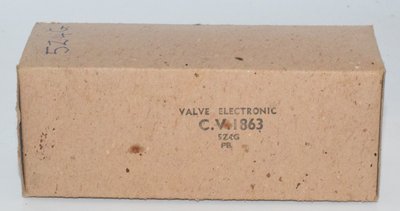
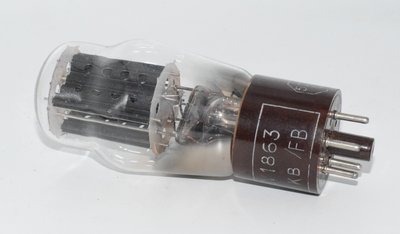
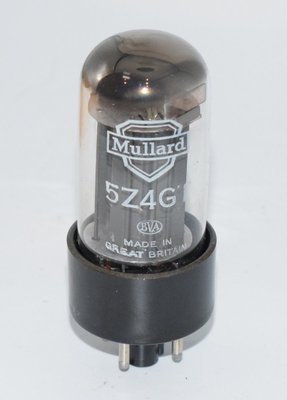
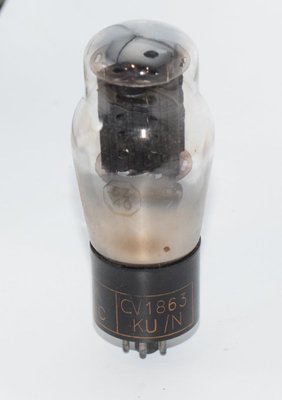
Throughout the 1940s and 1950s, the 5Z4GT was manufactured by numerous companies worldwide, including National Union, RCA, Sylvania, Mullard (UK), and many others. It found widespread use in medium-power amplifiers and receivers, and remains a valued component in vintage audio restoration and new tube amplifier designs today.
2. Technical Specifications and Design
Physical Specifications
| Cathode Type | Coated Unipotential (Indirectly Heated) |
| Pin Connections | 5L-0-O |
| Base | Intermediate Shell Octal, 5-Pin |
| Bulb | T9-D |
| Maximum Diameter | 1-5/16" |
| Maximum Overall Length | 3-5/16" |
| Maximum Seated Height | 2-3/4" |
| Mounting Position | Any |
Absolute Maximum Ratings
| Heater Voltage | 5.0 A.C. Volts |
| Heater Current | 2.0 Amps |
| Maximum Peak Inverse Voltage | 1400 Volts |
| Maximum Steady State Peak Plate Current* | 750 mA |
| Tube Voltage Drop | 20 Volts (measured with applied D.C. at 125 mA plate current) |
*When filter condensers larger than 4 µF are used, it may be necessary to add additional plate supply impedance.
Full-Wave Rectifier — Condenser Input to Filter
| Heater Voltage | 5.0 A.C. Volts |
| A.C. Plate Voltage per Plate (RMS) | 350 max. Volts |
| D.C. Output Current | 125 max. mA |
| Total Effective Plate Supply Impedance per Plate | 30 min. Ohms |
Full-Wave Rectifier — Choke Input to Filter
| Heater Voltage | 5.0 A.C. Volts |
| A.C. Plate Voltage per Plate (RMS) | 500 max. Volts |
| D.C. Output Current | 125 max. mA |
| Minimum Value of Input Choke | 5 Henrys |
Pin Configuration (Octal Base — Bottom View)
The 5Z4GT uses an Intermediate Shell Octal 5-pin base with the following standard connections:
- Pin 1: No Connection (or internal shield on some variants)
- Pin 2: Heater
- Pin 3: No Connection
- Pin 4: Plate 1
- Pin 5: No Connection
- Pin 6: Plate 2
- Pin 7: No Connection
- Pin 8: Heater/Cathode
Note: The pin designation "5L-0-O" from the original datasheet refers to the standard RMA basing diagram. Builders should always verify pinout against the specific manufacturer's datasheet for their production variant, as some manufacturers may have minor variations in unused pin connections.
Important note on specifications: As a rectifier tube, the 5Z4GT does not have amplification factor (µ), transconductance (gm), or plate resistance (rp) ratings — these parameters apply to amplifying tubes (triodes, pentodes, etc.), not rectifiers. Similarly, grid bias range is not applicable as the 5Z4GT has no control grid. Maximum plate dissipation is not separately specified; instead, the tube's limits are defined by maximum peak inverse voltage, maximum peak plate current, and maximum DC output current as listed above.
3. Applications and Usage
The 5Z4GT was designed primarily as a power supply rectifier for radio receivers and audio amplifiers requiring moderate B+ voltages and currents. Its principal applications include:
- Radio Receivers: The 5Z4GT was widely used in console and tabletop radio receivers of the 1940s and 1950s, providing rectified B+ voltage for the receiver's amplifier stages.
- Audio Amplifiers: Many medium-power push-pull amplifiers of the era used the 5Z4GT as their rectifier, particularly designs using 6V6, 6L6, or EL34 output tubes operating at moderate plate voltages.
- Test Equipment: The tube found use in laboratory power supplies and test instruments where stable, reliable rectification was needed.
- Instrument Amplifiers: Some early guitar and musical instrument amplifiers employed the 5Z4GT in their power supply sections.
The indirectly heated cathode of the 5Z4GT provides a notable advantage: a slight delay in B+ voltage application as the cathode heats up, which can help protect other tubes in the circuit during warm-up. However, this "soft start" is less pronounced than with some other rectifier types.
The datasheet's note about filter condensers larger than 4 µF is particularly important for designers. When large capacitor-input filters are used, the initial charging surge can exceed the tube's peak current rating. Adding series resistance or impedance in the plate supply (minimum 30 ohms per plate for condenser input) protects the tube from excessive peak currents.
For choke-input filter designs, the 5Z4GT can handle significantly higher AC plate voltages (up to 500V RMS per plate versus 350V RMS with condenser input), making it versatile across different power supply topologies. The minimum input choke value of 5 Henrys ensures proper operation and prevents excessive peak currents.
4. Sound Characteristics
While rectifier tubes do not directly amplify the audio signal, they have a profound influence on the sonic character of a tube amplifier through their effect on the power supply. The 5Z4GT, with its indirectly heated cathode and specific internal impedance characteristics, imparts a recognizable sonic signature that audiophiles and engineers have described over decades of use:
- Warm and Smooth Presentation: The 5Z4GT is generally described as producing a warm, smooth tonal character. Its 20-volt internal voltage drop (at 125 mA) and associated internal impedance create a power supply with inherent "give," which many listeners perceive as a natural, organic quality in the music.
- Controlled Dynamics: Compared to solid-state rectification, the 5Z4GT introduces a subtle dynamic compression effect. This is often described as "sag" — when the amplifier demands more current during transient peaks, the rectifier's internal impedance causes a slight momentary drop in B+ voltage. This effect rounds off harsh transients and contributes to a more musical, less fatiguing listening experience.
- Midrange Richness: Users frequently note that the 5Z4GT contributes to a rich, full midrange. The tube's impedance characteristics interact with the power supply filter network to create a slightly softer, more harmonically complex presentation in the critical midband frequencies.
- Bass Character: The bass response with a 5Z4GT tends to be described as warm and slightly rounded rather than tight and punchy. Amplifiers using this rectifier may exhibit a gentle softness in the lowest octaves compared to designs using lower-impedance rectifiers like the 5AR4/GZ34 or solid-state diodes.
- Treble Smoothness: High frequencies are generally perceived as smooth and non-fatiguing. The power supply interaction tends to tame any harshness in the upper registers, making the 5Z4GT a popular choice for listeners who prefer a relaxed, non-aggressive top end.
- Noise Floor: As an indirectly heated rectifier, the 5Z4GT typically exhibits lower hum and noise compared to directly heated types like the 5Y3GT, since the cathode structure is less prone to introducing heater-frequency modulation into the DC output.
It is worth noting that the sonic differences between rectifier tubes, while real and measurable in terms of power supply impedance and regulation, are subtle compared to the differences introduced by signal tubes, output transformers, or speakers. Nevertheless, experienced listeners consistently identify the 5Z4GT's contribution to the overall sonic character of an amplifier.
5. Equivalent or Substitute Types
The following tubes are generally considered equivalent or potentially substitutable for the 5Z4GT, though designers should verify compatibility in their specific circuit:
| Type | Compatibility Notes |
|---|---|
| 5Z4G | The ST-shape glass version. Electrically identical to the 5Z4GT; direct substitute. Larger physical envelope (ST-14 vs. T9). |
| 5Z4 | The original metal envelope version. Electrically identical; direct substitute. Different physical appearance. |
| GZ30 (CV2748) | European (Mullard) designation. Generally considered equivalent with the same heater voltage and current (5V, 2A). Verify specific ratings for your application. |
| 5Y3GT | Not a direct substitute. While it shares the same octal base and 5V heater, the 5Y3GT is a directly heated (filament-type) rectifier with different internal impedance and current ratings. It may work in some circuits but will change the power supply characteristics. The 5Y3GT generally has higher voltage drop and lower current capability. |
| 5AR4 / GZ34 | Not a direct substitute without circuit modification. The 5AR4/GZ34 has a 5V heater at 1.9A (similar), but it has significantly lower internal impedance and higher current capability (250 mA vs. 125 mA). Substituting a GZ34 into a circuit designed for the 5Z4GT may result in higher B+ voltages that could stress other components. Additionally, the GZ34's lower voltage drop means less "sag" and a different sonic character. |
| 5U4G / 5U4GB | Not a direct substitute. The 5U4G has a 5V heater but draws 3.0A (vs. 2.0A for the 5Z4GT), requiring a more robust heater winding. It also has higher current capability and different impedance characteristics. The power transformer must be able to supply the additional heater current. |
Important: When substituting rectifier tubes, always verify that the power transformer's high-voltage secondary and 5V heater winding ratings are compatible with the substitute tube's requirements. Pay particular attention to heater current draw, maximum AC plate voltage ratings, and the effect of different internal impedance on the resulting B+ voltage.
6. Notable Characteristics
- Indirectly Heated Cathode: The 5Z4GT's coated unipotential cathode is one of its defining features. Unlike directly heated rectifiers (5Y3GT, 5U4G) where the filament itself serves as the cathode, the 5Z4GT uses a separate cathode sleeve heated by an internal heater element. This provides better isolation between the heater circuit and the rectified output, potentially reducing hum.
- Delayed B+ Application: The indirectly heated cathode takes slightly longer to reach operating temperature than a directly heated filament, providing a natural time delay before B+ voltage appears. This can serve as a rudimentary form of protection for other tubes in the amplifier, allowing their heaters to warm up before plate voltage is applied.
- Moderate Internal Impedance: With a 20-volt drop at 125 mA, the 5Z4GT has a moderate internal impedance that places it between the higher-impedance 5Y3GT and the lower-impedance 5AR4/GZ34. This makes it a versatile choice for amplifiers where some power supply "softness" is desired without excessive voltage loss.
- Peak Inverse Voltage Rating: The 1400V PIV rating is robust and provides good safety margin in most typical applications.
- Filter Capacitor Limitation: The manufacturer's note about filter capacitors larger than 4 µF is an important design consideration. Modern electrolytic capacitors are often much larger than those available in 1940, and designers must ensure adequate series impedance (minimum 30 ohms per plate) to limit peak charging currents when using capacitor-input filters.
- Versatile Mounting: The ability to mount in any position gives designers flexibility in chassis layout.
- Dual Operating Modes: The significant difference in maximum AC plate voltage between condenser-input (350V RMS) and choke-input (500V RMS) filter configurations gives designers considerable flexibility. Choke-input designs also provide better voltage regulation, though at lower output voltage for a given transformer secondary voltage.
7. Usage in the Audio Community
The 5Z4GT enjoys a dedicated following in the audio community, valued for both its historical significance and its sonic contributions to tube amplifier designs.
Vintage Amplifier Restoration
The 5Z4GT is found in numerous vintage amplifiers and receivers from the 1940s through the 1960s. Restorers of equipment from manufacturers such as RCA, Zenith, Philco, and others frequently need 5Z4GT tubes to maintain originality. The tube remains available as NOS (New Old Stock) from various manufacturers, with Mullard UK NOS examples being particularly sought after by collectors and audiophiles.
New Amplifier Designs
Contemporary tube amplifier designers sometimes specify the 5Z4GT in new builds, particularly in lower-powered single-ended and push-pull designs where its moderate current capability (125 mA maximum) is sufficient. It is especially popular in amplifiers using pairs of 6V6, EL84, or single pairs of 6L6/EL34 output tubes where total B+ current requirements fall within the 5Z4GT's ratings.
Guitar Amplifiers
The 5Z4GT has found a niche in the guitar amplifier community, where the "sag" effect of tube rectification is highly prized. The momentary B+ voltage drop during hard playing creates a natural compression effect that many guitarists describe as "feel" or "touch responsiveness." The 5Z4GT's moderate impedance provides a noticeable but not excessive sag, making it suitable for amplifiers where dynamic response is important but excessive power supply droop would be undesirable.
Hi-Fi and Audiophile Applications
In the audiophile community, the 5Z4GT is appreciated for its warm, smooth sonic character. It is often chosen for headphone amplifiers and lower-powered speaker amplifiers where its current limitations are not a constraint. Some audiophiles prefer the 5Z4GT over the more commonly specified 5AR4/GZ34 in circuits where a slightly warmer, more romantic presentation is desired.
Tube Rolling
Rectifier tube rolling — swapping different rectifier types to alter an amplifier's sonic character — is a popular practice among audiophiles. The 5Z4GT is often part of this conversation, as it occupies a middle ground between the softer, saggier 5Y3GT and the tighter, more regulated 5AR4/GZ34. However, as noted in the equivalents section, substituting different rectifier types requires careful attention to electrical compatibility.
Collectibility and Availability
NOS 5Z4GT tubes from premium manufacturers — particularly Mullard (UK), Brimar, RCA, and Sylvania — command premium prices among collectors. Mullard-manufactured examples are especially prized in the audio community for their perceived superior construction quality and sonic characteristics. Current production 5Z4GT tubes are available from some manufacturers, though many audiophiles prefer vintage NOS stock. As with all NOS tubes, buyers should exercise caution regarding authenticity, as rebranding and misidentification are common in the vintage tube market.