Introduction and History
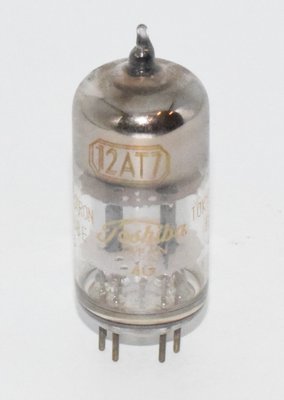
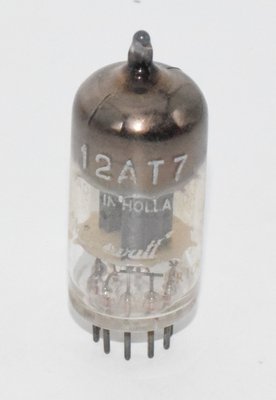
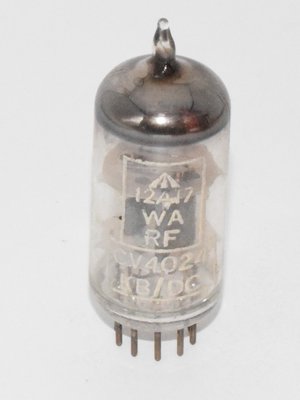
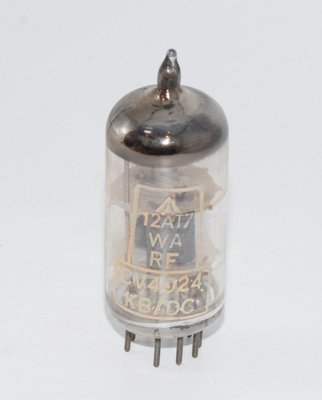
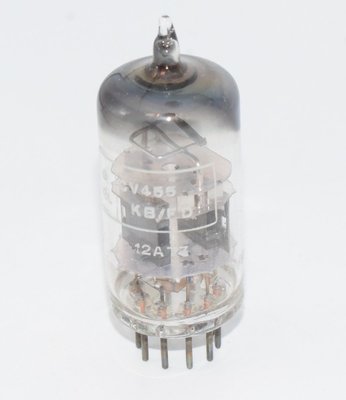
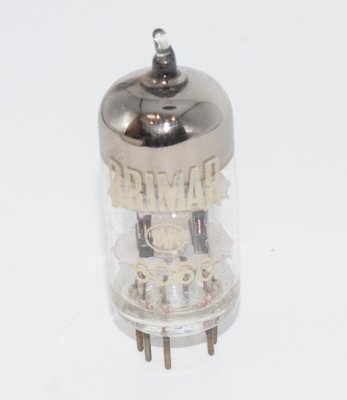
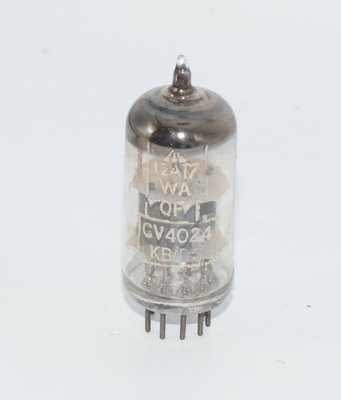
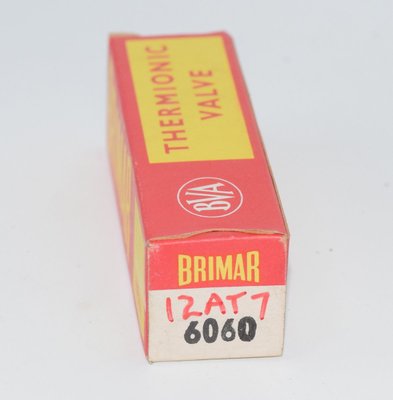
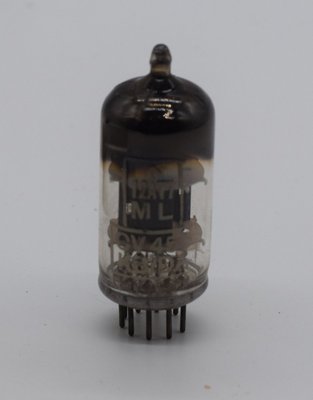
The 6060 is a high-quality double triode vacuum tube manufactured by Brimar (British Made, a brand of Standard Telephones and Cables, later part of the STC/ITT group). It is electrically equivalent to the 12AT7 / ECC81 family of medium-mu dual triodes, but was produced to enhanced quality standards — often designated with Brimar's "Special Quality" or "T" (Trustworthy) markings. The 6060 designation was assigned as a Brimar house type number for their premium-grade 12AT7 production, intended for professional, military, and industrial applications where reliability and tight parameter tolerances were paramount.
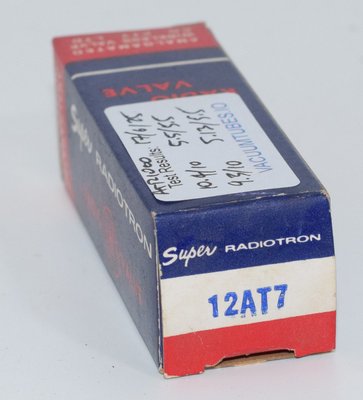
The 12AT7 family was originally developed in the late 1940s as part of the post-war miniature (noval) tube revolution. RCA introduced the 12AT7 in 1947, and it quickly became one of the most widely used dual triodes in the industry, particularly for high-frequency applications. Brimar, one of Britain's premier valve manufacturers, produced their own versions to exacting standards. The 6060 designation represents Brimar's commitment to producing valves that met or exceeded the stringent requirements of military and telecommunications equipment.
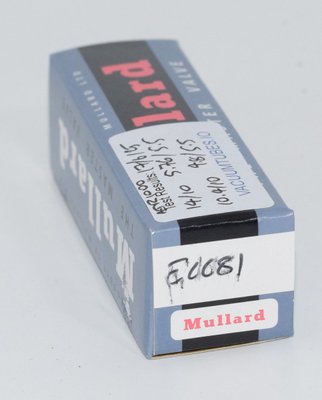
Brimar tubes from this era are highly regarded by collectors and audio enthusiasts. The company's Footscray (London) factory was known for meticulous quality control, and Brimar valves frequently appeared in BBC equipment, British military hardware, and professional audio gear. The 6060 / 12AT7 Brimar tubes are today considered among the finest examples of the 12AT7 type ever produced.
Technical Specifications and Design
The 6060 is a miniature double triode with two electrically independent triode sections sharing a common envelope. It features oxide-coated cathodes with indirect heating and a center-tapped filament allowing operation at either 6.3 V or 12.6 V heater supply. The tube was designed primarily for high-frequency amplification, oscillator, and mixer service at frequencies up to 300 MHz.
Heater Ratings
| Parameter | Value |
|---|---|
| Heater Voltage | 12.6 V or 6.3 V ± 10% |
| Heater Current | 0.15 A (at 12.6 V) or 0.3 A (at 6.3 V) |
Absolute Maximum Ratings (Per Section)
| Parameter | Maximum |
|---|---|
| Plate Voltage (Va) | 330 V |
| Plate Dissipation per Section | 2.8 W |
| Minimum Grid Voltage (DC) | −55 V |
| Grid Resistance (Rg) | 0.25 MΩ |
| Cathode-to-Filament Voltage | ± 100 V |
| Maximum Bulb Temperature | 200 °C |
Typical Operating Characteristics — Class A1 Amplifier (Per Section)
| Parameter | Condition 1 | Condition 2 |
|---|---|---|
| Plate Voltage (Va) | 100 V | 250 V |
| Cathode Resistance (Rk) | 270 Ω | 200 Ω |
| Amplification Factor (μ) | 60 | 60 |
| Plate Resistance (rp) | ~15 kΩ | ~5.5 kΩ |
| Transconductance (gm) | 4 mA/V | 10.9 mA/V |
| Plate Current (Ia) | 3.7 mA | 10.0 mA |
| Grid Voltage for 10 μA Grid Current | −5 V | −12 V |
Design Limits for Equipment Projects
| Parameter | Minimum | Maximum |
|---|---|---|
| Heater Current (at Vf = 12.6 V) | 138 mA | 162 mA |
| Heater Current after 500 h | 138 mA | 162 mA |
| Heater Current after 1000 h | 138 mA | 162 mA |
| Plate Current Difference Between Sections (max) | — | 3.2 mA |
| Plate Current per Section (at Va=250V, Vg=−20V, Ra=0.1MΩ) | — | 100 μA |
| Transconductance per Section (Vf=12.6V, Va=250V, Vg=0, Rk=200Ω, Ck=1000μF) | 4.5 mA/V | 6.5 mA/V |
| Transconductance after 500 h | 3.8 mA/V | 6.5 mA/V |
| Transconductance after 1000 h | 3.8 mA/V | 6.5 mA/V |
| Amplification Factor per Section | 50 | 70 |
| Reverse Grid Current (at Va=250V, Vg=0, Rg=500kΩ, Rk=200Ω) | — | 0.7 μA |
| Reverse Grid Current after 500 h / 1000 h | — | 0.7 μA |
| Filament-Cathode Current (Vfk=±100V) | — | 10 μA |
| Microphonic Voltage (at Va=250V, Vg=−3V, Rk=0, Ra=2kΩ, 10g at 50Hz) | — | 100 mV |
Interelectrode Capacitances (per Section)
| Capacitance | Without Shield | With Shield |
|---|---|---|
| Grid to Anode (per section) | 1.6 pF | 1.6 pF |
| Input (per section) | 2.5 pF | 2.5 pF |
| Output, Section 1 | 0.5 pF | 1.2 pF |
| Output, Section 2 | 0.4 pF | 1.5 pF |
| Filament to Cathode | 2.8 pF | 2.8 pF |
| Grid to Grid (approx.) | 0.005 pF | 0.004 pF |
| Anode to Anode (max) | 0.33 pF | 0.25 pF |
Note: External shield has an internal diameter of 22.2 mm and is connected to the cathode.
Design Limits for Interelectrode Capacitances (Without External Shield)
| Capacitance | Minimum | Maximum |
|---|---|---|
| Grid to Anode | 1.30 pF | 1.90 pF |
| Input | 2.0 pF | 3.0 pF |
| Output (Section 1) | 0.20 pF | 0.70 pF |
| Output (Section 2) | 0.16 pF | 0.60 pF |
| Filament to Cathode | 2.10 pF | 3.50 pF |
| Anode to Anode | 0.15 pF | 0.33 pF |
Insulation Resistance Between Electrodes
| Condition | Minimum |
|---|---|
| Grid vs. other electrodes at 100 V (new) | 100 MΩ |
| Grid vs. other electrodes at 100 V (after 500 h / 1000 h) | 50 MΩ |
| Anode vs. other electrodes at 300 V (new) | 100 MΩ |
| Anode vs. other electrodes at 300 V (after 500 h / 1000 h) | 50 MΩ |
Special Control Tests
- Filament Fatigue: 2000 cycles of 1 minute on, 4 minutes off, at Vf = 7.5 V, Va = Vg = 0, Vfk = 100 V.
- Shock Resistance: Five shocks of 450 g applied successively in four directions along three perpendicular axes.
- Vibration Fatigue: Sinusoidal vibration applied successively along three perpendicular directions, 3 × 24 hours, at 2.5 g acceleration, 25 Hz frequency.
Physical Characteristics
| Parameter | Value |
|---|---|
| Base Type | Noval (B9A) — 9-pin miniature |
| Socket | 9C12 |
| Envelope | Miniature glass (A.22-2 UTE) |
| Maximum Diameter | 22.2 mm |
| Maximum Seated Height | ~49.2 mm (39.7 ± 2.3 mm body + pins) |
| Maximum Overall Height | ~56 mm (including pins) |
| Pin Diameter | 1.02 ± 0.05 mm |
| Net Weight | 12 g |
| Mounting Position | Any (all positions) |
Pin Configuration (Noval B9A Base — Bottom View)
| Pin | Connection |
|---|---|
| 1 | Anode, Section 2 |
| 2 | Grid, Section 2 |
| 3 | Cathode, Section 2 |
| 4 | Filament (Heater) |
| 5 | Filament (Heater) |
| 6 | Anode, Section 1 |
| 7 | Grid, Section 1 |
| 8 | Cathode, Section 1 |
| 9 | Filament Center Tap |
For 12.6 V heater operation, pins 4 and 5 are connected to the 12.6 V supply. For 6.3 V operation, pins 4 and 5 are connected in parallel (with pin 9 as the common return), drawing 0.3 A.
Applications and Usage
The 6060 / 12AT7 was designed as a versatile medium-mu dual triode suitable for a wide range of applications:
- High-Frequency Amplification: The tube's primary design purpose was grounded-grid RF amplification, oscillator, and mixer service at frequencies up to 300 MHz. Its relatively low interelectrode capacitances and high transconductance at the 250 V operating point (10.9 mA/V) made it ideal for VHF circuits.
- Phase Inverters: The dual matched triode sections make the 6060 excellent for split-load (cathodyne) and long-tailed pair phase inverter circuits in push-pull amplifiers. Brimar's tight section-matching specification (maximum 3.2 mA difference between sections) is particularly valuable here.
- Voltage Amplification: With an amplification factor of 60, the 12AT7 family provides moderate gain — less than the 12AX7 (μ ≈ 100) but more than the 12AU7 (μ ≈ 17). This makes it suitable for driver stages where moderate gain with good linearity is required.
- Oscillator Circuits: The tube's ability to operate reliably at high frequencies and its robust construction make it well-suited for local oscillator service in superheterodyne receivers and frequency converters.
- Military and Professional Equipment: The 6060 was specifically designed for military and professional equipment, with its reinforced internal structure providing enhanced mechanical robustness and high operational reliability. The extensive shock (450 g) and vibration testing specifications confirm its suitability for demanding environments.
- Guitar Amplifiers: The 12AT7 type is widely used in guitar amplifier phase inverters, reverb driver circuits, and effects loops, where its lower gain compared to the 12AX7 provides better headroom and cleaner signal handling.
Sound Characteristics
The 6060 / 12AT7 Brimar is held in high regard among audiophiles and guitar amplifier enthusiasts for its distinctive sonic qualities. As a Brimar Special Quality tube, it exhibits characteristics that set it apart from standard 12AT7 production:
- Tonal Balance: The Brimar 6060 is frequently described as having a warm, rich midrange with a smooth, slightly rounded top end. Unlike some American-made 12AT7s that can lean toward brightness, the Brimar tends toward a more balanced, "British" tonal character — full-bodied without being dark or veiled.
- Detail and Resolution: Audiophiles note that the 6060 Brimar offers excellent micro-detail retrieval and a sense of air around instruments. The tight manufacturing tolerances contribute to low noise floors, allowing subtle musical details to emerge clearly.
- Dynamics: The tube is praised for its dynamic responsiveness. It handles transients well, with a natural, uncompressed quality that preserves the attack and decay of instruments. The relatively high transconductance (up to 10.9 mA/V at 250 V) contributes to a lively, responsive feel.
- Soundstage: In hi-fi preamplifier and phono stage applications, the 6060 Brimar is noted for presenting a wide, well-defined soundstage with good depth and instrument separation. The low anode-to-anode capacitance (0.33 pF maximum) helps maintain channel separation.
- Noise Performance: The Special Quality designation means these tubes were selected for low noise and low microphonics. The vibration specification (maximum 100 mV under 10 g acceleration at 50 Hz) indicates robust construction that resists microphonic pickup — a critical quality for phono stages and sensitive preamplifier circuits.
- Harmonic Character: When driven into mild distortion (as in guitar amplifier applications), the 12AT7 type produces a smoother, more compressed breakup compared to the 12AX7, with a pleasing blend of even and odd harmonics. The Brimar variant is noted for a particularly musical quality to its distortion character.
Overall, the 6060 Brimar is considered a "musician's tube" — one that prioritizes musicality and natural tonal qualities over analytical precision. It is particularly valued in applications where the tube's character can contribute positively to the overall sonic presentation.
Equivalent and Substitute Types
The 6060 is electrically equivalent to the 12AT7 / ECC81 family. However, it is important to note that while many types share the same basic electrical characteristics and pinout, they may differ in construction quality, parameter tolerances, and specific ratings. The following are related types that share the same basic noval (B9A) pinout and general electrical characteristics:
Different Rating Substitutes (Not Necessarily Drop-In)
The following types are related to the 6060 but may have different ratings, tighter tolerances, or specific construction differences. Always verify specific ratings before substitution in critical applications:
- 12AT7 — The standard commercial type; direct equivalent in most applications.
- 12AT7WA — Ruggedized military version with enhanced shock and vibration resistance.
- 12AT7WC — Another military-grade variant with specific environmental ratings.
- ECC81 — European (Mullard/Philips) designation for the 12AT7; electrically identical.
- ECC801 / ECC801S — Special quality, long-life versions of the ECC81 with tighter parameter spreads.
- E81CC — Telefunken/European premium-grade ECC81 with frame-grid construction in some versions; enhanced specifications.
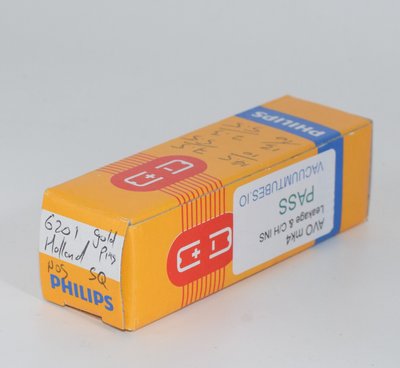
- 6201 — Premium-grade 12AT7 with tighter tolerances, originally specified by the US military (often associated with GE and other American manufacturers).
- CK6201 — Raytheon designation for the 6201 type.
- 6679 — A low-noise, selected version of the 12AT7 family.
- 7492 — Special-purpose variant of the 12AT7.
- 7728 — Another special-purpose variant.
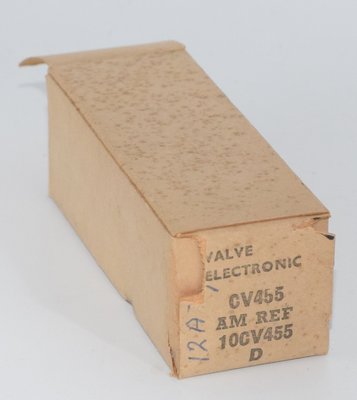
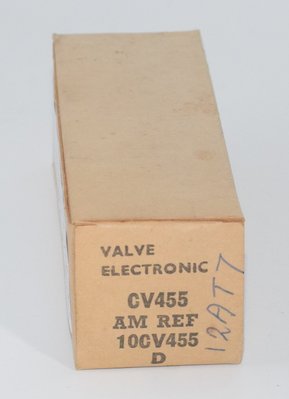
- CV455 — British military (CV register) designation for the 12AT7/ECC81.
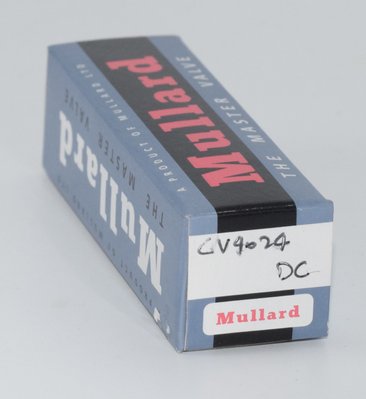
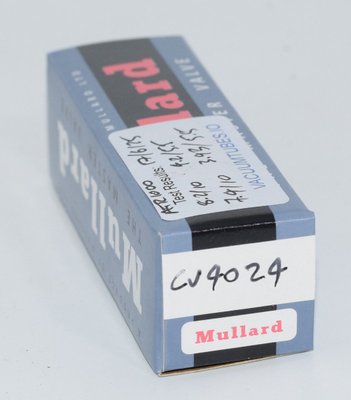
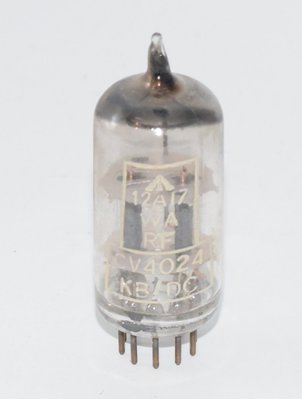
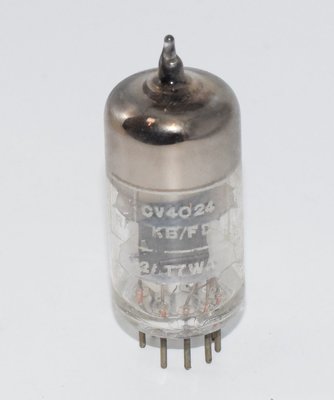
- CV4024 — British military premium-grade designation, often associated with Mullard and Brimar production.
- CV8154 — Another CV register designation for a 12AT7 variant.
- CV9859 — CV register designation.
- CV10662 — CV register designation.
- M8162 — Mullard special quality designation for their premium ECC81.
- A2900 — GEC/MOV designation.
- B152, B309, B739 — Various European manufacturer designations.
- CC81E — French designation variant.
- E2157 — Telefunken/European designation.
- QA2406 / QS2406 — Additional manufacturer-specific designations.
Important Note: While all of the above types share the same fundamental 12AT7/ECC81 electrical characteristics and B9A pinout, they are classified as "different rating substitutes" rather than guaranteed drop-in replacements. Differences may exist in maximum ratings, transconductance ranges, heater warm-up characteristics, or construction details. In critical or high-reliability applications, always verify that the substitute type meets the specific requirements of the circuit.
The 12AT7 family should not be confused with or substituted for the 12AX7 (ECC83) or 12AU7 (ECC82) without circuit modifications, as these types have significantly different amplification factors, transconductance values, and plate resistance characteristics.
Notable Characteristics
- Reinforced Internal Structure: The 6060 / 12AT7WA features a reinforced internal construction specifically designed for military and professional applications. This provides exceptional mechanical robustness and resistance to shock (rated for 450 g impacts) and vibration (2.5 g at 25 Hz for extended periods).
- Excellent Section Matching: The maximum allowable difference between the plate currents of the two triode sections is specified at only 3.2 mA, indicating tight manufacturing control. This is particularly valuable for phase inverter and balanced circuit applications.
- Long-Term Stability: The datasheet specifies performance parameters not only for new tubes but also after 500 and 1000 hours of operation. The transconductance is guaranteed to remain within 3.8–6.5 mA/V even after 1000 hours, and heater current remains stable at 138–162 mA throughout the tube's rated life. Life test conditions are specified as: Vf = 12.6 V, Va = 250 V, Rk = 200 Ω, Rg = 0.5 MΩ, Vfk = 135 V, with intermittent operation.
- High-Frequency Capability: Designed for operation up to 300 MHz, the 6060 features carefully controlled interelectrode capacitances. The extremely low grid-to-grid capacitance (0.005 pF without shield) ensures minimal crosstalk between sections at high frequencies.
- Versatile Heater Configuration: The center-tapped filament (pin 9) allows operation at either 6.3 V (0.3 A) or 12.6 V (0.15 A), providing flexibility for both automotive/mobile (12 V) and standard mains-powered (6.3 V) equipment.
- Low Microphonics: The maximum microphonic voltage is specified at 100 mV under 10 g acceleration at 50 Hz, with a 2 kΩ anode load — a stringent specification that confirms the tube's suitability for sensitive audio applications.
- Brimar Special Quality Heritage: Brimar's "T" (Trustworthy) designation and Special Quality markings indicate that these tubes underwent additional testing and selection beyond standard commercial production. This heritage makes NOS (New Old Stock) examples particularly sought after.
- Universal Mounting: The tube can be operated in any mounting position ("toutes positions"), adding to its versatility in equipment design.
Usage in the Audio Community
The 6060 Brimar occupies a special place in the audio community, valued both for its inherent quality and its relative scarcity compared to more common 12AT7 variants. Here is how it is used across various audio applications:
Hi-Fi Preamplifiers and Phono Stages
The 6060 is a popular tube rolling choice for high-end preamplifiers and phono stages that use the 12AT7 type. Its low noise characteristics and tight section matching make it particularly well-suited for RIAA phono equalization circuits, where noise performance is critical and section balance affects channel matching. Audiophiles report that the Brimar 6060 brings a warmth and musicality to phono stages that can be lacking with modern production tubes.
Guitar Amplifiers
In the guitar amplifier world, the 12AT7 is a staple tube used in phase inverter positions (notably in Fender, Marshall, and Vox designs), reverb driver circuits, and effects loops. The 6060 Brimar is sought after by tone-conscious players who want a premium-quality phase inverter tube. Its robust construction and stable long-term performance are practical advantages in the demanding environment of a gigging amplifier. Players report that the Brimar 6060 provides a tighter, more articulate low end and smoother high-frequency response compared to standard 12AT7s in phase inverter duty.
Headphone Amplifiers
The 12AT7 type is used in numerous tube headphone amplifier designs, and the 6060 Brimar is a favored upgrade tube in this application. Its moderate gain (μ = 60) provides a good balance between voltage swing and noise performance, and its musical character is well-suited to the intimate listening experience of headphones.
DAC Output Stages and Buffer Circuits
Some high-end digital-to-analog converters use 12AT7-type tubes in their output buffer stages to add a touch of tube character to the digital signal path. The 6060's combination of low noise, good linearity, and musical harmonic character makes it an excellent choice for these applications.
Tube Rolling and Collecting
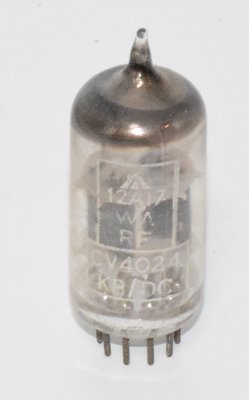
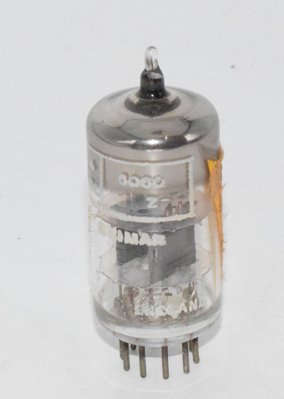
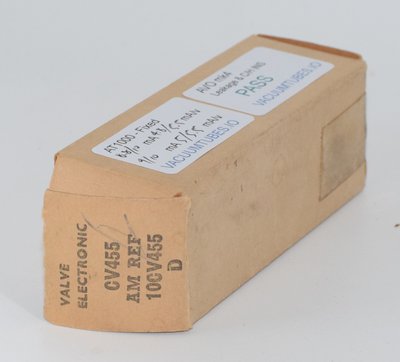
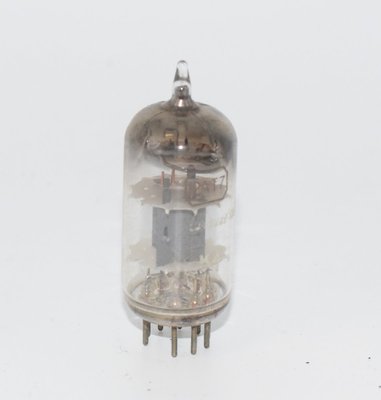
The 6060 Brimar is a collector's tube. NOS (New Old Stock) examples, particularly those with the "T" Special Quality designation, command premium prices on the vintage tube market. Collectors value the distinctive Brimar construction — typically featuring grey plates, a sturdy mica support structure, and the characteristic Brimar printing and labeling. Some NOS examples are found wrapped in paper, which occasionally adheres to the "T" sticker — a minor cosmetic issue that does not affect the tube's performance but is noted by collectors.
The audio community generally considers the Brimar 6060 to be in the top tier of 12AT7-type tubes, alongside the Mullard CV4024 / M8162, Telefunken ECC81, and Amperex Bugle Boy ECC81. Its combination of British manufacturing quality, special-quality selection, and musical sonic character ensures its continued desirability among discerning audio enthusiasts.
Practical Considerations
When using the 6060 in audio equipment, the following practical points should be noted:
- The tube's amplification factor of 60 (with a design spread of 50–70) means that gain may vary somewhat between individual tubes. For critical applications, testing and matching is recommended.
- The maximum plate dissipation of 2.8 W per section should be respected to ensure long tube life. In typical audio circuits operating at 250 V plate voltage with a 200 Ω cathode resistor, the plate current of approximately 10 mA results in about 2.5 W dissipation — comfortably within the rated limit.
- The 0.25 MΩ maximum grid resistance specification should be observed; exceeding this value can lead to grid emission problems and unstable operation, particularly as the tube ages.
- For lowest noise in phono stage applications, ensure that the heater supply is either DC or elevated AC with a center-tap referenced to a positive DC voltage relative to the cathode, taking advantage of the ±100 V cathode-to-filament voltage rating.