1. Introduction and History
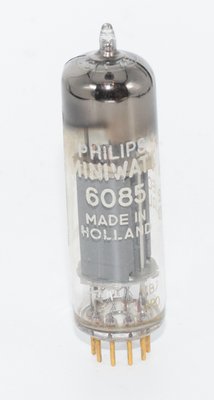
The 6085 is a long-life double audio-frequency triode manufactured by N.V. Philips Gloeilampenfabrieken in Eindhoven, Holland. First released via RTMA release #1029 on October 16, 1951, the 6085 was designed to meet the demanding requirements of professional audio, telecommunications, and instrumentation equipment where extended service life and exceptional reliability were paramount.
The 6085 is the American RTMA-registered designation for what is more widely known in European professional circles as the E80CC — the "E" prefix denoting the 6.3V heater series and the "80" indicating the special-quality, long-life (10,000-hour) professional grade in the Philips/Mullard naming convention. This tube was part of Philips' prestigious professional-grade valve lineup, featuring rigid internal construction specifically engineered to minimize microphonics and ensure consistent performance over its extended operational life.
The Philips datasheet describes it as a "Long Life Double A.F. Triode with Rigid Construction", underscoring its intended role in audio-frequency amplification circuits where mechanical stability and low noise were critical. The tube employs a coated unipotential cathode and is housed in a compact T6½ (miniature) glass envelope with a 9-pin noval base.
Philips produced the 6085/E80CC at their Heerlen and Eindhoven factories in the Netherlands, and the tube was also manufactured under license by Mullard in the UK (where it carried the military designation CV5989) and by other Philips subsidiaries. The "SQ" (Special Quality) Gold Pin variants from Philips Miniwatt are particularly prized by collectors and audiophiles for their premium construction and carefully selected components.
2. Technical Specifications and Design
Physical Specifications
| Parameter | Value |
|---|---|
| Cathode | Coated unipotential |
| Base | Small button noval 9-pin (B9A / Noval) — JETEC basing designation 9A |
| Bulb | T6½ |
| Maximum overall length | 2 5/8" |
| Maximum seated height | 2 3/8" |
| Bulb length excluding tip | 2" ± 3/32" |
| Maximum diameter | 7/8" |
| Mounting position | Any |
Pin Configuration (Bottom View of Base)
| Pin | Function |
|---|---|
| Pin 1 | Plate — System I |
| Pin 2 | Grid — System I |
| Pin 3 | Cathode — System I |
| Pin 4 | Heater |
| Pin 5 | Heater |
| Pin 6 | Plate — System II |
| Pin 7 | Grid — System II |
| Pin 8 | Cathode — System II |
| Pin 9 | Filament centre tap |
Heater Data
| Parameter | 6.3V Operation | 12.6V Operation |
|---|---|---|
| Heater voltage | 6.3 volts | 12.6 volts |
| Heater current | 600 mA | 300 mA |
The centre-tapped heater (Pin 9) allows operation at either 6.3V (pins 4 and 5 in parallel) or 12.6V (pins 4 and 5 in series), providing flexibility for different power supply configurations.
Direct Interelectrode Capacitances
Triode System I
| Parameter | Value |
|---|---|
| Grid to all other elements except plate | 2.8 pF |
| Plate to all other elements except grid | 1.2 pF |
| Grid to plate | 2.6 pF |
| Grid to heater | max. 0.2 pF |
Triode System II
| Parameter | Value |
|---|---|
| Grid to all other elements except plate | 2.7 pF |
| Plate to all other elements except grid | 1.3 pF |
| Grid to plate | 2.75 pF |
| Grid to heater | max. 0.2 pF |
Between Systems I and II
| Plate to plate | max. 0.8 pF |
Maximum Ratings — Each System (Design Centre Values)
| Parameter | Maximum Value |
|---|---|
| Plate voltage (without current) | 550 volts |
| Plate voltage | 300 volts |
| Plate dissipation | 1.5 watts |
| Negative grid bias | 200 volts |
| Grid circuit resistance | 2 megohms |
| Cathode current | 10 mA |
| Voltage between heater and cathode | 60 volts |
| External resistance between heater and cathode | 20,000 ohms |
Typical Characteristics — Each System
| Parameter | Value |
|---|---|
| Plate voltage | 250 volts |
| Grid voltage | -5.5 volts |
| Plate current | 6 mA |
| Transconductance (gm) | 2700 micromhos (2.7 mA/V) |
| Amplification factor (μ) | 30 |
| Plate resistance (rp) | ~11.1 kΩ (calculated: μ/gm = 30/0.0027) |
Note: The plate resistance of approximately 11.1 kΩ is calculated from the relationship rp = μ / gm. This value should be confirmed against additional manufacturer data if precision is required for a specific design.
3. Applications and Usage
The 6085/E80CC was designed primarily for professional and industrial applications where long service life, low noise, and mechanical ruggedness were essential requirements:
- Professional Audio Equipment: Microphone preamplifiers, mixing console input stages, and studio line amplifiers where low noise and consistent gain were critical. The rigid construction minimized microphonic pickup in vibration-prone studio environments.
- Telecommunications: Carrier frequency equipment, repeater amplifiers, and telephone exchange circuits where tubes needed to operate reliably for thousands of hours without maintenance.
- Instrumentation: Precision measurement equipment, oscilloscopes, and laboratory instruments requiring stable, low-drift amplification stages.
- Computing and Data Processing: Early computer circuits and data processing equipment where the long-life rating reduced costly downtime for tube replacement.
- Voltage Amplification: General-purpose audio-frequency voltage amplification in both single-ended and differential (long-tailed pair) configurations.
- Phase Splitter Circuits: The matched dual-triode construction made it ideal for cathodyne and differential phase splitter stages driving push-pull output stages.
- RIAA Phono Preamplifiers: The moderate amplification factor of 30 combined with good transconductance made it suitable for phono stage designs requiring precise equalization.
The tube's ability to operate at plate voltages up to 300V (or 550V without current flow) and its generous maximum grid bias of 200V gave designers considerable flexibility in circuit topology. The relatively high maximum grid circuit resistance of 2 megohms also simplified input coupling designs.
4. Sound Characteristics
The 6085/E80CC has earned a devoted following among audiophiles and recording engineers for its distinctive sonic qualities. While subjective descriptions of tube sound always carry a degree of personal interpretation, several characteristics are consistently noted by experienced listeners:
- Tonal Balance: The 6085 is widely regarded as having a neutral to slightly warm tonal balance. It does not impose heavy coloration on the signal, making it a favorite for purist audio designs. Compared to the ubiquitous 12AX7/ECC83, the 6085 presents a more open and less compressed midrange.
- Midrange Clarity: The tube is frequently praised for its exceptional midrange resolution and articulation. Vocals and acoustic instruments are rendered with a natural presence and dimensionality that many listeners find captivating. The rigid internal construction contributes to this clarity by minimizing microphonic artifacts that can smear fine detail.
- Bass Response: The 6085 delivers a controlled, well-defined low end. The moderate plate resistance (~11 kΩ) allows it to drive subsequent stages with authority, and bass notes are described as tight and articulate rather than bloated or loose.
- Treble Character: High frequencies are extended and airy without the grain or harshness sometimes associated with lesser triode types. The relatively low interelectrode capacitances (grid-to-plate of 2.6 pF) help maintain bandwidth and preserve high-frequency detail.
- Dynamics and Transients: The 6085's good transconductance of 2700 µmhos provides responsive signal handling, and listeners note excellent micro-dynamic resolution — the ability to convey subtle gradations in volume and intensity that bring recordings to life.
- Noise Floor: As a professional-grade long-life tube, the 6085 typically exhibits very low noise and hum levels, particularly in the coveted Philips SQ (Special Quality) Gold Pin versions. This low noise floor contributes to a sense of "blackness" between notes and enhances the perception of detail and spatial information.
- Soundstage: When used in well-designed preamplifier circuits, the 6085 is noted for producing a wide, deep, and three-dimensional soundstage with precise image placement. The low plate-to-plate capacitance between sections (max. 0.8 pF) helps maintain channel separation in stereo applications.
Overall, the 6085/E80CC is considered a "reference-grade" small-signal triode — one that reveals the character of the recording and the circuit design rather than imposing its own strong sonic signature. This transparency, combined with a subtle organic warmth, places it among the most respected dual triodes in the audiophile pantheon.
5. Equivalent or Substitute Types
| Type | Relationship | Notes |
|---|---|---|
| E80CC | Identical — European designation | The E80CC is the Philips/Mullard European pro-audio designation for the same tube. The "E" denotes 6.3V heater; "80" denotes the special-quality long-life (10,000-hour) professional series. Fully interchangeable with 6085 in all respects — same pinout, same ratings. |
| CV5989 | Identical — UK military designation | The CV (Common Valve) number assigned by the UK Ministry of Defence for military procurement. Electrically and physically identical to the 6085/E80CC. Often manufactured by Mullard to Philips specifications. Fully interchangeable. |
Important Compatibility Notes:
The 6085/E80CC is not a direct drop-in substitute for the more common ECC83/12AX7 or ECC82/12AU7 families, despite sharing the noval base. The pinout is different in critical ways — most notably, the 6085 has separate cathode connections for each triode section (pins 3 and 8), whereas the 12AX7/12AU7 family shares a common cathode arrangement with different pin assignments. The heater current (600 mA at 6.3V) also differs from the 12AX7 family (300 mA at 12.6V / 150 mA at 6.3V). Do not substitute a 6085 into a socket designed for 12AX7, 12AU7, or 12AT7 without a complete circuit redesign.
The 6085/E80CC is sometimes compared to the 6201/E81CC (a long-life version of the 12AT7) and the 6189/E82CC (a long-life version of the 12AU7), but these are not interchangeable types. Each has different electrical characteristics and, in some cases, different pinouts.
6. Notable Characteristics
- Long-Life Professional Design: The "80" series designation in the Philips system indicates a tube designed for a minimum service life of 10,000 hours — far exceeding the typical 2,000–5,000 hour life expectancy of standard consumer-grade equivalents. This was achieved through careful cathode chemistry, conservative operating parameters, and precision manufacturing.
- Rigid Construction: The internal electrode structure features a rigid, mechanically stable assembly specifically designed to resist vibration and shock. This rigid construction is explicitly called out in the Philips datasheet title and is a key differentiator from standard dual triodes. It makes the 6085 highly resistant to microphonic noise — a critical advantage in sensitive audio input stages.
- Centre-Tapped Heater: Pin 9 provides a filament centre tap, enabling operation at either 6.3V or 12.6V. This dual-voltage capability was valuable in professional equipment designed for different power supply standards. The centre tap also allows precise heater biasing to minimize hum in DC-heated configurations.
- Matched Sections: As a professional-grade tube, the two triode sections of the 6085 were manufactured to tighter tolerances than standard dual triodes, resulting in better section-to-section matching. This is reflected in the very similar (though not identical) interelectrode capacitance values between System I and System II in the datasheet.
- Moderate Amplification Factor: With a μ of 30, the 6085 falls between the high-μ 12AX7 (μ ≈ 100) and the low-μ 12AU7 (μ ≈ 17). This moderate gain makes it versatile — sufficient for most voltage amplification tasks while maintaining good linearity and headroom.
- Any Mounting Position: The tube is rated for operation in any mounting position, providing maximum flexibility in equipment design.
- Low Plate-to-Plate Capacitance: The maximum 0.8 pF capacitance between the two plate systems indicates good internal shielding between sections, important for maintaining channel separation in stereo applications and preventing unwanted coupling in multi-stage amplifiers.
- Philips SQ Gold Pin Variants: The most sought-after versions are the Philips Miniwatt SQ (Special Quality) Gold Pin production, which featured gold-plated pins for superior contact reliability and were individually tested to tighter specifications. These command premium prices on the vintage tube market.
7. Usage in the Audio Community
The 6085/E80CC occupies a special place in the high-end audio community, revered as one of the finest small-signal dual triodes ever produced. Its usage spans several key areas:
High-End Preamplifier Designs
A number of boutique and high-end audio manufacturers have designed preamplifiers specifically around the E80CC/6085. Its moderate gain (μ = 30), excellent linearity, and low noise make it an ideal candidate for line-stage preamplifiers where signal purity is the primary design goal. The tube's characteristics allow designers to achieve sufficient gain in two stages while maintaining wide bandwidth and low distortion.
Headphone Amplifiers
The 6085 has found a dedicated following in the headphone amplifier community. Its moderate plate resistance and good transconductance allow it to drive headphone output stages effectively, and its low noise floor is particularly appreciated in the intimate listening environment of headphone use, where any hiss or hum is immediately apparent.
Phono Stages
The 6085's low noise characteristics and rigid construction make it an excellent choice for moving-magnet phono preamplifier stages. Several respected phono stage designs employ the E80CC in RIAA equalization circuits, where its combination of gain, linearity, and freedom from microphonics yields exceptional vinyl playback quality.
DAC Output Stages
In hybrid digital-to-analog converter designs, the 6085 is sometimes employed as a tube output buffer or gain stage following the DAC chip. Its transparency and natural tonal qualities are valued for adding a subtle analog warmth to digital sources without obscuring detail.
DIY and Custom Builds
The DIY audio community has embraced the 6085/E80CC enthusiastically. Numerous circuit designs and build guides are available on audio forums, with builders sharing schematics for line stages, phono preamps, and headphone amplifiers based on this tube. The separate cathode connections for each section (pins 3 and 8) provide flexibility for both common-cathode and differential amplifier topologies.
Tube Rolling and Collecting
The 6085/E80CC is a popular subject for tube rolling — the practice of swapping different tube brands and vintages to find preferred sonic characteristics. Collectors and audiophiles distinguish between various production runs:
- Philips Miniwatt SQ Gold Pin (Holland): The most coveted version, featuring gold-plated pins, the Philips Miniwatt shield logo, and "SQ" marking. These are considered the reference standard and command the highest prices.
- Philips Heerlen production: Standard Philips production from the Heerlen factory, identifiable by specific date codes and factory markings. Excellent quality, slightly more affordable than SQ versions.
- Mullard (UK): Produced at the Mullard Blackburn factory, often carrying the CV5989 military designation. Valued for a slightly warmer tonal character compared to Dutch production.
- Siemens and other European production: Various European manufacturers produced E80CC equivalents, each with subtle sonic differences appreciated by discerning listeners.
Market and Availability
As a professional-grade tube that has been out of production for decades, the 6085/E80CC has become increasingly scarce and expensive on the vintage tube market. NOS (New Old Stock) examples in original packaging command premium prices, particularly the Philips SQ Gold Pin variants. This scarcity has led some amplifier designers to offer adapter solutions allowing the use of more readily available tube types, though purists maintain that no substitute fully replicates the 6085's sonic qualities.
The enduring demand for the 6085/E80CC in the audio community is a testament to the excellence of Philips' original 1951 design — a tube that continues to set the standard for small-signal triode performance more than seven decades after its introduction.