Introduction and History
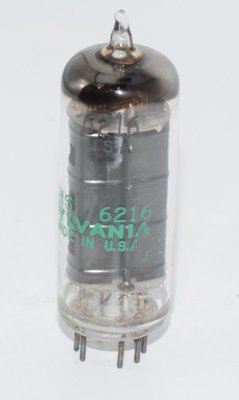
The 6216 is a beam pentode power amplifier tube manufactured by Tung-Sol Electric Inc. at their Electron Tube Division in Bloomfield, New Jersey. The datasheet is dated November 1, 1961, placing this tube firmly in the era of advanced miniature tube development for military and aerospace applications. Designed specifically for mobile and aircraft use, the 6216 features a coated unipotential cathode and was engineered to be extremely resistant to the severe vibrations encountered in high-speed military aircraft.
The 6216 represents a class of rugged, high-performance miniature beam pentodes that emerged in the late 1950s and early 1960s as the military demanded increasingly reliable vacuum tube solutions for airborne electronics. While solid-state devices were beginning to appear, vacuum tubes remained essential for many military applications due to their inherent resistance to electromagnetic pulse (EMP) and radiation effects, as well as their proven reliability in high-vibration environments.
The tube was produced primarily by Tung-Sol and Sylvania in the United States. Sylvania-manufactured examples are known to exist as new-old-stock (NOS), and the tube carries the British CV (Common Valve) designation CV9728 as its military equivalent.
Technical Specifications and Design
General Description
- Type: Beam Pentode Power Amplifier
- Construction: Miniature Type
- Cathode: Coated Unipotential (indirectly heated)
- Base: 9-Pin Miniature (E9-1 / JEDEC 9CE)
- Envelope: Glass Bulb (T-6½)
- Outline Drawing: JEDEC 6-3
- Mounting Position: Any
Physical Dimensions
- Maximum Diameter: 0.875 inches
- Maximum Seated Height: 2.375 inches
- Maximum Overall Length: 2.625 inches
Pin Configuration (Bottom View, JEDEC 9CE)
| Pin | Connection |
|---|---|
| 1 | P (Plate) |
| 2 | G1 (Control Grid) |
| 3 | G3, K (Suppressor Grid, Cathode — internally connected) |
| 4 | H (Heater) |
| 5 | H (Heater) |
| 6 | P (Plate) |
| 7 | G2 (Screen Grid) |
| 8 | K (Cathode) |
| 9 | NC (No Connection) |
Note: The plate is brought out to two pins (1 and 6) for improved current handling and reduced lead inductance. The suppressor grid (G3) is internally connected to the cathode (K) at pin 3.
Heater Characteristics and Ratings
| Parameter | Value |
|---|---|
| Heater Voltage (average) | 6.3 Volts |
| Heater Current (average) | 1200 mA (1.2 A) |
| Maximum Heater-Cathode Voltage | 150 Volts |
Maximum Ratings (Design Center Values per EIA Standard RS-239)
| Parameter | Maximum Value |
|---|---|
| Plate Voltage | 300 Volts |
| Grid #2 (Screen) Voltage | 200 Volts |
| Positive DC Grid #1 Voltage | 0 Volts |
| Plate Dissipation | 10 Watts |
| Grid #2 Dissipation | 1.0 Watts |
| Cathode Current | 110 mA |
| Bulb Temperature at Any Point | 210 °C |
| Grid #1 Circuit Resistance (Fixed Bias) | 0.1 Megohm |
| Grid #1 Circuit Resistance (Self Bias) | 0.5 Megohm |
Direct Interelectrode Capacitances (Without Shield)
| Capacitance | Value |
|---|---|
| Grid to Plate (G1 to P), Max. | 0.370 pF |
| Input: G1 to (H+K+G2+G3+B.P.+B.S.+I.S.) | 12.3 pF |
| Output: P to (H+K+G2+G3+B.P.+B.S.+I.S.) | 6.7 pF |
Average Characteristics (Filter Reactor Conditions)
At Plate Voltage = 100V, Grid #2 Voltage = 100V, Grid #1 Voltage = −3V, Grid #1 Resistor = 0.1 Megohm:
| Parameter | Value |
|---|---|
| Plate Resistance (approx.) | 18,500 Ohms |
| Transconductance | 12,800 µmhos |
| Plate Current | 72 mA |
| Grid #2 Current | 3 mA |
| Grid #1 Voltage (approx.) for Ib = 50 µA | −25 Volts |
Class A Audio Amplifier Operating Conditions
| Parameter | Value |
|---|---|
| Plate Voltage | 200 Volts |
| Grid #2 (Screen) Voltage | 100 Volts |
| Grid #1 (Control Grid) Voltage | −6 Volts |
| Peak AF Grid #1 Voltage | 6 Volts |
| Zero Signal Plate Current | 47 mA |
| Max. Signal Plate Current | 51 mA |
| Zero Signal Grid #2 Current | 2.0 mA |
| Max. Signal Grid #2 Current | 4.0 mA |
| Plate Resistance | 38,800 Ohms |
| Transconductance | 8,800 µmhos |
| Load Resistance | 4,500 Ohms |
| Total Harmonic Distortion | 10 Percent |
| Max. Signal Power Output | 3.8 Watts |
Typical Operation — Filter Reactor
| Parameter | Value |
|---|---|
| DC Plate Supply Voltage (Input to Filter) | 400 Volts |
| DC Plate Voltage (Plate to Cathode) | 60 Volts |
| DC Grid #2 Voltage | 100 Volts |
| DC Grid #1 Voltage | −1 Volt |
| DC Output Voltage (Output from Filter) | 335 Volts |
| DC Cathode Current | 110 mA DC |
| RMS Ripple Voltage (in Output) (Note 1) | 210 mV |
Typical Operation — Class C Oscillator-Amplifier at 50 MC
| Parameter | Value |
|---|---|
| DC Plate Voltage | 300 Volts |
| DC Grid #2 Voltage | 150 Volts |
| DC Grid #1 Voltage | −50 Volts |
| Peak RF Grid #1 Voltage | 65 Volts |
| DC Plate Current | 63 mA |
| DC Grid #2 Current | 8.0 mA |
| DC Grid #1 Current | 2.0 mA |
| Grid #1 Driving Power (approx.) | 0.3 Watts |
| Useful Power Output | 8.8 Watts |
Note: The amplification factor (µ) is not explicitly stated in the Tung-Sol datasheet. However, it can be estimated from the relationship µ = gm × rp. Using the filter reactor conditions (gm = 12,800 µmhos, rp = 18,500 Ohms), µ ≈ 237. Under Class A audio conditions (gm = 8,800 µmhos, rp = 38,800 Ohms), µ ≈ 341. These values are approximations and should be confirmed against additional manufacturer data if precision is required.
Applications and Usage
The 6216 was designed as a versatile beam pentode suitable for a wide range of applications. According to the Tung-Sol datasheet, the tube may be used in:
- Class A Amplifier Applications: With 200V plate voltage and 100V screen voltage, the 6216 delivers 3.8 watts of audio power output in single-ended Class A configuration with a 4,500-ohm load resistance.
- Class B and Class C Amplifier Applications: The tube is capable of delivering 8.8 watts of useful power output as a Class C oscillator-amplifier at 50 MC (MHz), demonstrating its RF capabilities.
- Electronic Voltage-Regulated Power Supplies: One of the primary intended applications. The tube functions as a series pass element (filter reactor) in regulated power supplies, where it replaces a conventional iron-core choke. The datasheet includes a detailed comparison showing the 6216's filtering action versus a 12H/150mA iron-core choke, with the tube providing superior ripple reduction (210 mV RMS output ripple) while delivering a DC output voltage of 335V from a 400V input at 110 mA cathode current.
- Wide Band Video Amplifiers: The relatively high transconductance (up to 12,800 µmhos) and low interelectrode capacitances make the 6216 suitable for wideband video amplification.
- Passive Switching Applications: The tube can be used as a switching element in various electronic circuits.
The tube's primary design intent was for military mobile and aircraft electronics, where its extreme vibration resistance was essential. The rugged construction and miniature 9-pin base made it ideal for compact military equipment that had to withstand the harsh environment of high-speed aircraft.
The filter reactor application is particularly noteworthy. The Tung-Sol datasheet includes a complete circuit diagram showing the 6216 used as an active filter element in a power supply, with a 60K resistor feeding the screen grid from 400V, a 470K cathode-to-grid bias resistor, and a 0.05 MFD bypass capacitor. This configuration provided better voltage regulation and ripple rejection than a comparable passive LC filter, while being lighter and more compact — critical advantages in airborne equipment.
Sound Characteristics
The 6216 is not a mainstream audio tube, and published listening evaluations are scarce compared to common audio pentodes like the EL84 or 6V6. However, its electrical characteristics provide insight into its potential sonic signature, and the limited community of experimenters who have used it in audio circuits report the following observations:
- High Transconductance Character: With a transconductance of 8,800 µmhos in Class A audio service (and up to 12,800 µmhos under other conditions), the 6216 is a "hot" tube with high gain. This tends to produce a lively, dynamic sound with strong transient response. The tube reacts quickly to signal changes, lending a sense of immediacy and presence to the audio.
- Beam Pentode Tonality: As a beam pentode, the 6216 shares the general sonic family of beam power tubes — characterized by strong even-order harmonics at low levels transitioning to a mix of even and odd harmonics as the tube is driven harder. This gives it a warm fundamental tone at moderate levels with increasing edge and bite as output approaches clipping.
- Moderate Power, Compact Sound: At 3.8 watts Class A output, the 6216 falls into the low-power single-ended amplifier category. Tubes in this power range tend to produce an intimate, detailed sound that excels with acoustic instruments, vocals, and small-ensemble music. The relatively high distortion figure (10% THD at full output) suggests the tube is being pushed to its limits in the specified Class A configuration, and backing off the drive level would yield cleaner performance.
- Military Ruggedness vs. Microphonics: The 6216's vibration-resistant construction means it is inherently less microphonic than many civilian audio tubes. This is a significant advantage in audio applications, as microphonic tubes can introduce unwanted coloration, ringing, or feedback susceptibility. The rigid internal structure of the 6216 contributes to a cleaner, more controlled sound.
- Midrange Presence: Experimenters who have tried similar high-transconductance military beam pentodes in audio circuits often note a pronounced midrange presence — the frequencies where the human ear is most sensitive. This can make vocals and lead instruments sound forward and engaging.
It should be noted that the 6216's relatively high heater current (1.2A) and the 10-watt plate dissipation rating mean it runs warm, and the thermal characteristics can influence long-term tonal stability. The tube reaches a stable operating point relatively quickly due to the robust cathode design.
Equivalent or Substitute Types
The 6216 is a specialized military-grade beam pentode, and direct equivalents are limited:
| Type | Relationship | Notes |
|---|---|---|
| CV9728 | Direct equivalent | British military CV designation for the 6216. Electrically and physically identical; direct drop-in replacement. This is the confirmed close/identical substitute. |
The 6216 does not have a widely recognized direct civilian equivalent. While it shares some general characteristics with other beam pentodes in the 6-10 watt dissipation class (such as the 6AQ5/EL90 family or the 6AR6), these are not pin-compatible or electrically identical substitutes and should not be used as drop-in replacements. The 6216 uses a 9-pin miniature base (JEDEC 9CE) with a unique pinout including dual plate pins, which differs from most common audio beam pentodes.
Any substitution beyond the CV9728 would require circuit modifications and careful verification of all operating parameters. Builders should consult the original equipment documentation before attempting any tube substitution.
Notable Characteristics
- Extreme Vibration Resistance: The defining feature of the 6216. Tung-Sol specifically engineered this tube to withstand the vibrations of high-speed military aircraft. The internal structure uses reinforced element supports and tight mechanical tolerances that make it far more rugged than typical commercial tubes.
- Dual Plate Pins: The plate connection is brought out to two pins (pins 1 and 6), which reduces lead inductance and improves high-frequency performance. This dual-pin arrangement also provides better current distribution and improved thermal characteristics at the base.
- Exceptional Transconductance: At 12,800 µmhos under filter reactor conditions, the 6216 offers remarkably high transconductance for a tube of its size and power rating. This makes it highly effective as a series pass element in voltage regulators, where high transconductance translates directly to better regulation and lower output impedance.
- Versatile Operating Range: The tube is rated for operation from low-voltage filter reactor service (60V plate-to-cathode) all the way up to 300V plate voltage in Class C RF service at 50 MHz, demonstrating exceptional versatility across a wide range of frequencies and operating modes.
- Low Grid-to-Plate Capacitance: At only 0.370 pF maximum, the grid-to-plate capacitance is very low, contributing to excellent high-frequency stability and making the tube suitable for wideband video and RF applications without neutralization.
- Superior Filtering Performance: The Tung-Sol datasheet demonstrates that the 6216 used as an active filter reactor provides better ripple rejection than a conventional 12H/150mA iron-core choke, while being significantly lighter and more compact — a critical advantage in airborne equipment where weight is at a premium.
- High Heater Current: The 1200 mA (1.2A) heater current is notably high for a miniature tube, reflecting the robust cathode design needed for the high emission current capability (110 mA maximum cathode current). This must be accounted for in power supply design.
- Internal Suppressor-Cathode Connection: The suppressor grid (G3) is internally connected to the cathode at pin 3, simplifying external circuit connections but preventing the use of the suppressor as an independent control element.
Usage in the Audio Community
The 6216 occupies a niche position in the audio community. It was never designed as an audio tube, and it does not appear in any mainstream commercial audio amplifier designs. However, it has attracted interest from several segments of the tube audio world:
DIY and Experimental Amplifier Builders
The 6216 appeals to adventurous DIY amplifier builders who enjoy exploring obscure military-surplus tubes. Its 3.8-watt Class A output rating places it in the sweet spot for single-ended triode/pentode amplifier enthusiasts who pair low-power tube amps with high-efficiency speakers. The Tung-Sol datasheet provides a complete Class A audio amplifier operating point (200V plate, 100V screen, −6V bias, 4,500-ohm load), giving builders a solid starting point for amplifier design.
Regulated Power Supply Applications
Among audio enthusiasts who build tube-regulated power supplies for their amplifiers and preamplifiers, the 6216 is valued as a series pass tube. Its high transconductance and current capability (up to 110 mA cathode current) make it effective in shunt or series regulator circuits that provide clean, stable B+ voltage to sensitive audio stages. The datasheet's filter reactor circuit, with its demonstrated 210 mV ripple output, shows the tube's effectiveness in this role. Audio purists who believe that power supply quality is fundamental to amplifier sound quality find the 6216 to be an excellent choice for this application.
NOS Availability and Collectibility
The 6216 is available as new-old-stock (NOS) from both Tung-Sol and Sylvania production. Sylvania-manufactured examples are known to exist in original boxes. Because the tube was produced in significant quantities for military contracts but never achieved widespread civilian use, NOS supplies remain available at reasonable prices compared to sought-after audio tubes. This makes the 6216 an attractive option for experimenters who want high-quality, unused military-grade tubes without paying premium audiophile prices.
Guitar Amplifier Experimentation
Some guitar amplifier experimenters have explored the 6216 as an alternative output tube in custom or modified amplifiers. The beam pentode character, moderate power output, and rugged construction make it potentially interesting for small practice amplifiers or recording amplifiers where a unique tonal character is desired. However, the non-standard pinout (9-pin base with dual plate pins) means that the 6216 cannot be dropped into existing amplifier designs without significant socket and circuit modifications.
Headphone Amplifier Applications
The 6216's power output level and operating characteristics make it a candidate for output-transformer-coupled (OTC) headphone amplifiers. At reduced drive levels, the tube can deliver clean, low-distortion power well suited to driving headphones through a small output transformer. The low microphonic character of the military construction is particularly advantageous in headphone listening, where the intimate listening environment makes any tube noise or microphonic artifacts immediately audible.
Community Perception
Within the tube audio community, the 6216 is generally regarded as a well-built, high-quality tube that deserves more attention than it receives. Its military pedigree assures builders of consistent quality and long service life. The main barriers to wider adoption are the non-standard pinout, the high heater current requirement, and the lack of published audio amplifier circuits using this tube. For those willing to design original circuits or adapt existing topologies, the 6216 offers an opportunity to build a unique amplifier with a tube that few others are using — a significant appeal in a community that values individuality and sonic exploration.