Introduction and History
The 6485 is a high transconductance, sharp cut-off pentode designed for voltage amplifier service, originally developed for wide band and IF amplifier applications in television receivers. Manufactured by Tung-Sol Electric Inc. at their Electron Tube Division in Bloomfield, New Jersey, the 6485 datasheet is dated March 1, 1963, placing its development firmly in the golden age of American vacuum tube engineering.
The 6485 is explicitly described by Tung-Sol as being identical to the 6AH6 with one critical improvement: the tube is specifically designed to maintain its emission and remain free from excessive cathode interface resistance even after long periods of operation under cut-off conditions. This was a significant reliability enhancement, as cathode interface resistance buildup was a well-known failure mode in tubes that spent extended periods in cut-off — a common operating condition in gated AGC circuits and keyed IF amplifier stages found in television receivers of the era.
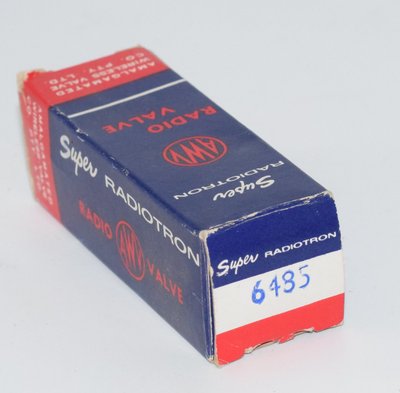
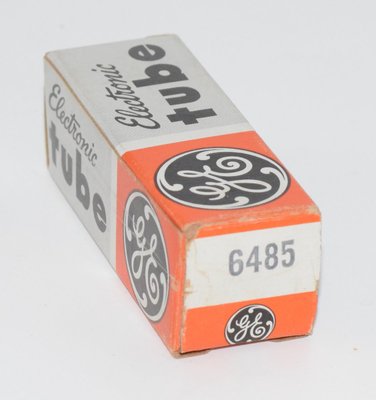
The 6485 was produced by several manufacturers including Tung-Sol, GE, and Super Radiotron (an Australian/international brand), reflecting its widespread adoption in the television and communications industries during the late 1950s and 1960s.
Technical Specifications and Design
Physical Construction
| Parameter | Specification |
|---|---|
| Tube Type | Sharp Cut-Off Pentode |
| Envelope | Glass Bulb B (Miniature) |
| Base | Miniature Button, 7-Pin Base E7-1 (B7G) |
| Basing Diagram | JEDEC 7CC |
| Outline Drawing | JEDEC 5-2 |
| Maximum Diameter | 0.750 inches |
| Maximum Seated Height | T − 5½ inches (1.875 inches max bulb length) |
| Maximum Overall Height | 2.125 inches |
| Mounting Position | Any |
Pin Configuration (Bottom View, JEDEC 7CC)
| Pin | Connection |
|---|---|
| Pin 1 | Grid 1 (Control Grid, G1) |
| Pin 2 | Grid 3 (Suppressor Grid, G3) |
| Pin 3 | Heater (H) |
| Pin 4 | Heater (H) |
| Pin 5 | Plate (P) |
| Pin 6 | Grid 2 (Screen Grid, G2) |
| Pin 7 | Cathode (K) |
Heater Characteristics
| Parameter | Value |
|---|---|
| Heater Voltage | 6.3 Volts |
| Heater Current | 450 mA |
Maximum Ratings (Design Center Values per EIA Standard RS-239)
| Parameter | Maximum Value |
|---|---|
| Plate Voltage | 300 Volts |
| Grid 2 (Screen) Voltage | 150 Volts |
| Plate Dissipation | 3.2 Watts |
| Grid 2 Dissipation | 0.6 Watts |
| Cathode Current | 25 mA |
Note: At maximum plate dissipation ratings, Tung-Sol specifies that at least one surface of the shield (if used) must be blackened.
Typical Operating Characteristics — Pentode Connected
| Parameter | Value |
|---|---|
| Plate Voltage | 300 Volts |
| Grid 2 (Screen) Voltage | 150 Volts |
| Cathode Resistor | 160 Ohms |
| Plate Current | 10 mA |
| Transconductance (gm) | 9,000 µmhos |
| Plate Resistance (rp) | 0.5 Megohms (500 kΩ) |
| Grid 2 Current | 2.5 mA |
| Grid 1 Voltage for Ib = 10 µA (approx.) | −7 Volts |
The amplification factor (µ) in pentode mode can be calculated from the relationship µ = gm × rp, yielding approximately µ = 9,000 × 10−6 × 500,000 = 4,500. This extremely high µ is characteristic of sharp cut-off pentodes and reflects the tube's suitability for high-gain voltage amplifier stages.
Typical Operating Characteristics — Triode Connected
When triode-connected (Grid 2 and Grid 3 tied to Plate):
| Parameter | Value |
|---|---|
| Plate Voltage | 150 Volts |
| Cathode Resistor | 160 Ohms |
| Plate Current | 12.5 mA |
| Transconductance (gm) | 11,000 µmhos |
| Amplification Factor (µ) | 40 |
| Plate Resistance (rp) | 3,600 Ohms (0.0036 Megohms) |
| Grid 1 Voltage for Ib = 10 µA (approx.) | −7 Volts |
Direct Interelectrode Capacitances
| Capacitance | Without Shield | With Shield* |
|---|---|---|
| Grid 1 to Plate (G1 to P) (Max.) | 0.030 pF | 0.020 pF |
| Input: G1 to (H + K + G2 + G3) | 10 pF | 10 pF |
| Output: P to (H + K + G2 + G3) | 2.0 pF | 3.6 pF |
*Using JEDEC Shield 316 connected to cathode.
Grid 3 (Suppressor) Characteristics
Per the Tung-Sol datasheet, Grid 3 has practically no control characteristics and is not intended to be used as a control electrode. Its transconductance to the plate approximates 2 micromhos and its µ is 0.7 to 1.0.
TV Application Data
The datasheet provides detailed application data for television IF/video service with a screen voltage of 150V and plate load of 4,000 ohms, covering four coupling configurations:
| Coupling/Sync Polarity | Output Volts P-P | Voltage Gain | Max Screen Dissipation (W) | Max Plate Dissipation (W) | Cathode Resistor (Ω) | Cathode Current No Sig. (mA) | Cathode Current With Sig. (mA) | Grid Resistor (Ω) |
|---|---|---|---|---|---|---|---|---|
| DC− | 66 | 22 | 0.6 | 3.2 | 39 | 20 | 13 | 5,000 |
| DC+ | 100 | 25 | 0.4 | 3.2 | 270 | 8 | 15 | 5,000 |
| AC− | 100 | 25 | 0.4 | 3.2 | 39 | 20 | 21 | 1 Megohm |
| AC+ | 100 | 25 | 0.6 | 3.2 | 39 | 20 | 18 | 1 Megohm |
Applications and Usage
The 6485 was designed primarily for voltage amplifier service in television applications, specifically:
- Wide Band IF Amplifiers: The high transconductance of 9,000 µmhos in pentode mode, combined with very low grid-to-plate capacitance (0.030 pF max without shield, 0.020 pF with shield), made the 6485 ideal for intermediate frequency amplifier stages where bandwidth and gain were both critical.
- Video IF Stages: Television receivers of the 1960s required stable, high-gain IF strips, and the 6485's resistance to cathode interface degradation under cut-off conditions made it particularly reliable in AGC-controlled stages.
- Gated/Keyed AGC Circuits: The sharp cut-off characteristic allowed clean switching between conducting and non-conducting states, essential for keyed AGC systems.
- General Purpose Voltage Amplification: With its high gain and excellent high-frequency characteristics, the 6485 found use in instrumentation, communications receivers, and laboratory equipment.
- Triode-Connected Applications: When wired as a triode (g2 and g3 tied to plate), the 6485 offers a transconductance of 11,000 µmhos with a plate resistance of only 3,600 ohms and an amplification factor of 40, making it a capable low-impedance driver stage.
Sound Characteristics
The 6485, being electrically identical to the 6AH6, shares the sonic reputation of that well-regarded pentode. In audio applications, the 6485/6AH6 family is characterized by:
- Exceptional Detail and Resolution: The very high transconductance (9,000 µmhos in pentode, 11,000 µmhos in triode) translates to fast, responsive amplification that preserves transient detail. Listeners frequently describe the sound as "vivid" and "articulate," with excellent micro-detail retrieval.
- Extended High Frequencies: Originally designed for wideband video IF service, the 6485 naturally excels at preserving high-frequency information. The extremely low grid-to-plate capacitance (0.020–0.030 pF) minimizes Miller effect, contributing to an airy, open top end that many audiophiles prize.
- Pentode Mode Character: In pentode configuration, the 6485 delivers high voltage gain with the characteristic pentode sound — dynamic, punchy, and with a slightly forward midrange presentation. The very high plate resistance (500 kΩ) means the tube's output impedance is dominated by the plate load, giving designers significant control over tonal balance.
- Triode Mode Character: Triode-connected, the 6485 transforms into a remarkably linear amplifier with low plate resistance (3,600 ohms) and a moderate µ of 40. In this configuration, the sound becomes warmer, more liquid, and more harmonically rich, with reduced odd-order harmonic content compared to pentode operation. The low rp provides excellent damping and a more relaxed, natural presentation.
- Sharp Cut-Off Behavior: Unlike remote cut-off (variable-µ) pentodes, the 6485's sharp cut-off characteristic means it transitions cleanly between conducting and non-conducting states. In audio terms, this contributes to a precise, well-defined sound with clear note boundaries and minimal "smearing" of dynamic contrasts.
- Noise Performance: As a well-designed pentode with controlled electrode spacing and quality construction, the 6485 can deliver low noise performance when properly implemented, making it suitable for sensitive preamplifier stages.
The overall sonic signature of the 6485 is best described as fast, detailed, and dynamic — a tube that rewards careful circuit design with exceptional clarity and bandwidth. Different manufacturers (Tung-Sol, GE, Super Radiotron) may exhibit subtle sonic variations due to differences in materials and construction tolerances, with NOS Tung-Sol examples generally being the most sought-after.
Equivalent or Substitute Types
| Type | Compatibility | Notes |
|---|---|---|
| 6AH6 | Direct substitute | The 6485 is explicitly stated by Tung-Sol to be identical to the 6AH6, with the sole difference being improved cathode construction for resistance to interface degradation under prolonged cut-off. Same pinout (JEDEC 7CC), same base (7-pin miniature B7G), same electrical ratings. Fully interchangeable in all circuits. |
| CK6485 | Direct substitute | The CK-prefixed version (Raytheon designation convention) is the same tube. Fully interchangeable. |
| 6AH6WA | Direct substitute (ruggedized) | Military-grade ruggedized version of the 6AH6 with enhanced mechanical and environmental specifications. Electrically identical, pin-compatible. Often preferred for its superior construction quality. |
Important Note: While the 6485 is a sharp cut-off pentode, it should not be confused with remote cut-off (variable-µ) types such as the 6BA6 or 6SK7, which have fundamentally different grid characteristics and are not suitable substitutes despite superficial similarities as miniature pentodes.
Notable Characteristics
- Cathode Interface Resistance Immunity: The defining feature that distinguishes the 6485 from the standard 6AH6 is its engineered resistance to cathode interface buildup. This was achieved through specialized cathode processing and materials, ensuring reliable emission even after extended periods of cut-off operation. This makes the 6485 particularly desirable for applications where the tube may sit at cut-off for significant portions of its operating life.
- Exceptionally High Transconductance: At 9,000 µmhos (pentode) and 11,000 µmhos (triode), the 6485 offers remarkably high transconductance for a miniature pentode of its era. This enables high gain-bandwidth products essential for video and wideband amplifier service.
- Very Low Feedback Capacitance: The grid-to-plate capacitance of only 0.030 pF (0.020 pF with shield) is exceptionally low, minimizing unwanted feedback and enabling stable high-frequency operation without neutralization in many circuit configurations.
- Versatile Triode Connection: The triode-connected characteristics are particularly noteworthy — with gm of 11,000 µmhos and rp of only 3,600 ohms, the triode-connected 6485 rivals dedicated triode types for linearity and output impedance performance.
- Grid 3 Independence: The suppressor grid (G3) has essentially no control function (transconductance to plate of only ~2 µmhos, µ of 0.7–1.0), meaning it serves purely as an electrostatic shield between screen and plate, contributing to the tube's excellent pentode characteristics.
- Universal Mounting: The tube may be operated in any mounting position, providing flexibility in equipment design.
Usage in the Audio Community
While the 6485 was designed for television IF amplifier service, it has found a dedicated following in the audio community, primarily through its identity as an improved 6AH6:
Headphone Amplifiers
The 6485/6AH6 is a popular choice in DIY and boutique headphone amplifier designs. In triode-connected mode, the combination of high transconductance (11,000 µmhos), low plate resistance (3,600 ohms), and moderate amplification factor (40) makes it an excellent voltage amplifier or driver stage. The low rp provides good current delivery capability, and the high gm ensures ample gain for driving subsequent stages or even low-impedance headphones through appropriate coupling.
Preamplifier Stages
Audio experimenters have employed the 6485 in phono preamplifiers and line-stage preamps, taking advantage of its high gain in pentode mode or its linearity in triode mode. The sharp cut-off characteristic ensures clean signal handling without the compression effects that variable-µ tubes can introduce. The very low Miller capacitance makes the 6485 particularly attractive for RIAA phono stages where bandwidth and phase accuracy are critical.
Hybrid Amplifier Designs
The 6485's high transconductance makes it well-suited for hybrid tube/solid-state designs where a tube voltage amplifier stage drives a solid-state output stage. The tube's ability to deliver high voltage gain with wide bandwidth complements the current delivery capabilities of transistor output stages.
Tube Rolling and Collectibility
Because the 6485 is a direct substitute for the 6AH6, owners of equipment designed around the 6AH6 can tube-roll with 6485s and vice versa. NOS (New Old Stock) examples from Tung-Sol and GE are particularly sought after. The 6485's improved cathode construction may actually make it the preferred choice over standard 6AH6 production for long-term reliability, especially in equipment that may sit idle for extended periods.
Guitar Amplifier Modifications
While not a standard guitar amplifier tube, some amp modifiers have experimented with the 6485/6AH6 as a high-gain preamp tube in custom builds, taking advantage of its sharp cut-off characteristic for aggressive clipping behavior and its high transconductance for maximum gain per stage. These applications are niche but demonstrate the tube's versatility beyond its original television service design.
Availability and Market
The 6485 is less commonly encountered than the standard 6AH6, making it somewhat of a collector's item. NOS examples from Tung-Sol, GE, and Super Radiotron appear periodically on the vintage tube market. The tube's relative obscurity compared to the 6AH6 can sometimes work in the buyer's favor, as prices may be lower for what is essentially the same tube with improved cathode longevity. Audiophiles seeking the 6AH6 sound should consider the 6485 as a potentially superior and sometimes more affordable alternative.