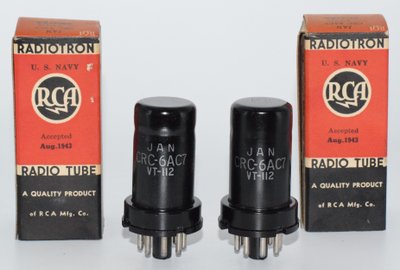
Introduction and History
The 6AC7 is a sharp-cutoff, high-transconductance pentode originally designed for service as a wide-band video amplifier, radio-frequency amplifier, mixer, and oscillator. Developed during the late 1930s and widely produced throughout World War II and beyond, the 6AC7 became one of the most important RF pentodes of its era. It was manufactured by all major American tube makers including RCA, General Electric, Sylvania, and others.
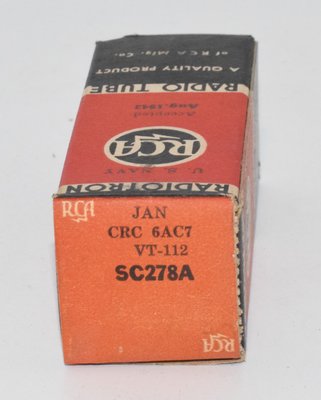
During World War II, the 6AC7 was assigned the military designation VT-112 (and Signal Corps designation SC278A), reflecting its critical importance in military radar, communications, and electronic warfare equipment. The tube's combination of high transconductance, sharp cutoff characteristics, and excellent high-frequency performance made it indispensable in wartime electronics. Its metal-shell (MT-8) envelope provided inherent shielding — a significant advantage in sensitive RF applications where stray coupling could degrade performance.
The 6AC7 represented a significant advancement over earlier RF pentodes, offering a transconductance of 9000 micromhos — exceptionally high for its time — while maintaining very low grid-to-plate capacitance. This combination of characteristics made it a favorite for IF amplifier stages, video amplifiers in early television receivers, and laboratory instrumentation. The General Electric datasheet (ET-T263A, dated 6-52) provides the definitive specifications for this type.
Technical Specifications and Design
General Characteristics
| Parameter | Value |
|---|---|
| Tube Type | Sharp-Cutoff RF Amplifier Pentode |
| Cathode | Coated Unipotential (Indirectly Heated) |
| Envelope | MT-8 (Metal Shell) |
| Base | B8-21, Small Wafer Octal 8-Pin |
| Mounting Position | Any |
| Basing Designation | RTMA 8N |
Heater Ratings
| Parameter | Value |
|---|---|
| Heater Voltage (A-C or D-C) | 6.3 Volts |
| Heater Current | 0.45 Ampere |
| Heater-Cathode Voltage (Max) | 90 Volts |
Maximum Ratings (Design Center Values)
| Parameter | Maximum Value |
|---|---|
| Plate Voltage | 300 Volts |
| Screen Supply Voltage | 300 Volts |
| Screen Voltage | 150 Volts |
| Plate Dissipation | 3.0 Watts |
| Screen Dissipation | 0.38 Watts |
| Heater-Cathode Voltage | 90 Volts |
| Grid Circuit Resistance (Fixed Screen Voltage) | 0.25 Megohm |
| Grid Circuit Resistance (Series Screen Resistor) | 0.5 Megohm |
Direct Interelectrode Capacitances
(With Pin 1 connected to Pin 5)
| Parameter | Value |
|---|---|
| Grid 1 to Plate (Max) | 0.015 µµf (pF) |
| Input | 11 µµf (pF) |
| Output | 5 µµf (pF) |
Typical Operating Conditions — Class A₁ Amplifier
| Parameter | Condition 1 (Fixed Screen) | Condition 2 (Screen Resistor) |
|---|---|---|
| Plate Voltage | 300 V | 300 V |
| Suppressor Voltage | 0 V | 0 V |
| Screen Supply Voltage | — | 300 V |
| Screen Voltage | 150 V | — |
| Screen Resistor | — | 60,000 Ohms |
| Cathode Bias Resistor (Min) | 160 Ohms | 160 Ohms |
| Plate Resistance (Approx) | 1.0 Megohm | 1.0 Megohm |
| Transconductance (gm) | 9000 Micromhos (9.0 mA/V) | 9000 Micromhos (9.0 mA/V) |
| Plate Current | 10 mA | 10 mA |
| Screen Current | 2.5 mA | 2.5 mA |
Notes from the datasheet:
- When a fixed screen voltage is used (Condition 1), a sharp-cutoff characteristic is obtained.
- When a screen resistor is used (Condition 2), an extended-cutoff characteristic is obtained, which may be utilized in applications where gain is controlled by variation of the grid bias.
- In RF and IF stages, the suppressor should be connected directly to ground to minimize feedback.
- The cathode bias resistor should be adjusted to give a plate current of 10 milliamperes.
Derived Characteristics
With a transconductance of 9000 µmhos and a plate resistance of approximately 1.0 Megohm, the amplification factor (µ) can be calculated as:
µ = gm × rp = 9000 × 10⁻⁶ × 1,000,000 = 9000
This extremely high amplification factor is characteristic of sharp-cutoff RF pentodes and reflects the tube's ability to deliver very high voltage gain in appropriate circuits.
Pin Connections (RTMA 8N — Bottom View)
| Pin | Connection |
|---|---|
| Pin 1 | Shell and Internal Shield |
| Pin 2 | Heater |
| Pin 3 | Grid Number 3 (Suppressor) |
| Pin 4 | Grid Number 1 (Control Grid) |
| Pin 5 | Cathode |
| Pin 6 | Grid Number 2 (Screen) |
| Pin 7 | Heater |
| Pin 8 | Plate |
The internal shield (Pin 1) should be connected to the cathode (Pin 5) for proper shielding and to achieve the specified interelectrode capacitance values.
Physical Dimensions
The 6AC7 uses the MT-8 metal envelope with the following maximum dimensions:
- Maximum diameter: 1 9/32 inches
- Maximum seated height: 2 7/8 inches
- Base type: RTMA 8-1
- Maximum overall base diameter: 1 5/16 inches
Applications and Usage
Original Intended Applications
The 6AC7 was principally designed for the following applications:
- Wide-Band Video Amplifier: The high transconductance of 9000 µmhos combined with relatively low interelectrode capacitances made the 6AC7 ideal for video amplifier service in early television receivers and oscilloscopes. The tube could deliver substantial gain across a wide bandwidth.
- Radio-Frequency Amplifier: The extremely low grid-to-plate capacitance of only 0.015 pF, combined with the internal metal shield, made the 6AC7 outstanding for RF amplifier stages where stability was paramount.
- IF Amplifier Stages: The sharp-cutoff characteristic (with fixed screen voltage) or extended-cutoff characteristic (with screen resistor) made it versatile for IF amplifier applications with or without AGC.
- Mixer/Converter: The tube's high transconductance and sharp cutoff made it suitable for frequency conversion applications.
- Oscillator: The 6AC7 could serve as a stable oscillator in various circuit configurations.
Military Applications
Under its VT-112 military designation, the 6AC7 saw extensive use in:
- Radar receivers (IF amplifier chains)
- Military communications receivers
- Electronic countermeasures equipment
- Test and measurement instrumentation
Important Design Note
The GE datasheet specifically states that the 6AC7 is not recommended for low-level audio-frequency applications unless the heater voltage is obtained from a DC source. When used at low frequencies, the use of cathode bias is recommended. This caution relates to the potential for heater-induced hum, which is more problematic in high-gain, low-level audio stages.
Sound Characteristics
Although the 6AC7 was never designed as an audio tube, its exceptional electrical characteristics have attracted the attention of adventurous audio designers and experimenters. When pressed into audio service, the 6AC7 exhibits a distinctive sonic signature:
- Exceptional Detail and Resolution: The very high transconductance of 9000 µmhos translates to extremely high gain capability, which in audio circuits can reveal micro-details and subtle textural information that lower-gm tubes may obscure. The tube has an almost "analytical" quality to its presentation.
- Fast and Dynamic: The 6AC7's RF heritage — designed for wide bandwidth and fast signal handling — gives it a transient response that many listeners describe as quick, punchy, and highly dynamic. Leading edges of notes are rendered with precision and speed.
- Lean and Articulate Midrange: Unlike the warm, lush midrange associated with audio-specific pentodes like the EF86, the 6AC7 tends toward a leaner, more articulate midrange presentation. Some listeners find this refreshingly transparent; others may find it less forgiving of poor source material.
- Extended High Frequencies: The tube's wide-bandwidth design contributes to an open, extended top end with excellent air and sparkle. High-frequency detail is rendered cleanly without the rolled-off character of some audio pentodes.
- Potential for Hum: As the manufacturer's datasheet warns, the 6AC7 can introduce heater-induced hum in low-level audio applications unless DC heater supplies are used. This is a practical consideration that significantly affects perceived sound quality and must be addressed in circuit design.
- Noise Considerations: Being an RF tube, the 6AC7 was optimized for signal-to-noise ratio at radio frequencies. At audio frequencies, noise performance can vary between specimens, and careful tube selection may be necessary for critical low-level applications.
Overall, the 6AC7's sonic character can be described as fast, detailed, and transparent — qualities that appeal to listeners who prioritize accuracy and resolution over warmth and euphonic coloration.
Equivalent or Substitute Types
The following types are close or identical substitutes for the 6AC7:
| Type | Notes |
|---|---|
| VT-112 | Direct military equivalent (US Army Signal Corps designation). Identical specifications and pinout. Often found as VT-112 or VT-112A. |
| CV660 | British military (CV register) equivalent. Direct substitute. |
| CV747 | British military equivalent. Direct substitute. |
| CV846 | British military equivalent. Direct substitute. |
| CV849 | British military equivalent. Direct substitute. |
Related Types (Not Direct Substitutes)
- 6SH7: A glass-envelope version with similar characteristics but in a different envelope style. While electrically similar, the glass envelope lacks the inherent shielding of the 6AC7's metal shell. Pin compatibility should be verified before substitution.
- 6AG5: A miniature (7-pin) sharp-cutoff pentode with somewhat similar characteristics but a completely different base and pinout — not a drop-in replacement.
- EF86 / 6267: Sometimes compared to the 6AC7 in audio discussions, but the EF86 is a purpose-designed audio pentode with different specifications, lower transconductance, and a 9-pin miniature base. Not interchangeable.
Caution: Always verify pinout compatibility and electrical ratings before substituting any tube type. While the CV-series equivalents listed above are considered direct substitutes, individual specimens may have been manufactured to tighter or different tolerances for specific military applications.
Notable Characteristics
Sharp vs. Extended Cutoff Operation
One of the most interesting features of the 6AC7 is its ability to exhibit either sharp-cutoff or extended-cutoff behavior depending on the screen grid circuit configuration:
- With a fixed screen voltage (Condition 1: screen at 150V), the tube displays a sharp-cutoff characteristic, making it ideal for applications requiring a well-defined signal handling range.
- With a series screen resistor (Condition 2: 60,000 ohm resistor from 300V supply), an extended-cutoff characteristic is obtained, enabling smooth AGC (Automatic Gain Control) operation where gain is varied by changing the control grid bias.
This dual-personality behavior is clearly visible in the average characteristics curves provided in the GE datasheet, where the transfer characteristics show markedly different cutoff profiles under the two operating conditions.
Exceptionally Low Grid-to-Plate Capacitance
The 6AC7's grid-to-plate capacitance of only 0.015 pF (with the internal shield connected to cathode) is remarkably low, even by modern standards. This is achieved through the combination of the metal envelope acting as an external shield and the internal shield structure connected via Pin 1. This extremely low feedback capacitance is what enables stable high-gain operation at radio frequencies without neutralization.
High Plate Resistance
The plate resistance of approximately 1.0 Megohm is very high, characteristic of a well-designed pentode. This means the tube behaves nearly as an ideal current source, and its gain is almost entirely determined by the transconductance and the load impedance. In practical terms, this allows the 6AC7 to deliver very high voltage gain with appropriate plate loads.
Metal Envelope Construction
The MT-8 metal envelope is a defining physical characteristic of the 6AC7. The metal shell serves as an integral electrostatic shield, eliminating the need for external shield cans that were required with glass-envelope tubes. The shell is internally connected to Pin 1, which should be grounded (typically through connection to the cathode at Pin 5) for proper shielding.
Wartime Production and NOS Availability
Due to massive wartime production under the VT-112/SC278A designations, large quantities of NOS (New Old Stock) 6AC7 tubes remain available. Military-specification tubes were manufactured to exacting standards and often exhibit tighter parameter tolerances than their civilian counterparts. RCA-manufactured examples from the 1943 era are particularly sought after, with matched pairs available that are specified to within 5% for anode current and mutual conductance.
Usage in the Audio Community
Despite the manufacturer's explicit caution about low-level audio-frequency use, the 6AC7 has found a dedicated following in the audio community, driven by its exceptional transconductance and the ready availability of high-quality NOS specimens at reasonable prices.
Phono Preamplifier Stages
Some adventurous DIY audio designers have employed the 6AC7 in phono preamplifier input stages, taking advantage of its 9000 µmho transconductance to achieve very high gain with low noise. Success in this application absolutely requires DC heater supplies, as the GE datasheet warns. When properly implemented with DC heaters and careful layout, the 6AC7 can deliver impressive performance in this demanding application, offering a different sonic perspective compared to the more commonly used EF86 or 12AX7.
Microphone Preamplifiers
The 6AC7 has been used in studio-grade microphone preamplifier designs, particularly in circuits inspired by vintage military and broadcast equipment. Its high gain and wide bandwidth can yield a fast, detailed sound that some recording engineers find appealing for certain sources.
Guitar Amplifier Modifications
In the guitar amplifier world, the 6AC7 is occasionally used as an experimental preamp tube by builders seeking unusual tonal characteristics. The tube's sharp-cutoff behavior and high gain produce a distinctive clipping character when overdriven. However, this remains a niche application, as the 6AC7's octal base and metal envelope require physical modifications to amplifiers designed for miniature preamp tubes.
Headphone Amplifiers
The 6AC7 appears in some DIY headphone amplifier designs, where its high transconductance allows for simple, high-gain voltage amplifier stages. The tube's fast transient response is considered an asset in headphone listening, where detail retrieval is particularly valued.
Practical Considerations for Audio Use
- DC Heater Supply: Absolutely essential for low-level audio applications. The manufacturer explicitly states this requirement.
- Cathode Bias: Recommended by the datasheet for audio-frequency operation. A minimum cathode bias resistor of 160 ohms (adjusted for 10 mA plate current) provides a stable operating point.
- Shielding: Pin 1 (shell and internal shield) must be connected to Pin 5 (cathode) or ground for proper shielding and to achieve the specified low interelectrode capacitances.
- Suppressor Grounding: For minimum feedback in amplifier stages, the suppressor (Pin 3) should be connected directly to ground.
- NOS Selection: Due to the wide production base and long manufacturing history, 6AC7 specimens can vary in noise characteristics. For critical audio applications, testing and selecting individual tubes for low noise and microphonics is recommended. Matched pairs from reputable suppliers (matched to within 5% for anode current and transconductance) are available for balanced or push-pull configurations.
- Availability and Cost: The 6AC7/VT-112 remains one of the most affordable high-quality NOS pentodes available, with military-grade specimens often costing a fraction of comparable audio-specific types like the EF86. This price advantage, combined with excellent performance potential, makes it an attractive option for budget-conscious audiophiles and experimenters.
The 6AC7 stands as a testament to the versatility of well-designed vacuum tubes. While its primary legacy is in RF and video amplification, its exceptional electrical characteristics continue to inspire creative applications in the audio world more than seven decades after its introduction.