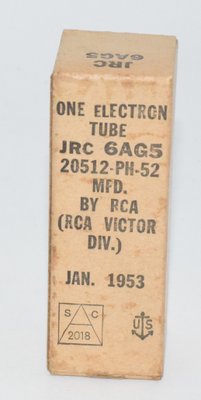
The 6AG5 is a compact, high-gain pentode vacuum tube that has earned a respected place in vintage audio equipment and guitar amplifier design. This comprehensive guide explores its technical specifications, historical significance, sound characteristics, and modern applications in the audio community.
1. Introduction and History
The 6AG5 vacuum tube was developed in the post-World War II era as part of the RCA tube family. It represents a refinement of pentode technology, designed specifically for applications requiring high voltage gain in a compact form factor. The tube emerged during the golden age of radio and early television, when manufacturers sought efficient, reliable amplification devices for consumer electronics.
The 6AG5 designation follows the RCA numbering system: the "6" indicates a 6.3-volt heater design, "A" signifies it's an improved version, "G" denotes its pentode configuration, and "5" is the specific type identifier. This tube gained particular prominence in the 1950s and 1960s, finding applications in radio receivers, television sets, and eventually, musical instrument amplifiers.
The tube's development coincided with the miniaturization trend in electronics, making it popular among manufacturers seeking to reduce equipment size without sacrificing performance. Its legacy continues today, with vintage equipment enthusiasts and boutique amplifier manufacturers actively seeking NOS (New Old Stock) examples, particularly those manufactured by respected makers like National Union and RCA.
2. Technical Specifications and Design
Physical Characteristics
The 6AG5 is a noval tube, featuring a standard 9-pin miniature base. It measures approximately 2.75 inches (70mm) in height and has a glass envelope containing the internal electrode structure. The compact design made it ideal for space-constrained applications in consumer electronics.
Electrical Specifications
| Parameter | Value |
|---|---|
| Heater Voltage | 6.3V AC or DC |
| Heater Current | 0.45A |
| Maximum Plate Voltage | 330V |
| Maximum Screen Voltage | 330V |
| Maximum Plate Dissipation | 3.5W |
| Amplification Factor (μ) | ~1000 |
| Plate Resistance | ~80,000 ohms |
| Transconductance (gm) | ~12,500 micromhos |
| Maximum Plate Current | ~60mA |
Internal Structure
The 6AG5 features a pentode configuration with five active elements: a cathode, control grid, screen grid, suppressor grid, and plate (anode). This configuration provides exceptional voltage amplification and excellent impedance matching characteristics. The control grid is tightly wound, enabling high gain from relatively small input signals.
The suppressor grid (fifth grid) is internally connected to the cathode, eliminating the need for an external connection. This design feature simplifies circuit implementation and reduces the number of tube pins required. The screen grid is bypassed to ground for AC signals, stabilizing gain and improving linearity.
Operating Characteristics
The 6AG5 operates efficiently in the 300-330V plate voltage range, typical of consumer audio equipment from its era. Its high amplification factor (approximately 1000) allows for significant voltage gain from modest input signals. The tube exhibits good linearity across its operating range, making it suitable for both small-signal and moderate-power amplification applications.
The tube's transconductance of approximately 12,500 micromhos provides efficient conversion of input voltage changes to output current changes. This characteristic made the 6AG5 particularly valuable in RF (radio frequency) amplification circuits, where efficiency and gain were paramount considerations.
3. Applications and Usage
Historical Applications
During the 1950s and 1960s, the 6AG5 found widespread use in:
- AM/FM Radio Receivers: Employed as an RF amplifier stage to boost weak incoming signals before detection and audio amplification
- Television Sets: Used in tuner sections and IF (intermediate frequency) amplifier stages
- Phonograph Amplifiers: Served as a preamplifier stage in turntable systems, providing the high impedance input necessary for magnetic cartridge signals
- Public Address Systems: Utilized in small to medium-sized PA amplifiers for voice and music reproduction
Modern Audio Community Applications
Today, the 6AG5 enjoys renewed interest among audio enthusiasts and professional musicians:
Guitar Amplifiers
The 6AG5 has become increasingly popular in boutique and vintage guitar amplifier design. Its high gain and relatively low power dissipation make it ideal for:
- Preamp Stages: Providing the initial voltage amplification that shapes tone and gain character in amplifiers
- Tone Stacks: Enabling effective EQ circuits with good frequency response shaping
- Overdrive Channels: Contributing to the natural compression and harmonic saturation prized by guitarists
Amplifier manufacturers such as Fender, Marshall, and various boutique builders have incorporated 6AG5s into classic and modern designs. The tube's ability to produce musical distortion when pushed contributes to its desirability among tone-conscious players.
High-Fidelity Audio Systems
Vintage hi-fi enthusiasts actively seek 6AG5 tubes for restoration and maintenance of classic equipment. The tube's low noise floor and smooth frequency response make it suitable for:
- Preamplifier circuits in vintage integrated amplifiers
- Phono preamplifier stages in turntable systems
- Tuner circuits in vintage receivers
Vintage Equipment Restoration
The 6AG5 remains essential for restoring and maintaining classic audio equipment from the 1950s-1970s. NOS (New Old Stock) examples, particularly those manufactured by respected makers like National Union, command premium prices due to their scarcity and superior performance characteristics compared to modern reproductions.
DIY and Hobbyist Projects
Amateur radio operators, tube audio enthusiasts, and electronics hobbyists continue to design and build projects utilizing the 6AG5. The tube's well-documented characteristics and availability of historical design information make it popular for experimental amplifier designs and restoration projects.
4. Sound Characteristics
Frequency Response
The 6AG5 exhibits a smooth, extended frequency response across the audio spectrum. In properly designed circuits, the tube demonstrates flat response from approximately 20Hz to 20kHz, with gentle roll-off characteristics at frequency extremes. This neutrality makes it suitable for both music and voice applications.
Gain and Headroom
With an amplification factor exceeding 1000, the 6AG5 provides substantial voltage gain from minimal input signals. This high gain allows for:
- Excellent signal-to-noise ratio in low-level signal applications
- Effective overload characteristics when driven hard
- Natural compression and saturation when pushed into non-linear operation
Harmonic Character
The 6AG5 produces primarily second and third-order harmonic distortion when operated near its limits. These lower-order harmonics are generally perceived as musically pleasant, contributing to the tube's reputation for warm, natural sound. This characteristic is particularly valued in guitar amplifiers, where subtle harmonic enhancement can improve sustain and tonal richness.
The harmonic signature of the 6AG5 differs from output tubes, being more subtle and refined. This makes it particularly effective in preamp and small-signal stages where transparency is desired, yet some tonal coloration is appreciated.
Transient Response
The 6AG5 demonstrates excellent transient response, accurately reproducing attack and decay characteristics of musical instruments. The tube's fast grid-to-plate response and low plate resistance contribute to its ability to follow rapid signal changes without compression or lag.
Noise Characteristics
Well-manufactured examples of the 6AG5, particularly NOS units from reputable manufacturers, exhibit exceptionally low noise floors. This makes them ideal for sensitive preamplifier applications where signal clarity and absence of background noise are paramount. Microphonic noise is generally minimal in quality examples, though tube microphony can be a consideration in some units.
Tone Shaping Capability
In guitar amplifier applications, the 6AG5 contributes to overall tonal character through its impedance characteristics and harmonic content. The tube's high input impedance allows for effective tone stack circuits, while its gain characteristics enable smooth, responsive distortion when overdriven.
5. Notable Characteristics
High Gain in Compact Form
The 6AG5's primary advantage is its exceptional voltage gain packed into a small physical package. This made it ideal for space-constrained applications in consumer electronics and continues to make it attractive for modern boutique amplifier designs where compact tube complements are desired.
Low Power Consumption
With a heater current of only 0.45A and maximum plate dissipation of 3.5W, the 6AG5 draws minimal power compared to output tubes. This characteristic made it economical to operate in consumer equipment and makes it practical for modern applications with limited power supplies.
Excellent Linearity
The 6AG5 exhibits superior linearity across its operating range, making it suitable for applications requiring low distortion. When operated within its rated specifications, the tube produces minimal harmonic distortion, contributing to its reputation for clean, clear amplification.
Stable Operation
The internal connection of the suppressor grid to the cathode provides inherent stability, reducing the likelihood of oscillation or parasitic effects. This design feature contributed to the tube's reliability in consumer equipment and continues to make it a stable choice in modern circuit designs.
Thermal Stability
The 6AG5 demonstrates good thermal stability, with operating characteristics remaining relatively consistent across the normal operating temperature range. This stability made it reliable in equipment subjected to varying environmental conditions and contributes to consistent performance in modern applications.
Availability and Collectibility
While the 6AG5 is no longer manufactured in significant quantities, NOS examples remain relatively available compared to many other vintage tube types. Particularly sought-after are examples manufactured by National Union, RCA, and other respected makers. The tube's continued use in vintage equipment restoration and modern boutique designs maintains collector interest and supports a healthy secondary market.
6. Equivalent or Substitute Types
Direct Equivalents
Several tube types offer similar characteristics and can serve as substitutes in many applications:
- 6AK5: Nearly identical to the 6AG5, with virtually interchangeable characteristics. The 6AK5 is slightly more common in some markets and may serve as an alternative source.
- 6AK5W: A military-grade version of the 6AK5 with enhanced specifications and reliability. Can be substituted in most 6AG5 applications with potentially superior performance.
Functional Alternatives
While not perfect substitutes, these tubes can serve similar functions in some applications:
- 6V6GT: Lower gain but similar pentode configuration, suitable for slightly different impedance matching requirements
- 12AU7: Dual triode offering different gain characteristics, not recommended as a direct substitute but usable in redesigned circuits
Substitution Considerations
When substituting tube types, careful attention must be paid to:
- Plate voltage ratings and maximum dissipation
- Input and output impedance requirements
- Desired gain characteristics
- Physical tube dimensions and socket compatibility
Direct substitution with the 6AK5 is generally safe, but other alternatives require circuit analysis and potential modifications to ensure proper operation and safety.
Conclusion
The 6AG5 vacuum tube represents an elegant solution to the challenge of achieving high voltage gain in a compact, efficient package. Its historical importance in consumer electronics, combined with its continued relevance in modern audio applications, ensures its place in tube technology history.
For audio enthusiasts, musicians, and equipment restorers, the 6AG5 remains a valuable component offering smooth, musical amplification with excellent reliability. Whether restoring vintage equipment or designing modern boutique amplifiers, the 6AG5's proven performance characteristics and tonal qualities make it a tube worth understanding and appreciating.
The availability of NOS examples, particularly those from respected manufacturers like National Union, provides an opportunity for discerning audio professionals to experience the sound quality that made these tubes legendary in their era. As tube audio continues to experience renewed interest, the 6AG5's role in delivering transparent, musical amplification ensures its continued relevance for generations of audio enthusiasts to come.