Introduction and History
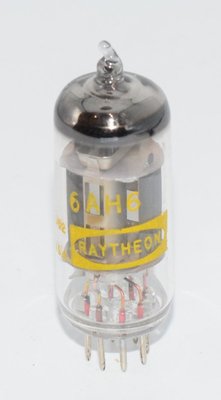
The 6AH6 is a miniature sharp-cutoff pentode originally designed for radio-frequency amplifier service. Manufactured by General Electric (under both the GE and Ken-Rad brands), RCA, Raytheon, Sylvania, and other American tube makers, the 6AH6 was introduced in the late 1940s as part of the post-war wave of miniature glass tubes that replaced the larger octal-based designs of the 1930s and early 1940s.
Its principal application, as stated in the original GE datasheet (ET-T520A, dated March 1951, superseding ET-T520 dated November 1947), is as a sharp-cutoff pentode with high transconductance and low input and output capacitances, making it well-suited for use as a wide-band amplifier or as a reactance tube. The 6AH6 found extensive use in television receivers, test equipment, radar IF strips, and military electronics throughout the 1950s and 1960s. Its combination of high gain, sharp cutoff characteristics, and compact miniature envelope made it a versatile workhorse in both commercial and military applications.
The tube was produced in enormous quantities during its heyday, and NOS (New Old Stock) examples from manufacturers such as Raytheon, GE, RCA, and Sylvania remain available on the surplus market today, where they have found a second life in audiophile and guitar amplifier applications.
Technical Specifications and Design
General Description
| Tube Type | 6AH6 |
| Function | Sharp-Cutoff RF Amplifier Pentode |
| Cathode | Coated Unipotential (indirectly heated) |
| Envelope | T-5½, Glass |
| Base | E7-1, Miniature Button 7-Pin (B7G) |
| Mounting Position | Any |
| RTMA Basing | 7CC |
Heater Ratings
| Heater Voltage | 6.3 Volts (AC or DC) |
| Heater Current | 0.45 Ampere |
| Heater-Cathode Voltage (Max) | 90 Volts |
Maximum Ratings
| Parameter | Maximum Value |
|---|---|
| Plate Voltage | 300 Volts |
| Screen Supply Voltage | 300 Volts |
| Screen Voltage | 150 Volts |
| Plate Dissipation | 3.2 Watts |
| Screen Dissipation | 0.4 Watt |
| Cathode Current | 13 Milliamperes |
| Heater-Cathode Voltage | 90 Volts |
Characteristics and Typical Operation — Class A₁ Amplifier
| Parameter | Pentode Connection | Triode Connection |
|---|---|---|
| Plate Voltage | 300 V | 150 V |
| Suppressor Voltage | 0 V | — |
| Screen Voltage | 150 V | — |
| Cathode Bias Resistor | 160 Ω | 160 Ω |
| Amplification Factor (μ) | — | 40 |
| Plate Resistance (rp) | 0.5 MΩ (500 kΩ) | 0.0036 MΩ (3,600 Ω) |
| Transconductance (gm) | 9,000 µmhos | 11,000 µmhos |
| Plate Current | 10 mA | 12.5 mA |
| Screen Current | 2.5 mA | — |
| Grid #1 Voltage (approx) for Ib = 10 µA | −7 V | −7 V |
Note: For pentode connection, Pin 2 (suppressor) is connected to Pin 7 (cathode) at the socket. For triode connection, connect grids 2 (screen) and 3 (suppressor) to the plate.
Note from datasheet: Grid number 3 has practically no control characteristics, and it is not intended to be used as a control electrode. Its transconductance to the plate approximates 2 micromhos and the mu is 0.7 to 1.0.
Direct Interelectrode Capacitances
| Parameter | Without Shield | With Shield* |
|---|---|---|
| Grid 1 to Plate (Max) | 0.030 µµF | 0.020 µµF |
| Input | 10 µµF | 10 µµF |
| Output | 2.0 µµF | 3.6 µµF |
* With external shield #316 connected to Pin 7 (cathode).
Physical Dimensions
- Maximum diameter: 2⅛ inches (including base)
- Maximum seated height: 1-15/16 inches (approximately)
- Maximum overall height: approximately 2¾ inches
- Envelope designation: T-5½ glass
Pin Configuration (RTMA 7CC — Bottom View)
| Pin | Connection |
|---|---|
| Pin 1 | Grid Number 1 (Control Grid) |
| Pin 2 | Grid Number 3 (Suppressor) |
| Pin 3 | Heater |
| Pin 4 | Heater |
| Pin 5 | Plate |
| Pin 6 | Grid Number 2 (Screen) |
| Pin 7 | Cathode |
Applications and Usage
The 6AH6 was designed primarily as a radio-frequency amplifier pentode, and its original applications reflect this heritage:
- Wide-Band IF Amplifiers: The combination of high transconductance (9,000 µmhos in pentode mode) and low interelectrode capacitances made the 6AH6 an excellent choice for intermediate-frequency amplifier stages in television receivers and radar equipment. The sharp-cutoff characteristic allowed effective AGC (Automatic Gain Control) operation.
- Reactance Tube Circuits: The datasheet specifically mentions the tube's suitability as a reactance tube, used in AFC (Automatic Frequency Control) circuits for FM discriminators and television local oscillator stabilization.
- Video Amplifiers: The high gm and low capacitances enabled wide-bandwidth video amplifier stages with good gain-bandwidth product.
- Test Equipment: The 6AH6 was widely used in oscilloscopes, signal generators, and other laboratory instruments manufactured by Tektronix, Hewlett-Packard, and others throughout the 1950s and 1960s.
- Military Electronics: The tube saw extensive military use, reflected in its multiple CV (Common Valve) designations for British/NATO service.
- Triode-Connected Operation: When strapped as a triode (screen and suppressor connected to plate), the 6AH6 delivers an amplification factor of 40, transconductance of 11,000 µmhos, and a very low plate resistance of only 3,600 ohms — characteristics that make it an attractive small-signal amplifier stage with excellent linearity.
Sound Characteristics
While the 6AH6 was never designed as an audio tube, its electrical characteristics — particularly in triode-connected mode — have attracted the attention of audiophiles and amplifier designers who have explored its sonic potential:
- Triode Mode — Clean and Detailed: When triode-strapped, the 6AH6 exhibits remarkably low plate resistance (3,600 Ω) and high transconductance (11,000 µmhos), yielding a tube that drives subsequent stages with authority. Listeners describe the triode-connected 6AH6 as having a clean, fast, and highly detailed sound with excellent transient response. The low plate resistance provides good damping and control, resulting in tight, well-defined bass.
- Pentode Mode — Lively and Dynamic: In pentode configuration, the very high plate resistance (500 kΩ) and high gain produce a more lively, dynamic sound with greater apparent detail and air. However, the pentode mode can also introduce more of the characteristic "pentode hardness" at higher signal levels, which some listeners find less musically engaging than triode operation.
- Sharp Cutoff Character: Unlike remote-cutoff (variable-mu) pentodes, the 6AH6's sharp cutoff characteristic means it transitions more abruptly from conduction to cutoff. In audio applications, this translates to a more precise, less "soft" clipping behavior, which can be desirable in certain circuit topologies but requires careful biasing to avoid harshness.
- High Transconductance Signature: The 6AH6's high gm gives it a fast, responsive character. Audiophiles often note that high-gm tubes tend to sound more immediate and present, with excellent micro-dynamics and a sense of speed that lower-gm tubes may lack.
- Manufacturer Variations: As with most vintage tubes, sonic character varies by manufacturer. Raytheon 6AH6 tubes are often praised for a smooth, balanced presentation, while GE examples are described as slightly more forward and detailed. Sylvania-made tubes are sometimes noted for a warmer midrange. These subjective differences, while subtle, are part of the tube-rolling experience that audiophiles enjoy.
Equivalent or Substitute Types
The following types are verified as close or identical substitutes for the 6AH6:
| Type | Notes |
|---|---|
| CV2521 | British military equivalent designation. Direct substitute, identical pinout and specifications. |
| CV8190 | British CV designation. Direct substitute for the 6AH6. |
| CV8208 | British CV designation. Direct substitute for the 6AH6. |
The following types are sometimes mentioned in connection with the 6AH6 but should be verified carefully before substitution:
- 6AK5 / EF95: Another miniature sharp-cutoff pentode with the same B7G base, but with significantly different operating parameters (lower gm, lower plate dissipation). Not a direct substitute — circuit modifications would be required.
- EF94 / 6AU6: Similar miniature pentode on the same base, but with different characteristics. The 6AU6 has lower transconductance and different bias requirements. Not a drop-in replacement.
- 6AH6WA / 6AH6W: Ruggedized military versions of the 6AH6 with enhanced reliability specifications. These are direct substitutes with identical electrical characteristics but built to tighter mechanical and environmental tolerances.
Important: Always verify pin-for-pin compatibility and operating point suitability before substituting any tube type. Even tubes with similar designations may have critical differences in maximum ratings or bias requirements.
Notable Characteristics
- Exceptionally High Transconductance: At 9,000 µmhos in pentode mode and 11,000 µmhos in triode mode, the 6AH6 offers remarkably high transconductance for a miniature receiving tube. This makes it capable of delivering substantial voltage gain in a single stage.
- Versatile Dual-Mode Operation: The 6AH6 performs well in both pentode and triode configurations, with the triode mode offering an attractive combination of µ = 40, gm = 11,000 µmhos, and rp = 3,600 Ω — parameters that rival dedicated triode types.
- Low Grid-to-Plate Capacitance: The maximum grid-to-plate capacitance of only 0.030 µµF (without shield) or 0.020 µµF (with shield) makes the 6AH6 exceptionally stable at high frequencies, minimizing the risk of parasitic oscillation in RF amplifier stages.
- Sharp Cutoff: The tube reaches approximate cutoff (Ib = 10 µA) at a grid voltage of only −7 V in both pentode and triode modes, confirming its sharp-cutoff characteristic. This makes it suitable for AGC-controlled stages where a well-defined gain reduction characteristic is needed.
- Suppressor Grid Note: The datasheet explicitly states that Grid 3 (suppressor) has practically no control characteristics and is not intended as a control electrode, with a transconductance to the plate of only approximately 2 µmhos and a mu of 0.7 to 1.0.
- Moderate Heater Power: At 6.3V / 0.45A, the heater draws approximately 2.8 watts — moderate for a miniature pentode of this performance level, making it practical for battery-operated or portable equipment when operated from a suitable supply.
Usage in the Audio Community
The 6AH6 has carved out a niche in the audio community despite its origins as an RF tube. Its adoption by audio enthusiasts stems from several factors:
Headphone Amplifiers
The triode-connected 6AH6 is particularly well-suited to headphone amplifier designs. Its low plate resistance of 3,600 Ω provides excellent drive capability for headphone output transformers, while the high transconductance of 11,000 µmhos ensures ample gain. Several DIY headphone amplifier designs feature the 6AH6 as a driver or output tube in triode mode, where it can deliver clean, detailed sound at the modest power levels required for headphone listening.
Preamplifier Stages
In pentode mode, the 6AH6 can deliver very high voltage gain in a single stage, making it attractive for phono preamplifier and line-stage applications. Some designers have used it in RIAA phono stages where its high gm allows for generous feedback while maintaining low noise. The sharp-cutoff characteristic ensures predictable behavior across the operating range.
Guitar Amplifier Modifications
Some guitar amplifier builders and modifiers have experimented with the 6AH6 as a high-gain preamp tube alternative. Its sharp cutoff and high transconductance produce a distinctive clipping character that differs from the more common 12AX7 dual triode. However, since the 6AH6 uses a 7-pin miniature base rather than the 9-pin noval base of the 12AX7, it cannot be used as a drop-in replacement and requires circuit redesign.
Tube Rolling and Collecting
The 6AH6 is available as NOS from multiple manufacturers including Raytheon, GE, RCA, Sylvania, Tung-Sol, and others. Audiophiles who use equipment designed around this tube enjoy the variety of sonic flavors available through tube rolling. Raytheon-manufactured 6AH6 tubes, in particular, are sought after by collectors and audio enthusiasts. The relatively abundant supply and reasonable pricing of NOS 6AH6 tubes make them an accessible entry point for those interested in exploring vintage American miniature pentodes.
Experimental and DIY Projects
The 6AH6's combination of high performance, compact size, and wide availability has made it a popular choice for DIY audio experimenters. Its ability to operate effectively in both pentode and triode modes gives builders flexibility to voice their designs. The tube's well-documented characteristics and extensive published data (including the detailed GE curves shown in the original datasheet) make it straightforward to design around, even for relatively inexperienced builders.
Hybrid Amplifier Designs
Some modern hybrid amplifier designs (combining vacuum tubes with solid-state output stages) have employed the 6AH6 as a voltage amplifier stage. Its high transconductance and low output capacitance make it an effective interface between the tube input stage and a solid-state power amplifier, preserving the tube's sonic character while leveraging the power delivery capabilities of transistors.