1. Introduction and History
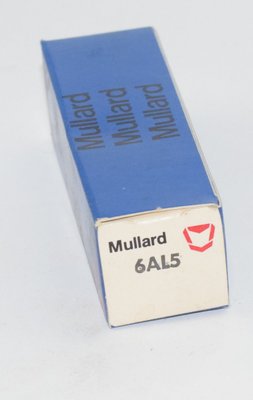
The 6AL5 is a miniature twin (double) diode vacuum tube designed for use in detection, automatic volume control (AVC), and low-current rectification circuits. Introduced in the late 1940s, it became one of the most widely produced and universally recognized signal diodes of the miniature tube era. Its European designation is EB91, and it was manufactured by virtually every major valve maker worldwide, including Mullard, Philips, Siemens, Brimar (STC), RCA, Sylvania, GE, Tung-Sol, AWV (Super Radiotron, Australia), and Compagnie Générale de T.S.F. (CSF, France).
The 6AL5 was developed as a direct miniature replacement for the older octal-based 6H6 double diode. Its compact B7G (miniature 7-pin) envelope and high perveance made it ideal for the new generation of compact radio and television receivers that emerged after World War II. The tube found extensive use in AM/FM radio receivers, television sets (for video detection and AGC), military communications equipment, and test instruments.
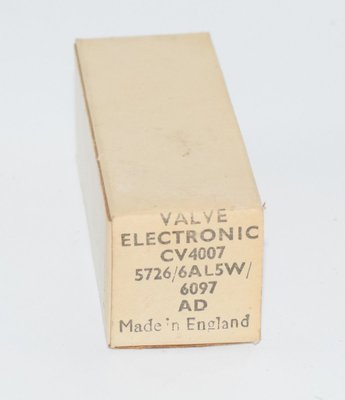
A ruggedized military version, the 5726 / 6AL5W, was developed for military and professional equipment. The attached CSF datasheet from October 1957 describes this variant, noting that it was developed under contract from the French Air Force's Telecommunications Technical Service (Service Technique des Télécommunications de l'AIR). The 5726/6AL5W features reinforced internal construction for greater mechanical robustness and higher operational reliability, with shock resistance rated at 450g and vibration fatigue testing at 2.5g acceleration.
The 6AL5 remained in widespread production well into the 1970s and is still readily available as new-old-stock (NOS) from numerous manufacturers and countries of origin.
2. Technical Specifications and Design
General Description
The 6AL5 is a high-perveance twin diode with two separate diode elements sharing a common heater but having independent cathodes. Each diode section can be used separately or in parallel for detection, AVC, rectification, and other low-current applications. The resonant frequency of each diode element exceeds 700 MHz, making it suitable for VHF applications.
Heater Ratings
| Parameter | Value |
|---|---|
| Heater Voltage (Vf) | 6.3 V ±10% |
| Heater Current (If) | 0.3 A |
| Cathode Type | Oxide-coated, indirectly heated |
Maximum Ratings (Absolute Limits)
| Parameter | Value |
|---|---|
| Peak Inverse Anode Voltage | 360 V |
| Peak Anode Current per Section | 60 mA |
| Instantaneous Anode Current at Turn-On (max 0.2 sec) | 350 mA |
| Maximum DC Rectified Current per Anode | 10 mA |
| Cathode-to-Heater Voltage | ±360 V |
| Maximum Bulb Temperature | 165 °C |
Note: As a diode, the 6AL5 has no control grid. Therefore, specifications such as amplification factor (μ), transconductance (gm), plate resistance (rp), and grid bias range do not apply to this tube type.
Interelectrode Capacitances (with external shield, internal diameter 19.2 mm, connected to heater)
| Capacitance | Value (pF) |
|---|---|
| Anode 1 to Cathode 1, heater & internal shield | 3.2 |
| Anode 2 to Cathode 2, heater & internal shield | 3.2 |
| Cathode 1 to Anode 1, heater & internal shield | 3.9 |
| Cathode 2 to Anode 2, heater & internal shield | 3.9 |
| Anode 1 to Anode 2 (max) | 0.026 |
Emission Characteristics (Design Center Limits)
| Parameter | Conditions | Min | Max |
|---|---|---|---|
| Heater Current (mA) | Vf = 6.3 V | 275 | 325 |
| Heater Current after 500 hrs (mA) | Vf = 6.3 V | 275 | 325 |
| Emission per Section (mA) | Vf = 6.3 V; Va = 10 V | 40 | — |
| Emission per Section after 500 hrs (mA) | Vf = 6.3 V; Va = 10 V | 35 | — |
| Anode Rest Current per Section (μA) | Vf = 6.3 V; Va = 0; Ra = 40 kΩ | 2 | 20 |
| Difference in Anode Currents Between Sections (μA) | Vf = 6.3 V; Va = 0; Ra = 40 kΩ | — | 5 |
Typical Operating Example: Full-Wave Rectification with Capacitor Input Filter
| Parameter | Value |
|---|---|
| AC Anode Voltage per Section (V rms) | 117 |
| Filter Input Capacitance (μF) | 8 |
| Total Effective Input Impedance per Anode (Ω) | 300 |
| Load Resistance (Ω) | 11,000 |
| Rectified Current per Anode (mA) | 9 |
| Voltage Drop per Anode at 18 mA (V) | 4.5 |
| Minimum Resonant Frequency (MHz) | 700 |
Insulation Resistance Between Electrodes
| Parameter | Conditions | Min (MΩ) |
|---|---|---|
| 300 V between anode of each section and all other electrodes | Vf = 6.3 V | 100 |
| Same, after 500 hours of service | Vf = 6.3 V | 50 |
Special Control Tests (5726/6AL5W Military Version)
- Heater Fatigue: 2,000 cycles of 1 minute on / 1 minute off at Vf = 7.5 V; Va = 0; Vfk = 135 V rms
- Shock Resistance: Five shocks of 450g applied successively in four directions along three perpendicular axes
- Vibration Fatigue: Sinusoidal vibration at 2.5g acceleration, 25 Hz, applied in three perpendicular directions (3 × 24 hours)
Physical Characteristics
| Parameter | Value |
|---|---|
| Base Type | Miniature 7-pin (B7G / 7C10) |
| Envelope | T-5½ miniature glass (A 19-1 UTE) |
| Maximum Diameter | 19 mm |
| Seated Height (max) | 38.1 mm |
| Pin Diameter | 1.02 ± 0.05 mm |
| Weight | 6 g |
| Mounting Position | Any (all positions) |
Pin Configuration (Bottom View)
| Pin | Connection |
|---|---|
| 1 | Cathode, Diode Section 1 |
| 2 | Anode, Diode Section 2 |
| 3 | Heater (Filament) |
| 4 | Heater (Filament) |
| 5 | Cathode, Diode Section 2 |
| 6 | Internal Shield (Screen) |
| 7 | Anode, Diode Section 1 |
The external shield (when used) should have an internal diameter of 19.2 mm and be connected to the heater/filament.
3. Applications and Usage
The 6AL5 was one of the most versatile and widely used signal diodes of the vacuum tube era. Its primary applications include:
- AM/FM Radio Detection: The most common application. One or both diode sections were used for envelope detection of AM signals or ratio detection / discriminator circuits in FM receivers.
- Automatic Volume Control (AVC) / Automatic Gain Control (AGC): One section typically served as the detector while the second provided a delayed AVC voltage to control the gain of preceding IF amplifier stages.
- Television Receivers: Used extensively for video detection, AGC, sync separator clamping, and noise cancellation circuits in both black-and-white and early color television sets.
- Low-Current Rectification: Both sections could be used in a full-wave rectifier configuration for generating bias voltages or other low-current DC supplies. The datasheet example shows full-wave rectification with 117 V rms input, 8 μF filter capacitor, and 11 kΩ load delivering 9 mA per anode.
- Military and Professional Equipment: The ruggedized 5726/6AL5W variant was specified for military communications, radar, and avionics equipment where high mechanical reliability was essential.
- Test Equipment: Used in oscilloscopes, signal generators, and voltmeters as precision detectors and clamp circuits.
- VHF Applications: With a resonant frequency exceeding 700 MHz, the 6AL5 was suitable for detection and rectification at VHF frequencies.
4. Sound Characteristics
As a diode, the 6AL5 does not amplify signals and therefore does not contribute tonal coloration in the same direct manner as triodes, pentodes, or beam tetrodes used in amplifier stages. However, its characteristics as a detector and rectifier do influence the overall sonic signature of the circuits in which it is employed:
- Clean, Transparent Detection: The 6AL5's high perveance and low forward voltage drop (approximately 4.5 V at 18 mA) result in efficient, low-distortion detection. In AM radio circuits, this translates to a clean, detailed recovered audio signal with minimal detector distortion compared to less efficient diode types.
- Smooth AGC Behavior: When used in AVC/AGC circuits, the 6AL5 provides smooth, progressive gain control that avoids the abrupt compression artifacts sometimes associated with semiconductor-based AGC. This contributes to a natural, unforced dynamic quality in vintage receivers.
- Low Noise Floor: The excellent inter-section isolation (anode-to-anode capacitance of only 0.026 pF maximum) and high insulation resistance (100 MΩ minimum) ensure minimal crosstalk and leakage, contributing to a quiet noise floor in sensitive receiver circuits.
- Warm, Natural Rectification: When used as a low-current power supply rectifier (for bias supplies, for example), the 6AL5's soft-recovery characteristics and gradual conduction onset contribute to the smooth, organic power delivery that audiophiles associate with tube rectification, albeit at much lower power levels than dedicated rectifier tubes.
- Section Matching: The tight specification on anode current difference between sections (maximum 5 μA) ensures balanced operation in push-pull detection and full-wave rectification, contributing to symmetrical waveform handling and low even-harmonic distortion.
In vintage radio restoration circles, the 6AL5 is generally regarded as a transparent, well-behaved component that does its job without imposing a strong sonic signature — which is precisely what a good detector diode should do.
5. Equivalent and Substitute Types
Direct Drop-In Equivalents (Identical Pinout and Ratings)
| Type | Notes |
|---|---|
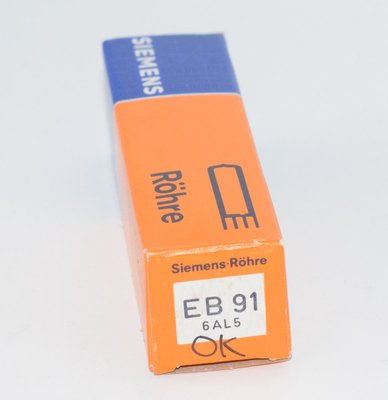
| EB91 | European (Mullard/Philips) designation; identical tube |
| 6D2 | Direct equivalent |
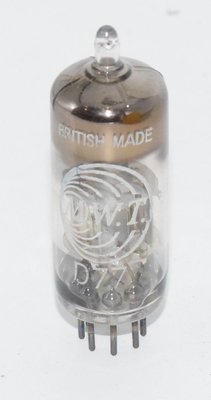
| D77 | Direct equivalent |
| EAA91 | Direct equivalent |
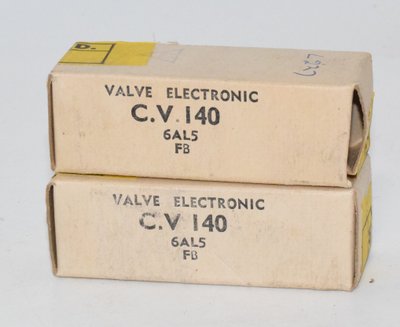
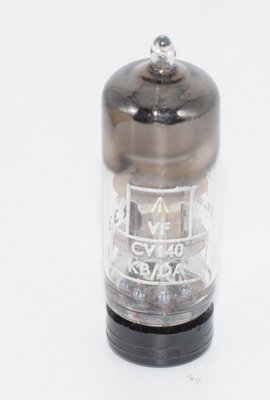
| CV140 | UK military designation (e.g., STC Brimar) |
| CV283 | UK military designation |
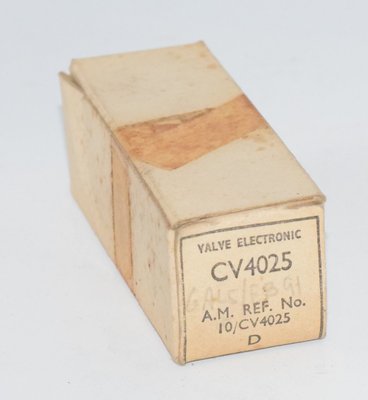
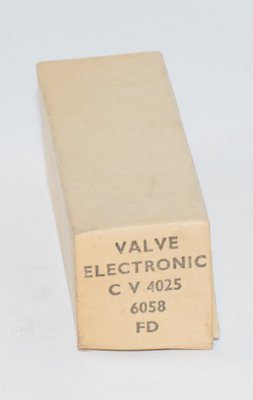
| CV4025 | UK military designation |
| CV8200 | UK military designation |
| CV10324 | UK military designation |
| CV10328 | UK military designation |
Related Types — NOT Direct Drop-In Replacements (Different Ratings or Specifications)
| Type | Notes |
|---|---|
| 5726 / 6AL5W / CK5726 | Ruggedized military version; tighter specs, enhanced mechanical construction. Electrically compatible but built to higher standards. Can substitute for 6AL5 but not vice versa in military applications. |
| 6058 | Related type with different ratings |
| E91AA | European special-quality variant |
| ED2 | Related type, different ratings |
| M8212 | Mullard special-quality designation |
| CV5189 | UK military designation for ruggedized variant |
| CV8224 | UK military designation, different ratings |
| CV8311 | UK military designation, different ratings |
| 12AL5 | 12.6 V heater version (series-string heater chains); NOT a drop-in replacement for 6AL5 due to different heater voltage |
| 3AL5 | Lower heater voltage variant; NOT a drop-in replacement |
Important: The 5726/6AL5W can generally be used in place of a standard 6AL5 without issues, as it meets or exceeds all 6AL5 specifications. However, a standard 6AL5 should not be substituted into equipment that specifically requires the 5726/6AL5W, as it may not meet the enhanced mechanical and environmental requirements.
6. Notable Characteristics
- Exceptional VHF Performance: With a minimum resonant frequency of 700 MHz, the 6AL5 was one of the highest-frequency-capable signal diodes of its era, making it suitable for VHF detection well beyond the FM broadcast band.
- High Perveance: The tube's high perveance (the ratio of current to voltage raised to the 3/2 power) means it conducts efficiently at low anode voltages, resulting in minimal signal loss in detector circuits. At 10 V anode voltage, each section delivers a minimum of 40 mA emission current.
- Excellent Section Isolation: The inter-anode capacitance of only 0.026 pF maximum, combined with an internal shield (pin 6), ensures excellent isolation between the two diode sections. This is critical for circuits where one section is used for detection and the other for AVC, preventing unwanted interaction.
- Robust Cathode-Heater Insulation: The ±360 V cathode-to-heater voltage rating allows the tube to be used in circuits where the cathode operates at a significant potential difference from the heater supply, common in series-string television receivers.
- Universal Mounting: The tube can be mounted in any position, providing maximum flexibility in equipment design.
- Tight Section Matching: The maximum 5 μA difference in anode rest currents between sections ensures balanced operation in full-wave and push-pull detection circuits.
- Long Service Life: The emission specifications after 500 hours of operation (minimum 35 mA per section) show only modest degradation from the initial 40 mA minimum, indicating excellent cathode longevity.
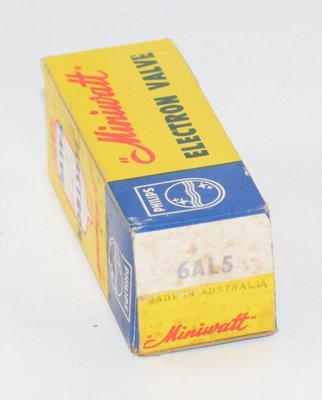
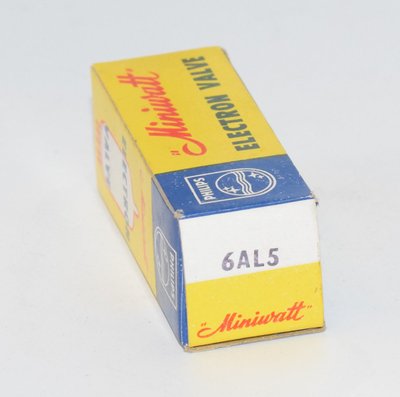
- Worldwide Production: The 6AL5/EB91 was manufactured by dozens of companies across North America, Europe, Asia, and Australia, making it one of the most universally available tube types. NOS examples are readily available from manufacturers including Mullard (UK), Philips Miniwatt (Netherlands, Japan, Australia), Siemens (Germany), STC Brimar (UK), AWV Super Radiotron (Australia), CSF (France), and many American manufacturers.
7. Usage in the Audio Community
While the 6AL5 is fundamentally a signal diode rather than an amplifying device, it has found several niches within the audio community:
Vintage Radio Restoration
The 6AL5 is an essential component in the restoration of vintage AM/FM radio receivers from the 1950s through 1970s. Virtually every quality FM tuner of the era used a 6AL5 or EB91 in the ratio detector or discriminator circuit. Restorers of classic receivers from manufacturers such as Fisher, Scott, Marantz, McIntosh, and others frequently need this tube. The quality of the 6AL5 directly affects the fidelity of the detected audio signal, and experienced restorers often prefer specific brands — Mullard and Philips examples are particularly sought after for their consistent quality and tight section matching.
Vintage Television Restoration
The tube was ubiquitous in television receivers for video detection and AGC circuits. Collectors restoring vintage television sets frequently require 6AL5 replacements.
DIY Audio Projects
In the DIY audio community, the 6AL5 finds use in several creative applications:
- Bias Supply Rectification: The tube is sometimes used as a small-signal rectifier for generating negative bias voltages in tube amplifier power supplies, where its soft-recovery characteristics are valued.
- Signal Clamping and Clipping: Some builders use the 6AL5 as a soft-clipping element in guitar amplifier and effects circuits, where the gradual onset of diode conduction provides a smoother, more musical clipping characteristic than silicon diodes.
- Peak Detection and Metering: Used in VU meter and peak-reading circuits in tube-based recording equipment and mixing consoles.
- Tube-Based Power Supply Regulation: Occasionally employed in shunt regulator circuits as a voltage reference or error-sensing element.
Tuner Enthusiasts
Among the dedicated community of vintage FM tuner enthusiasts, the 6AL5 is recognized as a critical component in the signal path. The tube's performance in the ratio detector directly influences distortion, stereo separation (in multiplex-equipped tuners), and overall audio quality. Tuner collectors often experiment with different brands and vintages of 6AL5/EB91 to optimize performance, with Mullard CV4025 and Philips Miniwatt examples commanding premium prices for their perceived superior performance.
Availability and Collecting
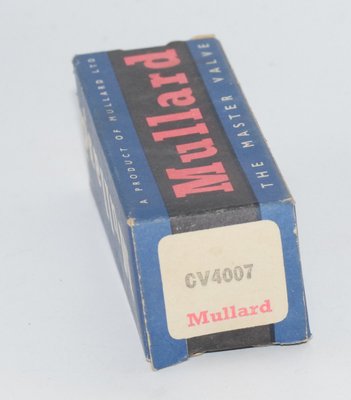
The 6AL5 remains one of the most affordable and readily available NOS tubes on the market. Its widespread production means that excellent examples from premium manufacturers can still be obtained at reasonable prices. Military-grade variants such as the 5726/6AL5W (CV4007, CV5189) are also available and are preferred by those seeking the highest reliability and tightest specifications. Collectors particularly value examples from:
- Mullard (UK) — including CV4007/CV140 military grades
- Philips Miniwatt (Netherlands, Japan, and Australia production)
- Siemens (Germany)
- STC Brimar (UK) — CV140 military designation
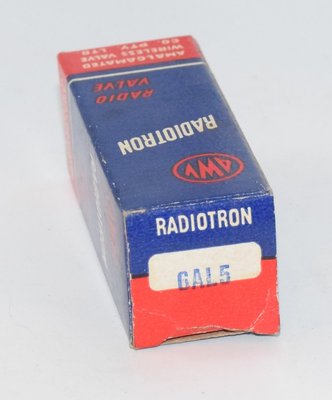
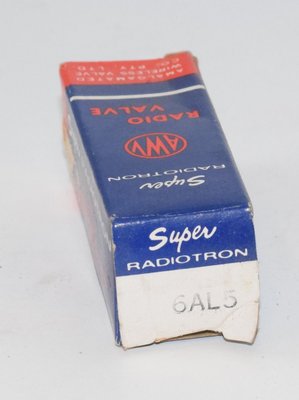
- AWV Super Radiotron (Australia)
The 6AL5's combination of universal availability, low cost, and essential function in vintage equipment ensures its continued relevance in the audio community for decades to come.