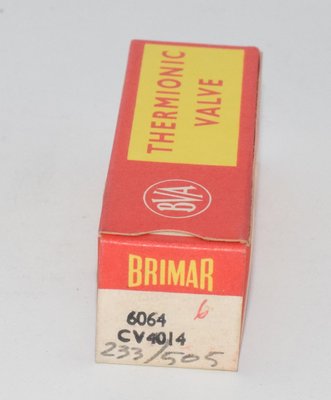
1. Introduction and History
The 6AM6 is a miniature sharp-cutoff RF pentode valve developed in the late 1940s as part of the post-war generation of compact, high-performance receiving tubes. It was designed primarily for use as a high-gain voltage amplifier at radio and intermediate frequencies, and quickly became one of the most widely produced and versatile small-signal pentodes of its era.
The 6AM6 is the American RETMA designation for what is more widely known in European markets as the EF91 (Mullard/Philips designation) or Z77 (Marconi-Osram designation). It was manufactured by virtually every major valve producer of the period, including Mullard, Brimar, Ediswan, Philips Miniwatt, GEC, and numerous others across Europe and the Commonwealth. The tube also received a wide array of British military CV (Common Valve) designations, reflecting its extensive use in military communications and radar equipment.
Introduced at a time when the electronics industry was transitioning from the larger octal-based tubes to the more compact miniature B7G (7-pin) platform, the 6AM6/EF91 represented a significant step forward in size reduction while maintaining excellent electrical performance. Its high transconductance and relatively low noise characteristics made it a natural choice for the front-end stages of radio receivers, television IF amplifiers, and a wide range of instrumentation applications throughout the 1950s and 1960s.
The tube was produced in enormous quantities — particularly in the United Kingdom, where Mullard, Brimar, and Ediswan were prolific manufacturers — and remains readily available today as new-old-stock (NOS). Its enduring popularity in the audio community, particularly among headphone amplifier builders and experimenters, has ensured continued demand well into the 21st century.
2. Technical Specifications and Design
General Description
The 6AM6 is a miniature sharp-cutoff pentode designed for RF and IF amplification, with a high transconductance that also makes it suitable for audio voltage amplification stages. It features an indirectly heated cathode and is constructed in a compact all-glass miniature envelope.
Heater Ratings
| Parameter | Value |
|---|---|
| Heater Voltage (Vh) | 6.3 V |
| Heater Current (Ih) | 0.3 A |
Maximum Ratings (Absolute Maximum Values)
| Parameter | Value |
|---|---|
| Maximum Plate (Anode) Voltage (Va max) | 250 V |
| Maximum Screen Grid Voltage (Vg2 max) | 250 V |
| Maximum Plate Dissipation (Pa max) | 2.5 W (typical manufacturer rating; confirm against specific manufacturer datasheet) |
| Maximum Screen Grid Dissipation (Pg2 max) | 0.7 W (typical; confirm against specific manufacturer datasheet) |
| Maximum Cathode Current (Ik max) | 15 mA (typical; confirm against specific manufacturer datasheet) |
Typical Operating Conditions (Pentode Connection)
The following data is taken directly from verified reference data (TDSL / manufacturer datasheets):
| Parameter | Value |
|---|---|
| Plate (Anode) Voltage (Va) | 250 V |
| Screen Grid Voltage (Vg2) | 250 V |
| Control Grid Voltage (Vg1) | −2.0 V |
| Plate (Anode) Current (Ia) | 10.0 mA |
| Screen Grid Current (Ig2) | 2.6 mA |
| Plate Resistance (rp / Ra) | 1,000,000 Ω (1 MΩ) |
| Transconductance (gm / S) | 7.5 mA/V |
| Amplification Factor (μ) | ~7,500 (calculated: μ = gm × rp = 7.5 × 1,000 = 7,500) |
Note on Amplification Factor: The very high amplification factor of approximately 7,500 is characteristic of sharp-cutoff RF pentodes with high plate resistance. This value is derived from the verified transconductance and plate resistance figures (μ = gm × rp). In practice, the actual voltage gain achieved in a circuit is determined by the load impedance relative to the plate resistance.
Grid Bias Range
The 6AM6 is a sharp-cutoff pentode. At the typical operating point, the control grid bias is −2.0 V. The tube reaches approximate cutoff at around −6 V to −8 V of grid bias (with Vg2 = 250 V), though the exact cutoff voltage should be confirmed against the specific manufacturer's published plate characteristic curves. The relatively small bias voltage required reflects the tube's high transconductance.
Physical Construction
| Parameter | Detail |
|---|---|
| Base Type | Miniature 7-pin (B7G / Noval sub-type) |
| Envelope Type | Miniature all-glass (T-6½ or similar small tubular envelope) |
| Mounting Position | Any (designed for universal mounting orientation) |
| Overall Length | Approximately 50–55 mm (excluding pins) |
| Maximum Diameter | Approximately 19–20 mm |
Pin Configuration (B7G Base — Bottom View)
        Pin 1: Grid 3 (Suppressor Grid) — internally connected to cathode in most versions
        Pin 2: Heater
        Pin 3: Plate (Anode)
        Pin 4: Screen Grid (Grid 2)
        Pin 5: Grid 1 (Control Grid)
        Pin 6: Cathode
        Pin 7: Heater
Note: The suppressor grid (g3) is internally connected to the cathode in standard production versions. Pin numbering follows the standard B7G convention viewed from the bottom (pin side) of the tube, with the key gap between pins 1 and 7.
Capacitances (Typical)
| Parameter | Value |
|---|---|
| Input Capacitance (Cin) | ~5.5 pF (confirm against datasheet) |
| Output Capacitance (Cout) | ~4.5 pF (confirm against datasheet) |
| Grid-to-Plate Capacitance (Cg1-a) | ~0.004 pF (confirm against datasheet) |
The extremely low grid-to-plate capacitance is a hallmark of the pentode design and is what makes the 6AM6 suitable for high-frequency amplification without neutralization.
3. Applications and Usage
The 6AM6 was designed as a general-purpose high-gain pentode and found widespread use across many areas of electronics:
Original Design Applications
- IF Amplification: The tube's primary intended application was as an intermediate frequency amplifier in superheterodyne radio receivers. Its high transconductance of 7.5 mA/V provided excellent gain per stage, and its sharp-cutoff characteristic made it well-suited to fixed-gain IF strips.
- RF Amplification: Used in the front-end RF amplifier stages of VHF and UHF receivers, where its low inter-electrode capacitances and high gain were advantageous.
- Television Receivers: Extensively used in early television sets, particularly in the UK, as video IF amplifiers. Multiple 6AM6/EF91 stages were commonly cascaded in TV IF strips.
- Video Amplification: With appropriate circuit design, the tube could serve as a wideband video amplifier.
- Military and Government Equipment: The numerous CV (Common Valve) designations — CV138, CV1955, CV2195, CV4014, CV8020, CV8732, CV10327 — attest to the tube's extensive use in British military communications, radar, and electronic warfare equipment. The CV4014 designation (also marked M8083 by Mullard) typically indicates a specially selected, high-reliability version manufactured to tighter tolerances.
- Test and Measurement Instruments: Used in oscilloscopes, signal generators, and other laboratory instruments where stable, high-gain amplification was required.
- Oscillator Circuits: Suitable for use in various oscillator configurations at radio frequencies.
Audio Applications
- Voltage Amplifier / Preamplifier Stage: The high transconductance and gain of the 6AM6 make it an effective audio voltage amplifier. It has been used in microphone preamplifiers, phono stages, and line-level preamplifiers.
- Headphone Amplifiers: One of the most popular modern applications for the 6AM6 is in DIY and boutique headphone amplifiers, where its high gain and compact size are particularly valued.
- Guitar Amplifiers: While not as common as the EF86 (6267) in guitar amplifier designs, the 6AM6/EF91 has been used in some amplifier circuits, particularly in experimental and custom builds.
4. Sound Characteristics
The 6AM6/EF91 has developed a distinct reputation within the audio community, and opinions on its sonic character are well-established among enthusiasts and engineers:
General Tonal Character
The 6AM6 is generally described as having a lively, detailed, and slightly forward sonic presentation. Compared to the more commonly discussed EF86 pentode, the 6AM6/EF91 tends to be characterized as having a brighter, more energetic top end with excellent transient response. The high transconductance contributes to a sense of immediacy and dynamic responsiveness that many listeners find engaging.
Frequency Response Qualities
- Treble: The 6AM6 is noted for its extended and articulate high-frequency reproduction. Some listeners describe the treble as "airy" and "sparkling," while others who prefer a warmer presentation may find it slightly bright or forward in certain circuit topologies. The tube's RF heritage means it has inherently excellent high-frequency performance.
- Midrange: The midrange is typically described as clear and detailed, with good resolution of vocal textures and instrumental timbres. It tends toward transparency rather than the lush, euphonic coloration associated with some triode designs.
- Bass: Bass reproduction is generally considered clean and well-defined, though not as full or weighty as some larger pentodes or triode-connected alternatives. The high plate resistance means that the tube's bass performance is heavily dependent on the circuit design and load conditions.
Dynamic and Spatial Qualities
The 6AM6 is praised for its micro-dynamic resolution — the ability to reveal subtle dynamic shadings and low-level detail. Soundstage presentation tends to be precise and well-defined, with good separation of instruments. The tube's fast transient response contributes to a sense of rhythmic precision and "pace" that many listeners appreciate.
Manufacturer Variations
As with many vintage valve types, different manufacturers' versions of the 6AM6 exhibit subtly different sonic characteristics:
- Mullard (UK): Generally considered among the finest examples, Mullard-made 6AM6 and CV4014 (M8083) tubes are prized for a slightly warmer and more refined presentation compared to other makers, with excellent low-noise performance. The CV4014/M8083 special-quality versions are particularly sought after.
- Brimar (UK): Brimar's 5A/160H and 6AM6 production is well-regarded for a balanced, slightly smooth character with good detail retrieval.
- Ediswan (UK): Ediswan examples are considered reliable performers with a clean, neutral character.
- Philips Miniwatt: Dutch and Australian Philips production is generally similar in character to Mullard (as both were part of the Philips group), with a reputation for consistency and musical refinement.
Noise Considerations
One important caveat regarding the 6AM6 in audio applications is that it was not specifically designed as a low-noise audio tube (unlike the EF86, which was purpose-built for audio preamplification). Standard production 6AM6 tubes can exhibit higher levels of microphony and hum compared to dedicated audio pentodes. However, specially selected versions — particularly the CV4014/M8083 — were manufactured to tighter specifications and tend to exhibit significantly better noise performance. Careful circuit design, including proper decoupling, shielding, and vibration isolation, can mitigate noise issues in audio applications.
5. Equivalent or Substitute Types
Close / Identical Substitutes (Direct Drop-In Replacements)
The following types are verified as close or identical substitutes for the 6AM6 and can generally be used as direct replacements without circuit modification:
| Type | Notes |
|---|---|
| 6F12 | Close/identical substitute. Russian designation for the same tube type. |
| CV8020 | Close/identical substitute. British CV designation. |
Different Rating Substitutes (NOT Direct Drop-In)
The following types are related to the 6AM6 but have different ratings, specifications, or selection criteria. They are not guaranteed drop-in replacements and may require circuit adjustments or verification of compatibility:
| Type | Notes |
|---|---|
| EF91 | The European (Mullard/Philips) designation. Electrically equivalent but classified as a different-rating substitute in some references, likely due to minor specification differences between RETMA and European standards. In practice, the EF91 and 6AM6 are widely considered interchangeable. |
| Z77 | Marconi-Osram (GEC/MOV) designation for the same basic tube. Same practical considerations as the EF91. |
| CV138 | British military CV designation. May have different screening or selection criteria compared to commercial 6AM6. |
| CV1955 | British military CV designation. Different selection or rating criteria. |
| CV2195 | British military CV designation. Different selection or rating criteria. |
| CV4014 | British military special-quality designation (also Mullard M8083). Selected for tighter tolerances, longer life, and improved reliability. Electrically compatible but manufactured to higher standards. |
| CV8732 | British military CV designation. Different selection or rating criteria. |
| CV10327 | British military CV designation. Different selection or rating criteria. |
| 6064 | Related type with different ratings. Verify specifications before substitution. |
Important Notes on Substitution
While the EF91, Z77, and various CV-numbered equivalents are widely used interchangeably with the 6AM6 in practice, it is always advisable to verify the specific ratings and pinout of any substitute tube against the original manufacturer's datasheet before installation. The CV4014/M8083 is particularly recommended for audio applications due to its tighter manufacturing tolerances and superior selection criteria.
The 6AM6 should not be confused with the EF86 (6267), which is a different tube type with a 9-pin Noval (B9A) base, different pinout, and different electrical characteristics, despite both being small-signal pentodes used in audio applications.
6. Notable Characteristics
High Transconductance
At 7.5 mA/V, the 6AM6 offers exceptionally high transconductance for a miniature pentode of its era. This translates to high voltage gain capability and excellent sensitivity, making it effective in applications where maximum gain per stage is desired.
Very High Plate Resistance
The plate resistance of 1 MΩ is characteristic of a well-designed sharp-cutoff pentode. This high output impedance means that the tube behaves almost as a pure current source, and the actual voltage gain in a circuit is primarily determined by the load impedance. This characteristic requires careful attention to load design in audio applications to achieve optimal frequency response and linearity.
Sharp-Cutoff Characteristic
Unlike variable-mu (remote-cutoff) pentodes, the 6AM6 has a sharp-cutoff grid characteristic. This means that the tube's transconductance remains relatively constant over its normal operating range and drops off sharply as the grid voltage approaches cutoff. This makes it suitable for fixed-gain applications but less appropriate for AGC (automatic gain control) circuits where a variable-mu type would be preferred.
Compact Physical Size
The B7G miniature base and small glass envelope make the 6AM6 one of the more compact high-performance pentodes available. This is advantageous in modern audio applications where chassis space may be limited, particularly in headphone amplifiers and portable designs.
Extensive Military Heritage
The sheer number of CV designations associated with the 6AM6 family (CV138, CV1955, CV2195, CV4014, CV8020, CV8732, CV10327) reflects the tube's importance in British military electronics. Military-grade examples, particularly the CV4014/M8083, are manufactured to exacting standards and are highly prized by audio enthusiasts for their consistency, low noise, and long service life.
Microphony Sensitivity
As a high-gain pentode in a relatively small envelope, the 6AM6 can be susceptible to microphonic noise — mechanical vibrations that are converted into electrical signals by movement of the tube's internal elements. This is a well-known characteristic that must be addressed in audio circuit design through the use of vibration-damping socket mounts, proper chassis isolation, and careful physical layout. The CV4014/M8083 special-quality version typically exhibits reduced microphony due to its enhanced internal construction.
Wide Availability as NOS
Due to the enormous production quantities during the 1950s and 1960s, the 6AM6 and its equivalents remain widely available as new-old-stock (NOS) tubes at reasonable prices. This abundance, combined with the variety of manufacturers represented, makes tube rolling (comparing different brands and vintages) a practical and enjoyable pursuit for audio enthusiasts.
7. Usage in the Audio Community
Headphone Amplifiers
The 6AM6/EF91 has found its most enthusiastic modern audience in the headphone amplifier community. Its high gain, compact size, and wide NOS availability make it an excellent choice for hybrid (tube/solid-state) and all-tube headphone amplifier designs. Several popular DIY headphone amplifier projects feature the 6AM6 as the voltage amplification stage, paired with either solid-state output devices or small power tubes. The tube's lively, detailed sonic character is well-suited to headphone listening, where its resolution and transient response can be fully appreciated.
Preamplifier Designs
Audio designers and DIY builders have incorporated the 6AM6 into line-stage and phono preamplifier circuits. When used in pentode mode, the tube provides very high gain — useful for moving-coil phono cartridge amplification or for driving insensitive power amplifiers. Some designers prefer to operate the 6AM6 in triode mode (with the screen grid connected to the plate) for reduced gain, lower output impedance, and a warmer, more linear tonal character, though this sacrifices much of the tube's gain advantage.
Guitar and Musical Instrument Amplifiers
While the EF86 is the more traditional choice for pentode-input guitar amplifiers (as used in the Vox AC15 and certain Matchless designs), the 6AM6 has been explored by amp builders seeking a different tonal flavor. Its higher gain and brighter character can produce a more aggressive, cutting tone that some players find desirable for certain musical styles. Custom and boutique builders have experimented with the 6AM6 in both clean preamp stages and as part of gain-cascading topologies.
Tube Rolling and Collecting
The 6AM6/EF91 family offers a rich field for tube rolling enthusiasts. With production spanning multiple decades and numerous manufacturers across the UK, Europe, and beyond, there is considerable variety in construction techniques, materials, and resulting sonic characteristics. Collectors and audio enthusiasts particularly seek out:
- Mullard CV4014 / M8083: The gold standard for audio use, with tight tolerances and excellent noise performance.
- Mullard 6AM6 (standard production): Well-regarded for musical, refined sound quality.
- Brimar 5A/160H / 6AM6: Valued for smooth, balanced presentation.
- Ediswan 6AM6: Clean, neutral performers with good reliability.
- Philips Miniwatt 6AM6: Consistent quality with a musical character similar to Mullard.
- Various CV-marked examples: Military surplus tubes often represent excellent value, as they were manufactured to stringent quality standards but may be available at lower prices than their commercially branded equivalents.
Circuit Design Considerations for Audio
Engineers and builders working with the 6AM6 in audio circuits should be aware of several practical considerations:
- Decoupling: Thorough power supply decoupling is essential due to the tube's high gain. Inadequate decoupling can lead to oscillation, motorboating, or excessive hum.
- Shielding: External tube shields are recommended in sensitive audio applications to reduce hum pickup and electromagnetic interference.
- Microphony mitigation: Use of damping rings, resilient socket mounts, or silicone dampers can significantly reduce microphonic noise.
- Screen grid supply: A well-regulated, well-filtered screen grid supply is important for low-noise operation and stable gain. Some designers use a series resistor and bypass capacitor to decouple the screen grid from the main B+ supply.
- Operating point selection: While the verified typical operating point (Va = 250 V, Vg2 = 250 V, Vg1 = −2.0 V) provides maximum transconductance, some audio designers prefer to operate the tube at reduced plate and screen voltages for lower noise, reduced microphony, and a different tonal balance.
- Load impedance: Given the very high plate resistance of 1 MΩ, the choice of plate load resistor significantly affects both gain and frequency response. Higher load resistances yield more gain but may compromise high-frequency bandwidth due to stray capacitance effects.
Community Perception
Within the audio community, the 6AM6/EF91 is generally regarded as an excellent and underappreciated tube that offers outstanding performance relative to its modest cost. It is often recommended as an affordable entry point for those exploring pentode-based audio circuits, and its wide NOS availability ensures that enthusiasts can experiment with different brands and vintages without significant financial investment. The tube has a dedicated following among headphone amplifier enthusiasts in particular, where its combination of high gain, compact size, and engaging sonic character has earned it a loyal and growing fan base.