1. Introduction and History
The 6AQ4 is a miniature triode vacuum tube (valve) designed for use as a grounded-grid amplifier at frequencies up to 250 Mc/s (MHz). It was formally released under RTMA Release No. 1166, dated March 20, 1953, reflecting the post-war push toward miniaturized, high-frequency tube designs suitable for television, FM radio, and UHF communications equipment.
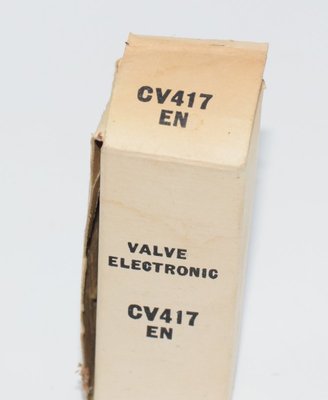
The 6AQ4 carries the Mullard designation EC91, and the NATO-codified CV417 designation was issued in response to NATO standardization requests. This cross-referencing between American RTMA, British Mullard, and NATO CV numbering systems underscores the tube's importance in both civilian and military electronics during the 1950s. Manufactured by firms including Mullard Limited (Century House, Shaftesbury Avenue, London W.C.2, England) and various American producers, the 6AQ4 found widespread use wherever a compact, high-transconductance triode was needed for VHF and UHF service.
The tube's grounded-grid topology made it particularly attractive for front-end RF amplifier stages, where its low interelectrode capacitances and high transconductance provided excellent gain with good stability at very high frequencies.
2. Technical Specifications and Design
Physical Specifications
| Parameter | Value |
|---|---|
| Cathode | Coated unipotential |
| Base | Miniature button 7-pin (B7G) |
| Envelope | T5-1/2 glass |
| Maximum Overall Length | 2-1/8" |
| Maximum Seated Height | 1-7/8" |
| Maximum Diameter | 3/4" |
| Mounting Position | Any |
Heater Data
| Parameter | Value |
|---|---|
| Heater Voltage | 6.3 volts |
| Heater Current | 0.3 ampere |
Interelectrode Capacitances
(With external shield connected to Pins 1 and 6)
| Parameter | Value |
|---|---|
| Plate to Grid | 2.5 µµF (pF) |
| Plate to Cathode and Heater | 0.2 µµF (pF) |
| Grid to Cathode and Heater | 8.5 µµF (pF) |
Maximum Ratings (Design Centre Values)
| Parameter | Value |
|---|---|
| Plate Voltage | 250 volts |
| Plate Dissipation | 2.5 watts |
| Cathode Current | 15 mA |
| Voltage between Heater & Cathode | 150 volts |
| Voltage between Grid and Cathode | 100 volts |
Operating Characteristics
| Parameter | Value |
|---|---|
| Plate Voltage | 250 volts |
| Grid Voltage | -1.5 volts |
| Plate Current | 10 mA |
| Transconductance (gm) | 8500 µmhos (micromhos) |
| Plate Resistance (rp) | 12,000 ohms |
| Amplification Factor (µ) | 100 |
| Equivalent Noise Resistance | 400 ohms |
Pin Connections (Basing Diagram 7DT)
| Pin | Connection |
|---|---|
| Pin 1 | Grid |
| Pin 2 | Cathode |
| Pin 3 | Heater |
| Pin 4 | Heater |
| Pin 5 | Cathode |
| Pin 6 | Grid |
| Pin 7 | Plate |
Note that the grid is brought out to two pins (1 and 6) and the cathode to two pins (2 and 5). This dual-pin arrangement for the grid facilitates effective grounding at VHF/UHF frequencies and allows connection of an external shield to Pins 1 and 6 for optimal shielding and reduced stray capacitance.
3. Applications and Usage
The 6AQ4 was primarily designed as a grounded-grid RF amplifier for very high frequency (VHF) and ultra-high frequency (UHF) applications up to 250 MHz. Its key applications include:
- Television tuner front-ends: The 6AQ4 served as an RF amplifier in early television receivers, particularly in VHF tuner strips where its high transconductance of 8500 µmhos and low noise (400 ohms equivalent noise resistance) provided excellent signal-to-noise performance.
- FM radio receivers: Used as a front-end amplifier in high-quality FM tuners, where its grounded-grid configuration provided stable gain without neutralization.
- Communications equipment: Military and commercial VHF/UHF receivers employed the 6AQ4 in RF amplifier and mixer stages. Its NATO CV417 designation confirms its adoption in military communications systems.
- Oscillator circuits: The tube's high µ of 100 and favorable interelectrode capacitances made it suitable for VHF oscillator applications.
- Instrumentation: Laboratory instruments requiring stable, low-noise amplification at high frequencies utilized the 6AQ4.
The grounded-grid configuration is particularly significant: by grounding the grid (which acts as an electrostatic shield between cathode and plate), the plate-to-cathode capacitance is reduced to a mere 0.2 pF, virtually eliminating feedback and ensuring unconditional stability at VHF frequencies. The input impedance in grounded-grid mode is low (approximately 1/gm, or roughly 118 ohms), which provides a good match to coaxial transmission lines.
4. Sound Characteristics
While the 6AQ4 was designed primarily for RF service rather than audio amplification, its electrical characteristics — particularly its high amplification factor of 100, high transconductance of 8500 µmhos, and relatively low plate resistance of 12,000 ohms — give it properties that are of interest to audio experimenters and designers.
When employed in audio circuits, the 6AQ4 exhibits the following tonal and sonic qualities:
- Detailed and articulate highs: The tube's design for high-frequency service translates into an extended and well-resolved treble response in audio applications. The high transconductance ensures fast, responsive signal handling, which audiophiles often describe as "airy" and "open" in the upper registers.
- Clean, linear midrange: With a µ of 100 and a relatively low plate resistance, the 6AQ4 can deliver a clean, transparent midrange with good linearity at moderate signal levels. The tube does not impose heavy coloration, making it suitable for applications where fidelity is prized over euphonic warmth.
- Moderate warmth: Like most miniature triodes of its era, the 6AQ4 imparts a subtle warmth that distinguishes it from solid-state devices, but it is not as lush or romantically colored as larger-frame audio triodes such as the 6SN7 or 12AX7. Its character is more "honest" and "fast" than "warm and syrupy."
- Low noise floor: The specified equivalent noise resistance of only 400 ohms is remarkably low, making the 6AQ4 one of the quieter miniature triodes available. This translates to a black, silent background in audio circuits — a quality highly valued in phono preamplifier and microphone preamplifier applications.
- Dynamic and punchy: The high transconductance gives the tube excellent transient response. Percussive instruments and plucked strings are rendered with snap and immediacy. The tube does not soften or round transients the way some lower-gm triodes can.
- Graceful overload characteristics: When pushed into mild overdrive, the 6AQ4 exhibits the soft clipping behavior characteristic of triodes, producing predominantly even-order harmonics (2nd and 3rd) that are musically consonant. However, its relatively low plate dissipation of 2.5 watts limits its use to small-signal stages.
Overall, the 6AQ4's sonic signature can be characterized as fast, transparent, and detailed — more akin to the sonic family of high-gm miniature triodes than to the warmer, more colored sound of classic audio-specific tubes. It rewards careful circuit design and quality passive components.
5. Equivalent or Substitute Types
| Type | Notes |
|---|---|
| EC91 (Mullard) | Direct equivalent. The Mullard designation EC91 has applied to this tube type. Electrically and physically identical; fully interchangeable. |
| CV417 | NATO/British military designation for the same tube. Direct equivalent, fully interchangeable. Often found as NOS stock from Thorn-AEI (formerly associated with Mullard/GEC supply chains). |
| 6AQ4A | An improved version with tighter manufacturing tolerances and potentially enhanced reliability. Pin-compatible and electrically interchangeable with the 6AQ4 in most circuits. Confirm specific ratings against the 6AQ4A datasheet if operating near maximum ratings. |
Important note: The 6AQ4 should not be confused with the 6AQ5 (a beam power pentode) or the 6AQ6 (a duplex-diode triode), despite the similar type numbering. These are entirely different tube types with different pinouts, functions, and electrical characteristics.
Builders should also be aware that while the EC91 and CV417 are direct equivalents, some European-manufactured examples may exhibit slightly different construction (e.g., different plate materials or getter configurations) that can result in subtle performance variations, particularly in critical RF applications. For audio use, these variations are generally inconsequential and may even be desirable for their tonal differences.
6. Notable Characteristics
- Exceptional high-frequency capability: Rated for operation up to 250 MHz, the 6AQ4 was among the higher-performing miniature triodes of its generation for VHF/UHF service. This capability stems from its carefully controlled interelectrode capacitances, short internal lead lengths, and the dual grid pins (1 and 6) that minimize grid inductance.
- Dual grid and cathode pins: The unusual pinout, with the grid brought out to both Pin 1 and Pin 6, and the cathode to both Pin 2 and Pin 5, is a deliberate design choice for RF performance. At VHF frequencies, even small amounts of lead inductance can cause instability or degrade performance. By providing two ground return paths for both the grid and cathode, the effective inductance is halved.
- Very low plate-to-cathode capacitance: At only 0.2 pF (with external shield connected to Pins 1 and 6), the 6AQ4 achieves remarkable isolation between input and output in grounded-grid configuration, enabling stable amplification at frequencies where many other triodes would oscillate.
- High amplification factor: A µ of 100 is notably high for a miniature triode of this era, placing it in the same league as tubes like the 12AX7 (µ = 100) in terms of voltage gain capability, though in a single-triode package optimized for RF rather than audio.
- Low equivalent noise resistance: At 400 ohms, the 6AQ4 offers a very low noise figure, making it attractive for front-end amplifier stages where signal-to-noise ratio is critical.
- High heater-to-cathode voltage rating: The 150-volt maximum heater-to-cathode voltage rating allows the tube to be used in circuits where the cathode operates at elevated DC potentials, a common requirement in series-string television receivers and certain RF amplifier configurations.
- Compact physical size: With a maximum diameter of only 3/4" and a seated height of 1-7/8", the 6AQ4 is well-suited to compact equipment designs. Its "any position" mounting capability adds further design flexibility.
7. Usage in the Audio Community
Although the 6AQ4 was never intended as an audio tube, it has attracted a dedicated following among DIY audio enthusiasts, experimenters, and boutique amplifier builders who appreciate its unique combination of high gain, low noise, and compact form factor.
Preamplifier and Line Stage Applications
The 6AQ4's high µ of 100 and transconductance of 8500 µmhos make it an excellent candidate for high-gain voltage amplifier stages in preamplifiers and line-level equipment. Its low equivalent noise resistance of 400 ohms is particularly attractive for phono stage designs, where the signal from a moving-magnet or moving-coil cartridge is extremely small and noise performance is paramount. Some builders have reported that the 6AQ4 delivers a more immediate, detailed sound in phono stages compared to the more commonly used 12AX7, attributing this to the tube's RF-optimized construction and lower parasitic capacitances.
Headphone Amplifiers
The single-triode-per-envelope format and the tube's modest heater power consumption (6.3V at 0.3A = 1.89 watts) make it appealing for compact headphone amplifier designs. Builders have used the 6AQ4 as a voltage gain stage driving a cathode follower output or a small power tube, achieving surprisingly refined sound quality from a minimalist circuit.
Guitar and Effects Applications
In the guitar electronics world, the 6AQ4 has found niche use in boutique effects pedals and small practice amplifiers. Its high gain and smooth overdrive characteristics when pushed into clipping make it suitable for creating tube-driven overdrive and distortion effects. The compact T5-1/2 envelope allows it to be fitted into stompbox-sized enclosures.
Experimental and Hobbyist Projects
The 6AQ4/EC91/CV417 is often available as NOS (New Old Stock) at reasonable prices, as it was produced in large quantities for military and commercial applications but is not in high demand among mainstream audio tube users. This affordability, combined with its interesting electrical characteristics, makes it a popular choice for hobbyist experimentation. Online forums and DIY audio communities feature numerous projects and discussions centered on extracting the best audio performance from this unconventional tube choice.
Practical Considerations for Audio Use
Audio builders working with the 6AQ4 should note several practical considerations:
- The dual grid pins (1 and 6) should typically both be connected to the grid circuit to minimize stray inductance, even at audio frequencies, as this can affect stability and reduce susceptibility to RF interference.
- Similarly, both cathode pins (2 and 5) should be connected together in the cathode circuit.
- The tube's operating point at 250V plate voltage, -1.5V grid bias, and 10 mA plate current provides a good starting point for audio circuit design, though many builders experiment with lower plate voltages and adjusted bias points to tailor the sound.
- The relatively low plate dissipation limit of 2.5 watts restricts the tube to small-signal applications; it is not suitable as an output tube except in the most modest milliwatt-level amplifiers.
- A quality 7-pin miniature socket with good contact tension is recommended, as the tube's RF heritage means it can be sensitive to poor socket connections that introduce microphonics or intermittent contact noise.
The 6AQ4 represents an intriguing option for the adventurous audio designer — a high-performance RF tube that, when thoughtfully applied to audio circuits, can deliver a fast, transparent, and engagingly detailed listening experience that stands apart from the more commonly encountered audio tube types.