1. Introduction and History
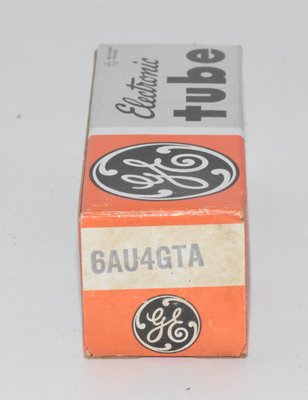
The 6AU4GTA is a half-wave vacuum rectifier tube designed primarily for use as a damper diode in horizontal-deflection circuits of color and wide-angle picture-tube television receivers. Developed during the golden age of American television in the 1950s, this tube was manufactured by major companies including General Electric (GE) and RCA, among others. It represents an improved version of the earlier 6AU4GT, with the 'A' suffix denoting enhanced ratings and reliability.
The 6AU4GTA belongs to a family of high-voltage, high-current rectifier tubes that were essential components in the horizontal output stages of CRT television sets. These tubes served the critical function of recovering energy stored in the deflection yoke's magnetic field during the horizontal retrace interval, converting it into usable DC voltage for the receiver's power supply — a process known as "damping." The glass octal envelope and robust construction made the 6AU4GTA well-suited to the demanding thermal and electrical environment of television horizontal output stages.
While originally designed for television service, the 6AU4GTA has found a second life in the audio community, where its high-current capability and robust construction have attracted the attention of amplifier designers and experimenters seeking unconventional rectifier solutions for tube amplifier power supplies.
2. Technical Specifications and Design
General Information
| Tube Type | 6AU4GTA |
| Function | Half-Wave Vacuum Rectifier (Damper Diode) |
| Base Type | Octal (8-pin) |
| Envelope | Glass Octal (Outline section 13G per RCA manual) |
| Mounting | Requires octal socket |
Heater Ratings
| Heater Voltage (ac/dc) | 6.3 volts |
| Heater Current | 1.8 amperes |
Direct Interelectrode Capacitances (Approximate)
| Plate to Heater and Cathode | 8.5 pF |
| Cathode to Heater and Plate | 11.5 pF |
| Heater to Cathode | 4 pF |
Damper Service — Maximum Ratings (Design-Maximum Values)
For operation in a 525-line, 30-frame system:
| Peak Inverse Plate Voltage | 4500 volts |
| Peak Plate Current | 1300 mA |
| Average Plate Current | 210 mA |
| Plate Dissipation | 6.5 watts |
| Heater-Cathode Voltage (Peak value) | +300 / −4500 volts |
| Heater-Cathode Voltage (Average value) | +100 / −900 volts |
Note: Pulse duration must not exceed 15% of a horizontal scanning cycle (10 microseconds).
Pin Configuration
The 6AU4GTA uses the 4CG octal basing diagram:
- Pin 1: Internal Connection (IC) — should not be used as a tie point
- Pin 2: Internal Connection (IC) — Note: this is an internal connection and should not be used as a tie point
- Pin 3: Cathode (K)
- Pin 4: No connection (available as tie point is not recommended)
- Pin 5: Plate (P)
- Pin 6: No connection
- Pin 7: Heater (H)
- Pin 8: Heater (H)
Important: The tube may be supplied with Pin No. 1 omitted. Socket terminals 1, 2, 4, and 6 should not be used as tie points, as specified by the manufacturer.
Physical Characteristics
The 6AU4GTA is housed in a glass octal (GT-type) envelope conforming to outline section 13G. It features a sturdy plate structure designed to handle the high peak currents encountered in damper service. The tube requires adequate ventilation due to its 6.5-watt plate dissipation rating and the significant heater power (approximately 11.3 watts). The cathode is an indirectly heated oxide-coated type, providing the high emission current necessary for damper operation.
Note: Amplification factor (μ), transconductance (gm), and plate resistance (rp) are not applicable parameters for this tube type, as it is a diode rectifier, not an amplifying device. These parameters apply only to triodes, pentodes, and other amplifying tube types.
3. Applications and Usage
Original Television Applications
The 6AU4GTA was designed specifically for use as a damper diode in the horizontal-deflection circuits of television receivers. In this role, the tube performs several critical functions:
- Damping: During the first portion of each horizontal trace, the damper diode conducts, absorbing the energy stored in the deflection yoke and associated circuitry from the previous retrace pulse. This prevents unwanted oscillations (ringing) that would appear as visible distortion on the left side of the picture.
- Boosted B+ Generation: The energy recovered by the damper diode is added to the existing B+ supply voltage, creating a "boosted B+" voltage that is used to power the horizontal output tube's plate circuit and sometimes other stages in the receiver. This energy recovery scheme significantly improves the overall efficiency of the horizontal deflection system.
- Rectification: The tube functions as a half-wave rectifier, conducting only during the portion of the horizontal cycle when the plate is positive with respect to the cathode.
The 6AU4GTA was particularly specified for color television and wide-angle picture tube receivers, where the deflection energy requirements were substantially greater than in earlier black-and-white sets. Its high peak inverse voltage rating of 4500 volts and peak current capability of 1300 mA made it suitable for these demanding applications.
Power Supply Rectification
Beyond its television origins, the 6AU4GTA's robust ratings make it a candidate for use as a rectifier in high-voltage, high-current power supply applications. Its ability to handle 210 mA average current and withstand 4500 volts PIV gives it considerable headroom in many power supply designs.
4. Sound Characteristics
As a rectifier tube, the 6AU4GTA does not amplify audio signals directly. However, when used in the power supply of a tube amplifier, it can influence the overall sonic character of the amplifier in subtle but meaningful ways. Audiophiles and engineers who have experimented with the 6AU4GTA in power supply applications report the following characteristics:
- Robust and Authoritative Bass: The 6AU4GTA's high current capability (210 mA average, 1300 mA peak) translates to excellent power supply regulation under dynamic signal conditions. This tends to produce a solid, well-controlled low-frequency response with good authority and punch. The power supply sags less under heavy transient demands, maintaining tighter bass definition.
- Smooth Rectifier Characteristics: Like most vacuum rectifiers, the 6AU4GTA introduces a soft, gradual voltage rise at power-on, providing a natural slow-start function that is gentle on filter capacitors and output tubes. This "soft start" behavior is valued by audiophiles who prefer vacuum rectification over solid-state alternatives.
- Dynamic and Open Presentation: The high peak current capability means the tube can deliver current quickly during musical transients, contributing to a sense of dynamic openness and liveliness that some listeners associate with well-designed vacuum-rectified power supplies.
- Warm Tonal Character: As with most vacuum rectifiers, the inherent voltage drop across the 6AU4GTA (which varies with current draw) introduces a subtle dynamic compression effect. This is often perceived as a slight warmth or richness in the midrange, particularly during louder passages.
- Natural Sag: While the 6AU4GTA has better regulation than many smaller rectifier tubes, it still exhibits the characteristic "sag" of vacuum rectification — a slight reduction in B+ voltage under heavy load. Guitar amplifier enthusiasts, in particular, value this quality for its contribution to a more organic, responsive playing feel.
It should be noted that the sonic influence of any rectifier tube is secondary to the overall circuit design, filter topology, and the amplifying tubes used. The 6AU4GTA's contribution is primarily in the domain of power supply behavior rather than direct signal coloration.
5. Equivalent or Substitute Types
Different Rating Substitutes (Not Direct Drop-In)
| Type | Notes |
|---|---|
| 6AU4GT | Earlier version of the same basic design. The 6AU4GTA has improved ratings over the 6AU4GT. While physically interchangeable (same octal base and pinout), the 6AU4GT may have lower maximum ratings. Check specific manufacturer datasheets before substituting — the 6AU4GT may not meet the full ratings required in circuits designed for the 6AU4GTA. |
| 19AU4GTA | Series-string heater version with a 19-volt heater instead of 6.3 volts. Not a drop-in replacement — the heater voltage difference means this tube cannot be used in 6.3V heater circuits without significant modification. Intended for series-string television receivers. |
General Considerations
When seeking substitutes for the 6AU4GTA, the critical parameters to match are:
- Peak inverse voltage rating (4500V in damper service)
- Peak plate current capability (1300 mA)
- Average plate current rating (210 mA)
- Heater voltage and current (6.3V, 1.8A)
- Base type and pinout (octal, 4CG basing)
- Heater-cathode voltage ratings (critical in damper service)
Other damper diodes such as the 6AX4GT, 6W4GT, or 6V3A may be found in similar circuits but have different ratings and are not direct substitutes without careful circuit analysis. Always verify that any substitute tube meets or exceeds all the maximum ratings required by the specific circuit.
6. Notable Characteristics
- High Heater-Cathode Voltage Rating: One of the most notable features of the 6AU4GTA is its exceptional heater-cathode voltage rating. In damper service, the cathode can swing to very high voltages relative to the heater (peak values of +300 to −4500 volts). This requires special insulation between the heater and cathode structures, and it is one of the key design challenges in damper tube construction.
- Internal Connections on Pins 1 and 2: Pin 2 is specifically noted as an internal connection. Along with pin 1, these pins should not be used as tie points on the socket. This is an important consideration for chassis builders and technicians.
- High Peak Current Capability: The 1300 mA peak plate current rating is remarkably high for a receiving-type tube, reflecting the demanding pulse-current requirements of horizontal deflection circuits.
- Substantial Heater Power: At 6.3V and 1.8A, the heater consumes approximately 11.3 watts — a significant power draw that must be accounted for in transformer and power supply design. This high heater current reflects the large cathode area needed for high-current emission.
- Pulse Duration Limitation: The datasheet specifies that pulse duration must not exceed 15% of a horizontal scanning cycle (10 microseconds). This is a critical design constraint for damper service applications.
- Adequate Ventilation Required: Like other power-handling tubes, the 6AU4GTA should be adequately ventilated to ensure reliable operation within its thermal limits.
- Robust Construction: The glass octal envelope and heavy-duty internal structure were designed to withstand the thermal cycling and high-voltage stresses of continuous television operation, making the 6AU4GTA a notably durable tube type.
7. Usage in the Audio Community
While the 6AU4GTA was never designed for audio applications, it has attracted interest from the audio community for several reasons:
Power Supply Rectification in Tube Amplifiers
The most common audio application for the 6AU4GTA is as a power supply rectifier in tube amplifiers. Its high current capability (210 mA average) makes it suitable for powering amplifiers that use multiple output tubes or high-current output stages. Compared to the ubiquitous 5U4GB (which is rated for 225 mA), the 6AU4GTA offers comparable current handling with the advantage of using a standard 6.3V heater supply rather than requiring a dedicated 5V rectifier winding. This can simplify transformer requirements in some designs.
DIY and Experimental Amplifier Projects
The 6AU4GTA is popular among DIY audio builders for several practical reasons:
- Availability and Cost: As a television tube produced in enormous quantities during the 1950s and 1960s, NOS (New Old Stock) 6AU4GTA tubes remain readily available from suppliers including GE-manufactured examples. They are typically very affordable compared to "audio-grade" rectifier tubes.
- Octal Base Convenience: The standard octal base makes the 6AU4GTA easy to integrate into amplifier designs using commonly available sockets and chassis hardware.
- High Voltage Tolerance: The 4500V PIV rating provides enormous headroom in audio power supply applications, where typical B+ voltages rarely exceed 500-600V.
- Soft-Start Capability: The vacuum rectifier's inherent slow warm-up provides a natural soft-start function, allowing filter capacitors to charge gradually and protecting output tubes from excessive voltage before their cathodes are fully heated.
Guitar Amplifier Applications
Some guitar amplifier builders have experimented with the 6AU4GTA as an alternative rectifier in high-power amplifier designs. The tube's high current capability and characteristic vacuum rectifier "sag" can contribute to the dynamic, touch-sensitive response that many guitarists prefer. The natural compression introduced by the rectifier tube's varying voltage drop under load is a sought-after characteristic in guitar amplifier design.
Considerations for Audio Use
Audio designers considering the 6AU4GTA should be aware of several important factors:
- Pinout Differences: The 6AU4GTA does not share the same pinout as common audio rectifier tubes like the 5U4, 5AR4/GZ34, or 5Y3. Circuit designs must account for the specific 4CG basing arrangement.
- Half-Wave Operation: The 6AU4GTA is a single diode (half-wave rectifier). For full-wave rectification, two tubes would be needed, or the design must accommodate half-wave operation with appropriate filtering.
- Heater Current Draw: At 1.8 amperes, the heater current is substantial and must be factored into the power transformer's heater winding capacity.
- Internal Connection Pins: Pins 1 and 2 are internal connections and must not be used as tie points — an important consideration when laying out the chassis and wiring.
Collector and NOS Market
The 6AU4GTA remains widely available as NOS stock, with GE-manufactured examples being among the most commonly encountered. Due to the tube's television origins and the massive production quantities, prices remain reasonable compared to sought-after audio tubes. This affordability, combined with the tube's robust specifications, makes it an attractive option for experimenters and builders who enjoy exploring unconventional tube choices in audio applications.