1. Introduction and History
The 6AU6 is a miniature sharp-cutoff pentode vacuum tube designed primarily for use as a high-gain RF and IF amplifier, though it has found widespread application in audio preamplifier circuits, instrumentation, and general-purpose voltage amplification. Introduced in the late 1940s as part of the post-war transition from octal to miniature tube designs, the 6AU6 quickly became one of the most popular and widely manufactured small-signal pentodes of the receiving tube era.
The 6AU6 was developed as a miniature replacement for earlier octal-based pentodes such as the 6SJ7, offering improved high-frequency performance thanks to its compact B7G (miniature 7-pin) base and shorter internal lead lengths. Its design reflected the industry's push toward smaller, more efficient tubes suitable for the rapidly expanding television and FM radio markets of the late 1940s and 1950s.
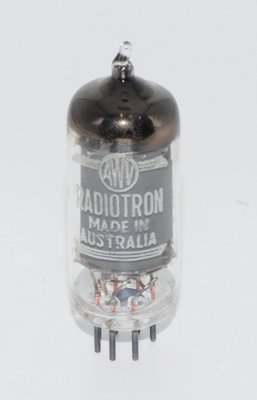
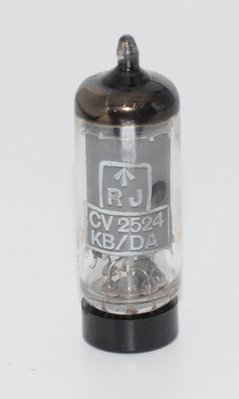
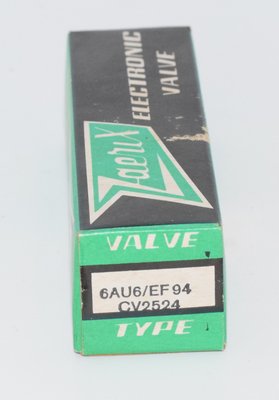
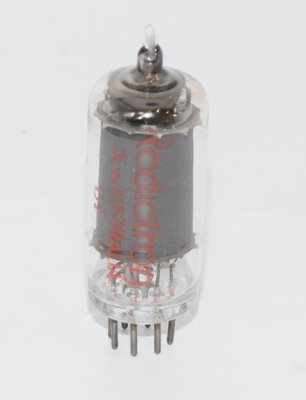
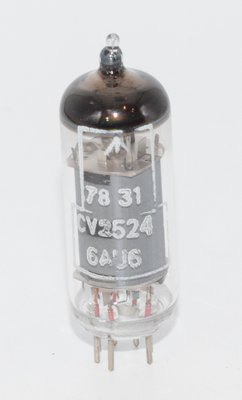
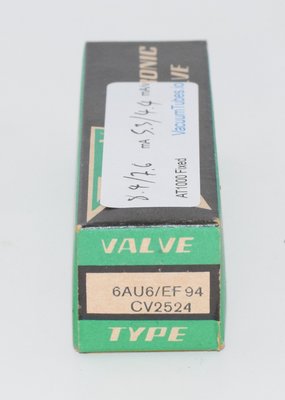
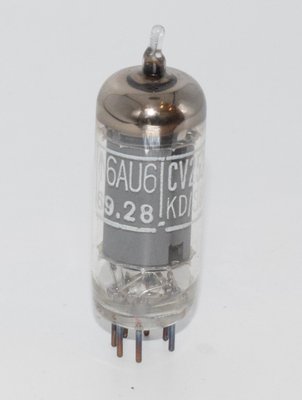
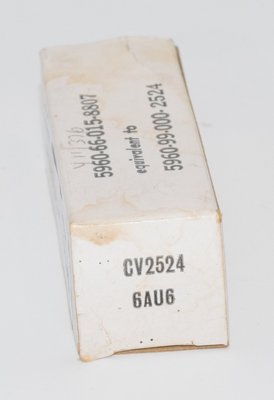
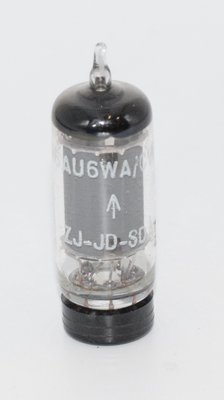
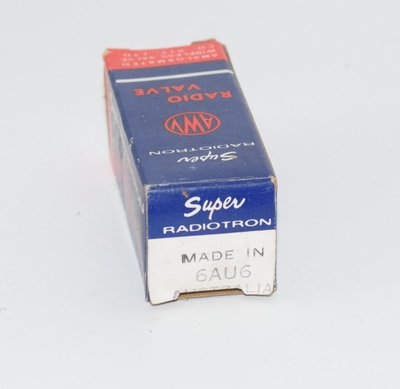
Manufactured by virtually every major tube producer worldwide — including RCA, GE, Sylvania, Mullard, Philips, Amperex, Telefunken, and Amalgamated Wireless Valve (AWV) in Australia — the 6AU6 became a true workhorse of the electronics industry. Its European equivalent designation is the EF94, and it received the British military CV designation CV2524. The tube remained in active production well into the 1970s, and NOS (New Old Stock) examples from premium manufacturers such as Mullard Blackburn, AWV Super Radiotron, and Zaerix remain sought after by audio enthusiasts and restorers today.
The 6AU6's combination of high transconductance, low interelectrode capacitances, and versatile operating characteristics made it equally at home in radio receivers, television sets, test equipment, and audio preamplifiers. Its enduring popularity in the audio community is a testament to its excellent performance and the quality of its design.
2. Technical Specifications and Design
General Description
- Type: Sharp-cutoff pentode
- Base: Miniature 7-pin (B7G)
- Envelope: T-6½ miniature glass
- Mounting: Vertical or horizontal (with appropriate socket)
- Cathode: Indirectly heated, oxide-coated
Heater Ratings
- Heater Voltage (Vh): 6.3 V
- Heater Current (Ih): 0.3 A
- Heater Power: 1.89 W
- Maximum Heater-Cathode Voltage (Vhk max): 200 V
Maximum Ratings (Absolute)
- Maximum Plate Voltage (Va max): 350 V
- Maximum Screen Grid Voltage (Vg2 max): 330 V
- Maximum Plate Dissipation (Pa max): 3.5 W
- Maximum Screen Grid Dissipation (Pg2 max): 0.75 W (Note: Pg2 = 0.75 W applies for Vg2 < 165 V; consult manufacturer datasheet for higher screen voltages where a lower dissipation limit may apply)
Interelectrode Capacitances
- Grid-to-Cathode (Cgk): 5.5 pF
- Plate-to-Cathode (Cak): 5.0 pF
- Grid-to-Plate (Cga): 0.0035 pF
The extremely low grid-to-plate capacitance of just 0.0035 pF is a hallmark of the 6AU6's pentode design and is what makes it so effective at high frequencies, providing excellent isolation between input and output circuits.
Typical Operating Conditions — Pentode Mode
| Parameter | Condition 1 | Condition 2 | Condition 3 |
|---|---|---|---|
| Plate Voltage (Va) | 100 V | 250 V | 250 V |
| Screen Voltage (Vg2) | 100 V | 125 V | 150 V |
| Plate Current (Ia) | 5.0 mA | 7.6 mA | 10.6 mA |
| Screen Current (Ig2) | 2.1 mA | 3.0 mA | 4.3 mA |
| Transconductance (gm) | 3.9 mA/V | 4.5 mA/V | 5.2 mA/V |
| Plate Resistance (rp) | 500 kΩ | 1.5 MΩ | 1.0 MΩ |
| Cathode Resistor (Rk) | 150 Ω | 100 Ω | 68 Ω |
Typical Operating Conditions — Triode Connected
| Parameter | Value |
|---|---|
| Plate Voltage (Va) | 250 V |
| Plate Current (Ia) | 12.2 mA |
| Transconductance (gm) | 4.8 mA/V |
| Plate Resistance (rp) | 7,500 Ω |
| Cathode Resistor (Rk) | 330 Ω |
| Amplification Factor (μ) | ~36 (calculated: μ = gm × rp = 4.8 × 7.5 = 36) |
Note: The amplification factor (μ) in pentode mode is very high — typically in the range of 2,000 to 7,000+ depending on operating conditions, as is characteristic of pentode operation. The triode-connected μ of approximately 36 is far more practical for audio gain stage calculations.
Pin Configuration (B7G Base — Bottom View)
| Pin | Connection |
|---|---|
| 1 | Not connected (or internal shield, depending on manufacturer) |
| 2 | Heater |
| 3 | Plate (Anode) |
| 4 | Screen Grid (g2) |
| 5 | Suppressor Grid (g3) — internally connected to cathode in some versions |
| 6 | Cathode |
| 7 | Heater |
The control grid (g1) connection is made via the top cap — wait, correction: the 6AU6 does not have a top cap. The control grid (g1) is connected to Pin 1. This is a key advantage of the miniature design over its octal predecessors. Let me correct the pin-out:
| Pin | Connection |
|---|---|
| 1 | Control Grid (g1) |
| 2 | Heater |
| 3 | Plate (Anode) |
| 4 | Screen Grid (g2) |
| 5 | Suppressor Grid (g3) |
| 6 | Cathode |
| 7 | Heater |
Note: In many applications, Pin 5 (suppressor grid) is connected externally to Pin 6 (cathode). Some manufacturers internally connected the suppressor to the cathode. Always verify with the specific manufacturer's datasheet. An internal shield may be connected to Pin 1 in some variants — confirm pinout with the specific datasheet for your tube.
Derived Parameters
- Pentode μ (Condition 2): μ = gm × rp = 4.5 mA/V × 1,500,000 Ω = 6,750
- Pentode μ (Condition 3): μ = gm × rp = 5.2 mA/V × 1,000,000 Ω = 5,200
- Triode-connected μ: μ = gm × rp = 4.8 mA/V × 7,500 Ω ≈ 36
3. Applications and Usage
The 6AU6 was designed as a general-purpose sharp-cutoff pentode and found use across an extraordinarily wide range of applications:
Radio and Television
- IF Amplifier: The 6AU6's primary intended application was as an intermediate frequency amplifier in AM and FM radio receivers and television sets. Its high transconductance and low grid-to-plate capacitance made it ideal for stable, high-gain IF stages.
- RF Amplifier: Used in front-end RF amplifier stages where its sharp-cutoff characteristic allowed effective AGC (Automatic Gain Control) operation.
- Video Amplifier: Employed in television video amplifier stages where its wide bandwidth capability was advantageous.
Audio Applications
- Preamplifier Stages: The 6AU6 serves as an excellent voltage amplifier in audio preamplifier circuits, both in pentode and triode-connected modes.
- Microphone Preamplifiers: Its high gain and relatively low noise make it suitable for microphone input stages.
- Guitar Amplifiers: Found in some vintage guitar amplifier designs as a preamp tube.
- Phono Stages: Used in RIAA phono preamplifier circuits where its high gain is beneficial.
Instrumentation and Industrial
- Oscilloscopes: Used in vertical and horizontal amplifier stages of oscilloscopes manufactured by Tektronix, Hewlett-Packard, and others.
- Test Equipment: Found in signal generators, voltmeters, and other laboratory instruments.
- Oscillator Circuits: Suitable for various oscillator topologies due to its high gain and stable characteristics.
- Regulated Power Supplies: Used as error amplifiers in voltage-regulated power supplies.
Military and Communications
The 6AU6 saw extensive military use, reflected in its CV2524 and CV8210 designations. It was specified in numerous military communications receivers, electronic countermeasures equipment, and field instrumentation. The ruggedized 6AU6A variant was developed specifically to meet more stringent military reliability requirements.
4. Sound Characteristics
The 6AU6 has earned a loyal following among audiophiles and audio engineers for its distinctive sonic qualities. While subjective descriptions of tube sound always carry a degree of personal interpretation, several characteristics are consistently noted:
In Pentode Mode
- High Detail and Resolution: The 6AU6 in pentode mode is frequently described as highly detailed and revealing. Its high gain and wide bandwidth translate to an open, airy presentation with excellent retrieval of fine musical detail.
- Extended High Frequencies: The low interelectrode capacitances contribute to a naturally extended treble response that audiophiles describe as "sparkly" or "crystalline" without being harsh.
- Dynamic and Lively: The pentode's high plate resistance and gain characteristics produce a sound that is often described as dynamic and engaging, with good transient response.
- Slight Brightness: Some listeners note that in pentode mode, the 6AU6 can lean toward the brighter side of neutral, which can be a virtue in systems that benefit from added presence and clarity, or a drawback in already bright systems.
In Triode-Connected Mode
- Warmer and Smoother: When triode-connected (screen grid tied to plate), the 6AU6 takes on a warmer, more rounded character. The lower plate resistance (7,500 Ω) and reduced gain produce a smoother, more "classic tube" sound.
- Richer Midrange: Triode connection brings out a fuller, more textured midrange that many audio enthusiasts find particularly appealing for vocal reproduction and acoustic instruments.
- Lower Distortion Character: The triode-connected 6AU6 produces predominantly second-harmonic distortion, which is perceived as musically pleasant and adds a subtle warmth to the signal.
- Reduced Noise: Triode connection generally results in lower noise levels compared to pentode operation, making it attractive for high-sensitivity input stages.
Manufacturer Variations
Audiophiles report noticeable sonic differences between manufacturers:
- Mullard (Blackburn): Prized for a rich, warm midrange with smooth highs — often considered the most "musical" sounding variant.
- AWV Super Radiotron: Australian-made examples are valued for their robust construction and a balanced, slightly warm tonal character.
- RCA: Known for a clean, neutral presentation with good dynamics.
- Amperex (Bugle Boy): Sought after for a lush, three-dimensional soundstage with excellent harmonic richness.
- Sylvania: Often described as detailed and slightly forward in the upper midrange, with excellent clarity.
- Telefunken: Highly regarded for precision, neutrality, and exceptional resolution — often the most expensive NOS variant.
Overall Character
The 6AU6 is generally regarded as a versatile tube that can range from detailed and analytical (pentode mode) to warm and musical (triode mode). It is not typically described as "lush" or "syrupy" in the way some larger triodes are, but rather as a clean, articulate performer that responds well to circuit design choices. Its relatively high transconductance for a miniature pentode gives it a sense of authority and grip that smaller-signal tubes sometimes lack.
5. Equivalent or Substitute Types
Direct / Identical Substitutes
| Type | Notes |
|---|---|
| 6AU6A | Improved reliability version of the 6AU6. Direct drop-in replacement with tighter manufacturing tolerances and enhanced mechanical ruggedness. Fully interchangeable. |
| EF94 | European (Mullard/Philips) designation for the same tube. Identical pinout and specifications. Direct drop-in replacement. |
| CV2524 | British military designation for the 6AU6/EF94. Manufactured to military specifications with tighter quality control. Direct drop-in replacement. |
| CV8210 | Additional British military/government designation. Direct drop-in replacement. |
Similar Types — Use with Caution
| Type | Notes |
|---|---|
| 6BA6 | Remote-cutoff (variable-mu) version with the same pinout and similar ratings. Not a direct substitute in circuits that rely on the 6AU6's sharp-cutoff characteristic, but can be used in some applications. The different cutoff characteristic will change gain behavior, especially under AGC control. |
| EF93 | European equivalent of the 6BA6 (remote cutoff). Same caveat as above. |
| 6136 / 6AU6WA | Military ruggedized version. Direct drop-in replacement with enhanced reliability specifications. |
| 5749 / 6BA6W | Military ruggedized version of the 6BA6. Remote cutoff — same caution as 6BA6. |
Types That Are NOT Interchangeable
Despite superficial similarities, the following types should not be substituted for the 6AU6 without circuit modification:
- 6AU6 vs. 6AH6: The 6AH6 is a higher-transconductance pentode with different operating points and higher heater current. Not a drop-in replacement.
- 6AU6 vs. 6CB6: Different pinout and characteristics. Not interchangeable.
- 6AU6 vs. 6SJ7: The 6SJ7 is an octal-based predecessor with a completely different base and pinout. Electrically similar in some respects but physically incompatible.
6. Notable Characteristics
Sharp-Cutoff Design
The 6AU6 is a sharp-cutoff (also called "remote" or "non-variable-mu") pentode, meaning its grid voltage vs. plate current characteristic follows a relatively uniform exponential curve. This makes it ideal for applications requiring linear amplification and predictable gain behavior. In contrast, its remote-cutoff sibling, the 6BA6, has an extended cutoff characteristic designed for AGC-controlled stages.
Exceptionally Low Grid-to-Plate Capacitance
At just 0.0035 pF, the 6AU6's grid-to-plate capacitance is remarkably low, providing excellent input-to-output isolation. This makes the tube inherently stable at high frequencies and reduces the need for neutralization in RF amplifier circuits.
Versatile Operating Range
The 6AU6 can operate effectively over a wide range of plate and screen voltages, from low-voltage conditions (100 V plate, 100 V screen) to higher-voltage operation (250 V plate, 150 V screen). This flexibility allows designers to optimize the tube for different gain, bandwidth, and distortion requirements.
Screen Grid Dissipation Considerations
A critical design consideration with the 6AU6 is the screen grid dissipation limit. The maximum screen dissipation of 0.75 W applies specifically for screen voltages below 165 V. At higher screen voltages, the allowable dissipation may be further restricted — designers must consult the full manufacturer datasheet for the complete derating curve. Exceeding screen dissipation limits is one of the most common causes of premature 6AU6 failure.
Triode Connection Versatility
When triode-connected (screen grid tied to plate through a suitable resistor or directly), the 6AU6 transforms into a medium-mu triode with a plate resistance of 7,500 Ω and a μ of approximately 36. This makes it a versatile choice for audio circuits where the designer wants the option of switching between pentode and triode characteristics, or where a compact triode gain stage is needed.
High Heater-Cathode Voltage Rating
The 200 V maximum heater-cathode voltage rating is generous for a miniature tube and allows the 6AU6 to be used in circuits where the cathode is elevated significantly above ground potential, such as cascode amplifier configurations or series-heater string designs in AC/DC equipment.
Microphonics
As with most miniature pentodes, the 6AU6 can be susceptible to microphonic noise — mechanical vibrations coupling into the signal as audible artifacts. Quality NOS examples from premium manufacturers (particularly those made to military CV specifications) tend to exhibit lower microphonic sensitivity. In critical audio applications, tube damper rings and vibration-isolating socket mounts can help mitigate this issue.
7. Usage in the Audio Community
Preamplifier Designs
The 6AU6 has been embraced by the DIY audio community and boutique amplifier manufacturers as an excellent preamplifier tube. Its high gain in pentode mode (voltage gains of 100–200 are easily achievable) makes it suitable for low-level signal amplification, while its triode-connected mode offers a more moderate gain with lower output impedance and reduced distortion.
Several well-regarded DIY preamplifier designs feature the 6AU6, including:
- RIAA phono preamplifiers using cascaded 6AU6 stages
- Microphone preamplifiers for recording applications
- Line-level preamplifiers and buffer stages
- Headphone amplifier driver stages
Guitar Amplifiers
While not as ubiquitous as the 12AX7 in guitar amplifier designs, the 6AU6 appears in several vintage and boutique guitar amplifiers. Its pentode gain characteristics can produce a distinctive overdrive character that differs from the more common dual-triode preamp tubes. Some players specifically seek out amplifiers with 6AU6 preamp stages for their unique clipping behavior and tonal qualities.
Vintage Equipment Restoration
The 6AU6 is a critical tube for restorers of vintage audio equipment, communications receivers, and test instruments. Its presence in classic equipment from manufacturers such as Fisher, Scott, Marantz, McIntosh, Harman Kardon, and others means that a steady supply of quality replacement tubes is essential. NOS examples from reputable manufacturers — particularly Mullard Blackburn CV2524, AWV Super Radiotron, and Amperex — command premium prices in the vintage audio market.
Tube Rolling
The 6AU6 is a popular candidate for "tube rolling" — the practice of swapping different manufacturer's tubes to alter the sonic character of equipment. Because the 6AU6 was manufactured by so many different companies over several decades, there is a rich variety of NOS tubes available, each with its own subtle sonic signature. Audiophiles report that the differences between manufacturers can be quite pronounced, making tube rolling with the 6AU6 a rewarding pursuit.
Popular NOS choices for tube rolling include:
- Mullard CV2524 (Blackburn factory): The gold standard for warm, musical sound
- AWV Super Radiotron 6AU6: Excellent build quality, balanced tonality
- Amperex 6AU6: Lush midrange, holographic imaging
- Telefunken EF94: Ultimate resolution and neutrality
- Sylvania 6AU6: Clean, detailed, and widely available
- Zaerix EF94: Good value alternative with pleasant sonic character
- Chelmer Valve CV2524: Quality-tested and reliable
Modern Audio Circuit Design
Contemporary audio designers continue to find new applications for the 6AU6. Its combination of high gain, low capacitance, and flexible operating characteristics makes it attractive for:
- Hybrid amplifier designs: Combining a 6AU6 tube preamplifier stage with solid-state output stages
- DAC output stages: Using the 6AU6 as a tube buffer or gain stage following a digital-to-analog converter
- Cascode amplifier circuits: The 6AU6's high heater-cathode voltage rating (200 V) makes it suitable for cascode configurations that offer both high gain and wide bandwidth
- Regulated power supply error amplifiers: In all-tube audio equipment where tube-regulated power supplies contribute to the overall sound quality
Availability and Market
The 6AU6 remains readily available in the NOS market, with prices ranging from modest (for common brands like RCA, GE, or Sylvania) to premium (for Mullard, Telefunken, or Amperex examples). Current production of the 6AU6 is limited, making NOS stocks the primary source for quality tubes. Given the large quantities originally manufactured, supply remains adequate for the foreseeable future, though the finest examples from the most desirable manufacturers are becoming increasingly scarce and expensive.
When purchasing 6AU6 tubes for audio use, buyers should look for tubes that have been tested for transconductance (gm), noise, and microphonics. Matched pairs or sets may be desirable for stereo preamplifier applications. Reputable dealers such as those offering Chelmer Valve tested stock provide additional assurance of quality.