1. Introduction and History
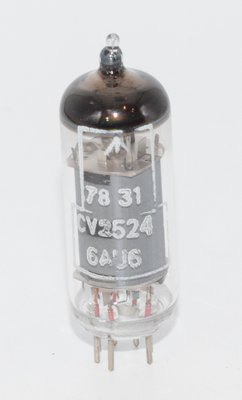
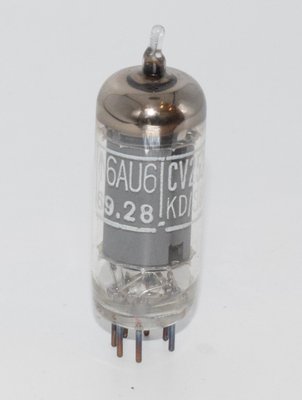
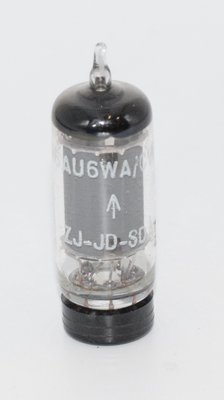
The 6AU6WA is a ruggedized, military-grade version of the popular 6AU6 sharp-cutoff pentode vacuum tube. Designed for demanding applications where reliability under harsh conditions was paramount, the 6AU6WA was developed to meet stringent military specifications (MIL-E-1/JAN standards) for vibration resistance, shock tolerance, extended life, and tighter parameter tolerances compared to the commercial 6AU6.
The original 6AU6 was introduced in the late 1940s as part of the post-war miniaturization movement in vacuum tube design. It quickly became one of the most widely used miniature pentodes, finding applications in virtually every type of electronic equipment from radio and television receivers to test instruments and industrial controls. The 'W' suffix denotes the ruggedized military variant, while the 'A' suffix indicates an improved version with enhanced specifications — typically tighter transconductance tolerances, better controlled characteristics, and improved mechanical construction.
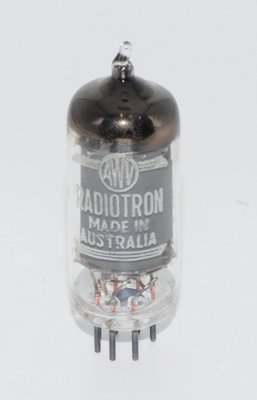
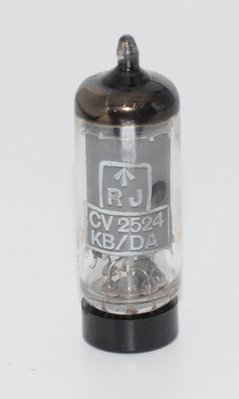
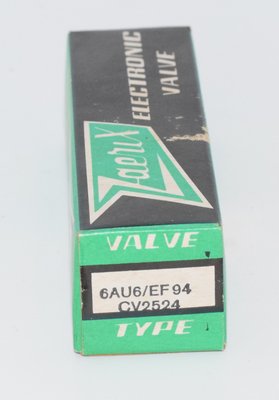
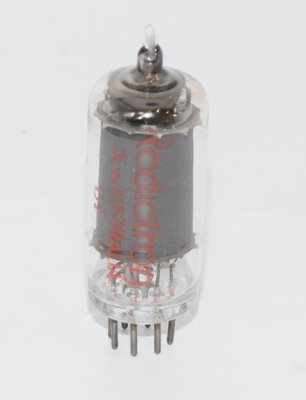
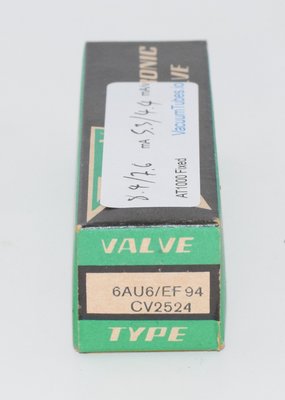
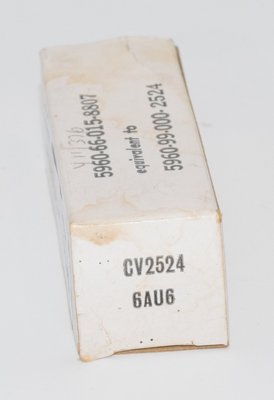
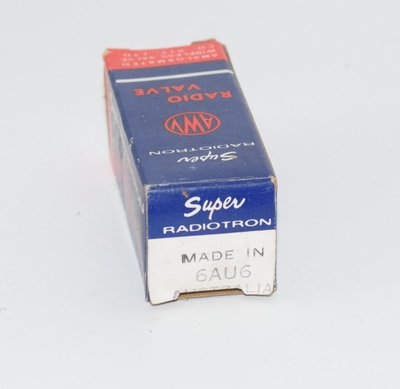
The 6AU6WA was manufactured by numerous companies worldwide, including major American firms (RCA, GE, Sylvania, Raytheon), European manufacturers (Mullard, Brimar), and companies in the Commonwealth such as Amalgamated Wireless Australia (AWA). Its NATO/CV designation is CV4023, under which it was widely used in British and allied military equipment.
The tube belongs to the broad family of 7-pin miniature sharp-cutoff pentodes that were the workhorses of mid-20th century electronics. Its combination of high transconductance, low noise capability, and versatile operating characteristics made it an enduring favorite among designers.
2. Technical Specifications and Design
General Description
The 6AU6WA is a miniature sharp-cutoff pentode designed for use as an RF amplifier, IF amplifier, or general-purpose voltage amplifier. It features a remote or semi-remote cutoff characteristic in some variants, but the standard 6AU6/6AU6WA is a sharp-cutoff type, making it suitable for applications requiring linear amplification and effective AGC (Automatic Gain Control) response.
Heater Ratings
| Parameter | Value |
|---|---|
| Heater Voltage (Eh) | 6.3 V |
| Heater Current (Ih) | 0.3 A |
Maximum Ratings (Absolute Maximum)
| Parameter | Value |
|---|---|
| Maximum Plate Voltage (Vp max) | 330 V |
| Maximum Screen Grid Voltage (Vg2 max) | 330 V |
| Maximum Plate Dissipation (Pp max) | 3.0 W |
| Maximum Screen Grid Dissipation (Pg2 max) | 1.0 W |
| Maximum Cathode Current (Ik max) | 20 mA |
| Maximum Heater-Cathode Voltage (Ehk) | ±100 V |
| Bulb Temperature (max) | 200°C (typical for W-rated types) |
Note: The 6AU6WA, being a military-grade tube, is tested and guaranteed to meet these ratings under more rigorous conditions than the commercial 6AU6. Values should be confirmed against the specific manufacturer's datasheet for the production lot in question, as minor variations exist between manufacturers.
Typical Operating Conditions (Class A Amplifier)
| Parameter | Condition 1 | Condition 2 |
|---|---|---|
| Plate Voltage (Vp) | 250 V | 150 V |
| Screen Grid Voltage (Vg2) | 150 V | 150 V |
| Control Grid Voltage (Vg1) | -1.0 V | -1.0 V |
| Plate Current (Ip) | ~5.2 mA | ~5.0 mA |
| Screen Current (Ig2) | ~1.8 mA | ~2.0 mA |
| Transconductance (gm) | ~5,200 µmhos (5.2 mA/V) | ~4,900 µmhos |
| Plate Resistance (rp) | ~1.0 MΩ | — |
| Amplification Factor (µ) | ~5,200 (calculated from gm × rp) | — |
Note: The amplification factor (µ) of sharp-cutoff pentodes is extremely high and somewhat variable; the figure of approximately 5,200 is a calculated value derived from gm × rp. In practice, pentodes are characterized primarily by their transconductance (gm) rather than µ, as the plate resistance is very high and varies significantly with operating conditions. Some datasheets list µ values in the range of 2,000–5,500 depending on the specific operating point.
Control Grid Bias Range
The 6AU6WA is a sharp-cutoff pentode. Typical grid bias for normal operation ranges from 0 V to approximately -8 V, with cutoff occurring at approximately -15 V to -20 V (depending on screen voltage). For AGC applications, the grid can be driven to cutoff smoothly due to the sharp-cutoff characteristic. The typical operating bias is -1.0 V for standard amplifier service at 150 V screen voltage.
Capacitances (Typical)
| Parameter | Value |
|---|---|
| Input Capacitance (Cin) | ~5.5 pF |
| Output Capacitance (Cout) | ~5.0 pF |
| Grid-to-Plate Capacitance (Cgp) | ~0.0035 pF |
Physical Construction
| Parameter | Detail |
|---|---|
| Base Type | Miniature 7-pin (B7G) |
| Envelope Type | T-6½ miniature glass envelope |
| Mounting Position | Any (military-rated for all orientations) |
| Overall Length | ~56 mm (2.2 inches) typical |
| Maximum Diameter | ~20 mm (0.8 inches) |
| Socket Required | 7-pin miniature (B7G) socket |
Pin-Out (B7G Base — Bottom View)
        Pin 1: No Connection (or internal shield — see note)
        Pin 2: Heater
        Pin 3: Plate (Anode)
        Pin 4: Screen Grid (G2)
        Pin 5: Suppressor Grid (G3) — internally connected to cathode in some versions
        Pin 6: Control Grid (G1)
        Pin 7: Heater & Cathode (common heater return)
        Shell/Shield: Internal shield (connected to Pin 1 in most versions)
Note: In the standard 6AU6 family, Pin 1 is connected to an internal shield between the control grid and the other elements, which is critical for low-noise RF/IF applications. This pin should typically be grounded for best performance. Pin 7 serves as both the heater return and the cathode connection. The suppressor grid (Pin 5) is internally connected to the cathode in most 6AU6 variants. Always verify the pinout against the specific manufacturer's datasheet, as minor variations can exist.
Military and Quality Specifications
The 6AU6WA is manufactured to meet or exceed MIL-E-1 (JAN) specifications. Key military-grade enhancements over the commercial 6AU6 include:
- Enhanced vibration and shock resistance (ruggedized internal structure)
- Tighter parameter tolerances (especially transconductance)
- Extended life testing and burn-in requirements
- Controlled heater warm-up characteristics
- Higher maximum ambient temperature ratings
- Lot-by-lot quality assurance testing
3. Applications and Usage
The 6AU6WA, like its commercial counterpart, is an extraordinarily versatile tube. Its primary applications include:
RF and IF Amplification
The 6AU6WA was extensively used as an intermediate frequency (IF) amplifier in radio and television receivers. Its high transconductance provides excellent gain, while the sharp-cutoff characteristic allows effective AGC control. The internal shield (Pin 1) minimizes grid-to-plate feedback, enabling stable high-frequency operation. It was commonly used at IF frequencies of 455 kHz (AM radio), 10.7 MHz (FM radio), and various television IF frequencies.
Military Electronics
As a MIL-spec tube, the 6AU6WA saw extensive use in military communications equipment, radar systems, electronic countermeasures (ECM) equipment, and shipboard/airborne electronics where reliability under extreme conditions was essential. Its ruggedized construction made it suitable for high-vibration environments such as aircraft and naval vessels.
Test and Measurement Equipment
Many classic test instruments from manufacturers like Hewlett-Packard, Tektronix, and Boonton used the 6AU6 family as voltage amplifiers, oscillator tubes, and buffer stages. The tighter tolerances of the WA variant made it particularly suitable for precision instrumentation.
Audio Amplification
The 6AU6WA serves well as a voltage amplifier (preamplifier) stage in audio circuits. Its high transconductance allows for significant voltage gain in a single stage, and its relatively low plate resistance (for a pentode) provides reasonable bandwidth. It is used in both triode-strapped and pentode configurations in audio preamplifiers, phono stages, and as driver stages for power tubes.
Oscillator Circuits
The tube's high gain and stable characteristics make it suitable for use in various oscillator circuits, including crystal oscillators, LC oscillators, and beat-frequency oscillators (BFOs).
Mixer/Converter Stages
In superheterodyne receivers, the 6AU6WA can be used as a mixer stage, taking advantage of its sharp-cutoff characteristic for clean signal mixing with minimal spurious responses.
4. Sound Characteristics
The 6AU6WA has developed a dedicated following among audiophiles and audio engineers, particularly those who appreciate the sonic qualities of sharp-cutoff pentodes in preamplifier and driver applications. Here is how the audio community generally characterizes its sound:
Pentode Mode
When operated as a pentode (with screen grid at a fixed positive voltage), the 6AU6WA delivers a sound that is often described as:
- Detailed and articulate: The high transconductance translates to excellent transient response and micro-detail retrieval. Fine textures in recordings — the shimmer of cymbals, the breath of a vocalist, the rosin on a bow — are rendered with clarity.
- Extended and airy treble: The wide bandwidth capability of the pentode configuration contributes to an open, spacious top end that audiophiles find appealing for classical music and acoustic recordings.
- Slightly forward midrange: Some listeners note a gentle presence-region emphasis that brings vocals and lead instruments slightly forward in the soundstage, lending an engaging, "alive" quality to the presentation.
- Tight, controlled bass: Compared to some triode stages, the pentode-mode 6AU6WA tends to produce bass that is well-defined and punchy rather than warm and bloomy.
- Wide, precise soundstage: The low grid-to-plate capacitance and high gain contribute to a presentation with good spatial separation and imaging.
Triode-Strapped Mode
When the screen grid is tied to the plate (triode-strapped), the 6AU6WA takes on a different character:
- Warmer and more liquid: The triode configuration reduces gain but introduces the more harmonically rich, even-order distortion profile that triode enthusiasts prize.
- Smoother treble: The top end becomes less extended but more refined, with a natural roll-off that many find musically pleasing.
- Fuller midrange: The midrange gains body and warmth, making this configuration particularly attractive for vocal-centric music and jazz.
- Reduced noise: Triode strapping generally reduces the shot noise contribution from the screen grid, resulting in a quieter background — beneficial in phono stages and high-gain applications.
Military-Grade Sonic Advantages
Audiophiles specifically seek out the WA (and CV4023) variants because the tighter manufacturing tolerances translate to:
- Lower microphonics compared to commercial 6AU6 tubes
- Better channel matching in stereo applications
- More consistent performance over the tube's lifetime
- Generally lower noise floor due to superior construction quality
The 6AU6WA is often compared favorably to the EF86 (6267) pentode, which is more commonly seen in audio circuits. While the EF86 is generally considered to have a slightly warmer, more "vintage" character, the 6AU6WA is praised for its greater clarity, lower noise potential, and more neutral tonal balance. Some designers and listeners prefer the 6AU6WA precisely because it is less colored, allowing the character of downstream tubes and the overall circuit topology to define the amplifier's voice.
5. Equivalent or Substitute Types
Direct/Identical Substitutes (Drop-in Replacements)
| Type | Notes |
|---|---|
| CV4023 | British military (CV) designation for the 6AU6WA. Identical specifications and pinout. Fully interchangeable. Manufactured by Mullard, Brimar, and others to tight military tolerances. |
| 6AU6WA (any manufacturer) | All 6AU6WA tubes from different manufacturers (RCA, GE, Sylvania, Raytheon, AWA, etc.) are interchangeable, though sonic character may vary slightly between brands. |
Different Rating Substitutes (NOT Direct Drop-in)
| Type | Notes |
|---|---|
| 6AU6WB | A further-improved military variant with potentially different rating tolerances or test conditions. While physically compatible (same B7G base and pinout), it may have different controlled characteristics. Not a guaranteed drop-in replacement in circuits designed specifically for 6AU6WA parameters. Check specific datasheet ratings before substituting. |
| CV8403 | A related CV-designated type with different ratings from the CV4023/6AU6WA. Not a direct drop-in substitute. Verify specifications before use. |
Closely Related Types (Use with Caution)
| Type | Notes |
|---|---|
| 6AU6 | The commercial (non-ruggedized) version. Electrically similar and physically identical (same B7G base and pinout). Can generally be used as a substitute in non-critical applications, but does not meet the tighter tolerances and ruggedization standards of the WA variant. May exhibit higher microphonics and wider parameter spread. |
| 6AU6A | An improved commercial version with controlled warm-up time. Generally interchangeable with the 6AU6WA in most circuits, but lacks full military qualification. |
| EF94 | European designation sometimes cross-referenced with the 6AU6 family. Verify pinout and ratings carefully before substituting, as some EF94 variants may have slightly different characteristics. |
Types That Are NOT Substitutes
The following tubes are sometimes confused with the 6AU6 family but are not interchangeable:
- 6AU6 vs. 6AK6: The 6AK6 is a power pentode with different characteristics and is not a substitute.
- 6AU6 vs. EF86 (6267): While both are miniature pentodes used in similar audio applications, they have completely different pinouts (the EF86 uses a 9-pin B9A/Noval base). They are absolutely not interchangeable without circuit redesign.
- 6AU6 vs. 6BA6: The 6BA6 is a remote-cutoff pentode with the same pinout. While it will physically fit, its remote-cutoff characteristic makes it unsuitable as a direct replacement in circuits designed for the sharp-cutoff 6AU6WA, particularly in AGC-controlled stages and audio applications where linearity matters.
6. Notable Characteristics
Sharp-Cutoff Design
The 6AU6WA's sharp-cutoff characteristic means that the tube's transconductance decreases relatively uniformly as the grid bias is made more negative, and the tube cuts off cleanly at a well-defined bias point. This is in contrast to remote-cutoff (variable-mu) types like the 6BA6, where the cutoff is gradual. The sharp-cutoff characteristic is advantageous in audio applications because it provides more linear amplification over the normal operating range and cleaner behavior when overdriven.
Internal Shield
One of the 6AU6's most notable design features is its internal electrostatic shield, connected to Pin 1. This shield is positioned between the control grid and the plate/screen grid assembly, dramatically reducing the grid-to-plate capacitance (Cgp) to approximately 0.0035 pF. This extremely low feedback capacitance enables stable high-gain operation at radio frequencies without neutralization. For audio applications, grounding Pin 1 ensures the lowest possible noise and best shielding from external interference.
Military-Grade Reliability
The 6AU6WA's ruggedized construction includes:
- Reinforced internal element supports to resist vibration and mechanical shock
- Tighter spot-welding and assembly tolerances
- Selected materials for longer cathode life
- Individual or lot-level testing to military acceptance criteria
- Controlled heater warm-up characteristics to prevent cathode stripping
These features make the 6AU6WA significantly more reliable and consistent than commercial 6AU6 tubes, which is why they command a premium in the audio market.
Versatility
Few miniature tubes match the 6AU6WA's versatility. It can be operated as:
- A pentode voltage amplifier (maximum gain)
- A triode-strapped amplifier (lower gain, lower noise, different harmonic character)
- An ultralinear-connected amplifier (screen tied to a tap on the plate load)
- A cascode amplifier element (paired with another tube for very high gain with low noise)
- An oscillator, mixer, or product detector
Low Noise Potential
When properly applied — with Pin 1 grounded, appropriate screen bypassing, and careful layout — the 6AU6WA is capable of very low noise performance. In triode-strapped mode, it approaches the noise performance of dedicated low-noise triodes, making it a viable choice for phono preamplifier stages and microphone preamps.
7. Usage in the Audio Community
Preamplifier and Phono Stage Applications
The 6AU6WA is most commonly encountered in audio as a high-gain voltage amplifier in preamplifier circuits. Its high transconductance allows a single stage to provide substantial gain — often 100× or more in pentode mode — making it useful in phono stages where the tiny signal from a moving-magnet or moving-coil cartridge must be amplified significantly. Designers such as those behind the classic Fisher, Scott, and Dynaco preamplifiers used 6AU6-family tubes in their front-end stages.
Guitar Amplifier Applications
While less common than the ubiquitous 12AX7 in guitar amplifiers, the 6AU6WA appears in several notable designs. Some boutique amplifier builders use it as a first gain stage for its unique tonal character — the pentode's higher gain and different harmonic distortion profile (more odd-order harmonics compared to triodes) can produce a grittier, more aggressive overdrive character that some players find desirable for certain musical styles. When triode-strapped, it offers a different flavor of clean tone compared to a 12AX7.
Headphone Amplifiers
The 6AU6WA has found a niche in the DIY headphone amplifier community. Its high gain makes it an excellent driver stage for power tubes in OTL (Output Transformer-Less) headphone amplifiers, and its compact size allows for smaller chassis designs. Several popular DIY headphone amplifier projects specify the 6AU6 or 6AU6WA.
Microphone Preamplifiers
Studio engineers and DIY audio enthusiasts have used the 6AU6WA in microphone preamplifier designs, taking advantage of its low noise capability (especially in triode mode) and high gain. Some vintage and vintage-inspired studio equipment uses this tube family in the signal path.
Tube Rolling and Collector Interest
The 6AU6WA/CV4023 is actively sought by tube rollers — audiophiles who swap different tube brands and vintages to fine-tune the sound of their equipment. Particularly prized examples include:
- Mullard CV4023: Often described as warm, rich, and musical with excellent midrange body. Highly sought after and commanding premium prices.
- Brimar CV4023: Known for a slightly more detailed and analytical presentation compared to Mullard, with excellent low-noise performance.
- Amalgamated Wireless Australia (AWA) 6AU6WA/CV4023: Australian-made NOS (New Old Stock) tubes that are increasingly collectible. AWA tubes are generally well-regarded for their consistent quality and are sought by collectors of Commonwealth military electronics.
- RCA 6AU6WA: American-made examples known for a balanced, neutral sound with good dynamics.
- GE 6AU6WA: Often characterized as having a slightly brighter, more detailed top end compared to RCA.
- Sylvania 6AU6WA: Praised for a smooth, refined presentation with good bass extension.
Availability and Market
The 6AU6WA remains relatively available as NOS (New Old Stock) due to the enormous quantities produced for military contracts during the Cold War era. Prices are generally moderate compared to more famous audio tubes like the EF86 or 12AX7, making the 6AU6WA an excellent value proposition for audiophiles seeking high-quality, military-grade tubes without paying premium prices. However, specific sought-after brands (particularly Mullard and Brimar CV4023) can command significantly higher prices.
Circuit Design Considerations for Audio Use
Audio designers working with the 6AU6WA should note the following practical considerations:
- Always ground Pin 1 (internal shield) for lowest noise and best shielding.
- Screen grid supply should be well-filtered and regulated for lowest noise in pentode mode; a series resistor and bypass capacitor are essential.
- Cathode bypass capacitor value significantly affects the low-frequency response and gain; a fully bypassed cathode gives maximum gain, while partial or no bypassing provides local negative feedback that reduces gain but improves linearity.
- Triode strapping (connecting screen to plate) reduces gain by roughly half but significantly lowers output impedance and noise, and changes the distortion character from predominantly odd-order to predominantly even-order harmonics.
- Plate load resistor values of 100 kΩ to 470 kΩ are typical for audio voltage amplifier service, with the choice affecting gain, bandwidth, and distortion characteristics.
- Microphonics: While the WA variant is significantly better than commercial 6AU6 tubes, socket dampers and careful mechanical isolation are still recommended in high-gain phono stage applications.
Summary
The 6AU6WA stands as a testament to the golden age of vacuum tube engineering — a versatile, reliable, and sonically capable tube that continues to find relevance in modern audio applications decades after its introduction. Its military-grade construction, tight tolerances, and excellent electrical characteristics make it a compelling choice for audio designers and enthusiasts who demand both performance and reliability. Whether used in a vintage restoration, a new boutique amplifier design, or a DIY project, the 6AU6WA rewards careful circuit design with engaging, detailed, and musical sound reproduction.