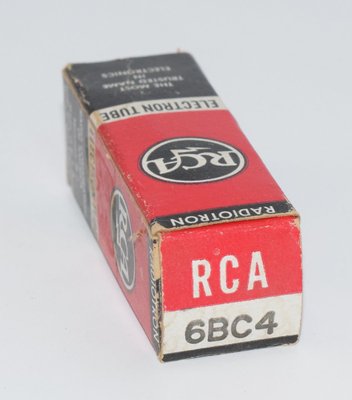
1. Introduction and History
The 6BC4 is a medium-mu miniature triode developed primarily for use as an RF amplifier in cathode-drive (grounded-grid) configurations within UHF television tuners. Designed to cover the frequency range of 470 to 890 MHz, the 6BC4 emerged during the early 1950s when the expansion of UHF television broadcasting in the United States created an urgent need for reliable, high-frequency receiving tubes capable of operating well into the ultra-high-frequency spectrum.
Manufactured by RCA and other major tube producers of the era, the 6BC4 was engineered with tight interelectrode capacitances and a compact miniature glass envelope to minimize parasitic effects at UHF frequencies. Its design reflects the transitional period in electronics when vacuum tubes were being pushed to their frequency limits before the widespread adoption of semiconductor devices for television front-end applications.
The tube was catalogued in the RCA Receiving Tube Manual and became a standard component in UHF converter boxes and integrated UHF tuner strips used in television receivers throughout the 1950s and into the 1960s. While its original application was firmly in the RF domain, the 6BC4's electrical characteristics — particularly its high transconductance and moderate amplification factor — have attracted attention from audio experimenters and enthusiasts in more recent decades.
2. Technical Specifications and Design
General Description
The 6BC4 is classified as a medium-mu triode in a miniature glass envelope. It was designed as an RF amplifier for cathode-drive circuits in UHF television tuners covering 470 to 890 MHz.
Heater Ratings
| Heater Voltage (ac/dc) | 6.3 volts |
| Heater Current | 0.225 ampere |
| Peak Heater-Cathode Voltage | ±75 max volts |
Direct Interelectrode Capacitances (Approx.)
| Grid to Plate | 1.6 pF |
| Grid to Heater and Cathode | 2.9 pF |
| Plate to Heater and Cathode | 0.26 pF |
| Heater to Cathode | 2.7 pF |
Class A1 Amplifier — Maximum Ratings (Design-Center Values)
| Plate Voltage | 250 volts |
| Cathode Current | 25 mA |
| Plate Dissipation | 2.5 watts |
Class A1 Amplifier — Characteristics
| Plate Supply Voltage | 150 volts |
| Cathode-Bias Resistor | 100 ohms |
| Amplification Factor (μ) | 48 |
| Plate Resistance (Approx.) | 4800 ohms |
| Transconductance (gm) | 10000 μmhos |
| Plate Current | 14.5 mA |
| Grid Voltage (Approx.) for plate current of 10 μA | −10 volts |
Maximum Circuit Values
| Grid-Circuit Resistance (fixed-bias operation) | Not recommended |
| Grid-Circuit Resistance (cathode-bias operation) | 0.5 megohm |
Physical Construction
- Envelope: Miniature glass (T-6½)
- Base: Miniature 9-contact (9-pin Noval) — designated as outline 6A in RCA documentation
- Socket Required: Miniature 9-contact socket
Pin Configuration (9DR Base)
The 6BC4 uses a 9-pin miniature (Noval) base with the following pin assignments, as shown in the RCA Receiving Tube Manual diagram labeled "9DR":
| Pin | Connection |
|---|---|
| 1 | Plate (P) |
| 2 | Grid (G2 — see note) |
| 3 | Grid (G) |
| 4 | Heater (H) |
| 5 | Heater (H) |
| 6 | Cathode (K) |
| 7 | Grid (G) |
| 8 | Grid (G) |
| 9 | Plate (P) |
Note: The 6BC4 uses a 9-pin base with multiple grid and plate connections to minimize lead inductance at UHF frequencies. The dual plate pins (1 and 9) and multiple grid connections are characteristic of tubes designed for very high frequency operation. Builders should consult the specific pinout diagram in the RCA manual (9DR base) to confirm connections for their particular application.
Key Derived Parameters
From the published specifications, the following relationships can be verified:
- μ = gm × rp = 10000 μmhos × 4800 ohms = 48 ✓ (matches published amplification factor)
- The tube operates at a quiescent bias point of approximately −1.45 V (derived from 14.5 mA through a 100-ohm cathode resistor) at 150 V plate supply
3. Applications and Usage
Original Design Intent
The 6BC4 was specifically designed for cathode-drive (grounded-grid) RF amplifier service in UHF television tuners. In this configuration, the grid is grounded for RF signals while the input signal is applied to the cathode, and the amplified output is taken from the plate. This grounded-grid topology was essential for stable operation at UHF frequencies (470–890 MHz) because it inherently provides excellent isolation between input and output, minimizing the feedback through the grid-to-plate capacitance that would otherwise cause oscillation.
Television Tuner Applications
In UHF television receivers of the 1950s and 1960s, the 6BC4 served as the first RF amplifier stage in the tuner strip. Its low interelectrode capacitances — particularly the grid-to-plate capacitance of only 1.6 pF and the remarkably low plate-to-heater/cathode capacitance of 0.26 pF — made it well-suited for operation at frequencies approaching 1 GHz. The multiple pin connections for grid and plate electrodes further reduced lead inductance, which is critical at UHF.
General RF Amplifier Service
Beyond television tuners, the 6BC4 found use in various RF amplifier applications where its combination of high transconductance (10000 μmhos) and moderate plate resistance (4800 ohms) provided good gain with reasonable bandwidth. The tube's characteristics made it suitable for:
- UHF converter boxes for adding UHF reception to VHF-only television sets
- Wideband RF preamplifiers
- Laboratory RF amplifier circuits
- Amateur radio UHF receiving equipment
Audio Amplifier Applications
While never intended for audio use, the 6BC4's electrical parameters make it an interesting candidate for experimental audio circuits. With a transconductance of 10000 μmhos, an amplification factor of 48, and a plate resistance of 4800 ohms, the 6BC4 occupies a middle ground between low-mu power triodes and high-mu voltage amplifier triodes. Its 2.5-watt plate dissipation rating allows it to function as a small signal amplifier or driver stage in audio equipment. The relatively low plate resistance of 4800 ohms is advantageous for driving subsequent stages or even serving as a low-power output stage with appropriate transformer matching.
4. Sound Characteristics
The 6BC4 was not designed as an audio tube, and as such, there is limited formal documentation of its sonic qualities. However, its electrical characteristics provide insight into its potential audio behavior, and experimenters who have employed it in audio circuits have noted several qualities:
Tonal Profile
With an amplification factor of 48 and a transconductance of 10000 μmhos, the 6BC4 falls into a category of medium-mu triodes that tend to produce a lively, detailed, and dynamically responsive sound. The high transconductance relative to its mu suggests a tube that responds quickly to signal changes, which translates to good transient response and a sense of immediacy in the audio presentation.
Harmonic Character
As a triode, the 6BC4 will predominantly generate second-harmonic distortion when driven into nonlinearity, which is generally perceived as warm and musically pleasant. The moderate amplification factor of 48 places it in a region where the harmonic spectrum is neither as sparse as a low-mu triode (like a 6AS7 or 2A3) nor as complex as a high-mu type (like a 12AX7). This suggests a balanced harmonic signature with a blend of warmth and clarity.
Dynamic Behavior
The 6BC4's very high transconductance of 10000 μmhos — which is exceptional for a tube of its size and dissipation class — gives it excellent signal-handling agility. In audio applications, this translates to:
- Fast, articulate transients — the tube can follow rapid signal changes with minimal lag
- Good microdynamic resolution — subtle variations in signal level are faithfully reproduced
- Extended high-frequency response — the tube's UHF heritage means it has no difficulty whatsoever with audio-frequency signals, and its bandwidth extends far beyond the audible range
Impedance Matching Considerations
The relatively low plate resistance of 4800 ohms means the 6BC4 can drive loads more effectively than higher-impedance triodes. In audio circuits, this translates to better damping characteristics and less sensitivity to load variations. When used as a driver stage, the low output impedance helps maintain signal integrity and reduces high-frequency rolloff caused by cable and interstage capacitance.
Noise Performance
Tubes designed for RF front-end service are typically engineered for low noise, as they must amplify weak antenna signals. The 6BC4 benefits from this design philosophy, and when used in audio circuits, it can be expected to exhibit relatively low microphonic noise and thermal noise compared to tubes not designed with such stringent noise requirements. However, individual specimens may vary, and NOS (New Old Stock) examples from quality manufacturers tend to perform best in this regard.
5. Equivalent or Substitute Types
Direct Equivalents
| Type | Notes |
|---|---|
| CV5038 | British military (CV) designation; close/identical substitute for the 6BC4. Direct replacement with identical specifications and pinout. |
Potentially Related Types
The 6BC4 occupies a somewhat unique niche as a 9-pin miniature medium-mu triode designed for UHF service. While other medium-mu triodes exist, direct substitution requires careful verification of pinout compatibility, heater ratings, and interelectrode capacitances. Some types that share certain characteristics but are not necessarily direct drop-in replacements include:
- 6AB4 / EC92 — Another miniature triode used in TV tuner applications, but with different specifications. Pin compatibility and electrical parameters should be verified before substitution.
- 6BC8/6BZ8 — A medium-mu twin triode (each section with μ=35, gm=6200 μmhos) used in VHF television tuners. Not a direct substitute due to being a dual triode with different pinout and characteristics, but related in application heritage.
Note: Due to the 6BC4's specialized 9-pin base configuration with multiple grid and plate connections optimized for UHF, substitution with other triode types requires careful analysis. The CV5038 remains the only verified close/identical substitute. Any other substitution should be confirmed against manufacturer datasheets for both electrical and mechanical compatibility.
6. Notable Characteristics
Exceptional Transconductance-to-Size Ratio
The 6BC4's transconductance of 10000 μmhos is remarkably high for a miniature triode with only 2.5 watts of plate dissipation and a heater drawing just 0.225 ampere. This high gm reflects the tube's closely spaced electrode structure, which was necessary for UHF operation but also makes it an efficient amplifying device at any frequency.
Multiple Pin Connections
The use of a 9-pin base with multiple connections for both the grid and plate electrodes is a distinctive feature of the 6BC4. This design reduces the inductance of the electrode leads, which is critical at UHF frequencies where even a few nanohenries of lead inductance can significantly affect circuit performance. In audio applications, this feature is of less practical significance but does contribute to the tube's extremely wide bandwidth capability.
Very Low Plate-to-Cathode Capacitance
The plate-to-heater/cathode capacitance of only 0.26 pF is exceptionally low, even by miniature tube standards. This was a key design goal for UHF grounded-grid amplifier service, where this capacitance directly affects the input impedance and bandwidth of the amplifier stage.
Cathode-Bias Only Operation
The RCA data specifies that fixed-bias operation is "Not recommended" for the 6BC4, with only cathode-bias operation permitted (with a maximum grid-circuit resistance of 0.5 megohm). This restriction suggests that the tube's grid characteristics may not be sufficiently well-controlled for safe fixed-bias operation, or that the tube's intended grounded-grid application made fixed-bias provisions unnecessary. Audio designers should take note of this limitation and use cathode-bias (self-bias) configurations.
Moderate Amplification Factor
The amplification factor of 48 places the 6BC4 in the medium-mu category. This is high enough to provide useful voltage gain in a single stage but low enough to maintain good linearity and a manageable plate resistance. The combination of μ=48 with rp=4800 ohms yields a tube that can drive a variety of loads effectively.
Cutoff Characteristics
The grid voltage for plate current of 10 μA is approximately −10 volts, indicating a moderately sharp cutoff characteristic. This means the tube transitions relatively quickly from full conduction to cutoff, which is relevant for both RF (signal handling) and audio (clipping behavior) applications.
7. Usage in the Audio Community
Niche Experimental Status
The 6BC4 remains a relatively obscure choice in the audio community, primarily because it was never marketed as an audio tube and its original application in UHF television tuners places it outside the mainstream awareness of most tube audio enthusiasts. However, a small but dedicated group of experimenters and DIY audio builders have explored its potential, drawn by its impressive specifications and the availability of NOS examples at reasonable prices.
Voltage Amplifier and Driver Stage Applications
In audio circuits, the 6BC4 is most commonly employed as a voltage amplifier or driver stage. Its amplification factor of 48 provides sufficient gain for most line-level and driver applications, while its high transconductance of 10000 μmhos ensures excellent signal-handling capability. The low plate resistance of 4800 ohms makes it particularly effective as a driver for power tubes, where the ability to deliver current into capacitive loads (such as the grid circuit of a power tube or an interstage transformer) is important.
Headphone Amplifier Designs
The 6BC4's combination of moderate gain, low output impedance, and small physical size makes it an attractive candidate for headphone amplifier designs. With a plate dissipation of 2.5 watts, it can deliver meaningful power levels for headphone listening, and its low plate resistance provides good damping for dynamic headphone drivers. The 9-pin miniature base allows for compact amplifier layouts.
Grounded-Grid Audio Amplifiers
Given the 6BC4's heritage as a grounded-grid RF amplifier, some audio experimenters have explored grounded-grid audio amplifier topologies using this tube. In a grounded-grid configuration, the tube provides voltage gain with very low input impedance and excellent isolation between input and output. While this topology is less common in audio than the conventional grounded-cathode configuration, it offers unique advantages including inherent stability and the ability to accept low-impedance signal sources directly.
SRPP and Mu-Follower Circuits
The 6BC4's parameters make it suitable for use in SRPP (Shunt-Regulated Push-Pull) and mu-follower circuits, where its high transconductance contributes to low output impedance and its moderate mu provides useful gain. These circuit topologies are popular in high-end audio preamplifier designs, and the 6BC4 can serve as an interesting alternative to more commonly used types like the 6DJ8/6922 or 12AU7.
Availability and Sourcing
NOS (New Old Stock) 6BC4 tubes are available from various vintage tube dealers, though they are not as commonly stocked as mainstream audio tubes. RCA-manufactured examples are considered the reference standard, as RCA was the primary designer and manufacturer of this type. The CV5038 military equivalent may also be found through surplus channels and can offer excellent quality due to the stringent testing requirements of military procurement. Prices for NOS 6BC4 tubes tend to be moderate, as demand from the audio community remains relatively low compared to popular audio tube types.
Community Perception
Among the small community of experimenters who have used the 6BC4 in audio applications, the tube is generally regarded as a hidden gem — a high-performance device that offers excellent measured specifications at a fraction of the cost of fashionable audio tubes. Its high transconductance, in particular, is frequently cited as a standout feature that contributes to a sense of speed and detail in audio reproduction. The tube's RF heritage is seen as both a curiosity and an advantage, as the engineering that went into minimizing parasitic effects at UHF frequencies results in a device that is essentially transparent at audio frequencies.
However, the 6BC4's 9-pin base with its unconventional pin assignments (multiple grid and plate connections) can present challenges for circuit designers accustomed to standard audio tube pinouts. Additionally, the manufacturer's recommendation against fixed-bias operation limits some circuit topologies. These factors, combined with the tube's relative obscurity, mean that the 6BC4 is unlikely to achieve mainstream popularity in the audio community but will continue to reward adventurous builders who are willing to explore beyond the conventional tube audio palette.