1. Introduction and History
The 6BE6 is a miniature pentagrid converter tube (heptode) developed in the late 1940s as part of the post-war transition from octal to miniature glass envelope designs. It was designed primarily as a combined local oscillator and mixer for superheterodyne radio receivers, replacing older octal pentagrid converters such as the 6SA7 and 6A8 in a more compact and efficient package.
The pentagrid converter concept — combining the oscillator and mixer functions into a single tube — was a hallmark of mid-20th century receiver design. The 6BE6 became one of the most widely produced tubes in this category, manufactured by virtually every major tube maker worldwide including RCA, Sylvania, GE, Philips, Mullard, Telefunken, and numerous others. Its European designation is EK90, following the Mullard-Philips naming convention where 'E' denotes a 6.3V heater and 'K' denotes a heptode mixer.
Production of the 6BE6 spanned from approximately 1948 through the late 1960s in Western factories, with production continuing longer in Eastern Europe and Asia. It was a staple of the "All American Five" and similar consumer radio designs, appearing in millions of AM receivers, communications receivers, and some early television tuners. Australian production by companies such as Philips (Hendon) and AWV Radiotron ensured widespread availability in the Southern Hemisphere as well.
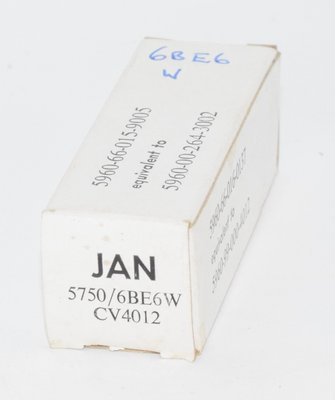
The tube was also produced in ruggedized military versions, notably the 6BE6W (also designated CV4012 under British military nomenclature), which featured enhanced construction for vibration resistance and tighter parameter tolerances.
2. Technical Specifications and Design
General Description
The 6BE6 is a pentagrid converter (heptode) with seven electrodes: a cathode, five grids, and a plate (anode). Grids 1 and 2 form the oscillator section, grid 3 is the signal input grid, and grids 4 and 5 are internally connected and serve as screen and suppressor functions for the mixer section. This arrangement allows a single tube to perform both local oscillator generation and signal mixing in a superheterodyne receiver.
Heater Ratings
| Parameter | Value |
|---|---|
| Heater Voltage (Vh) | 6.3 V |
| Heater Current (Ih) | 0.3 A |
Maximum Ratings (Absolute)
| Parameter | Value |
|---|---|
| Maximum Plate (Anode) Voltage (Va max) | 330 V |
| Maximum Screen Grid Voltage (Vg2 max) | 110 V |
| Maximum Plate Dissipation (Pa max) | 1.1 W |
| Maximum Screen Grid Dissipation (Pg2 max) | 1.1 W |
Typical Operating Conditions — Frequency Changer (Condition 1)
| Parameter | Value |
|---|---|
| Plate Voltage (Va) | 250 V |
| Screen Grid Voltage (Vg2) | 100 V |
| Grid 1 Voltage (Vg1) | −1.5 V |
| Plate Current (Ia) | 2.9 mA |
| Screen Grid Current (Ig2) | 6.8 mA |
| Plate Resistance (Ra / rp) | 1,000,000 Ω (1 MΩ) |
| Conversion Transconductance (Sc) | 0.475 mA/V |
Typical Operating Conditions — Frequency Changer (Condition 2)
| Parameter | Value |
|---|---|
| Plate Voltage (Va) | 100 V |
| Screen Grid Voltage (Vg2) | 100 V |
| Grid 1 Voltage (Vg1) | −1.5 V |
| Plate Current (Ia) | 2.6 mA |
| Screen Grid Current (Ig2) | 7.0 mA |
| Plate Resistance (Ra / rp) | 400,000 Ω (400 kΩ) |
| Conversion Transconductance (Sc) | 0.455 mA/V |
Note: The transconductance values listed above (0.475 mA/V and 0.455 mA/V) represent conversion transconductance (Sc), which is the ratio of IF output current to signal grid voltage in mixer operation. This is distinct from the static mutual conductance (gm) of any individual grid. The amplification factor (μ) for the signal grid is not commonly specified for pentagrid converters in the same manner as triodes or pentodes, as the tube's primary function is frequency conversion rather than linear amplification. Consult the full manufacturer datasheet for complete characteristic curves.
Physical Construction
| Parameter | Detail |
|---|---|
| Base Type | Miniature 7-pin (B7G) |
| Envelope | T-6½ miniature glass |
| Mounting Position | Any |
| Overall Length | Approximately 55 mm (2.17") |
| Maximum Diameter | Approximately 20 mm (0.78") |
Pin Configuration (B7G Base — Bottom View)
        Pin 1: Signal Grid (Grid 3 / G3)
        Pin 2: Plate (Anode)
        Pin 3: Heater
        Pin 4: Heater
        Pin 5: Oscillator Grid (Grid 1 / G1)
        Pin 6: Cathode
        Pin 7: Screen Grids (Grids 2, 4 / G2+G4)
Note: Grid 5 (suppressor) is internally connected to the cathode in most versions. The pin numbering follows standard B7G convention viewed from the bottom of the socket. Always verify against the specific manufacturer's datasheet, as some sources may describe the grid numbering differently depending on convention used.
3. Applications and Usage
The 6BE6 was designed specifically for frequency conversion (mixer/oscillator) service in superheterodyne receivers, and this remained its dominant application throughout its production life.
Primary Applications
- AM Broadcast Receivers: The 6BE6 was the standard converter tube in countless AM radio designs from the late 1940s through the 1960s. In the classic "All American Five" AC/DC radio (using the 12BE6 variant for series heater operation), it served as the first active stage, combining local oscillator generation with signal mixing to produce the 455 kHz intermediate frequency.
- Communications Receivers: Higher-quality communications receivers used the 6BE6 in their front-end converter stages, often with more elaborate oscillator circuits and better shielding than consumer radios. Examples include various Hallicrafters, National, and Hammarlund receivers.
- Shortwave Receivers: The tube's ability to operate reliably across a wide frequency range made it suitable for multi-band shortwave receivers.
- Television Tuners: Some early television receivers employed the 6BE6 in VHF tuner sections, though it was eventually superseded by higher-frequency types.
- Test Equipment: Signal generators and frequency converters in test instruments occasionally used the 6BE6.
Circuit Considerations
In typical operation, the oscillator section (grids 1 and 2) is connected in a Hartley, Colpitts, or other LC oscillator configuration. The incoming RF signal is applied to grid 3 (the signal grid), and the resulting mixed output at the intermediate frequency appears at the plate. The very high plate resistance (up to 1 MΩ) means that the IF transformer connected to the plate presents a relatively low impedance compared to the tube's internal resistance, which is typical for converter service.
The relatively low conversion transconductance (approximately 0.45–0.48 mA/V) is normal for pentagrid converters and is adequate for standard IF amplifier chain designs. AGC (Automatic Gain Control) voltage is typically applied to grid 3 to control the conversion gain.
4. Sound Characteristics
The 6BE6 was not designed as an audio amplifier, and its sonic characteristics are therefore discussed primarily in the context of its influence on the overall sound of radio receivers and, more recently, in experimental audio circuits built by hobbyists and DIY enthusiasts.
In Radio Receiver Service
As a frequency converter, the 6BE6 contributes to the overall character of the received audio in subtle but measurable ways:
- Noise Performance: Pentagrid converters are inherently noisier than triode-based mixer designs due to partition noise — the statistical variation in current division among the multiple grids. This gives receivers using the 6BE6 a slightly higher noise floor compared to those using separate triode oscillator and mixer stages. In practice, this is rarely objectionable on AM broadcast reception where atmospheric and man-made noise dominate.
- Intermodulation and Spurious Responses: The nonlinear mixing process in the 6BE6 can produce spurious responses and intermodulation products, particularly with strong signals. This can manifest as faint "birdies" or whistles at certain dial positions — a characteristic familiar to vintage radio enthusiasts.
- Warmth and Character: Vintage radio aficionados often describe the overall sound of receivers using the 6BE6 converter stage as having a warm, slightly soft quality. This is partly attributable to the gentle AGC action on the signal grid and the bandwidth-limiting effects of the IF transformers that follow.
In Experimental Audio Circuits
Some adventurous DIY audio builders have experimented with the 6BE6 in unconventional audio applications, including:
- Low-gain preamplifier stages: Using the tube in a pentode-like configuration (with the oscillator grids tied appropriately), the 6BE6 can serve as a quirky, low-gain voltage amplifier. The sound is typically described as soft, warm, and somewhat compressed, with a gentle roll-off at frequency extremes.
- Ring modulator and tremolo circuits: The pentagrid structure lends itself naturally to signal multiplication, making the 6BE6 useful in tremolo and vibrato circuits for guitar amplifiers and electronic organs. The modulation character is described as smooth and organic.
- Distortion character: When driven into nonlinear operation, the 6BE6 produces a complex mix of harmonics due to its multi-grid structure. The distortion is generally described as fuzzy and harmonically rich rather than the clean clipping of a triode or the harder edge of a conventional pentode.
Overall, the 6BE6 is not considered an audiophile-grade tube for high-fidelity signal path use, but it has a distinctive character that appeals to experimenters and those seeking unusual tonal textures.
5. Equivalent or Substitute Types
Direct / Identical Substitutes (Drop-in Replacements)
| Type | Notes |
|---|---|
| EK90 | European (Mullard-Philips) designation for the same tube. Electrically and physically identical. Direct drop-in replacement. |
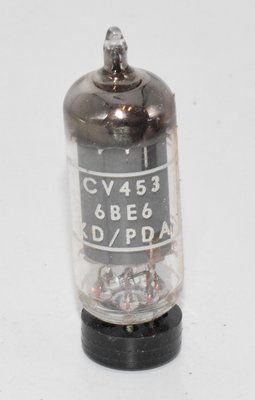
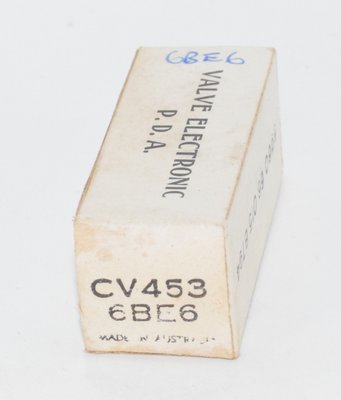
| CV453 | British military (CV) designation for the 6BE6/EK90. Identical specifications, often with tighter quality control. |
| CV10496 | Another British CV registration number for the 6BE6 type. Direct equivalent. |
| CV8201 | British CV designation, equivalent to 6BE6. Direct replacement. |
| X727 | Alternate designation equivalent to 6BE6. Direct replacement. |
Related Types — NOT Direct Drop-in Replacements
| Type | Difference |
|---|---|
| 12BE6 | Electrically similar but with a 12.6V / 0.15A heater for series-string (AC/DC) receiver designs. Not interchangeable without heater circuit modification. Pin connections differ for the heater. |
| 6BE6W | Ruggedized military version (also CV4012). Generally interchangeable with the standard 6BE6 but built to tighter tolerances and with enhanced mechanical construction. May have slightly different physical dimensions. |
| EK90W | European designation for the ruggedized version. Similar relationship to EK90 as 6BE6W has to 6BE6. |
| HK90 | A related type with different heater ratings. Not a direct drop-in replacement; verify heater voltage and current before substituting. |
Functional (But Not Pin-Compatible) Alternatives
- 6SA7 / 6SA7GT: Octal-based pentagrid converter with similar function but different base (octal) and pinout. Cannot be substituted without socket change.
- 6A8 / 6A8G: Older octal pentagrid converter. Similar function, different base and somewhat different characteristics.
- ECH81 (6AJ8): Triode-heptode converter in a 9-pin (B9A) envelope. Different approach to frequency conversion with separate triode oscillator section. Not pin-compatible.
6. Notable Characteristics
- Extremely High Plate Resistance: The 6BE6's plate resistance of up to 1 MΩ (at 250V plate voltage) is a defining characteristic. This means the tube behaves almost as a constant-current device, and the conversion gain is determined primarily by the external load impedance (IF transformer) rather than the tube's internal resistance.
- Low Plate Current, High Screen Current: An unusual feature of the 6BE6 is that the screen grid current (6.8–7.0 mA) significantly exceeds the plate current (2.6–2.9 mA). This is characteristic of pentagrid converters where a substantial portion of the cathode current is intercepted by the screen grids. Designers must account for this when calculating power supply requirements.
- Partition Noise: The multi-grid structure inherently produces partition noise as electrons are randomly divided among the various electrodes. This makes the 6BE6 noisier than triode-based mixer alternatives, a trade-off accepted for the convenience of single-tube frequency conversion.
- Oscillator Pulling: In some circuit configurations, strong signals applied to grid 3 can affect the oscillator frequency ("pulling"), causing detuning. Good circuit design with adequate isolation and buffering minimizes this effect.
- Widespread Availability: Due to the enormous production quantities, NOS (New Old Stock) 6BE6 tubes remain readily available and inexpensive. They were manufactured by dozens of companies worldwide, including RCA, Sylvania, GE, Tung-Sol, Raytheon, Philips, Mullard, Telefunken, Valvo, Amperex, AWV Radiotron, Matsushita, and many others.
- Robustness: The 6BE6 is generally a reliable and long-lived tube in normal service. The military 6BE6W variant is particularly robust, designed to withstand mechanical shock and vibration in military equipment.
- Sensitivity to Heater-Cathode Leakage: As with many miniature tubes, aged 6BE6 specimens can develop heater-to-cathode leakage, which introduces hum into the oscillator circuit. This is a common failure mode in vintage radios and is easily diagnosed with a tube tester.
7. Usage in the Audio Community
While the 6BE6 is fundamentally a radio-frequency tube, it has found a niche following in the audio community, particularly among DIY builders, experimenters, and those who appreciate unconventional circuit designs.
Vintage Radio Restoration
The largest audio-related use of the 6BE6 remains in the restoration and maintenance of vintage AM radio receivers. The vibrant community of antique radio collectors and restorers relies on NOS 6BE6 tubes to keep classic receivers operational. The tube's contribution to the overall "vintage radio sound" — warm, slightly bandwidth-limited, with a characteristic AM quality — is valued by collectors who prize authentic performance.
Guitar Effects and Experimental Circuits
The 6BE6 has attracted interest from guitar effects builders who exploit its pentagrid structure for:
- Tremolo/Vibrato circuits: The ability to modulate one signal with another using the separate grid structures makes the 6BE6 a natural choice for tube-based tremolo and vibrato effects. Several boutique pedal and effects unit designs incorporate the 6BE6 for this purpose, producing a smooth, organic modulation that is difficult to replicate with solid-state components.
- Ring modulators: The multiplicative nature of the pentagrid converter makes it suitable for ring modulator circuits, producing the characteristic sum-and-difference frequency outputs used for metallic, bell-like, or otherworldly sound effects.
- Frequency mixers for experimental music: Electronic music experimenters and noise artists have used the 6BE6 in its intended mixer role to create unusual heterodyne effects and frequency-shifted audio.
Low-Power Amplifier Experiments
Some hobbyists have built low-power headphone amplifiers and preamplifiers using the 6BE6, wiring it in various configurations (triode-strapped, pentode-mode with grids tied together, etc.). These projects are typically undertaken for the joy of experimentation rather than for high-fidelity performance. The results are described as having a unique, characterful sound — warm and soft with a vintage quality that some listeners find appealing for casual listening.
Availability and Cost
One significant advantage of the 6BE6 for audio experimenters is its exceptional availability and low cost. Because hundreds of millions were manufactured and the tube has limited demand compared to popular audio types like the 12AX7 or EL34, NOS 6BE6 tubes can typically be purchased for very modest prices. This makes them ideal for experimentation — builders can afford to try unusual circuits without worrying about the cost of rare or expensive tubes.
Collectibility
While not a high-value collector's item, certain variants of the 6BE6 are sought after by vintage radio enthusiasts:
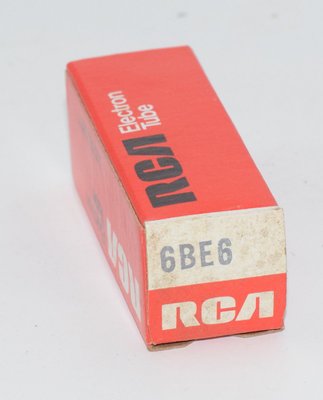
- Early RCA red-letter production examples are prized for their quality and historical significance.
- Philips Hendon (Australia) and AWV Radiotron branded examples (designated CV453 or 6BE6) are collected by Australian vintage radio enthusiasts.
- JAN (Joint Army-Navy) 6BE6W / CV4012 military-grade tubes are valued for their superior construction and tight tolerances.
- Telefunken and Mullard EK90 branded examples carry a modest premium among European vintage radio collectors.
In summary, while the 6BE6 will never rival the 12AX7 or 6L6 in audio fame, it occupies a charming and useful niche in the audio community — as a vital component in vintage radio restoration, a creative tool for effects builders, and an affordable platform for tube circuit experimentation.