1. Introduction and History
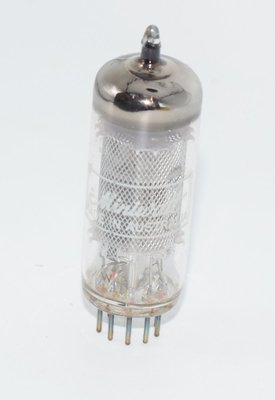
The 6BH5A is a beam power pentode vacuum tube developed in the mid-20th century, primarily manufactured by Philips under their Miniwatt brand in Australia. This tube emerged during the golden era of valve technology when audio amplification and television circuits were predominantly tube-based. The 6BH5A represents an evolution in the beam power tube family, designed to provide efficient power amplification with relatively low distortion characteristics.
Philips Miniwatt was known for producing high-quality vacuum tubes, and their Australian manufacturing facilities maintained strict quality standards. The 6BH5A was part of their specialized lineup aimed at specific applications in audio and video equipment of the era, particularly in the Australian and broader Oceania markets where Philips had a significant presence.
2. Technical Specifications and Design
The 6BH5A is a beam power pentode with the following specifications:
- Heater/Filament: 6.3V at approximately 0.8A
- Plate Voltage (Max): 300V
- Screen Voltage (Max): 300V
- Plate Dissipation: 10W
- Screen Dissipation: 2.5W
- Transconductance: Approximately 7,500-8,000 μmhos
- Base Type: 9-pin miniature (Noval)
- Envelope: Glass, typically with a T-9 bulb
The internal design of the 6BH5A features the classic beam power pentode structure with cathode, control grid, screen grid, beam-forming plates, and anode (plate). The beam-forming plates help direct the electron flow into concentrated beams, improving efficiency and reducing screen current. This design allows the tube to deliver relatively high power output while maintaining good linearity.
The 9-pin miniature base configuration represented the industry's move toward more compact tube designs compared to the earlier octal-based power tubes, allowing for more space-efficient equipment designs.
3. Applications and Usage
The 6BH5A found its primary applications in:
- Audio Power Amplifiers: Particularly in single-ended and push-pull configurations for radio receivers and smaller hi-fi systems
- Television Circuits: Often used as video output amplifiers in black and white television receivers
- Industrial Equipment: Various control and amplification applications where moderate power was required
- Radio Transmitters: Occasionally used in low-power stages of amateur radio equipment
In audio applications, the 6BH5A was appreciated for its ability to deliver clean power with acceptable distortion characteristics. A single 6BH5A in Class A operation could typically deliver 4-5 watts of audio power, while push-pull pairs could achieve 10-12 watts with reduced distortion.
In television circuits, the tube's relatively high transconductance made it suitable for video amplification tasks where bandwidth and gain were important considerations.
4. Equivalent or Substitute Types
The 6BH5A can be substituted with several other tube types, though exact matching depends on the specific circuit requirements:
- 6BQ5/EL84: Perhaps the closest equivalent, with similar characteristics though not identical
- 6CW5/EL86: Another potential substitute with comparable power capabilities
- 6P15P: Eastern European equivalent to the EL84, can often substitute for 6BH5A
- 7189: Industrial version of the 6BQ5/EL84 with slightly higher ratings
When substituting, it's important to consider that while these tubes may physically fit and function in place of the 6BH5A, circuit adjustments may be necessary to accommodate differences in operating characteristics. Bias settings, in particular, might need adjustment to ensure proper operation and tube longevity.
5. Notable Characteristics
The 6BH5A exhibits several notable characteristics that made it valuable for its intended applications:
- Efficiency: Good power output relative to its size and power consumption
- Linearity: Relatively low distortion characteristics, particularly when properly biased
- Reliability: The Philips Miniwatt production was known for consistent quality and long service life
- Heat Dissipation: Effective thermal characteristics allowing for sustained operation
- Gain: High gain factor making it suitable for applications requiring significant amplification
Audiophiles and vintage equipment enthusiasts often note that the Philips Miniwatt Australian-made tubes, including the 6BH5A, have a slightly different sonic signature compared to their European or American counterparts. Some describe this as a warmer, more detailed midrange response, though such characteristics are subjective and can vary based on the specific circuit implementation.
The 6BH5A has become increasingly collectible as New Old Stock (NOS) examples become scarcer. The Philips Miniwatt Australia production is particularly sought after by vintage audio enthusiasts for restoration projects and premium tube amplifiers.
In conclusion, the 6BH5A represents a well-engineered beam power pentode from the mature era of vacuum tube technology, offering a balance of performance characteristics that made it versatile across various applications in its heyday.