Introduction and History
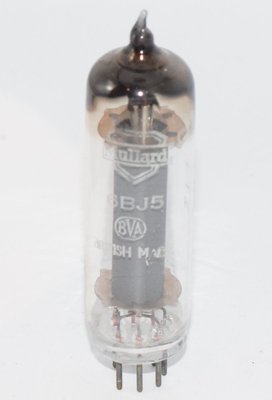
The 6BJ5 is a miniature power pentode valve originally developed and released by Amalgamated Wireless Valve Co., Ltd (AWV) of Sydney, Australia. The tube was registered through RTMA release #930, dated November 21, 1950, placing it firmly in the early 1950s era of miniature valve development. AWV was a major Australian valve manufacturer, and the 6BJ5 was designed for audio output service in radio receivers and amplifiers of the period.
The 6BJ5 was also manufactured by Mullard in the United Kingdom, with NOS (New Old Stock) examples from Mullard still appearing on the collector and audiophile market. The tube was primarily intended for single-ended Class A audio output stages, where its moderate power output and reasonable efficiency made it well-suited for domestic radio receivers and small amplifiers popular in the Australian and British Commonwealth markets.
As a product of the post-war miniaturization trend, the 6BJ5 utilized the compact miniature button 7-pin base (B7G) and the T5½ envelope, making it significantly smaller than the earlier octal-based power pentodes it was designed to complement or replace in certain applications.
Technical Specifications and Design
Mechanical Data
| Parameter | Value |
|---|---|
| Style | Miniature |
| Cathode | Coated, unipotential |
| Bulb (Envelope) | T5½ |
| Base | Miniature button 7-pin (B7G) |
| Maximum Overall Length | 2-3/4 inches |
| Maximum Diameter | 3/4 inch |
| Basing | 6CH |
Pin Connections
| Pin | Connection |
|---|---|
| Pin 1 | Control Grid (G1) |
| Pin 2 | Cathode and Suppressor (G3) |
| Pin 3 | Heater |
| Pin 4 | Heater |
| Pin 5 | Plate (Anode) |
| Pin 6 | Internal Connection (do not use) |
| Pin 7 | Screen Grid (G2) |
Note that the suppressor grid (G3) is internally connected to the cathode at Pin 2. Pin 6 is an internal connection and should not be connected to any external circuit.
Absolute Maximum Ratings (Design Center Values)
| Parameter | Value |
|---|---|
| Plate Voltage | 350 max. Volts |
| Screen Voltage | 275 max. Volts |
| Plate Dissipation | 9 max. Watts |
| Screen Dissipation | 3.0 max. Watts |
Typical Operating Conditions — Single Tube, Class A
| Parameter | Value |
|---|---|
| Heater Voltage | 6.3 Volts |
| Heater Current | 0.64 Amps |
| Plate Voltage | 250 Volts |
| Screen Voltage | 250 Volts |
| Grid Voltage (Bias) | −5.0 Volts |
| Plate Current | 35 mA |
| Screen Current | 5.5 mA |
| Mutual Conductance (Transconductance, gm) | 10,500 µmhos |
| Amplification Factor (µ) | 420 |
| Plate Resistance (rp) | 40,000 ohms |
| Plate Load Resistance | 7,000 ohms |
| Power Output | 4 Watts |
| Distortion | 9.2% |
Key Electrical Characteristics Analysis
The 6BJ5 exhibits a notably high transconductance of 10,500 µmhos (10.5 mA/V), which is impressive for a miniature power pentode of this era. Combined with a high amplification factor of 420 and a plate resistance of 40,000 ohms, these figures indicate a tube with excellent gain characteristics and strong sensitivity to grid voltage changes.
The relatively low bias voltage of −5.0 Volts means the tube requires only a modest signal swing to reach full output, making it easy to drive from a preceding voltage amplifier stage. The 4-watt power output in Class A single-ended operation, while modest by modern standards, was entirely adequate for domestic radio receivers of the 1950s and is of considerable interest to modern low-power audiophile amplifier builders.
The 9.2% total harmonic distortion figure at rated output is typical for a pentode operated in this configuration. In practice, this distortion figure can be significantly reduced through the application of negative feedback or by operating the tube in ultralinear or triode-strapped modes.
Applications and Usage
The 6BJ5 was primarily designed for use as an audio frequency power amplifier in single-ended Class A configurations. Its principal applications included:
- Radio Receiver Output Stages: The tube's 4-watt output capability made it ideal for the audio output stage of AM and shortwave radio receivers, which were the primary consumer electronics of the early 1950s in Australia and the broader Commonwealth market.
- Small Public Address Systems: In applications where modest power was sufficient, the 6BJ5 could serve as the output stage in small PA amplifiers.
- Instrument Amplifiers: The tube's characteristics made it suitable for small practice amplifiers and test equipment audio output stages.
- Industrial and Military Equipment: Australian-made military and industrial communications equipment of the era sometimes employed locally manufactured valves like the 6BJ5.
The tube's design for 250V plate and screen operation with a simple cathode bias arrangement (achievable with a cathode resistor of approximately 123 ohms, calculated from the 5V bias divided by the combined plate and screen current of approximately 40.5 mA) made it straightforward to implement in practical circuits.
With a recommended plate load resistance of 7,000 ohms, a standard output transformer with a primary impedance in this range would be paired with the 6BJ5 to drive typical loudspeaker loads of 4–16 ohms.
Sound Characteristics
The 6BJ5, like many power pentodes of its generation, possesses a distinctive sonic character that has attracted attention from the audiophile community, particularly among enthusiasts of single-ended amplifier designs:
- Tonal Balance: In pentode mode, the 6BJ5 delivers a lively, detailed sound with pronounced upper-midrange presence. The high transconductance of 10,500 µmhos contributes to a sense of immediacy and dynamic responsiveness that many listeners find engaging.
- Harmonic Structure: As a pentode, the 6BJ5 produces a mix of even and odd-order harmonics. The odd-order harmonics give the tube a slightly more assertive, "forward" character compared to triode-connected operation. When triode-strapped (screen tied to plate), the harmonic profile shifts toward predominantly even-order harmonics, yielding a warmer, smoother presentation at the expense of reduced output power (typically around 1.5–2 watts).
- Bass Response: The relatively low plate resistance of 40,000 ohms (compared to some beam tetrodes) provides reasonable damping of the output transformer and loudspeaker, though not as tight as triode operation. Bass reproduction tends to be full and somewhat warm, with a slight softness that many find musically pleasing.
- Dynamics and Transients: The high gm gives the 6BJ5 excellent transient response and micro-dynamic capability. Small signal details are rendered with clarity, making the tube particularly effective with acoustic music, vocals, and jazz recordings.
- Ultralinear Operation: When operated in ultralinear mode (with screen grid taps on the output transformer at approximately 40–43% of the primary winding), the 6BJ5 can achieve a desirable compromise between pentode power and triode-like linearity, reducing distortion while maintaining most of the available output power.
- Overall Character: Audiophiles who have used the 6BJ5 often describe it as having a characteristically "British" or "Commonwealth" sound — articulate, slightly warm, with good detail retrieval and a natural midrange that flatters vocal reproduction. The Mullard-manufactured versions are sometimes noted for a slightly richer, more refined tonal quality compared to other production sources, though such distinctions are subjective and debated.
Equivalent or Substitute Types
The 6BJ5 is a relatively uncommon type, and direct equivalents are limited. The following information should be considered carefully:
- Direct Equivalents: The 6BJ5 does not have widely documented direct equivalents in the major American or European numbering systems. It appears to be a type specific to the AWV/Australian valve numbering conventions, though it was also produced by Mullard UK.
- Possible Substitutes (with caution): Some references suggest similarities to other miniature power pentodes such as the 6AQ5/6V6GT family in terms of general application, but these are not direct pin-compatible substitutes. The 6BJ5's significantly higher transconductance (10,500 µmhos vs. approximately 4,100 µmhos for the 6AQ5) and different bias requirements mean that circuit modifications would be necessary for any substitution.
- The EL90/6AQ5 comparison: While the 6BJ5 shares the same 7-pin miniature base and general power pentode classification as the 6AQ5 (EL90), the pinout differs and the electrical characteristics are substantially different. The 6BJ5 has more than double the transconductance and a much higher amplification factor. These tubes should not be considered interchangeable without thorough circuit redesign.
Note: Anyone seeking substitutes for the 6BJ5 should carefully verify pinout compatibility and electrical parameters against the original datasheet before attempting any replacement. The unique characteristics of this tube mean that true drop-in replacements are rare.
Notable Characteristics
- Exceptionally High Transconductance: At 10,500 µmhos, the 6BJ5 boasts one of the highest transconductance figures among miniature power pentodes of its era. This high gm means the tube is very sensitive to input signal variations and requires minimal drive voltage to achieve full output.
- High Amplification Factor: The µ of 420 is remarkably high for a power pentode, indicating excellent voltage gain capability. This makes the 6BJ5 capable of delivering substantial gain in a single stage.
- Low Bias Requirement: With only −5.0 Volts of grid bias needed at 250V plate and screen operation, the 6BJ5 is exceptionally easy to drive. A single preceding triode voltage amplifier stage can easily provide sufficient signal swing for full output.
- Internal Suppressor Connection: The suppressor grid is internally tied to the cathode, simplifying circuit design but preventing the use of the suppressor as an additional control element.
- Pin 6 Internal Connection: Pin 6 is designated as an internal connection and must not be connected to external circuitry. This is an important consideration for anyone designing or building circuits around this tube.
- Moderate Heater Current: The 0.64A heater current at 6.3V represents a heater power of approximately 4 watts, which is moderate for a power pentode and must be accounted for in power supply design.
- Australian Heritage: As an AWV product, the 6BJ5 represents an important piece of Australian electronics manufacturing history. AWV (later known as AWA Valve Division) was one of the few Southern Hemisphere valve manufacturers, and their products are increasingly collectible.
Usage in the Audio Community
The 6BJ5 occupies a niche but enthusiastic position within the modern audio community:
Single-Ended Amplifier Projects
The 6BJ5 is particularly well-suited to single-ended (SE) amplifier construction, which has experienced a significant revival among audiophiles since the 1990s. Its 4-watt Class A output is sufficient to drive high-efficiency loudspeakers (typically 94 dB/W/m or higher) to satisfying listening levels in domestic environments. The low bias voltage requirement means that a simple two-stage amplifier — a single triode voltage amplifier followed by the 6BJ5 output stage — can deliver a complete, musically satisfying amplifier with minimal complexity.
DIY and Hobbyist Appeal
The relative obscurity of the 6BJ5 makes it attractive to DIY audio builders who enjoy working with unusual or lesser-known valve types. The tube's specifications suggest it could deliver excellent performance in carefully designed circuits, and the challenge of designing around a less-documented type appeals to experienced constructors. The 7-pin miniature base simplifies construction compared to octal-based designs.
Collector and NOS Market
NOS 6BJ5 valves, particularly those manufactured by Mullard UK, are sought after by collectors of vintage valves and by audiophiles who value the perceived sonic qualities of specific manufacturers. Mullard-branded tubes generally command a premium in the NOS market due to the company's legendary reputation for quality and consistency.
Triode-Strapped Operation
Many audio enthusiasts prefer to operate the 6BJ5 in triode mode by connecting the screen grid to the plate (either directly or through a small dropping resistor). This configuration dramatically reduces distortion — typically bringing THD down from the rated 9.2% to approximately 3–5% at equivalent output levels — while sacrificing some output power. The resulting sound is warmer and more "liquid," with the even-order harmonic dominance that triode enthusiasts prize. In triode mode, the plate resistance drops significantly, improving damping factor and bass control.
Ultralinear Configuration
For builders using output transformers with ultralinear taps (such as those available from boutique transformer manufacturers), the 6BJ5 can be operated in ultralinear mode. This provides a useful compromise: lower distortion than pure pentode operation with greater output power than triode strapping. The high transconductance of the 6BJ5 makes it particularly responsive to ultralinear operation.
Push-Pull Configurations
While the datasheet specifies single-tube Class A operation, pairs of 6BJ5 tubes can be used in push-pull configurations to achieve higher output power (potentially 8–10 watts in Class A or more in Class AB1) with significantly reduced even-order harmonic distortion. Such configurations would require appropriate phase-splitting circuitry and a center-tapped output transformer.
Pairing with High-Efficiency Speakers
The 4-watt output of the 6BJ5 in single-ended Class A makes it a natural partner for high-efficiency loudspeakers. Enthusiasts typically pair 6BJ5-based amplifiers with speakers using Lowther, Fostex, or similar full-range drivers in back-loaded horn enclosures, where sensitivities of 96–100+ dB/W/m ensure that the modest power output translates to ample volume for nearfield and moderate-sized room listening.
The 6BJ5 remains a fascinating and underappreciated valve type that rewards exploration by adventurous audio enthusiasts. Its combination of high transconductance, easy drive requirements, and musical sonic character make it worthy of consideration for anyone building low-power, high-quality audio amplifiers.