Introduction and History
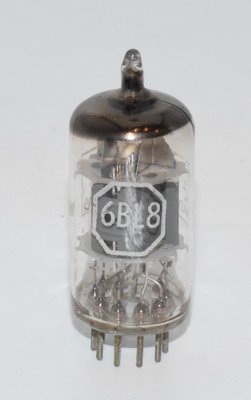
The 6BL8, known in European nomenclature as the ECF80, is a miniature combined medium-mu triode and sharp-cutoff pentode housed in a single glass envelope. Developed during the 1950s for use in color and black-and-white television receivers, the 6BL8/ECF80 was designed primarily for frequency-changer (mixer-oscillator) service. Its European equivalent designation, ECF80, follows the Mullard–Philips naming convention: 'E' for a 6.3V heater, 'C' for triode, and 'F' for sharp-cutoff pentode.
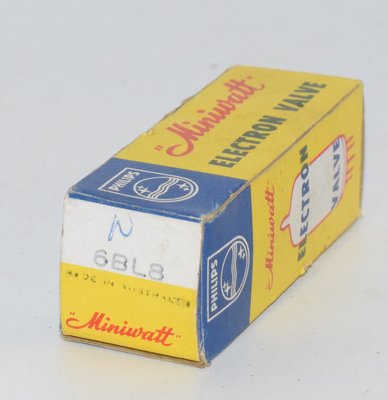
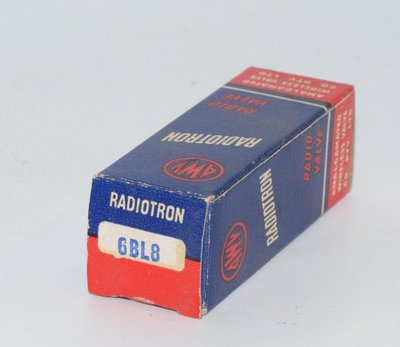
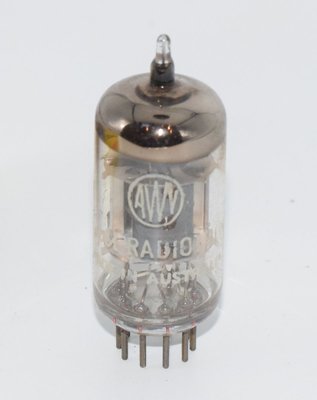
The tube was manufactured by numerous companies worldwide, including RCA, Philips, Mullard, Amperex, Siemens, Telefunken, and AWV (Amalgamated Wireless Valve Company) under the Super Radiotron and Philips Miniwatt brands in Australia. The 4BL8/XCF80 is an identical tube except for heater ratings, designed for series-string heater operation at 4.6 volts.
While originally intended for RF and IF applications in television sets, the 6BL8/ECF80 has found a second life in the audio community, where its dual-section design offers interesting possibilities for compact amplifier and preamplifier circuits.
Technical Specifications and Design
General Information
| Tube Type | 6BL8 / ECF80 |
| Equivalent Types | ECF80, 4BL8/XCF80 (different heater ratings) |
| Construction | Medium-Mu Triode – Sharp-Cutoff Pentode (combined) |
| Envelope | Miniature glass (T-6½) |
| Base Type | Noval (B9A) — 9-pin miniature |
| Outline | Section 6B (per RCA manual) |
| Socket | Miniature 9-contact socket required |
Heater Ratings
| Parameter | 6BL8/ECF80 | 4BL8/XCF80 | Unit |
|---|---|---|---|
| Heater Voltage (ac/dc) | 6.3 | 4.6 | volts |
| Heater Current | 0.45 | 0.6 | ampere |
| Peak Heater-Cathode Voltage | ±100 max | ±100 max | volts |
Pinout (9DC Base — Noval B9A)
Viewed from the bottom of the socket:
| Pin | Connection |
|---|---|
| 1 | Plate (Triode) — PT |
| 2 | Grid No.1 (Pentode) — G1P |
| 3 | Grid No.2 (Pentode, Screen) — G2P |
| 4 | Heater — H |
| 5 | Heater — H |
| 6 | Plate (Pentode) — PP |
| 7 | Grid No.3 (Pentode, Suppressor) / Internal Shield — G3P, IS |
| 8 | Cathode (Triode) — KT |
| 9 | Grid (Triode) — GT |
Note: The pentode cathode (KP) is internally connected. Pin 7 serves as both the suppressor grid (G3) and internal shield (IS).
Class A1 Amplifier — Maximum Ratings (Design-Center Values)
| Parameter | Triode Unit | Pentode Unit | Unit |
|---|---|---|---|
| Plate Supply Voltage | 550 | 550 | volts |
| Plate Voltage | 250 | 250 | volts |
| Grid-No.2 (Screen-Grid) Supply Voltage | — | 550 | volts |
| Grid-No.2 Voltage (cathode current of 14 mA) | — | 175 | volts |
| Grid-No.2 Voltage (cathode current less than 10 mA) | — | 200 | volts |
| Cathode Current | 14 | 14 | mA |
| Plate Dissipation | 1.5 | 1.7 | watts |
| Grid-No.2 Input (plate dissipation > 1.2 watts) | — | 0.5 | watt |
| Grid-No.2 Input (plate dissipation < 1.2 watts) | — | 0.75 | watt |
Characteristics — Triode Unit
| Parameter | Condition 1 | Condition 2 | Unit |
|---|---|---|---|
| Plate Voltage | 100 | 170 | volts |
| Grid-No.2 Voltage | — | 170 | volts |
| Grid-No.1 Voltage | −2 | −2 | volts |
| Amplification Factor | 20 | — | — |
| Mu-Factor (Grid No.2 to Grid No.1) | — | 47 | — |
| Plate Resistance (Approx.) | — | 0.4 | megohm |
| Transconductance | 5000 | 6200 | µmhos |
| Plate Current | 14 | 10 | mA |
| Grid-No.2 Current | — | 2.8 | mA |
| Input Resistance at 50 MHz | — | 0.01 | megohm |
| Equivalent Noise Resistance | — | 1500 | ohms |
Characteristics — Pentode Unit
Note: The reference datasheet pages provided cover the 6BL8/ECF80 entry beginning on page 202 and continuing onto page 203. The pentode characteristics shown at the top of page 203 are as follows:
| Parameter | Value | Unit |
|---|---|---|
| Plate Voltage | 170 | volts |
| Grid-No.2 Voltage | 170 | volts |
| Grid-No.1 Voltage | −2 | volts |
| Amplification Factor | — | — |
| Plate Resistance (Approx.) | 0.4 | megohm |
| Transconductance | 6200 | µmhos |
| Plate Current | 10 | mA |
| Grid-No.2 Current | 2.8 | mA |
Note: Some pentode-specific operating point data (e.g., separate pentode-only amplification factor and plate resistance at different conditions) should be confirmed against a complete manufacturer datasheet, as the provided pages show combined triode-pentode data that may overlap. The values above are taken directly from the RCA Receiving Tube Manual pages provided.
Maximum Circuit Values
| Parameter | Triode Unit | Pentode Unit | Unit |
|---|---|---|---|
| Grid-No.1 Circuit Resistance (fixed-bias) | 0.5 | 0.5 | megohm |
| Grid-No.1 Circuit Resistance (cathode-bias) | 0.5 | 1 | megohm |
Applications and Usage
The 6BL8/ECF80 was designed primarily for frequency-changer service in color and black-and-white television receivers. In this application, the triode section typically functions as the local oscillator while the pentode section serves as the mixer. This was a common and elegant arrangement that reduced tube count in television tuner front-ends.
Key original applications include:
- VHF Television Tuners: The primary intended application, with the triode as oscillator and pentode as mixer in superheterodyne TV tuner circuits.
- FM Radio Tuners: Similar frequency-changer service in high-quality FM receivers.
- IF Amplifiers: The pentode section could be used independently as an IF amplifier stage.
- General-Purpose Amplification: The triode section offers medium-mu amplification suitable for voltage gain stages, while the pentode provides sharp-cutoff characteristics ideal for controlled-gain applications.
The combination of a medium-mu triode (µ ≈ 20) with good transconductance (5000 µmhos) and a sharp-cutoff pentode with high transconductance (6200 µmhos) in a single envelope made the 6BL8/ECF80 an extremely versatile and space-efficient design for multi-function circuits.
Sound Characteristics
While the 6BL8/ECF80 was never designed as an audio tube, its adoption by the DIY audio community has led to a body of subjective listening impressions. The sonic character of the 6BL8/ECF80 varies depending on which section is employed and how it is biased:
Triode Section
- Tonal Balance: The triode section is generally described as having a warm, smooth midrange character typical of medium-mu triodes. It lacks the extreme transparency of high-mu triodes like the 12AX7 but offers a more relaxed, musical presentation.
- Detail and Resolution: With a transconductance of 5000 µmhos and a moderate amplification factor of 20, the triode section provides good detail retrieval without the analytical edge sometimes associated with higher-gain tubes.
- Dynamics: The relatively low plate resistance and good linearity contribute to a lively, dynamic sound with decent transient response.
Pentode Section
- Character: When used as a voltage amplifier in pentode mode, the sound tends to be more extended in the treble with greater apparent detail, though some listeners note a slight hardness compared to pure triode operation.
- Triode-Strapped Operation: Many audio builders connect the pentode section in triode mode (screen tied to plate) for a warmer, more linear sound with lower distortion, sacrificing some gain.
Overall Impressions
Audiophiles who have experimented with the 6BL8/ECF80 in preamplifier and headphone amplifier circuits often describe it as having a pleasant, slightly warm tonal character with good bass definition and a smooth, non-fatiguing treble. The tube is noted for being relatively quiet (low microphonics) due to its robust construction for RF service. The equivalent noise resistance of 1500 ohms in the triode section is respectable and contributes to a low noise floor in well-designed audio circuits.
Different manufacturers impart their own sonic signatures: Philips/Amperex-made ECF80s are often preferred for their slightly richer midrange, while Telefunken examples are prized for their clarity and detail. Australian-made Super Radiotron and Philips Miniwatt versions are considered good-quality alternatives.
Equivalent or Substitute Types
| Type | Equivalence | Notes |
|---|---|---|
| ECF80 | Direct equivalent | European designation for the 6BL8. Fully interchangeable — identical tube. |
| 4BL8 / XCF80 | Identical except heater | Heater: 4.6V at 0.6A (vs. 6.3V at 0.45A). Same pinout and electrical characteristics otherwise. Not a drop-in replacement without heater circuit modification. |
| 6BL8 (various brands) | Direct equivalent | Philips Miniwatt, Super Radiotron (AWV), Mullard, Amperex, Siemens, Telefunken, and other manufacturers all produced electrically identical versions. |
Important: The 6BL8/ECF80 should not be confused with the 6BM8/ECL82, which is a high-mu triode combined with a power pentode — a fundamentally different tube designed for audio output service. Similarly, the 6BK7B is a medium-mu twin triode (not a triode-pentode) and is not interchangeable.
Notable Characteristics
- Dual-Section Versatility: The combination of a medium-mu triode and a sharp-cutoff pentode in a single noval envelope provides exceptional circuit design flexibility. Both sections share a common cathode connection internally, which simplifies certain circuit topologies but constrains others.
- Sharp-Cutoff Pentode: The pentode section's sharp-cutoff characteristic means it transitions cleanly from conducting to non-conducting states, making it ideal for mixer applications and also beneficial for audio use where predictable gain behavior is desired.
- Good High-Frequency Performance: Originally designed for VHF television service, the 6BL8/ECF80 has low interelectrode capacitances and good performance at high frequencies. The input resistance at 50 MHz is specified at 0.01 megohm (10 kΩ), indicating the tube was optimized for RF work.
- Moderate Power Handling: With plate dissipation ratings of 1.5 watts (triode) and 1.7 watts (pentode), the 6BL8 is strictly a small-signal tube. It is not suitable for power output stages.
- Robust Construction: Built for the demanding environment of television tuner cans, the 6BL8/ECF80 features rigid internal construction that results in low microphonics — a desirable trait for audio preamplifier applications.
- Common Cathode: Both sections share a common cathode, which is an important consideration for circuit designers. This means both sections must operate at the same cathode potential unless AC coupling and separate bias arrangements are employed.
- Availability and Cost: As a television-era tube produced in enormous quantities, NOS (New Old Stock) 6BL8/ECF80 tubes remain readily available at modest prices, making them attractive for experimenters and budget-conscious audio builders.
Usage in the Audio Community
The 6BL8/ECF80 has carved out a niche in the DIY audio community, valued for its versatility, availability, and low cost. Here are the primary ways it is used in audio applications:
Preamplifier Circuits
The most common audio application for the 6BL8/ECF80 is in preamplifier designs. The triode section, with its amplification factor of 20 and transconductance of 5000 µmhos, provides a useful amount of voltage gain for line-stage preamplifiers. Some designers use both sections in cascade — triode feeding pentode (or vice versa) — to achieve higher overall gain in a single tube envelope, simplifying the power supply and reducing the chassis footprint.
Headphone Amplifiers
The 6BL8/ECF80 has become popular in compact headphone amplifier designs. The triode section can serve as the voltage amplifier while the pentode section (often triode-strapped) can drive headphones through an output transformer or coupling capacitor. Several published DIY headphone amplifier designs feature this tube prominently.
Phono Preamplifiers
With its low equivalent noise resistance of 1500 ohms in the triode section, the 6BL8/ECF80 is sometimes employed in phono preamplifier (RIAA) stages. The pentode section can provide the additional gain needed for moving-magnet cartridge amplification, while the triode section handles the RIAA equalization network.
Guitar Amplifier Experimentation
Some guitar amplifier builders have experimented with the 6BL8/ECF80 as a preamp tube, taking advantage of its unique tonal character and the ability to use both sections for different gain stages within a single tube socket. The sharp-cutoff pentode section can produce interesting overdrive characteristics distinct from the more common 12AX7.
Hybrid Amplifier Designs
The 6BL8/ECF80 appears in hybrid (tube/solid-state) amplifier designs where the tube provides voltage gain and tonal coloring while semiconductor output devices handle the power delivery. The dual-section design is particularly convenient in these applications, allowing a complete tube front-end in a single envelope.
Notable DIY Projects
Several well-known DIY audio projects feature the 6BL8/ECF80, particularly in the European audio community where the ECF80 designation is more commonly used. These range from simple single-ended amplifiers producing a watt or less (using the pentode section as an output tube driving high-efficiency speakers) to sophisticated multi-stage preamplifiers. The tube's low cost and wide availability make it an excellent choice for beginners learning tube audio circuit design.
Collector and NOS Market
In the NOS tube market, the 6BL8/ECF80 remains one of the more affordable tubes, though premium examples from Telefunken (identified by the diamond-bottom mark), early Mullard production, and Amperex Bugle Boy variants command higher prices among audio enthusiasts who believe these offer superior sonic performance. Australian-made examples from AWV (Super Radiotron) and Philips Miniwatt Australia are also sought after as quality alternatives to European production.